Workflow
INTEL(04335)
icon
Search documents
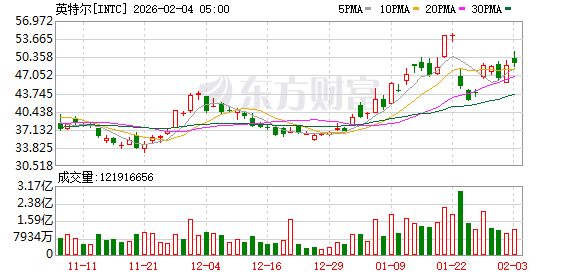
美股三大指数集体收涨,大型科技股多数上涨,英特尔涨超8%
Mei Ri Jing Ji Xin Wen· 2025-12-02 21:14
Core Viewpoint - The U.S. stock market experienced a collective rise on December 3, with major indices showing positive performance, indicating a favorable market sentiment [1] Group 1: Market Performance - The Dow Jones Industrial Average increased by 0.39% [1] - The Nasdaq Composite rose by 0.59% [1] - The S&P 500 index saw a gain of 0.25% [1] Group 2: Technology Sector - Most large-cap technology stocks experienced gains, with Intel rising over 8% [1] - Apple, Meta, and Qualcomm each increased by more than 1% [1] - Amazon, NVIDIA, Microsoft, and Netflix saw slight increases [1] - AMD declined by over 2% [1] - Broadcom fell by more than 1% [1] - Tesla and Oracle experienced minor declines [1]
美股三大指数集体收涨 英特尔涨超8%
Xin Lang Cai Jing· 2025-12-02 21:06
周二美股三大指数集体收涨,道指涨0.39%,纳指涨0.59%,标普500涨0.24%。大型科技股多数上涨, 英特尔涨超8%,苹果、Meta、高通涨超1%,亚马逊、英伟达、微软、奈飞小幅上涨。AMD跌超2%, 博通跌超1%,特斯拉、甲骨文小幅收跌。 来源:滚动播报 ...
美股异动 | 半导体股普涨 英特尔(INTC.US)涨逾4%
智通财经网· 2025-12-02 15:14
智通财经APP获悉,周二,美股半导体股普涨,费城半导体指数涨2.64%,英特尔(INTC.US)涨逾4%, 英伟达(NVDA.US)涨近3%,台积电(TSM.US)、迈威尔科技(MRVL.US)、AMD(AMD.US)涨逾2%。 ...
英特尔(INTC.US)斥资2亿美元加码马来西亚,强化东南亚芯片封装中心
智通财经网· 2025-12-02 04:17
Core Viewpoint - Intel (INTC.US) is set to invest an additional 860 million ringgit (approximately 208 million USD) in Malaysia, enhancing the country's role in the global semiconductor supply chain [1] Group 1: Investment Details - The investment commitment was made during a meeting between Malaysia's Prime Minister Anwar Ibrahim and Intel CEO Pat Gelsinger on December 2 [1] - Intel has already invested 12 billion ringgit in an advanced packaging facility in Penang, which is currently 99% completed [1] - In 2021, Intel pledged to invest 7 billion USD in building a factory in Penang [1] Group 2: Malaysia's Semiconductor Industry - Malaysia accounts for approximately 13% of the global chip packaging, assembly, and testing market, which is the final stage of semiconductor manufacturing [1] - The semiconductor industry drives about 40% of Malaysia's export output [1] - Malaysia is actively working to strengthen its position in the global supply chain amid competition from major economies enhancing their semiconductor capabilities [1] Group 3: Global Context - The Trump administration emphasized the necessity for the U.S. to establish a complete domestic semiconductor supply chain, encouraging local companies to expand within the U.S. despite lower manufacturing costs in Asia [1]
英特尔相中马来西亚,追加投资8.6亿林吉特
Sou Hu Cai Jing· 2025-12-02 04:03
IT之家 12 月 2 日消息,据马来西亚总理安瓦尔・易卜拉欣(Anwar Ibrahim)表示,英特尔公司将追加投资 8.6 亿林吉特(IT之家注:现汇率约合 14.73 亿 元人民币),以将马来西亚打造为其全球封装与测试运营中心。 安瓦尔指出,英特尔已在马来西亚开展业务,其中包括位于槟城州、投资 120 亿林吉特(现汇率约合 205.51 亿元人民币)的先进封装工厂,该工厂目前已 完成 99%。2021 年,这家美国芯片巨头曾承诺投资 70 亿美元(现汇率约合 495.51 亿元人民币)在槟城建设生产基地。 马来西亚在全球芯片封装、组装和测试市场中占据约 13% 的份额,这些环节是半导体制造的最后阶段。该行业贡献了马来西亚 40% 的出口总额。近年来, 随着全球主要经济体竞相强化本国半导体产业能力,马来西亚也正积极提升其在全球供应链中的战略地位。 与此同时,美国政府也曾多次强调,美国需建立完整的本土半导体供应链,并敦促国内企业优先在美国本土扩大产能,尽管目前亚洲地区的芯片制造成本仍 显著低于美国。 安瓦尔在周一与英特尔首席执行官陈立武(Lip-Bu Tan)会晤后于其 Facebook 帖文中透露,该公司 ...
硬刚英伟达?英特尔前CEO警告:量子技术重大突破将击破AI产业泡沫,GPU十年内开始被取代【附量子信息产业分析】
Qian Zhan Wang· 2025-12-01 07:42
Group 1: Core Insights - Pat Gelsinger, former CEO of Intel, warns that the rapid expansion of the AI industry may face a bubble burst due to significant breakthroughs in quantum technology, predicting that quantum computers will become mainstream within two years [2] - Gelsinger believes that the currently dominant GPU chips will be replaced within ten years, marking a pivotal shift in computing technology [2] - Quantum information technology is seen as a disruptive innovation that challenges the limits of classical computing, offering exponential advantages in fields like cryptography, materials simulation, and artificial intelligence [3] Group 2: National Strategies and Developments - Major countries are competing for dominance in quantum technology, with the U.S. accelerating its efforts through the National Quantum Initiative, while the EU has launched the Quantum Flagship program [3] - China has prioritized quantum information as a key technology direction, with plans to achieve global leadership in quantum communication and practical breakthroughs in quantum computing by 2030 [3][10] - The "14th Five-Year Plan" and the "15th Five-Year Plan" in China emphasize the importance of quantum technology alongside AI, 6G, and biomanufacturing [3] Group 3: Industry Structure and Ecosystem - Chinese quantum enterprises are characterized by a deep integration of research-driven initiatives and state-owned enterprise support, with many companies emerging from top research institutions [4][5] - Major state-owned enterprises and research institutes collaborate with top universities and returning overseas talent to form a robust support system for quantum technology development [5] - The landscape is dominated by a "national team leading, private enterprises following" model, allowing for sustained investment in cutting-edge fields [8] Group 4: Market Potential and Growth - The global quantum computing market, including hardware, software, and services, was valued at $1.1 billion in 2022 and is projected to grow to approximately $7.6 billion by 2027, with a compound annual growth rate of 79.72% from 2022 to 2030 [11] - The commercial launch of quantum computing is anticipated around 2030, with market demand expected to exceed $100 billion [11] Group 5: Challenges Ahead - Despite promising advancements, the commercialization of quantum computing remains a long-term endeavor, requiring substantial investment, high-level talent, and advanced equipment [13] - Ongoing challenges include achieving stable qubits and quantum error correction, necessitating increased R&D investment and international collaboration [13]
外媒:苹果低端MacBook芯片“去三星化”, 英特尔迎来“救局”大单
Huan Qiu Wang Zi Xun· 2025-12-01 06:36
Core Insights - Apple has decided to adopt Intel's 18A (1.8nm) process technology for its next-generation low-end MacBook and other Mac devices, marking a strategic shift in its advanced manufacturing choices [1][2] - This decision indicates Apple's intention to avoid reliance on Samsung's foundry, which currently has 2nm production capabilities, due to concerns over supply chain security [2][3] Group 1 - Intel is expected to start delivering chips based on the 18A process to Apple by mid-2027, with these chips likely to be part of the M6 or M7 series [2][3] - The new chips will be used in future product lines including MacBook Air, iPad Air, and iPad Pro, contributing to Apple's localized supply chain strategy [2][3] Group 2 - Samsung's dual role as a competitor in key markets such as smartphones, tablets, laptops, smartwatches, and XR devices has led Apple to exercise caution in its supply chain decisions [3]
几颗“边角料”芯片,竟让英特尔大涨10%
Hu Xiu· 2025-12-01 04:10
Core Viewpoint - The news highlights a significant market reaction to the rumor that Intel will manufacture Apple's M-series chips, indicating a potential shift in the semiconductor landscape and a re-evaluation of Intel's market position [1][3]. Group 1: Apple's Endorsement - Apple ships 20 million "standard" M-series chips annually, and transferring production to Intel would significantly impact Intel's business [4]. - Apple's role as a stringent quality inspector adds credibility to Intel's manufacturing capabilities, especially for the simpler M-series chips [4]. - Intel has entered a substantive collaboration phase with Apple, having signed a confidentiality agreement and received advanced process design kits (PDK) [6][4]. Group 2: Cook's Strategy - Apple's decision to support Intel, despite TSMC's strong performance, serves as a political statement and aligns with U.S. manufacturing policies [7]. - By outsourcing the production of lower-end M-series chips to Intel, Apple aims to diversify its supply chain and reduce dependency on TSMC [8][10]. - Establishing a dual-supplier system with Intel and TSMC is crucial for Apple to mitigate capacity risks and enhance bargaining power [9]. Group 3: Valuation Reconstruction - The market's reaction reflects a potential breaking of Intel's "IDM curse," as major tech companies show interest in Intel's manufacturing capabilities [11][16]. - Intel's previous struggles with its IDM model have led to significant capital expenditures with minimal returns, but the prospect of securing high-profile clients could change this narrative [14][15]. - The involvement of top-tier clients like Apple, Google, and Meta increases the likelihood of Intel's success in its foundry business, potentially leading to a substantial increase in its market valuation [17][18].
海外市场 | 英特尔暴涨10%,降息预期升温
Sou Hu Cai Jing· 2025-12-01 01:20
Core Viewpoint - US stock indices experienced a broad increase last Friday, with the Dow Jones up 0.61%, S&P 500 rising 0.54%, and Nasdaq gaining 0.65%, driven by market expectations of a Federal Reserve rate cut in December [1] Group 1: Stock Market Performance - The technology sector showed significant divergence, with Intel surging 10% due to market anticipation of its return to Apple's supply chain, while some AI-related stocks like Nvidia continued to adjust [1] - The Nasdaq Golden Dragon China Index slightly increased by 0.54%, with individual stock performances varying; Youdao rose over 10%, Bawang Tea increased by over 6%, and XPeng Motors gained over 3%, while Alibaba and Meituan saw slight declines [1] Group 2: Commodity Market Insights - In the commodities market, spot silver surged due to tight inventories and a short squeeze, breaking through $57 to reach a historical high; concerns over copper supply also led to record prices, with London gold spot prices exceeding $4200 per ounce [1] Group 3: Market Focus and Outlook - Short-term market attention is centered on the Federal Reserve's December policy meeting, with potential delays in economic data releases following the US government shutdown, which may increase asset price volatility [1] - There is a focus on technology stock earnings guidance and changes in the supply-demand dynamics of global industrial metals like copper and silver [1]
英特尔前CEO:量子计算将刺破AI泡沫 GPU寿命不到十年
Sou Hu Cai Jing· 2025-11-30 17:20
Group 1 - Gelsinger predicts that quantum computing will surpass industry expectations and could be the key trigger for the end of the current AI bubble [3][4] - He believes that the mainstream adoption of quantum computing will occur within two years, contrasting with Nvidia CEO Jensen Huang's estimate of twenty years [4] - Gelsinger forecasts that the dominance of GPUs will be challenged by new computing paradigms by the end of this century [5] Group 2 - Gelsinger compares the partnership between Microsoft and OpenAI to the historical relationship between Bill Gates and IBM, suggesting that OpenAI acts as a "distribution partner" supported by Microsoft's computing power [6] - He acknowledges significant internal management issues at Intel, admitting that the company had lost "basic discipline" during his tenure [8] - Gelsinger reveals that no products were delivered on time in the five years prior to his return, highlighting a severe lack of engineering capability [9]