INTEL(04335)

Search documents
美国政府豪掷89亿买下英特尔9.9%股份,救援还是收编?
Sou Hu Cai Jing· 2025-08-23 08:11
Core Viewpoint - The U.S. government has invested $8.9 billion to acquire a 9.9% stake in Intel, marking a shift from free market principles to state capitalism, as the government intervenes directly in the semiconductor industry to ensure national security and support a struggling company [1][3]. Group 1: Intel's Situation - Intel, once a dominant player in the global PC chip market, is now in a precarious position, facing declining PC sales and losing market share in data centers to competitors like AMD and NVIDIA [5]. - The company has delayed advancements in manufacturing processes, falling behind TSMC by several generations, which has raised concerns about its viability as a key player in U.S. semiconductor manufacturing [5][8]. - The recent investment from the government comes after Intel announced layoffs and cutbacks on overseas projects, indicating severe operational challenges [3][6]. Group 2: Government's Strategic Move - The U.S. government's direct investment in Intel is seen as a strategic move to maintain domestic high-end chip manufacturing capabilities, which are critical for national security [5][6]. - This intervention reflects a broader political agenda, as the Trump administration aims to demonstrate a revival of American manufacturing and competitiveness against China and other Asian countries [5][8]. - The investment is not merely a financial support but a means to integrate Intel into a national strategy, effectively transforming it into a quasi-state enterprise [3][6]. Group 3: Implications for the Semiconductor Industry - The government's stake in Intel signals a departure from traditional market dynamics, suggesting that the semiconductor industry is now intertwined with geopolitical considerations [8]. - The future of Intel will depend on its ability to catch up with TSMC in manufacturing technology, the political landscape in the U.S., and whether the company can reform its internal management practices [8]. - This situation raises questions about the operational independence of Intel, as decisions may increasingly be influenced by national interests rather than purely market-driven factors [6][8].


美国政府收购英特尔10%股份,特朗普:伟大的交易!
Di Yi Cai Jing Zi Xun· 2025-08-23 07:46
Group 1 - Intel has reached an agreement with the U.S. government for an investment of $8.9 billion, acquiring 433.3 million shares at $20.47 per share, representing 9.9% of Intel's stock [2][4] - Following the announcement, Intel's stock price increased by 5.5% [2] - The U.S. government will receive a five-year warrant to purchase an additional 5% of Intel's shares at $20 per share, contingent upon Intel relinquishing majority control of its foundry business [4][5] Group 2 - The investment is seen as a safety net for Intel, providing positive momentum, but does not change the reality of Intel's competitive lag [2] - Intel's CEO expressed optimism about future advancements in semiconductor technology and manufacturing in the U.S. [2] - The agreement alleviates pressure on Intel regarding funding from the CHIPS Act, which is tied to meeting certain milestones [5] Group 3 - The U.S. government will have a passive ownership stake without board representation or governance rights, but will support board decisions requiring shareholder approval [5] - There is potential for similar transactions in the future, as indicated by the U.S. government's interest in acquiring equity stakes in strategic companies [6][7] - Other foreign chip manufacturers, like Samsung, have received federal funding but are less likely to engage in equity negotiations similar to Intel's [7]
美国政府“国有化”英特尔 89亿美元拥有近10%股份
2 1 Shi Ji Jing Ji Bao Dao· 2025-08-23 07:28
Group 1 - The U.S. government has agreed to invest $8.9 billion in Intel, acquiring 9.9% of the company's shares at a price of $20.47 per share, marking a significant intervention in the semiconductor sector [1] - The investment will be sourced from $5.7 billion in previously granted but unpaid funds from the CHIPS and Science Act and $3.2 billion from the Department of Defense's Secure Enclave project, bringing the total U.S. investment in Intel to $11.1 billion [2] - Intel has been facing challenges in the AI sector, with its revenue declining and market capitalization dropping, while competitors like Nvidia have surged [3] Group 2 - The investment by the U.S. government is characterized as a passive equity investment, meaning it will not involve governance control or board seats for the government [2] - Intel has been actively expanding its manufacturing capabilities in the U.S., with over $100 billion planned for factory expansions and significant investments in research and development [2] - The recent investment from the U.S. government is seen as a new model of strategic support for high-tech companies, differing from traditional subsidies and tax incentives [3]
英特尔出售股权换89亿美元拨款,美国政府持股约10%
Nan Fang Du Shi Bao· 2025-08-23 06:39
Core Viewpoint - Intel has reached an agreement with the U.S. government to sell 9.9% of its shares in exchange for $8.9 billion in funding, following a $2 billion investment from SoftBank [1][2] Group 1: Agreement Details - The U.S. government will purchase 433.3 million shares at a price of $20.47 per share, totaling approximately $110 billion in value [1] - The funding consists of $5.7 billion from the CHIPS and Science Act and $3.2 billion from the Department of Defense under the Secure Enclave project [1] - Intel's total government funding will reach $11.1 billion, including a previously received $2.2 billion from the CHIPS and Science Act [1] Group 2: Government's Stake and Rights - The U.S. government will hold a passive stake, meaning it will not have board seats or governance rights [1] - Intel has granted the U.S. government a five-year warrant to purchase an additional 5% of its shares at $20 per share if Intel's ownership of its foundry business falls below 51% [2] Group 3: Leadership and Market Context - Intel's CEO, Pat Gelsinger, emphasized the company's commitment to advanced technology manufacturing in the U.S. [2] - The agreement comes amid Intel's struggles in a competitive market, facing challenges from TSMC and experiencing declining revenues and stock prices [4] - Recent tensions between Trump and Gelsinger were resolved, leading to the negotiation of this equity stake [4] Group 4: Industry Implications - The deal raises questions about whether the U.S. government will consider similar equity stakes in other chip manufacturers receiving funding [4] - Officials clarified that the government does not intend to acquire stakes in companies like Micron and TSMC, which are increasing their investments in the U.S. [4] - TSMC has announced significant investments in the U.S., totaling $165 billion, while Micron has increased its investment from $125 billion to $200 billion [5][6]
英特尔将接受美政府89亿美元投资
Bei Jing Ri Bao Ke Hu Duan· 2025-08-23 06:16
Core Viewpoint - Intel has reached an agreement with the U.S. government for an investment of $8.9 billion, making the government one of its largest shareholders [1] Group 1: Investment Details - The U.S. government will acquire 9.9% of Intel's common stock, totaling 433.3 million shares at a price of $20.47 per share [1] - The funding for this investment comes from $5.7 billion in subsidies granted under the CHIPS and Science Act and an additional $3.2 billion from a government funding project [1] - Including previously received subsidies of $2.2 billion, the total investment from the U.S. government in Intel amounts to $11.1 billion [1] Group 2: Shareholder Rights - The U.S. government's investment will be classified as passive, meaning it will not have board seats, governance rights, or information rights [1] - The government has agreed to align with the company's board on matters requiring shareholder approval, with few exceptions [1]
韦德布什谈美政府入股英特尔:改变不了在竞争中落后多年的现实
Ge Long Hui A P P· 2025-08-23 05:43
Core Viewpoint - The U.S. government's investment provides Intel with a safety net and some positive momentum, but it does not change the reality of Intel's long-standing competitive disadvantages [1] Group 1 - The investment is seen as a small positive step for Intel in a challenging situation [1] - The investment does not alter the fact that Intel has been lagging behind in competition for many years [1]
韦德布什谈美政府入股英特尔:英特尔获得利好 但改变不了落后事实
Xin Lang Cai Jing· 2025-08-23 05:07
Core Viewpoint - The U.S. government's investment provides Intel with a safety net and some positive momentum, but it does not change the reality of Intel's long-standing competitive disadvantages [1] Group 1 - The investment is seen as a small positive step for Intel amidst challenging circumstances [1] - The investment does not alter the fact that Intel has been lagging behind in competition for many years [1]
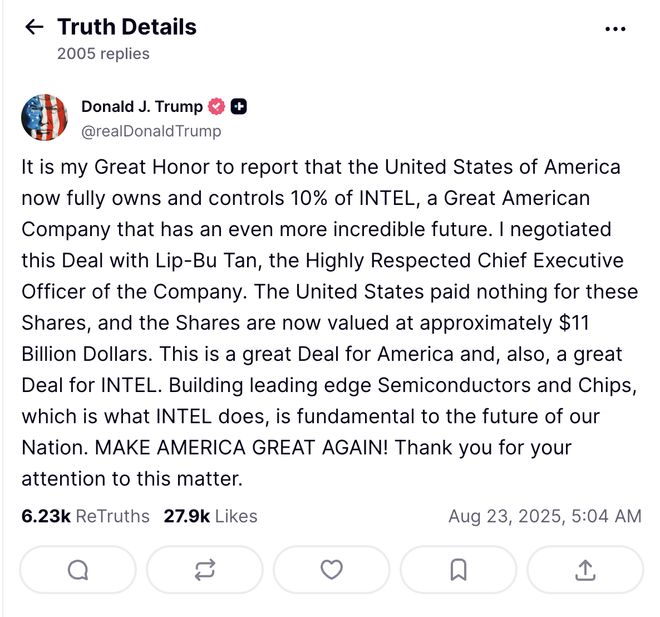
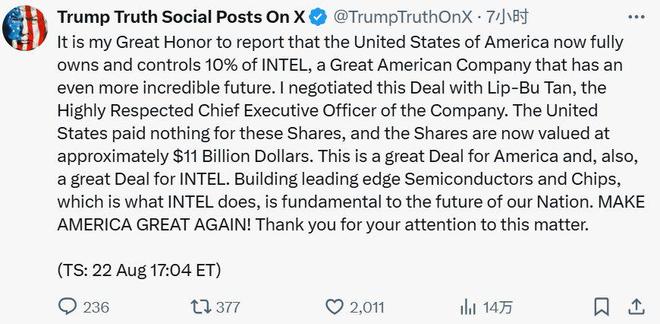
特朗普:美国政府没有花任何成本就获得了英特尔10%的股份
Ge Long Hui A P P· 2025-08-23 05:01
Core Viewpoint - The U.S. government has acquired a 10% stake in Intel, valued at approximately $11 billion, marking a significant move to strengthen control over American companies [1] Group 1: Government Acquisition - The U.S. government purchased 10% of Intel's shares, totaling about 433.3 million shares at a price of $20.47 per share, amounting to an investment of approximately $8.9 billion [1] - The acquisition is part of the Trump administration's efforts to enhance control over U.S. enterprises [1] Group 2: Funding Sources - The funding for the acquisition includes $5.7 billion from the approved but not yet disbursed subsidies under the CHIPS and Science Act, and an additional $3.2 billion from a separate government project aimed at developing secure chips [1]
怎么看特朗普政府入股?美知名投行分析师答一财:未改变英特尔落后竞争多年现实
Di Yi Cai Jing· 2025-08-23 04:14
Core Viewpoint - Intel has reached an agreement with the U.S. government for an investment of $8.9 billion, acquiring 9.9% of Intel's common stock at $20.47 per share, which is expected to provide a safety net for the company amid ongoing competitive challenges [2][3]. Investment Details - The U.S. government will purchase shares at a price lower than Intel's recent closing price of $24.80, but similar to the price from early August [3]. - The agreement includes a five-year warrant allowing the government to acquire an additional 5% of Intel's shares at $20 each, contingent upon Intel relinquishing majority control of its foundry business [3]. - Intel's board has approved the transaction without requiring shareholder approval [3]. Company Strategy and Performance - Intel's CEO, Pat Gelsinger, emphasized the importance of U.S.-based design and manufacturing of advanced silicon technology and computing products [2]. - The company recently reported revenue exceeding expectations for Q2 2025 and is implementing a plan to reduce its workforce by approximately 15%, aiming for a total of around 75,000 employees by year-end [3]. - Key growth areas identified by Intel include disciplined foundry operations, revitalizing the x86 ecosystem, and optimizing its AI strategy [3]. Government Ownership and Influence - The U.S. government's ownership will be passive, without board representation or governance rights, but it will support board decisions requiring shareholder approval [4]. - This agreement alleviates pressure on Intel regarding funding from the CHIPS Act, which is contingent on meeting certain milestones [5]. Future Implications - The U.S. government may pursue similar equity transactions in the future, as indicated by President Trump, who expressed interest in more such deals [6]. - The government aims to secure direct benefits for taxpayers through equity stakes rather than merely providing subsidies [6].
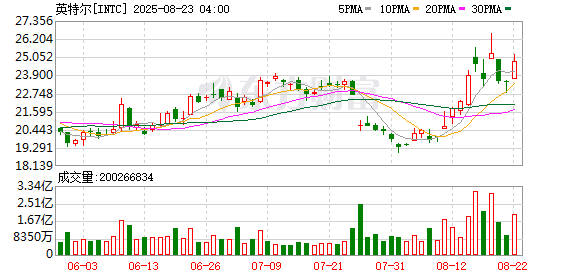
【环球财经】美国政府收购英特尔约10%股份 成为大股东
Zhong Guo Jin Rong Xin Xi Wang· 2025-08-23 04:12
Core Viewpoint - Intel has reached an agreement with the U.S. government for an investment of $8.9 billion, resulting in the government acquiring a 9.9% stake in the company, making it one of Intel's largest shareholders [1] Investment Details - The investment consists of $5.7 billion in subsidies from the CHIPS and Science Act and an additional $3.2 billion from a government-funded project [1] - The government will purchase 433.3 million shares at a price of $20.47 per share, totaling $8.9 billion [1] - Including previously received subsidies of $2.2 billion, the total investment from the U.S. government amounts to $11.1 billion [1] Shareholder Rights - The U.S. government will hold a passive stake and will not have board seats, governance rights, or information rights [1] - The government has agreed to align with the company's board on matters requiring shareholder approval, with few exceptions [1]