
INTEL(04335)

Search documents
CEO手捧1.8纳米晶圆:英特尔的生死赌注
Sou Hu Cai Jing· 2025-10-10 07:12
Core Insights - Intel has unveiled the world's first PC chip based on 1.8nm technology, named "Panther Lake," which offers up to 15% improvement in energy efficiency and up to 30% increase in chip density compared to the previous generation Intel 3 [1][3] Group 1: Technology and Manufacturing - The 18A process technology currently has a yield rate of less than 10%, while competitors like TSMC have achieved a yield rate of 30% for their 2nm chips [3] - Intel's CEO must convince customers to pre-order the next-generation 14A chip manufacturing technology; failure to meet expectations could jeopardize Intel's costly chip manufacturing plans [3] Group 2: Financial Support and Market Performance - Intel has received significant funding, including $8.9 billion from the U.S. government through the CHIPS and Science Act, $2 billion from SoftBank, and $5 billion from NVIDIA, totaling $15.9 billion [3] - Following these investments, Intel's stock price has increased by 68.3% since early August [3] Group 3: Production Timeline - The "Panther Lake" wafer is scheduled to enter mass production at the Arizona Fab 52 facility later this year, with the first model expected to ship by the end of the year and a full launch planned for January 2026 [3]


英特尔重磅!芯片自主可控重要性凸显!科创人工智能ETF实时成交额超9300万元,或有资金逢跌抢筹!
Xin Lang Ji Jin· 2025-10-10 06:57
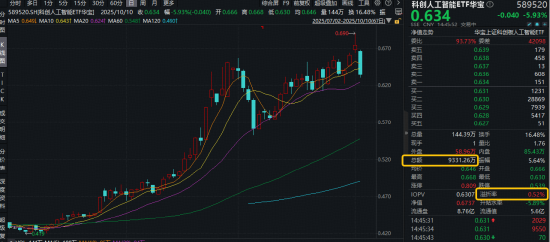
Group 1 - Intel announced the architecture details of its new client processor, Intel Core Ultra (3rd generation), which is based on the Intel 18A process technology and is expected to ship later this year [1] - The Intel Core Ultra processor will support a wide range of consumer and commercial AI PCs, gaming devices, and edge computing solutions [1] - Intel also previewed the Intel Xeon 6+ (codenamed Clearwater Forest), designed for large-scale data centers, cloud service providers, and telecom operators, aimed at expanding workloads and reducing energy costs [1] Group 2 - The demand for AI computing has surged significantly over the past six months, with Nvidia's new architecture, Blackwell, experiencing "very high" demand [1] - The rise of AI is seen as a driving force behind a new round of technological revolution and industrial transformation [1] - Domestic AI chip and model development in China is progressing towards a unified ecosystem, with expectations for accelerated growth in the domestic AI industry [1][2] Group 3 - The urgency for domestic computing power replacement in China is increasing due to the U.S. restrictions on advanced chip exports and the suppression of domestic computing chips and models [2] - The domestic computing power sector is expected to maintain good growth momentum, with potential breakthroughs in model and chip aspects [2] - The focus on the domestic AI industry chain is reflected in the performance of the Sci-Tech Innovation Artificial Intelligence ETF (589520), which saw a significant trading volume despite a market pullback [2] Group 4 - The Sci-Tech Innovation Artificial Intelligence ETF (589520) is highlighted for its three key points: policy support for AI, the importance of domestic control in technology, and its high elasticity and offensive potential compared to direct investments in individual stocks [4][5] - The ETF's top ten holdings account for over 70% of its weight, with the semiconductor sector representing more than half of the portfolio [6]
决定未来成败,英特尔CEO展示全球首款1.8纳米工艺芯片晶圆
3 6 Ke· 2025-10-10 02:47
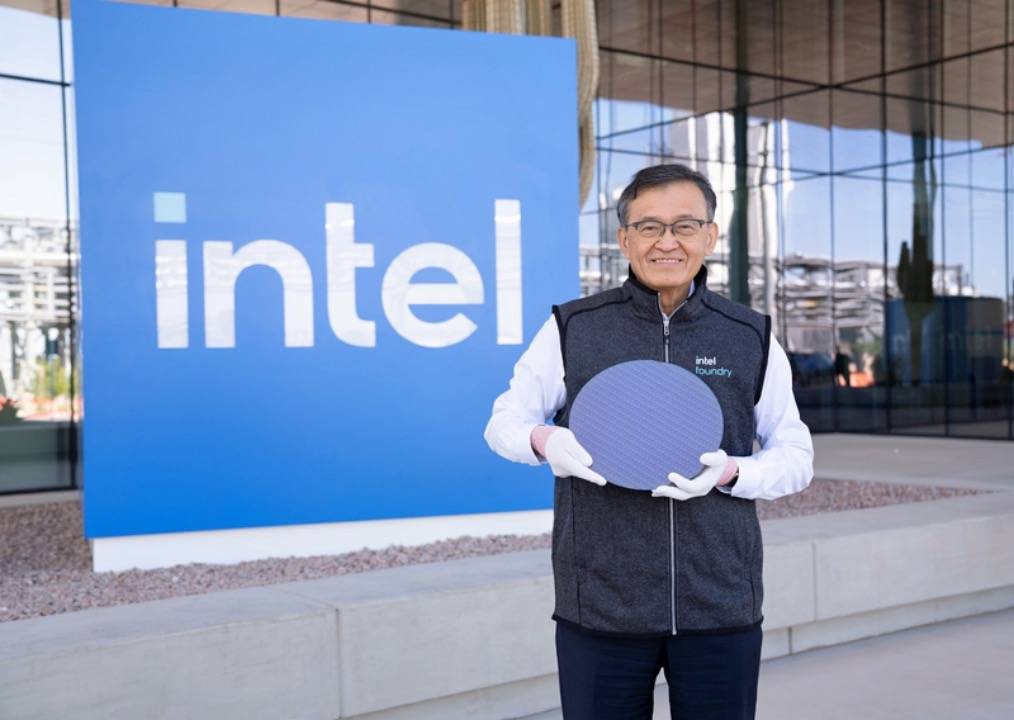
对英特尔而言,Panther Lake的意义早已超越一款产品。过去五年,英特尔在先进制程竞赛中持续落 后,台积电3纳米工艺已实现规模量产,三星3纳米也进入商用阶段,而英特尔此前10纳米、7纳米工艺 多次延期,导致其在PC芯片市场被AMD蚕食份额,AI芯片领域更被英伟达拉开代差——2024年全球AI 加速芯片市场中,英伟达市占率超80%,英特尔占比不足5%。 与此同时,英特尔营收连续六个季度下滑,2024财年净亏损达76亿美元,市值一度被AMD反超,"技术 领先者" 的标签岌岌可危。在此背景下,Panther Lake承载着其夺回技术话语权、重获客户信任的战略使 命。 为了这场 "翻身仗",英特尔近期已通过资本合作获得多方助力。8月,美国政府通过《芯片与科学法 案》专项基金,向英特尔注资89亿美元,持股比例达9.9%,成为其第三大股东,这笔资金主要用于18A 工艺研发与52号晶圆厂扩建。同在8月,软银集团以20亿美元认购英特尔普通股,聚焦AI与边缘计算领 域合作。 在美国亚利桑那州英特尔的奥科蒂洛园区内,该公司首席执行官陈立武双手托举着一块英特尔酷睿 Ultra系列3处理器(代号"Panther Lake")的 ...

半导体早参丨英特尔公布首款18A制程PC芯片关键细节,存储产业缺货潮愈演愈烈
Mei Ri Jing Ji Xin Wen· 2025-10-10 01:09
Market Performance - As of October 9, 2025, the Shanghai Composite Index rose by 1.32% to close at 3933.97 points, the Shenzhen Component Index increased by 1.47% to 13725.56 points, and the ChiNext Index gained 0.73% to 3261.82 points [1] - The overnight performance of U.S. markets showed the Dow Jones Industrial Average fell by 0.52%, the Nasdaq Composite decreased by 0.08%, and the S&P 500 dropped by 0.28% [1] - The Philadelphia Semiconductor Index increased by 3.40%, while individual semiconductor stocks like NXP Semiconductors, Micron Technology, and ARM saw declines of 1.87%, 2.14%, and 2.33% respectively [1] Industry Insights - Intel announced key details about its upcoming Panther Lake notebook processor, which will be the company's first chip manufactured using the next-generation 18A process technology, aiming to restore its leadership in chip manufacturing [2] - The Panther Lake processor will integrate multiple components, including graphics and central processing units, on a single circuit and is expected to begin ramping up production this year, with initial shipments by the end of 2025 and full market availability starting January 2026 [2] - A new wave of shortages in the storage industry is intensifying, with DDR4 DRAM prices rising over 12% and DDR5 16Gb prices increasing by 8.5% in the past week, prompting several manufacturers to pause pricing until post-holiday market conditions become clearer [2] - Companies like Adata, Team Group, and Apacer have observed strong price increases and have decided to halt pricing for DDR4 and DDR5 products, while NAND Flash and SSD products continue to be quoted [2] Company Actions - Shengmei Shanghai announced that its actual controller and chairman, Hui Wang, along with other executives, plan to reduce their holdings in the company by up to 0.04%, 0.03%, 0.02%, 0.03%, and 0.02% respectively, with the reduction period set from November 3, 2025, to February 2, 2026 [3] - Guosen Securities highlighted the significant investment intentions between OpenAI and NVIDIA, indicating a robust demand for AI infrastructure driven by the evolution of large models, which in turn boosts the demand for computing power [3] - The semiconductor materials ETF and its associated funds focus on semiconductor equipment (59%) and materials (25%), benefiting from the ongoing AI revolution and the need for domestic substitution in the semiconductor sector [3][4]
英特尔18A工艺首秀,Panther Lake深度揭秘:全新架构迎接AI浪潮
3 6 Ke· 2025-10-10 00:27
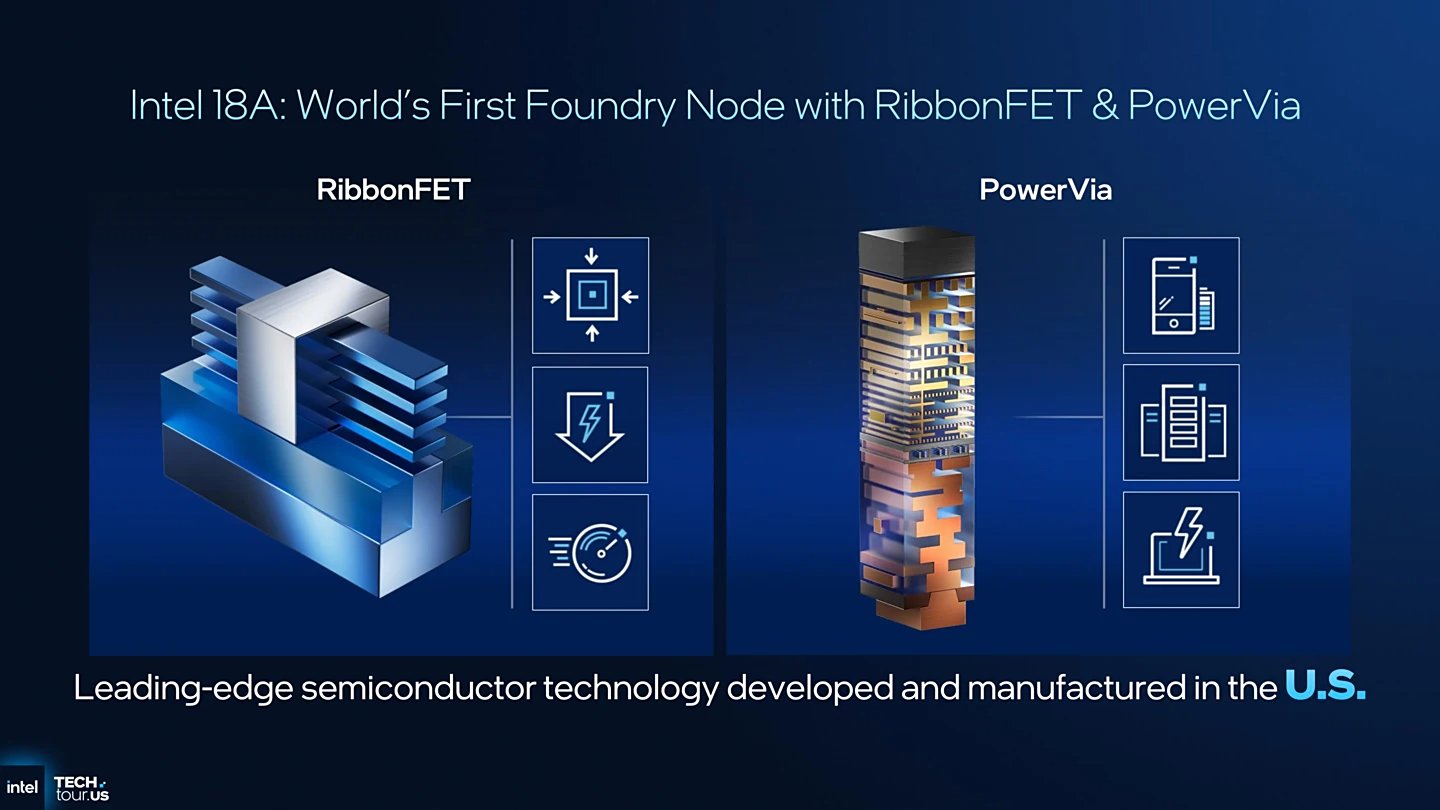
Core Insights - Intel's Panther Lake architecture represents a significant advancement in processor technology, utilizing the new Intel 18A process for improved performance and efficiency [4][11][35] - The architecture introduces innovative features such as RibbonFET transistors and PowerVia backside power delivery, which enhance power efficiency and performance stability [9][11][37] - Panther Lake's modular design allows for customizable chip configurations, catering to various device requirements and optimizing performance for different use cases [12][14][35] Group 1: Technology Innovations - Panther Lake is the first consumer product platform to use Intel's 18A process, featuring new technologies like RibbonFET and PowerVia [4][11] - RibbonFET technology replaces traditional FinFET architecture, significantly reducing leakage and performance instability during process upgrades [7][9] - PowerVia technology moves power delivery to the back of the chip, reducing thermal pressure and improving current efficiency [11][19] Group 2: Architectural Changes - The new architecture shifts from a monolithic design to a multi-chip design, allowing for modular chip configurations [12][14] - Panther Lake introduces a new core architecture with performance cores (Cougar Cove) and efficiency cores (Darkmont), enhancing IPC and clock speeds [15][19] - The architecture includes Memory Side Cache, optimizing memory bandwidth and reducing latency for better performance [17][19] Group 3: AI and GPU Enhancements - Panther Lake features the new Xe3 graphics architecture, which significantly improves graphics performance and AI capabilities [22][27] - The Xe3 GPU can achieve up to 120 TOPS in AI performance, surpassing previous generations [24][28] - The fifth-generation NPU in Panther Lake offers enhanced capabilities for AI tasks, supporting various applications while maintaining low power consumption [28][30] Group 4: Connectivity and User Experience - Panther Lake supports Wi-Fi 7 and Bluetooth 6.0, enhancing wireless connectivity and user experience [31][33] - The architecture integrates Thunderbolt 5 support and provides multiple PCIe 5.0 lanes for high-performance peripherals [33] - New multimedia features, including an upgraded image processing unit and media encoding engine, cater to the growing demand for remote work and content creation [33][35] Group 5: Market Implications - Panther Lake is positioned as a pivotal development in the transition to AI PCs, marking a new era in personal computing [35][37] - The combination of advanced technologies and modular design is expected to drive significant changes in the PC market over the coming years [35][37] - As subsequent architectures like Nova Lake are introduced, the trend towards AI integration in PCs is anticipated to accelerate [35][37]
英特尔展示1.8纳米CPU,正在美国量产
Guan Cha Zhe Wang· 2025-10-09 23:56
Core Insights - Intel has announced the details of its new client processor architecture, Intel® Core™ Ultra (3rd generation), codenamed Panther Lake, which is expected to start shipping later this year [1] - Panther Lake is the first product based on Intel's 18A (1.8nm) process technology, with mass production beginning this year and widespread market availability anticipated by January 2026 [1][5] - The Intel 18A process node offers a 15% performance improvement per watt and a 30% increase in chip density compared to the Intel 3 process technology [1] Processor Specifications - The Intel® Core™ Ultra processor (3rd generation) will feature up to 16 new performance cores (P-core) and efficiency cores (E-core), with over 50% performance improvement compared to the previous generation [3] - It will also include the new Intel Iris™ GPU with up to 12 Xe cores, providing over 50% improvement in graphics performance [3] - The platform's AI performance can reach up to 180 TOPS (trillions of operations per second) [3] Server Processor Development - Intel previewed the Intel® Xeon® 6+ processor (codenamed Clearwater Forest), which will be the company's first server processor based on Intel 18A, expected to launch in the first half of 2026 [5] - Clearwater Forest can support up to 288 efficiency cores and boasts a 17% increase in instructions per cycle (IPC) compared to the previous generation [5] Key Innovations - Intel 18A introduces key innovations such as RibbonFET, a new transistor architecture that enhances performance and energy efficiency, and PowerVia, a groundbreaking back-side power delivery system [5] - The advanced packaging and 3D chip stacking technology, Foveros, allows for the stacking and integration of multiple chiplets into advanced SoC designs, providing flexibility, scalability, and performance advantages [5] Future Outlook - Intel's CEO, Pat Gelsinger, emphasized that advancements in semiconductor technology are ushering in a new computing era, which is expected to shape the development of the next several decades [6] - The new generation of computing platforms is positioned to drive innovation across Intel's various business sectors [6]

OpenAI暗示不会下单英特尔
Jing Ji Ri Bao· 2025-10-09 23:29
Core Viewpoint - OpenAI's CEO, Altman, prefers to rely on TSMC for increased production capacity rather than diversifying orders to Intel, contrasting with other chip manufacturers' strategies [1] Group 1: OpenAI's Strategy - OpenAI is not currently involved in chip manufacturing but is developing specialized AI chips, reportedly using TSMC's 3nm process [1] - Altman expressed a clear preference for TSMC to expand its production capacity instead of considering Intel as a manufacturing partner [1] Group 2: Industry Context - Other industry leaders, including NVIDIA's Huang and AMD's Su, have left the door open for potential collaboration with Intel, indicating a more cautious approach to supply chain diversification [1] - Altman's direct comments on the semiconductor supply chain suggest a strong understanding of the industry's dynamics and the importance of TSMC in the current landscape [1]

英特尔全新18A制程AI PC芯片首秀,在美生产厂全面投产
Hua Er Jie Jian Wen· 2025-10-09 19:42
Core Insights - Intel is focusing on domestic production of advanced semiconductor products while attracting external investments, revealing details about its first 18A process product, the Panther Lake AI PC processor architecture [1][3] - The Panther Lake architecture is expected to start shipping by the end of this year, with widespread market availability anticipated in January 2026 [1] - Intel's Chandler, Arizona Fab 52 plant has commenced full production, preparing for large-scale manufacturing of 18A process chips later this year [1][5] Product Development - The Panther Lake architecture features a scalable multi-chip design that enhances AI performance, with the Core Ultra third-generation processors offering over 50% improvement in CPU performance compared to previous generations [4] - The integrated Intel Arc GPU in the Panther Lake processors also sees a performance increase of over 50%, with AI acceleration capabilities reaching 180 Platform TOPS [4] - The upcoming Xeon 6+ server processor, based on the 18A process, is set to launch in the first half of 2026, targeting data centers and cloud service providers [1][8] Manufacturing and Technology - Fab 52 is Intel's fifth large wafer fabrication facility in Arizona, playing a crucial role in the company's $100 billion expansion investment in the U.S. [5] - The 18A process incorporates innovative technologies such as RibbonFET transistors and PowerVia back-side power delivery, enhancing performance and efficiency [7] - Intel aims for the 18A process to serve as the foundation for at least three generations of client and server products, supporting the "America First" initiative [7]
科氪|英特尔Panther Lake凤凰城首秀:架构、能效与AI的三维革命,解码下一代PC核心动力
3 6 Ke· 2025-10-09 16:39
Core Insights - The article discusses the innovative architecture of Panther Lake, which utilizes Foveros 2.5D packaging technology to create a modular heterogeneous design, significantly reducing data transmission latency by 40% and power consumption by 25% [2][5]. Architecture Innovation - Panther Lake features a modular design that separates core functions into independent tiles, allowing for high-speed interconnects via a silicon interposer [2]. - The Compute Tile integrates up to a 16-core CPU with improved IPC by 18% and energy efficiency enhancements across different core types [5]. - A three-level cache system is established, with L1 cache doubled to 1MB per core, L2 cache increased to 2MB, and a new 8MB Memory Side Cache that reduces DRAM access latency by 30% [15]. Memory and Connectivity - Panther Lake supports both LPDDR5 and DDR5 memory, with LPDDR5 reaching speeds of 9600 MT/s and DDR5 up to 7200 MT/s, providing substantial data throughput for AI applications [16]. - The Platform Controller Tile includes multiple I/O interfaces, including 20 PCIe lanes and Wi-Fi 7 R2, achieving theoretical transmission rates of 5.8 Gbps [17]. GPU and NPU Capabilities - The GPU Tile employs a new Xe3 architecture with configurations of 4 and 12 Xe cores, showing a 30% increase in core frequency and significant performance improvements in gaming applications [20]. - The NPU achieves 50 TOPS with a 35% reduction in power consumption per TOPS, enhancing compatibility with large language models [25]. - The collaboration between CPU, GPU, and NPU allows for intelligent task allocation, optimizing performance across various AI applications [27]. Scalability - Panther Lake's architecture supports various configurations, allowing OEMs to adjust core counts and GPU specifications based on product positioning, catering to different market segments [37]. - This flexibility enables a consistent technology experience across different price points, making AI capabilities more accessible [37]. Future Outlook - Panther Lake is positioned to drive the widespread adoption of AI PCs, with capabilities that support real-time AI functions and gaming performance [37]. - Consumer laptops featuring Panther Lake are expected to launch by the end of 2025, marking a shift from technology demonstration to market penetration [37].
英特尔公布首款18A制程PC芯片架构细节 明年1月将广泛供应
Di Yi Cai Jing· 2025-10-09 14:04
Core Insights - Intel has announced the details of its new client processor architecture, Intel® Core™ Ultra (3rd generation), codenamed Panther Lake, which is expected to start shipping later this year [1] - Panther Lake is Intel's first product built on the Intel 18A process technology, with mass production beginning this year and the first SKU expected to ship by the end of the year, aiming for widespread market availability by January 2026 [1] - Intel also previewed the Intel® Xeon® 6+ (codenamed Clearwater Forest), which will be the first server processor based on Intel 18A, expected to launch in the first half of 2026 [1]