
MICROSOFT(04338)

Search documents
微软将于明年7月上调商业版Office订阅价格
Xin Lang Cai Jing· 2025-12-04 23:48
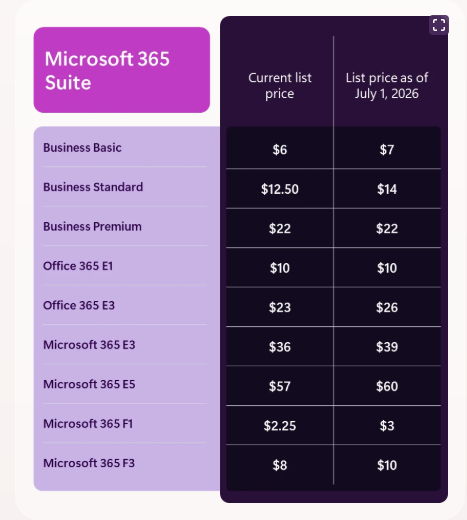
Core Viewpoint - Microsoft announced a price increase for its Office software subscriptions aimed at business and government customers, effective July 1, 2026 [1]. Pricing Summary - Microsoft 365 Business Basic will increase from $6 to $7 [2] - Microsoft 365 Business Standard will rise from $12.50 to $14 [2] - Microsoft 365 Business Premium will remain at $22 [2] - Office 365 E1 will stay at $10 [2] - Office 365 E3 will increase from $23 to $26 [2] - Microsoft 365 E3 will rise from $36 to $39 [2] - Microsoft 365 E5 will increase from $57 to $60 [2] - Microsoft 365 F1 will rise from $2.25 to $3 [2] - Microsoft 365 F3 will increase from $8 to $10 [2]


微软将于明年7月上调全球企业与政府版 Microsoft 365 价格
Sou Hu Cai Jing· 2025-12-04 23:21
Core Viewpoint - Microsoft will increase the monthly subscription prices for Microsoft 365 for business and government customers starting July 2026, reflecting the addition of over 1,100 new features, including generative AI-driven productivity tools and enhanced security capabilities [1] Pricing Adjustments - The price for Microsoft 365 E3 will rise approximately 8.3% to $39 per user per month, while E5 will increase by about 5.3% to $60 per user per month [1] - The F1 and F3 frontline worker plans will see significant increases, with prices rising from $2.25 to $3 (33% increase) and from $8 to $10 (25% increase) respectively [1]
微软七月上调Office商业订阅价格,一线员工产品涨幅达33%
Hua Er Jie Jian Wen· 2025-12-04 21:11
Core Viewpoint - Microsoft plans to increase the prices of its Office software for business and government customers starting July 1 next year, marking the second price adjustment since 2022. The price hikes will significantly impact various customer segments, including small businesses and large enterprises, as well as government clients like the U.S. Department of Defense [1][2]. Pricing Details - The price adjustments will see the Business Basic plan for small and medium-sized enterprises rise from $6 to $7 per user per month, while the Business Standard plan will increase from $12.5 to $14. The Business Premium plan will remain at $22 [2]. - For enterprise products, the Office 365 E1 plan will maintain its price at $10, but the Office 365 E3 plan will increase from $23 to $26, a 13% rise. The Microsoft 365 E3 plan, which includes the Windows operating system, will go from $36 to $39, an 8% increase. The Microsoft 365 E5 plan will see a slight increase from $57 to $60 [2][3]. Significant Increases for Frontline Workers - The most notable price increase is for frontline worker plans, with the Microsoft 365 F1 subscription rising from $2.25 to $3, a 33% increase, and the Microsoft 365 F3 plan increasing from $8 to $10. Government clients will experience similar percentage increases [3]. Historical Context and Market Background - Price adjustments for commercial Office subscriptions are infrequent. Since the launch of Office 365 in 2011, Microsoft has only made a significant price increase once in 2022. The rebranding of Office 365 to Microsoft 365 occurred in 2020, and a price increase for consumer Office suites was announced in January of this year [4][5]. Financial Impact and Strategic Positioning - The price increase highlights the central role of productivity software in Microsoft's financial landscape, with nearly 43% of the company's total revenue of $77.7 billion in the last fiscal quarter coming from the "Productivity and Business Processes" segment, which includes Office. The Microsoft 365 commercial cloud service revenue grew by 17%, driven mainly by products aimed at small and medium-sized enterprises and frontline workers [6]. - The $30 per month Microsoft 365 Copilot service remains excluded from this price adjustment, maintaining its status as a high-end AI feature with independent pricing. There are mixed sentiments among companies regarding the deployment of Copilot, reflecting uncertainty about the cost-effectiveness of AI tools [6].
微软下调AI软件销售指标
Cai Jing Wang· 2025-12-04 03:20
据微软Azure云部门的两名销售人员透露,由于多个部门在截至6月的财年中未达成AI产品销售增长目 标,目前微软多个业务线已下调部分AI产品的销售增长指标。这两名知情人士表示,微软针对特定产 品下调销售指标的情况实属罕见。(新浪财经) 微软及其他企业级软件公司的高管曾将2025年誉为人工智能实现多步骤任务自动化的元年——例如基于 公司销售数据生成仪表盘。但随着年末临近,微软已下调对其新一代AI产品(即"智能代理")的市场渗 透预期,不再强求客户快速为这类产品付费。 ...
微软罕见下调AI软件销售指标,应对企业客户付费抵触情绪
Huan Qiu Wang Zi Xun· 2025-12-04 02:57
来源:环球网 【环球网科技综合报道】12月4日消息,据WebProNews报道,微软旗下多个业务部门已下调部分AI产 品的销售增长预期。这一调整源于不少销售人员未能完成截至6月结束的财年销售目标,而此类针对特 定产品调低销售配额的举动,被相关业务人员称为"罕见"情况。 据Azure云业务的两名销售人员透露,微软在产品销售指标设定上向来较为稳定,此次专门下调AI产品 销售预期,实则反映出企业客户对AI付费服务的抵触情绪,微软正通过调整销售策略积极应对这一市 场现状。 目前,微软方面尚未就销售指标调整的具体细节及后续应对举措作出进一步回应。(纯钧) ...

苹果AI业务主管詹南德里亚将退休,微软前高管接任相关职务
Huan Qiu Wang Zi Xun· 2025-12-04 02:57
Core Insights - Apple has updated its executive leadership page, removing information about John Giannandrea, who will officially retire in Spring 2026, having previously stepped down as head of AI operations [1][3] - Amal S. Subramaniam, former VP of AI at Microsoft, will take over as Apple's VP of AI, reporting to Senior VP of Software Engineering Craig Federighi [3] - Giannandrea joined Apple in 2018 and was responsible for key AI projects like Siri and Core ML, previously serving as Senior VP of Engineering at Google [3] AI Strategy and Management Changes - The teams previously managed by Giannandrea, including AI infrastructure, search, and knowledge, have been reassigned to Sabih Khan and Eddy Cue [3] - The launch of the new "Apple Intelligence" Siri feature, initially scheduled for Spring 2025, has been postponed by a year, now set for 2026 [3] - Reports indicate that the delays in the Siri project are linked to leadership management issues, privacy policy constraints, and team collaboration challenges [3]

微软CEO纳德拉:大型企业需以变革适配AI时代
Sou Hu Cai Jing· 2025-12-04 02:42
Group 1 - The core viewpoint is that large organizations face significant disadvantages in the AI competition due to their size and complexity, which hinders innovation compared to startups [1][3] - Microsoft CEO Satya Nadella emphasizes the need for large companies to undergo a mindset shift from being self-assured to being eager to learn, adopting a "beginner's mind" to avoid past successes becoming obstacles [3][4] - Nadella highlights the importance of empathy and emotional intelligence as essential soft skills for business development in the AI era [3] Group 2 - Nadella warns that equating AI projects with traditional IT system upgrades will lead to failure, stressing the need for a fundamental restructuring of AI application systems [4] - He outlines four key implementation steps for successful AI integration: re-evaluating and optimizing core workflows, adopting modern AI tools, enhancing employee training, and transforming data assets from outdated systems into AI-readable resources [4]

微软下调AI产品销售预期引股价震荡 市场反思狂热投资价值
Huan Qiu Wang· 2025-12-04 02:42
【环球网财经综合报道】当地时间周三美股盘中,科技巨头微软公司股价显著下挫,早盘一度下跌超过3%。截至收盘,股价跌幅收窄至约 2%,报每股480美元。此次股价波动直接源于一则内部消息,微软已下调了面向企业客户的部分人工智能产品的销售增长目标。 微软面临的困境并非孤例,它揭示了当前企业级AI市场的一个核心矛盾:科技公司庞大的基础设施投入与客户可感知的实际价值之间,存在 巨大落差。 包括微软、谷歌、Meta和亚马逊在内的科技巨头,正在芯片、服务器和数据中心建设上投入巨额资本,以满足AI计算需求。然而,企业客户 开始抱怨,使用AI处理日常任务所节省的成本难以量化,且该技术仍会犯错,有时甚至代价高昂。一些企业发现,AI工具在需要稳定调用其 他业务系统数据等关键任务上表现不佳,导致其削减了相关支出计划。 这种怀疑情绪正在行业高层中蔓延。IBM首席执行官阿尔温德·克里希纳本周公开表示,以当前数据中心的天价建设与运营成本计算,科技巨 头们的相关资本支出"绝无可能"获得足够回报。麻省理工学院(MIT)近期的一项研究也为这场"降温"提供了注脚:该研究指出,尽管企业 已在生成式AI上投入数百亿美元,但高达95%的组织未能看到明确的 ...

岗位意外减3.2万!开市客起诉特朗普,微软下调AI指标
Sou Hu Cai Jing· 2025-12-04 02:24
此前特朗普曾罕见承认关税政策导致美国消费者购买商品时的花费增加,尽管他坚称政策总体有益。路透社报道指出,特朗普承认"由于他的关税政策,美 国消费者正在承受更高的商品价格"。这种政策立场的反复折射出通胀压力对行政决策的实质性约束。 科技愿景与商业落地的温差 在传统制造业面临关税与成本双重挤压之际,政府试图通过押注新兴科技寻找新的增长叙事。特朗普政府正计划加速推动机器人产业发展,商务部长霍华德 ·卢特尼克近期多次会见机器人行业的公司高管。知情人士透露,政府正考虑在明年发布一项关于机器人的行政命令,试图在AI等关键领域构建竞争优势。 中小企业在当前的经济环境下承受了主要的冲击,裁员潮在这一领域尤为集中。员工数少于50人的小型企业合计减少了12万个岗位,其中20至49人规模的企 业裁员人数达到7.4万人。相比之下,大型企业仍保持了净增态势,劳动力市场的分化格局愈发显著。ADP首席经济学家Nela Richardson指出,"雇主正在应 对谨慎的消费者和不确定的宏观经济环境,招聘活动近期波动明显"。 关税承诺与通胀现实的博弈 然而科技巨头在人工智能商业化落地方面正遭遇现实阻力,市场预期开始出现修正。微软内部多个业务部门 ...


微软下调人工智能软件销售配额 -因客户抵触新产品The Information-Microsoft Lowers AI Software Sales Quotas as Customers Resist Newer Products
2025-12-04 02:21
Summary of Key Points from Microsoft AI Sales Quotas Conference Call Company Overview - The conference call primarily discusses Microsoft and its AI product sales strategies, particularly in relation to its Azure cloud unit and AI software offerings. Core Insights and Arguments - Microsoft has lowered sales quotas for certain AI products due to underperformance by sales teams, marking a rare adjustment in expectations for AI product sales [3][20] - Multiple sales teams within Microsoft failed to meet their AI product sales quotas in the previous fiscal year, leading to a reduction in growth targets for the current fiscal year [3][20] - Corporate customers have expressed difficulty in measuring the ROI from AI technologies, which has contributed to their reluctance to increase spending on advanced AI solutions [4][11] - Microsoft is revamping its AI agent features for Windows computers, aiming to improve functionality and address previous privacy concerns associated with earlier versions [17][18] Financial Performance and Market Dynamics - Despite challenges in traditional business spending on AI, Microsoft has benefited from significant new spending by AI firms like OpenAI, which is projected to rent approximately $15 billion worth of cloud servers from Microsoft this year [5][6] - OpenAI has also adjusted its revenue projections for AI agents, lowering expectations by $26 billion over the next five years, indicating broader market challenges [11][12] Customer Feedback and Product Development - Companies like Carlyle have reported difficulties in using Microsoft's AI tools effectively, leading to reduced spending on these products [8][9] - Microsoft is developing a new open-source model, Fara-7B, to enhance privacy and functionality in AI tasks, which is expected to run entirely on customer computers [19] Competitive Landscape - Other enterprise software firms, such as Salesforce and ServiceNow, are also facing challenges in increasing AI revenue and are offering discounts to attract customers to new AI products [14][15] - The overall trend indicates that large cloud and software providers are adjusting their revenue expectations for AI, as seen with Google and Amazon's previous adjustments [16] Additional Important Insights - Microsoft is focusing on improving AI agent features that can automate tasks on customer desktops, which could enhance user experience and drive future sales [17][18] - The ongoing adjustments in sales quotas and product features reflect a broader industry trend of recalibrating expectations in response to customer feedback and market conditions [11][16]