MICROSOFT(04338)

Search documents
1.3万亿美元的“AI幻灭”:微软(MSFT.US)、亚马逊(AMZN.US)领跌,投资者不再为愿景买单
Zhi Tong Cai Jing· 2026-02-17 06:29
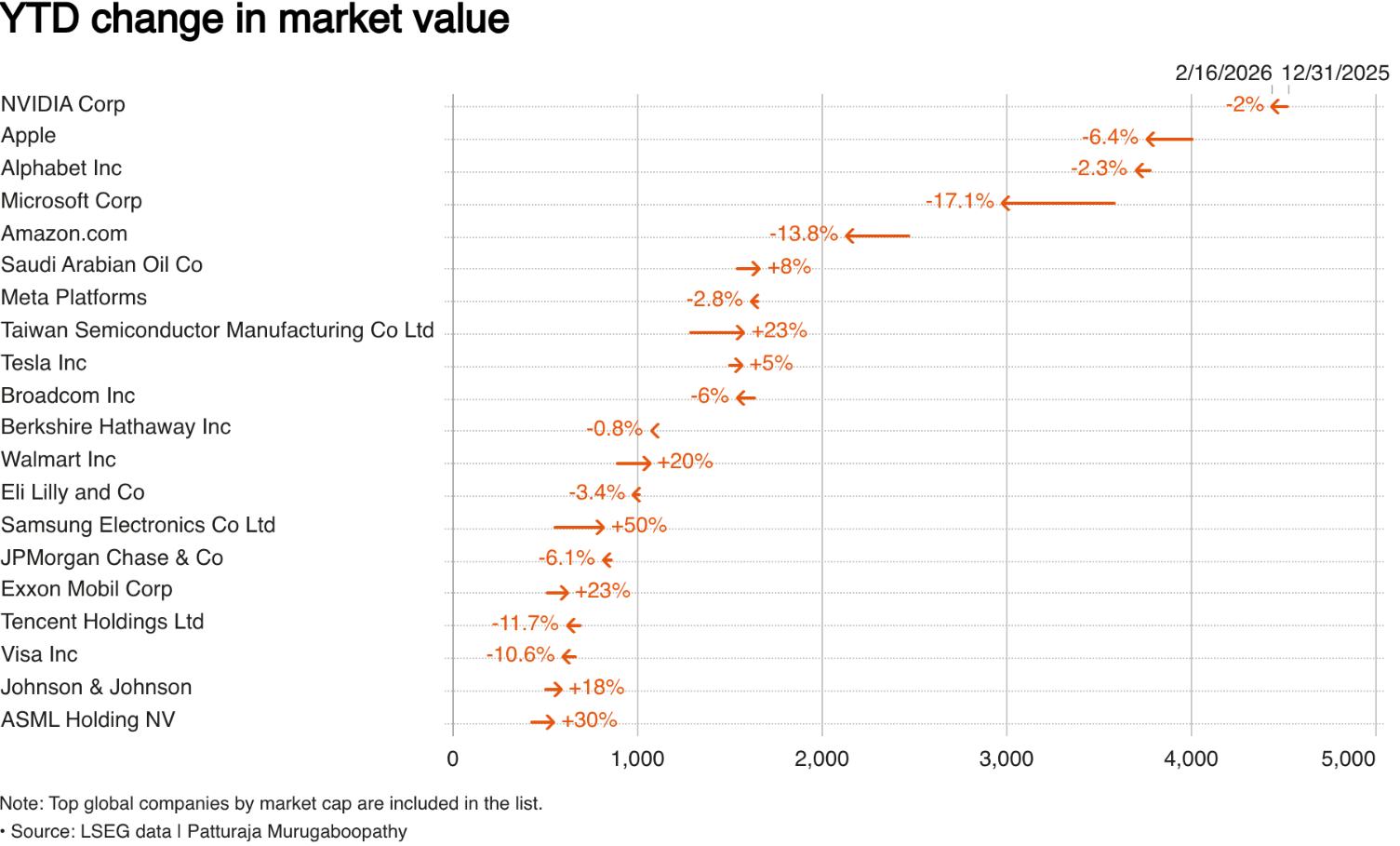
Core Viewpoint - The significant decline in the market value of major tech stocks is attributed to investor skepticism regarding the returns on massive investments in artificial intelligence, leading to a total market value loss exceeding $1.3 trillion since January 2026 [1]. Group 1: Impact on Major Tech Stocks - Microsoft has experienced a market value drop of approximately $613 billion, with its current valuation around $2.98 trillion [2]. - Amazon's market value has decreased by about $343 billion, currently valued at $2.13 trillion, reflecting a year-to-date decline of approximately 13.85% [3]. - Apple's market value has shrunk by $256.4 billion, now standing at $3.76 trillion, while Alphabet's valuation has decreased by $879.6 billion to $3.7 trillion [4]. Group 2: Investor Sentiment and Spending Concerns - Investors are increasingly focused on short-term financial transparency rather than long-term AI goals, indicating a shift in sentiment from previous speculative enthusiasm [5]. - Amazon's announcement of a projected 50% increase in capital investments this year has heightened concerns about rising costs in the AI development sector [6]. - Microsoft faces intense competition from Google's Gemini model and Anthropic's Claude Cowork AI, raising fears about profit compression and the adoption of its AI solutions [7]. Group 3: Emerging Companies - Taiwan Semiconductor Manufacturing Company (TSMC) has seen its market value increase by $293.9 billion, now valued at approximately $1.58 trillion [8]. - Samsung Electronics' market value has risen by $272.9 billion, reaching $817 billion [8]. - Walmart's market value has grown by $179.2 billion, now at $1.07 trillion, contrasting sharply with the losses of major tech stocks [8].


视频丨九连跌创纪录!继微软后,亚马逊成第二家跌入熊市的科技七巨头!

Xin Lang Cai Jing· 2026-02-15 14:03
炒股就看金麒麟分析师研报,权威,专业,及时,全面,助您挖掘潜力主题机会! 责任编辑:尉旖涵 炒股就看金麒麟分析师研报,权威,专业,及时,全面,助您挖掘潜力主题机会! 责任编辑:尉旖涵 ...
桥水去年Q4增持英伟达和黄金股, 减持谷歌、微软
Mei Ri Jing Ji Xin Wen· 2026-02-15 02:16
Group 1 - Bridgewater, the world's largest hedge fund, disclosed its U.S. stock holdings report (13F) as of the end of 2025 [2] - In Q4 2025, Bridgewater increased its positions in technology stocks such as Micron Technology, Oracle, NVIDIA, and Amazon, as well as in gold stocks like Newman Mining [2] - The fund reduced its holdings in stocks like Google and Microsoft [2]
桥水Q4增持英伟达和黄金股,减持谷歌、微软


Xin Lang Cai Jing· 2026-02-15 01:22
Group 1 - The core viewpoint of the article is that Bridgewater, the world's largest hedge fund, has disclosed its U.S. stock holdings report as of the end of 2025, indicating significant changes in its investment strategy [1] Group 2 - In Q4 2025, Bridgewater increased its holdings in technology stocks such as Micron Technology, Oracle, NVIDIA, and Amazon [1] - The fund also increased its investment in gold stocks, specifically Newman Mining [1] - Conversely, Bridgewater reduced its positions in stocks like Google and Microsoft [1]
高盛推出“抗AI冲击”主题投资组合,看好甲骨文和微软等
Ge Long Hui A P P· 2026-02-14 12:05
Group 1 - Goldman Sachs has launched a new "anti-AI impact" thematic investment portfolio, betting on companies less likely to be affected by AI disruptions [1] - The portfolio includes a long position in companies that require physical execution, are heavily regulated, or must be accountable by humans, which are difficult to replace with AI [1] - On the short side, the strategy targets companies with workflows that could be gradually automated by AI, such as Duolingo and Semrush [1] Group 2 - Goldman Sachs is optimistic about AI infrastructure-related companies, covering areas like computing power, cloud services, data facilities, development tools, and cybersecurity, with Oracle and Microsoft as representative firms [1]

索罗斯Q4调仓路线图:猛砍Snowflake,狂买微软、英伟达,新建仓黄金股
Zhi Tong Cai Jing· 2026-02-14 02:05
Group 1: Core Investment Strategy - Soros Fund Management significantly increased its exposure to core technology stocks, including adding 161,000 shares of Microsoft (MSFT.US), 118,000 shares of Nvidia (NVDA.US), and approximately 66,000 shares of Apple [1] - The fund also made moves in the software and mobility sectors, increasing positions in Atlassian (TEAM.US) by approximately 216,000 shares, Salesforce (CRM.US) by about 55,000 shares, and Uber (UBER.US) by around 119,000 shares [1] - In defensive and growth sectors, the fund increased its holdings in utility company Exelon (EXC.US) by approximately 488,000 shares and gaming giant Electronic Arts (EA.US) by about 318,000 shares [1] Group 2: Reduction and Caution - The fund reduced its positions in high-volatility and financial stocks, significantly cutting 168,000 shares of Snowflake (SNOW.US) and 151,000 shares of Circle Internet Group (CRCL.US) [2] - A notable reduction was also seen in Interactive Brokers (IBKR.US), with a decrease of 813,000 shares, indicating a cautious stance towards the financial brokerage sector [2] Group 3: New Positions and Exits - Soros Fund Management opened new positions in gold-related assets such as New Gold (NGD.US) and established positions in DigitalBridge (DBRG.US), Blue Owl Capital (OWL.US), Exact Sciences (EXAS.US), and Xcel Energy (XEL.US) [3] - The fund completely exited positions in KeyCorp (KEY.US), CareTrust REIT (CTRE.US), Cipher Mining (CIFR.US), and KKR & Co. (KKR.US), indicating a shift away from traditional banking and certain cryptocurrency mining stocks towards more stable or defensive sectors [3] - Overall, the fund's strategy reflects a clear intention to embrace AI and core technology assets while avoiding high-volatility cloud and data companies like Snowflake, and hedging against macroeconomic uncertainties by investing in gold stocks [3]
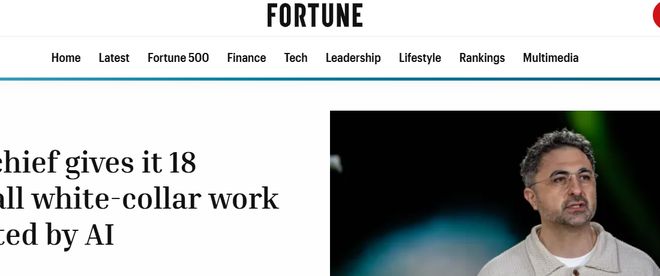
微软AI负责人预言:18个月内多数白领将被AI替代
Huan Qiu Wang Zi Xun· 2026-02-14 01:52
来源:环球网 【环球网科技综合报道】2月14日消息,微软AI首席执行官穆斯塔法·苏莱曼在接受《金融时报》采访 时,抛出震撼行业的预言:未来18个月内,AI将在大多数甚至所有专业任务上达到人类水平,包括会 计、法律、营销、项目管理在内的各类白领工作,尤其是需要坐在电脑前完成的任务,将被AI完全自 动化,这一判断涵盖了MBA、法学院毕业生及各类普通白领。 苏莱曼的预言并非孤例,而是科技行业大佬对AI影响的又一激进判断。此前,Anthropic首席执行官达 里奥·阿莫代伊曾警告,AI可能淘汰一半入门级白领岗位;福特首席执行官吉姆·法利称AI将使美国白领 岗位减半;马斯克也于上月表示,通用人工智能最早可能在今年出现。 不过,外媒报道称,目前AI在专业服务领域影响有限,2025年汤森路透报告显示,律师、会计师仅用 AI处理文档审核等针对性任务, productivity提升微弱,未出现大规模岗位流失;甚至有研究表明,AI 可能降低部分从业者效率,如非营利组织METR发现,AI使软件开发者的任务耗时增加20%。 苏莱曼表示,算力的指数级增长是其预言的核心依据,他还透露微软AI的核心使命是实现超级智能, 减少对OpenAI ...
继微软后,亚马逊成第二家跌入熊市的“七巨头”
Di Yi Cai Jing Zi Xun· 2026-02-14 01:31
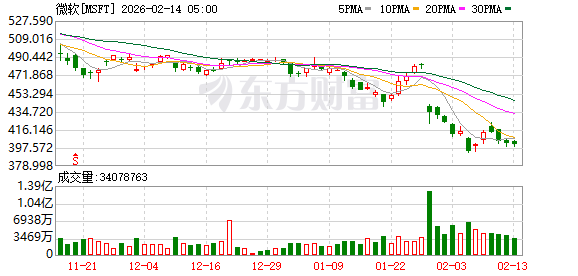
2026.02.14 本文字数:1973,阅读时长大约3分钟 作者 | 第一财经 樊志菁 本周,市场对AI开支过高的担忧仍然挥之不去。投资者正强烈抵制科技巨头激进的人工智能投入计 划,导致 "七巨头"股价大幅下挫。亚马逊股价连续下挫,华尔街担忧大规模投入将使亚马逊在2026年 成为云业务巨头中首个出现自由现金流为负的公司。 首家自由现金流为负的云巨头? 自上周发布财报以来,亚马逊股价已经连跌九个交易日,创2006年以来最长纪录,正式跌入技术性熊 市,即从重要高点下跌20%及以上。周五该股进一步失守200美元,较11月3日254美元的历史收盘价下 跌近23%。 亚马逊由此成为继微软之后,第二家跌入熊市的 "七大科技巨头"成员。微软股价在1月29日步入熊市, 此前一天该公司公布的Azure云业务增速不及市场预期。截至本周收盘,微软股价较10月28日542.07美 元的历史收盘价下跌超过1/4。 亚马逊规模庞大的人工智能投入计划并未获得投资者认可。尽管投资者对亚马逊AI战略与云业务增长 节奏不匹配的质疑从去年就已出现,但该公司仍加倍押注这一方向。在四大云服务巨头中,亚马逊、微 软、Meta与谷歌2026年AI资本开 ...

继微软后,亚马逊成第二家跌入熊市的七巨头
Xin Lang Cai Jing· 2026-02-14 00:47
Core Viewpoint - Concerns over excessive AI spending persist in the market, leading to significant stock declines among the "Big Seven" tech companies [1] Group 1: Company Impact - Investors are strongly resisting aggressive AI investment plans from tech giants, resulting in a sharp drop in stock prices [1] - Amazon's stock has been on a continuous decline, with Wall Street worried that its large-scale investments may lead to negative free cash flow by 2026, making it the first cloud business giant to experience this [1]
继微软后 亚马逊成第二家跌入熊市的“七巨头” 下一个或是这家
Di Yi Cai Jing· 2026-02-14 00:43
Core Viewpoint - Concerns over excessive AI spending have led to significant stock declines among major tech companies, particularly Amazon, which is facing fears of becoming the first cloud giant with negative free cash flow by 2026 [2][3]. Group 1: Stock Performance - Amazon's stock has fallen for nine consecutive trading days, marking its longest losing streak since 2006 and entering a technical bear market with a drop of over 20% from its peak [3]. - As of the latest close, Amazon's stock price has decreased nearly 23% from its historical closing price of $254 on November 3, now trading below $200 [3]. - Microsoft also entered a bear market earlier this year, with its stock down over 25% from its historical closing price of $542.07 on October 28 [3]. Group 2: AI Investment Plans - Amazon plans to invest $200 billion in AI capital expenditures by 2026, the highest among the four major cloud service providers, contributing to a total expected AI capital expenditure of $650 billion across Amazon, Microsoft, Meta, and Google [3]. - Despite a strong 24% growth in Amazon Web Services (AWS) for the fourth quarter, investor skepticism remains regarding the alignment of Amazon's AI strategy with its cloud business growth [3]. Group 3: Analyst Perspectives - Some analysts believe the market's negative sentiment towards Amazon's AI investments is overblown, arguing that the company is strategically investing in future cloud computing capabilities [4]. - Deutsche Bank analyst Lee Horowitz suggests that the risk of underinvestment is greater than that of overinvestment for Amazon, and he has set a target price of $290 for Amazon's stock [4]. - William Blair analyst Dylan Carden acknowledges the risks associated with increased capital spending but sees it as a sign of Amazon's competitive advantage in rapidly scaling its AWS infrastructure [4]. Group 4: Market Dynamics - The recent sell-off in tech stocks reflects a growing divide among the "Seven Giants," with concerns about AI spending impacting companies like Amazon, Microsoft, and Meta more severely than others like Google [5][6]. - Google has managed to avoid the worst of the sell-off due to its vertically integrated technology system, which provides a buffer against excessive spending concerns [6]. - The upcoming Nvidia earnings report on February 25 is anticipated to be a key catalyst for the AI sector, potentially revealing whether the AI boom is cooling off [7].