
MICROSOFT(04338)

Search documents
继微软后,亚马逊成第二家跌入熊市的“七巨头”,下一个或是这家
Di Yi Cai Jing Zi Xun· 2026-02-14 00:41
Core Viewpoint - Concerns over excessive AI spending have led to significant stock declines among the "Seven Giants," particularly Amazon, which is facing fears of becoming the first cloud giant with negative free cash flow by 2026 [1][2]. Group 1: Amazon's Stock Performance - Amazon's stock has fallen for nine consecutive trading days, marking its longest losing streak since 2006 and officially entering a technical bear market, down nearly 23% from its historical closing price of $254 on November 3 [2]. - The company's substantial AI investment plans have not been well-received by investors, leading to skepticism about the alignment of its AI strategy with cloud business growth [2][3]. Group 2: AI Capital Expenditure - Amazon, along with Microsoft, Meta, and Google, is projected to spend a total of $650 billion on AI capital expenditures by 2026, with Amazon's share being $200 billion, the highest among global cloud service giants [2]. - This unexpected capital expenditure has overshadowed Amazon Web Services' (AWS) impressive 24% growth in the fourth quarter, raising concerns that such large investments could result in negative free cash flow [2]. Group 3: Analyst Perspectives - Some analysts believe that the market's pessimism towards Amazon is overblown, arguing that the company is not becoming more capital-intensive but is instead investing in future cloud computing capabilities to drive digital transformation [3]. - Analysts from Deutsche Bank and William Blair acknowledge the risks associated with increased capital spending but suggest that it may reflect Amazon's inherent advantages in upgrading its existing AWS infrastructure [3]. Group 4: Support for Amazon - Notable investors, such as Bill Ackman's Pershing Square Capital, have disclosed holdings in Amazon, indicating confidence in the company's long-term prospects despite current market challenges [4]. - The fund's report highlights expectations for AWS to double its data center capacity by 2027, driven by demand from AI inference business expansion [4]. Group 5: Market Trends and Comparisons - The recent sell-off in tech stocks has highlighted a divergence in performance among the "Seven Giants," with concerns about AI spending impacting companies like Amazon, Microsoft, and Meta more severely than others like Google [5][6]. - The upcoming earnings report from Nvidia is anticipated to be a key catalyst for the AI sector, potentially revealing whether the AI boom is cooling and if Nvidia can deliver substantial returns on its large customer investments [6].
微软遭FTC反垄断调查,股价承压,财报超预期但Azure增速放缓
Jing Ji Guan Cha Wang· 2026-02-13 19:42
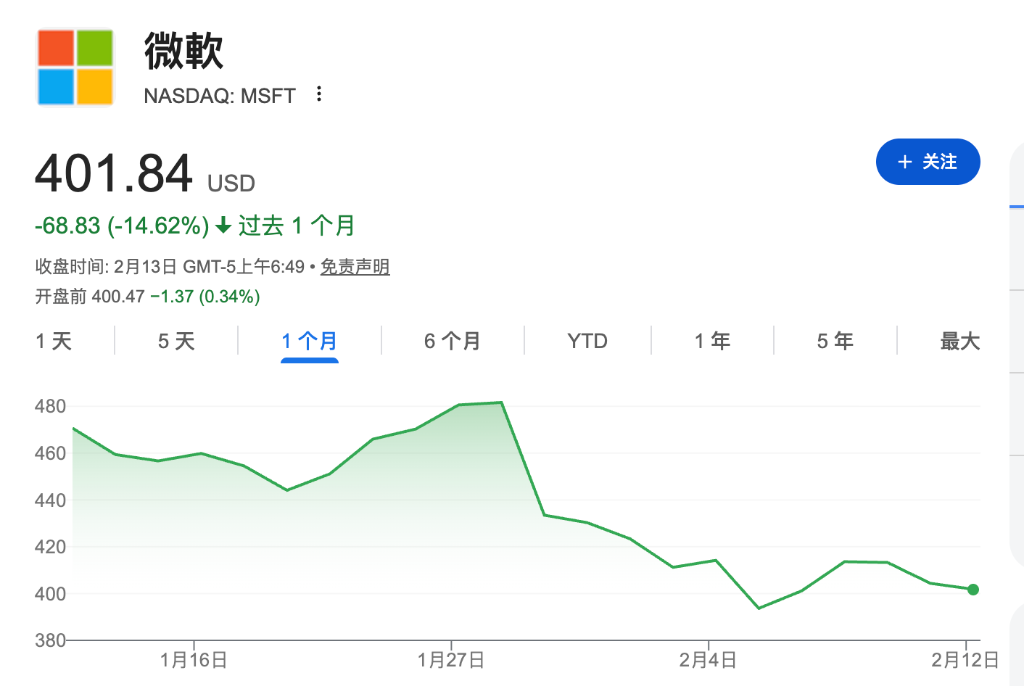
财报分析微软2026财年第二季度财报显示,总收入813亿美元,同比增长17%,Non-GAAP EPS为4.14美 元,超市场预期。但Azure增速固定汇率下为38%,略低于前期,且资本支出375亿美元引发对利润率的 忧虑。 机构观点分析师对微软前景存在分歧。Stifel于2月初将评级从"买入"下调至"持有",目标价392美元,担 忧资本开支压力。摩根士丹利则看好微软AI集成能力,列为被错杀股。 以上内容基于公开资料整理,不构成投资建议。 经济观察网根据智通财经2026年2月14日报道,美国联邦贸易委员会(FTC)正加强微软的反垄断调查,涉 及云计算和AI领域,调查微软是否通过许可规则设置壁垒限制竞争。这一消息在资本开支压力背景下 可能进一步压制股价,微软股价目前处于去年4月以来低点。 股票近期走势微软股价近期波动较大。2026年2月9日至13日,美股微软(MSFT.OQ)股价先涨后跌再反 弹,2月13日收盘报403.92美元,当日涨0.52%。年初至今股价下跌16.48%,20日跌幅为11.55%,反映市 场对AI资本开支和增长放缓的担忧。 ...
布米普特拉北京投资基金管理有限公司:微软探索数据中心供电新布局
Sou Hu Cai Jing· 2026-02-13 17:03
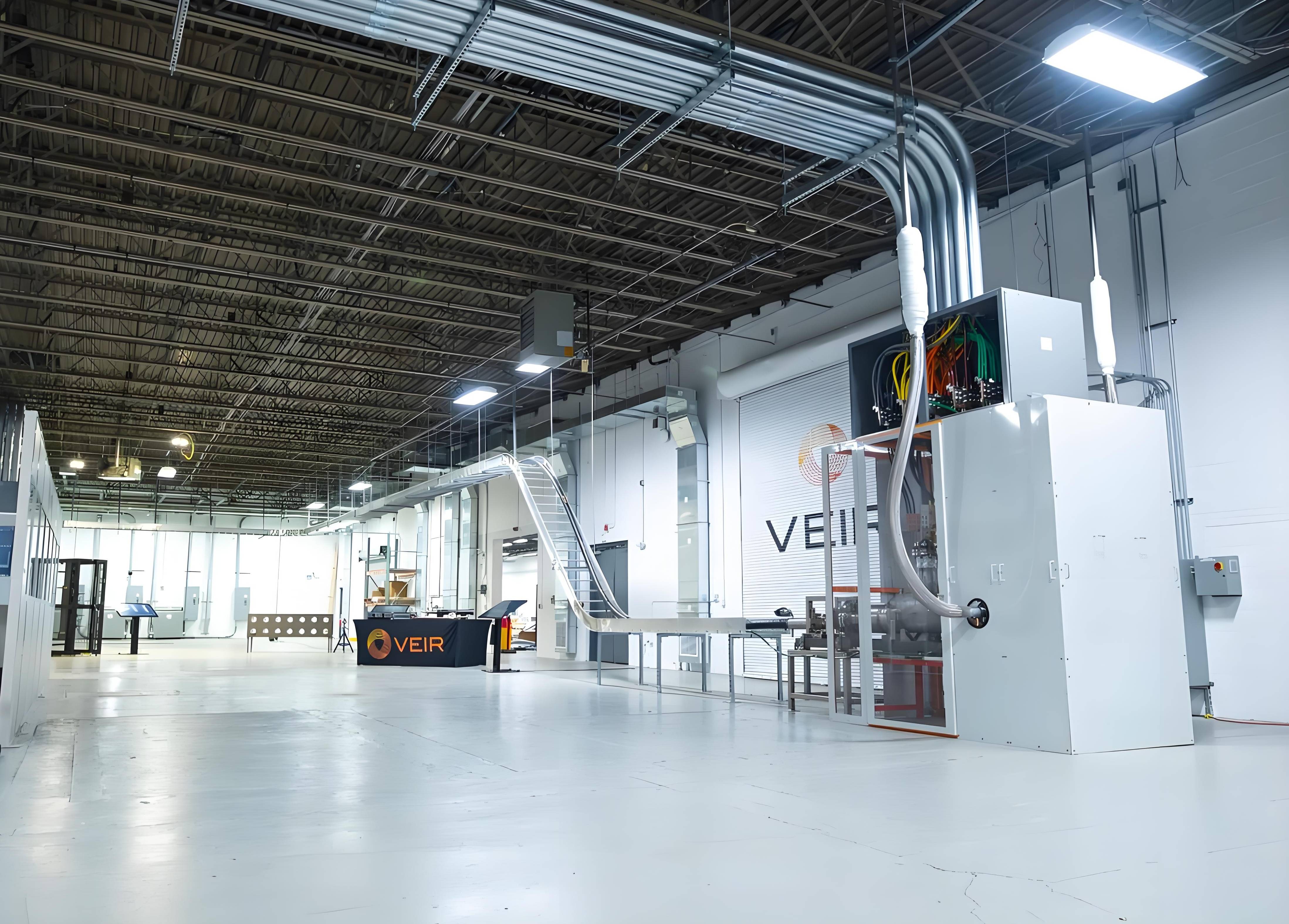
微软正将目光投向高温超导技术,以破解人工智能算力扩张带来的数据中心供电瓶颈。该企业近日在官方博客中披露,正评估将高温超导电缆引入数据中心 供电体系,这项以"零电阻"传输电能的成熟技术,如今在经济性与制造层面已具备超大规模场景落地潜力。 这一布局使微软数据中心在电力、网络与热管理三大战略方向形成完整创新拼图。此前该企业已在空心光纤与微流体冷却技术上取得进展,高温超导的加入 补齐了电力传输环节的关键短板。 成本仍是超导电缆大规模应用的核心障碍。高温超导带材通常采用稀土钡铜氧化物制备,材料与制程成本高昂。同时运行过程中需液氮持续冷却,增加系统 复杂度。然而这一瓶颈正因人工智能与核聚变产业的交汇而出现转机。 传统数据中心及绝大多数能源基建至今仍依赖铜导线。电流通过铜线时每一步都会遭遇电阻,不仅产生热量、限制传输容量,还推高冷却负担。高温超导电 缆则完全不同:在液氮冷却至极低温的环境下,电流实现零电阻流动,不发热、无电压衰减,且体积与重量较同等传输能力的铜缆可缩小约十倍。 微软全球基础设施营销总经理表示,主要在两类场景推动高温超导技术落地。在数据中心内部,更纤细的电力排线可极大提升机架布局灵活度,打破当前供 电布局对算 ...


FTC升级对微软反垄断调查,向竞争对手质询云与AI业务
Ge Long Hui A P P· 2026-02-13 16:22
Core Viewpoint - The Federal Trade Commission (FTC) is accelerating its investigation into Microsoft regarding potential illegal monopolization in the enterprise computing market through its cloud software and AI products, including Copilot [1] Group 1: Investigation Details - The FTC has recently issued civil investigative demands to Microsoft's competitors in the commercial software and cloud computing markets [1] - These demands include inquiries about Microsoft's licensing and other business practices [1] - At least six companies have received such requests, which are akin to civil subpoenas [1] Group 2: Evidence Gathering - The FTC is seeking evidence to demonstrate that Microsoft makes it more difficult for customers to use competitors' cloud services alongside products like Windows and Office [1] - The agency has also requested information regarding Microsoft's bundling of AI, security, and identity software with products such as Windows and Office [1]
1480亿美元的赌注:为何高盛认为市场误读了微软的资本开支?
Hua Er Jie Jian Wen· 2026-02-13 13:19
Core Viewpoint - Microsoft has seen a 15% decline in stock price since the earnings report on January 28, primarily due to concerns over increased capital expenditures without a corresponding rise in Azure growth guidance and competition from new AI tools in the Office 365 business [1] Group 1: Capital Expenditure and Azure Growth - Microsoft is adjusting its computing power allocation, increasing the share for internal research and Copilot from approximately 10% to 20% [3][5] - For fiscal year 2026, capital expenditures are projected to reach $148 billion, a 400% increase from fiscal year 2022 [3] - Current computing power allocation is about 70% for Azure and 30% for Copilot and internal research, with new GPU allocations approaching a more balanced 60/40 split [6] Group 2: Iceberg Model of Computing Investment - Goldman Sachs introduced an "iceberg analogy" to explain Microsoft's computing capital expenditure strategy, distinguishing between visible investments that directly impact Azure and Office 365 and invisible investments crucial for long-term strategy [4] - If all new computing capacity is allocated to Azure, its growth rate could exceed 40%, indicating a strategic postponement of some growth potential for long-term investments [4][10] Group 3: Drivers of Increased Internal Allocation - Four structural factors are driving the increased demand for Microsoft's computing power, leading to a significant evolution in capital expenditure structure [7] - Azure AI computing power accounts for the largest share, with a multiplier of 4-5 times for "computing power/quarterly new revenue," translating to $0.20 to $0.25 in revenue for every $1 of capital expenditure [8] Group 4: Copilot Investment Strategy - Microsoft is positioning Copilot as a cost-effective enterprise-level LLM solution, priced at approximately $30 per user per month, compared to ChatGPT Enterprise at $60 [12] - Copilot is beginning to make a substantial contribution to M365 commercial cloud revenue, projected to reach $89 billion in fiscal year 2026 [13] - The adoption rate of Copilot is increasing among both internal employees and external customers, driving up computing power consumption [9]
刚刚,一个2.6万亿AI独角兽诞生,英伟达微软押注,马斯克急了
3 6 Ke· 2026-02-13 02:28
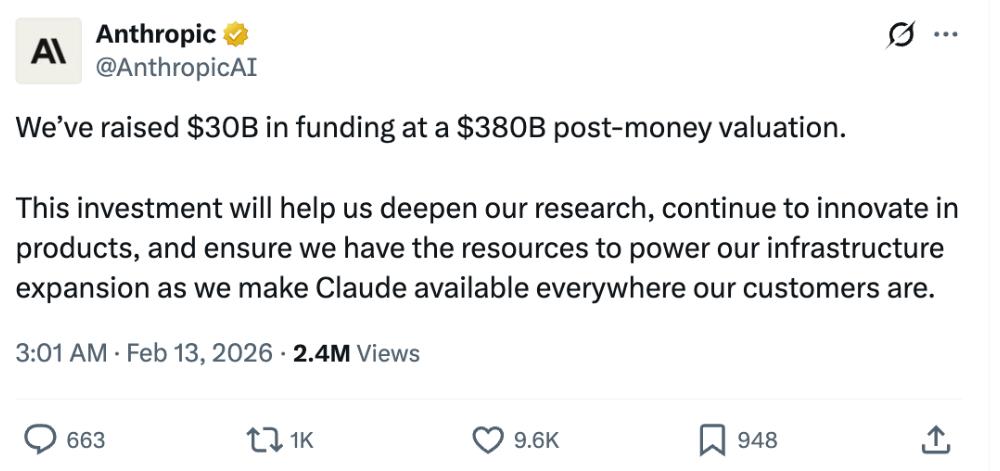
Core Insights - Anthropic has completed a $30 billion Series G funding round, achieving a post-money valuation of $38 billion and an annual recurring revenue of $14 billion, with an average growth rate exceeding 10 times over the past three years [1][2]. Funding and Investment - The funding will support advanced research, product development, and infrastructure expansion, with Claude being the only AI model available on major cloud platforms: Amazon Web Services, Google Cloud, and Microsoft Azure [2]. - Key investors in this round include the Ontario Teachers' Pension Plan and Coatue, along with significant contributions from firms like Blackstone, Goldman Sachs, JPMorgan, and Sequoia Capital [4][5]. Customer Growth and Revenue - The number of Claude customers spending over $100,000 annually has increased sevenfold in the past year, with over 500 clients now spending more than $1 million annually, including 8 out of the top 10 Fortune 500 companies [6]. - Claude Code, launched in 2025, has generated over $2.5 billion in annual recurring revenue, doubling its growth since early 2026, and now accounts for more than half of total revenue [6][11]. Product Development and Features - Anthropic has released the Claude Opus 4.6 model, which features a 1 million token context window, enhancing its capabilities in long-context queries and reasoning [7][10]. - Claude Code has become a popular tool among developers, allowing for automated engineering tasks and code management, with a graphical UI version called Cowork launched to cater to non-technical users [9][10]. Market Position and Strategy - Unlike OpenAI's consumer-focused approach, Anthropic emphasizes the B2B market, achieving significant commercial success with a focus on transforming technological advancements into market advantages [11]. - The company is preparing for an IPO, potentially in 2026, having engaged legal and investment banking firms for preliminary preparations [10].
微软:解析外部与内部资本开支的应用场景
2026-02-13 02:18
12 February 2026 | 4:03PM EST Equity Research Microsoft Corp. (MSFT) Microsoft is down ~15% since its 1/28 report, primarily for two reasons: 1) upward revisions to capex without upward revisions to Azure, resurfacing questions on ROI and Azure's competitive positioning relative to peers; and 2) ongoing debate on whether the knowledge worker applications business (Office 365) is disintermediated with new AI competition, such as Claude Cowork. We focus our analysis here on the first concern: capex ROI. Micro ...
AI“超级代理”大战打响!四大赛道全面铺开,OpenAI、Anthropic正挑战微软们的软件帝国
Hua Er Jie Jian Wen· 2026-02-13 02:01
Core Insights - Major AI companies like OpenAI and Anthropic are launching enterprise-level AI products that challenge existing enterprise software markets, prompting traditional software vendors like Microsoft and Salesforce to accelerate their own AI tools and management platforms [1][2] Group 1: Competitive Landscape - The competition involves four main product categories: browser-based agents, computer-operable agents, agent-building tools, and agent management consoles [1][2] - OpenAI and Google provide browser-based agents capable of executing multi-step tasks, while Anthropic's Cowork and Google's Gemini Computer Use are examples of computer-operable agents [2] - Agent-building tools such as Salesforce's Agentforce and Google's Gemini Enterprise allow clients to create agents that can access various enterprise applications [2] - The agent management console market features competitors like Microsoft's Agent 365 and OpenAI's Frontier, raising questions about the necessity of multiple consoles for clients [2] Group 2: Adoption Challenges - Despite the promising outlook, new agent technologies face significant challenges before widespread adoption, including security concerns and usability issues [3] - Companies like OpenAI and Anthropic indicate that their computer-operable agents are still in research preview, suggesting they are not yet ready for large-scale enterprise deployment [3] - Hilton's CTO Onkar Birk expressed caution in adopting new subscriptions, highlighting the complexity and investment required for developing customer support agents [4] Group 3: Traditional Software Companies' Response - OpenAI's strategy involves positioning its agent command technology above traditional enterprise "record systems," which are critical for storing business data [5] - Traditional enterprise application companies like Salesforce and Microsoft have not yet taken steps to block AI agents from accessing or modifying data within their systems [5] - There is a recognition that traditional companies are utilizing technologies from OpenAI and Anthropic to support their own agents, even as these AI firms promote their competitive tools [5] Group 4: Market Dynamics - Snowflake, a database company, has released a product supported by AI models from OpenAI and Anthropic, enabling clients to develop agents for searching and retrieving business metrics [6] - The competitive landscape is characterized by high stakes, with industry leaders feeling pressure to either achieve a $1 trillion valuation or face potential failure [6]



加剧AI恐慌!微软高管:大多数白领工作将在“未来12-18个月内”完全自动化
Hua Er Jie Jian Wen· 2026-02-13 01:09
这一警告并非孤例。大规模劳动力替代的问题正困扰着全球各国政府,尽管在更广泛的经济逆风中,真 实的失业人数仍不明朗。 微软人工智能业务负责人发出迄今最激进的自动化预警,称绝大多数白领专业工作可能在一年半内被 AI取代,这一时间表远早于商界和政策制定者的普遍预期,为全球劳动力市场敲响警钟。 微软AI首席执行官Mustafa Suleyman在接受英国《金融时报》采访时表示,律师、会计师、项目经理和 营销人员等从事电脑办公的专业人士,其"大多数任务"将在未来12至18个月内被AI完全自动化。 AI导致的失业已初现端倪。根据职业介绍公司Challenger的报告,今年1月有7624个工作岗位因AI被 裁,占当月裁员总数的7%;2025年全年,AI导致的裁员公告达54836人。自2023年开始追踪以来, 79449个计划裁员岗位归咎于AI。 与此同时,AI安全与滥用风险也在加速升温。Anthropic在最新破坏活动报告中警告,其Claude模型在特 定计算机使用场景下对"有害滥用"更敏感,甚至出现与化学武器开发相关的风险信号。 AI大规模取代白领还有12至18个月的时间窗口 Suleyman的预测标志着科技行业对AI取 ...
微软(MSFT.US)重调与OpenAI关系:转攻AI“自给自足” 发力自研前沿模型
Zhi Tong Cai Jing· 2026-02-12 12:41
微软(MSFT.US)人工智能业务负责人穆斯塔法.苏莱曼表示,公司正寻求在AI领域实现"真正的自给自 足",通过自主研发高性能模型,逐步降低对OpenAI的技术依赖。 苏莱曼透露,这一战略转向始于2025年10月微软与OpenAI合作关系重构之后。据悉,自此微软开始独 立构建最前沿技术,而非继续倚重外部伙伴。 微软迄今已向OpenAI累计投资逾130亿美元,持有这家ChatGPT开发商近27%股权。 "我们必须开发自己的基础模型——站在绝对前沿、拥有吉瓦级算力,以及全球顶尖的AI训练团队。"苏 莱曼表示。他是谷歌DeepMind联合创始人之一,于2024年3月加入微软。 苏莱曼表示,微软的目标是通过打造"专业级通用人工智能"抢占更多企业市场份额。这类AI工具可为律 师、会计师、项目经理、营销人员等知识工作者完成日常工作。 "未来12到18个月内,白领坐在电脑前完成的大部分任务,都将由AI完全自动化。"他说。 未来两到三年内,AI智能体将能在大型机构内部工作流中实现更优协同。据悉,这类AI工具还将具备 持续学习、持续进化的能力,自主执行更多任务。 "创建新模型将像做播客、写博客一样普及,"苏莱曼表示,"未来,地 ...