JD HEALTH(06618)

Search documents
美国医药调研反馈:肿瘤、代谢、自免、中枢神经系统赛道推荐更新
Haitong Securities International· 2026-02-06 11:33
Investment Rating - The report provides an "Outperform" rating for multiple companies in the healthcare sector, including BeiGene, JD Health, WuXi Biologics, and others, indicating a positive outlook for these stocks [1]. Core Insights - The macro and industry environment is improving due to the resolution of policy uncertainties, the release of significant clinical data, and a resurgence in global M&A activity, leading to a notable increase in investor sentiment towards innovative drugs for 2026 [4][11]. - In oncology, the PD-1/VEGF dual antibody approach is transitioning from "mechanism validation" to "clinical and industrial resonance," with multiple global Phase III trials underway, expected to catalyze approvals and data releases within the year [5][17]. - The metabolic sector is seeing growth in the cash-pay market for GLP-1 drugs, driven by limited insurance coverage and high out-of-pocket costs, prompting companies to enhance accessibility through direct sales and pricing adjustments [6][25]. - In the autoimmune space, there is a growing concentration risk among major products from multinational corporations (MNCs), with new antibody platforms expected to yield significant data in 2026, potentially leading to new business development opportunities [7]. - The central nervous system (CNS) investment focus remains on advancing Aβ monoclonal antibody treatments, with key data expected to open up early intervention market opportunities [9]. Summary by Sections Oncology - The PD-1/VEGF dual antibody's clinical and industrial certainty is strengthening, with major companies conducting multiple global Phase III trials across high-value indications [17]. - The Pan-RAS precision therapy is entering a realization phase, with key Phase III data expected in 2026 for pancreatic cancer and NSCLC [22]. Metabolic - The cash-pay market for GLP-1 drugs is expanding due to limited insurance coverage, with companies like Eli Lilly and Novo Nordisk adopting different direct-to-consumer strategies to enhance accessibility [25][26]. - Small nucleic acid therapies are expected to upgrade treatment paradigms, showing competitive data in weight loss and safety profiles when combined with GLP-1 [30]. Autoimmune - MNCs are increasingly reliant on a few blockbuster products, with structural opportunities arising from new antibody platforms expected to report data in 2026 [7]. - The trend towards oral formulations in autoimmune diseases is gaining traction, offering advantages in adherence and competitive differentiation [7]. CNS - The focus in CNS remains on Aβ monoclonal antibody treatments, with advancements expected to shift treatment towards earlier intervention populations [9]. - New delivery methods, such as systemic administration of small nucleic acids, are being explored as complementary approaches [9].


京东健康(06618):CSIWM 个股点评:强劲的销售增长:京东健康
citic securities· 2026-02-06 07:04
本文是由投资/产品专员而非分析师撰写的文章汇编。 它不构成研究报告,也不应被解释为研究报告,也不旨在提供 专业、投资或任何其他类型的建议或推荐。 CSIWM 个股点评 2026 年 2 月 6 日 京东健康 6618 HK 本文内容由 Kylie Kwok (郭凯欣) 提供 中信证券财富管理(香港) 产品及投资方案部 中国互联网行业 电话:(852) 2237 9250 / 电邮:wminvestmentsolutions@citics.com.hk 强劲的销售增长 摘要 中信证券财富管理与中信里昂研究观点一致。根据中信里昂研究 2026 年 2 月 3 日发布的题为《Robust sales growth》的报告,分析预计京东健康(JDH)将在 2025 年下半年保持强劲增长势头,收入将同比增长,主要是因 为"双 11"表现强劲,以及 12 月流感病例激增所导致。药品与保健品销售表现尤为突出,经调整息税前利润预计翻 倍,主要得益于毛利率扩张和运营杠杆效应,抵消了线下门店投资。分析指出,预计京东健康在 2026 年收入实现同 比增长但且上行风险显著,因为原研药和院内药品外流是长年趋势。 分析预计京东健康在 2 ...
港股开盘受压 恒指低开1.97% 百度集团(09888)跌4.33%
Xin Lang Cai Jing· 2026-02-06 05:55
Market Overview - The Hong Kong stock market opened under pressure, with the Hang Seng Index down 1.97%, the National Enterprises Index down 1.88%, and the Hang Seng Tech Index down 2.42% [1][3] - Major stocks such as Baidu Group, Zijin Mining, AIA, and JD Health experienced declines of 4.33%, 4.14%, 4.02%, and 3.96% respectively [1][3] - Only a few blue-chip stocks, including Mengniu Dairy, Midea Group, and New Oriental, recorded slight gains [1][3] Company Specifics - China Overseas Development reported a 20.4% year-on-year increase in contract property sales amounting to approximately RMB 144.78 billion in January, while the sales area decreased by 12.9% to about 516,600 square meters [1][3] - The company anticipates that approximately RMB 111.46 billion in recognized property sales will convert into contract property sales in the coming months [1][3] - Meituan plans to acquire all issued shares of Dingdong, a leading fresh e-commerce company in mainland China, for an initial cost of USD 717 million, which is subject to adjustments [1][3] - NIO reported a positive earnings forecast, expecting adjusted operating profit (non-GAAP) between RMB 700 million (approximately USD 100 million) and RMB 1.2 billion (approximately USD 172 million) for Q4 2025, marking its first quarter of adjusted operating profit [2][4] - In contrast, NIO recorded an adjusted operating loss of RMB 5.5436 billion in Q4 2024 [2][4]




亚马逊资本支出拖累利润指引 明星科网股普遍受压 阿里巴巴-W(09988)跌3.38%
Xin Lang Cai Jing· 2026-02-06 05:33
金吾财讯 | 明星科网股普遍受压,阿里巴巴-W(09988)跌3.38%,京东健康(06618)跌3.38%,哔哩哔哩- W(09626)跌3.38%,快手-W(01024)跌2.88%,贝壳-W(02423)跌2.33%,百度集团-SW(09888)跌2.13%, 网易-S(09999)跌2.08%。 隔晚亚马逊(AMZN)盘后跌近10%,司宣布今年资本支出将达到惊人的2000亿美元,因此影响营业利润 指引低于预期。去年该公司的资本支出约为1300亿美元,而分析师的事前预期仅为1500亿美元。 金吾财讯 | 明星科网股普遍受压,阿里巴巴-W(09988)跌3.38%,京东健康(06618)跌3.38%,哔哩哔哩- W(09626)跌3.38%,快手-W(01024)跌2.88%,贝壳-W(02423)跌2.33%,百度集团-SW(09888)跌2.13%, 网易-S(09999)跌2.08%。 隔晚亚马逊(AMZN)盘后跌近10%,司宣布今年资本支出将达到惊人的2000亿美元,因此影响营业利润 指引低于预期。去年该公司的资本支出约为1300亿美元,而分析师的事前预期仅为1500亿美元。 ...



京东健康(06618) - 截至二零二六年一月三十一日止月份之股份发行人的证券变动月报表
2026-02-05 08:31
股份發行人及根據《上市規則》第十九B章上市的香港預託證券發行人的證券變動月報表 截至月份: 2026年1月31日 狀態: 新提交 致:香港交易及結算所有限公司 I. 法定/註冊股本變動 | 1. 股份分類 | 普通股 | | 股份類別 | 不適用 | | | 於香港聯交所上市 (註1) | | 是 | | | --- | --- | --- | --- | --- | --- | --- | --- | --- | --- | --- | | 證券代號 (如上市) | 06618 | | 說明 | | | | | | | | | 多櫃檯證券代號 | 86618 | RMB | 說明 | | | | | | | | | | | | 法定/註冊股份數目 | | | 面值 | | | 法定/註冊股本 | | | 上月底結存 | | | | 100,000,000,000 | USD | | 0.0000005 | USD | | 50,000 | | 增加 / 減少 (-) | | | | 0 | | | | USD | | 0 | | 本月底結存 | | | | 100,000,000,000 | USD | | ...
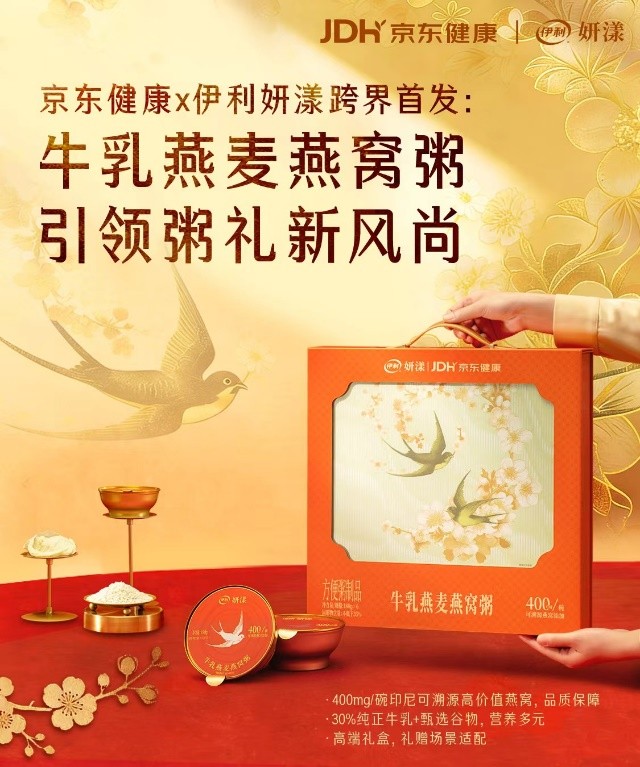
伊利妍漾联名定制燕窝粥新品在京东健康独家首发
Sou Hu Wang· 2026-02-05 07:39
Group 1 - JD Health and Yili Group have launched a co-branded product, a milk oat bird's nest porridge, aimed at high-end health needs for consumers [1][3] - The new product combines high-quality milk, premium oats, and traceable bird's nest, catering to nutrition, taste, and convenience, making it a unique choice in the New Year gift market [1][3] - The collaboration reflects the ability of both companies to develop customized products based on specific consumer scenarios and trends [3] Group 2 - During the New Year shopping season, there is a notable trend of "sending health as gifts," with significant increases in searches for health gift boxes and related products [3] - From January 26 to February 1, the average daily visitor volume for health gift box products increased 13 times year-on-year, while searches for New Year gift boxes rose 3.5 times [3] - The rising interest in traditional health products like bird's nest has doubled in search volume, indicating strong consumer demand for high-quality health products before the Spring Festival [3]

里昂:预计今年中国互联网行业涨势延续,首选腾讯、小米和阿里等
Ge Long Hui· 2026-02-05 04:00
Core Viewpoint - The report from Citi indicates that the Chinese internet industry is expected to perform strongly by 2025, driven by the leadership of DeepSeek in the domestic AI trend, with growth anticipated to continue into 2026, particularly in the competitive landscape of AI and generative video applications [1] Industry Summary - The competition between China and the United States in the fields of AI models, applications, cloud services, and autonomous driving (Robotaxi) is expected to intensify [1] - Despite geopolitical challenges, the Chinese gaming and e-commerce sectors are experiencing rapid growth in overseas markets, although there is a cautious outlook for the domestic e-commerce sector [1] Investment Strategy - Citi favors sectors related to AI, gaming, and health, predicting that industry revenue and adjusted EBIT will grow by 12% and 29% year-on-year, respectively [1] - China is expected to lead the global implementation of AI applications [1] Preferred Stocks - Citi has listed six preferred stocks for 2026, including Tencent, Xiaomi, Alibaba, NetEase, Kuaishou, and JD Health, highlighting optimism for Alibaba's cloud business, Tencent's AI applications, and Xiaomi's consumer-grade AI devices [1]



大行评级丨里昂:预计今年中国互联网行业涨势延续,首选腾讯、小米和阿里等
Ge Long Hui· 2026-02-05 03:24
里昂发表研报指,中国互联网行业在2025年表现强劲,随着DeepSeek引领国内AI趋势,预计2026年涨 势将延续,尤其在代理AI和生成式视频应用的竞争将加剧。中国与美国将在全球范围内的AI模型、应 用、云服务及自动驾驶(Robotaxi)领域展开正面竞争。 尽管面临地缘政治挑战,中国游戏和电商在海外市场持续快速增长,但该行对国内电商板块的前景持谨 慎态度。在投资策略上,里昂偏好AI、游戏及健康相关板块,并认为中国有望在全球引领AI应用落 地。里昂列出2026年六大首选股,包括腾讯、小米、阿里巴巴、网易、快手及京东健康,并特别指出看 好阿里巴巴的云业务、腾讯的AI应用,以及小米的消费级AI设备。 ...
9568亿资本版图再扩容!刘强东冲刺第七家上市公司
Sou Hu Cai Jing· 2026-02-04 16:23
Group 1 - The core point of the news is that JD.com is set to add its seventh listed company, JD Intelligent Property Development Co., Ltd., which aims to enhance its logistics infrastructure and global presence, potentially reaching a valuation of 9,568 billion RMB [1][3][5] - JD Intelligent Property Development has refiled its prospectus with the Hong Kong Stock Exchange, with major underwriters including Bank of America and Goldman Sachs, indicating a well-prepared approach for its second attempt at going public [3] - The company specializes in logistics parks and smart warehousing, managing assets exceeding 120 billion RMB across 285 projects globally, with 12.8% of its assets located overseas [3] Group 2 - The valuation of 9,568 billion RMB is derived from the combined market capitalization of JD.com's existing and upcoming listed companies, including JD Group, JD Health, JD Logistics, and JD Industry, among others [4][5] - JD Group's market capitalization is approximately 300 billion RMB, while the combined market value of JD Health, JD Logistics, and JD Industry exceeds 400 billion RMB, contributing significantly to the overall valuation [4] - The upcoming IPO of JD Intelligent Property Development is expected to raise funds for expanding overseas logistics nodes and upgrading domestic infrastructure, aiming to replicate China's logistics model globally [5] Group 3 - The expansion of JD's logistics capabilities through the new company is anticipated to enhance delivery speeds, particularly in remote areas, benefiting consumers and intensifying competition in the e-commerce logistics sector [5] - The comprehensive listing strategy of JD.com across various sectors, including retail, health, logistics, and infrastructure, is expected to create stronger synergies within its business ecosystem [5][6] - The upcoming IPO is seen as a significant milestone for JD.com and reflects the company's ambition for global expansion in the e-commerce landscape [6]


互联网医疗首诊破冰:为等这个春天,熬死了多少英雄少年
3 6 Ke· 2026-02-04 09:24
Group 1 - The introduction of online first consultations for pediatric specialties in Beijing marks a significant policy shift, allowing patients to access expert advice without prior in-person visits [1][3][4] - The pilot program focuses on three pediatric specialties: growth and development, nutrition, and dermatology, which are deemed suitable for online consultations due to their non-urgent nature [4][6] - The policy aims to alleviate the burden of travel for families seeking medical care, particularly for those with children needing non-emergency consultations [2][6] Group 2 - The pilot program is limited to two top pediatric hospitals in Beijing and will last for one year, emphasizing a cautious approach to implementation [4][8] - Online first consultations are expected to reduce the pressure on core hospitals by diverting non-urgent cases, creating a more efficient healthcare system [6][8] - Major internet healthcare platforms like Alibaba Health and JD Health are poised to benefit from this policy change, as it allows them to expand their services beyond follow-up consultations to include initial diagnoses [7][8] Group 3 - The success of the pilot in Beijing could lead to broader implementation across other cities and hospitals, potentially including common conditions like colds and chronic diseases in the future [9][10] - The integration of online consultations with insurance reimbursement policies is crucial for maximizing the convenience and effectiveness of the new system [10] - The pilot is expected to drive technological advancements in healthcare, such as improved video consultations and AI-assisted diagnostics [10][11] Group 4 - Challenges remain, including ensuring patient safety and maintaining quality standards across online and offline consultations [11][12] - The distinction between online consultation and diagnosis needs to be clarified to prevent disruptions in the healthcare system [11][12] - Smaller internet healthcare platforms may struggle to compete if they cannot meet the high standards required for online first consultations, potentially leading to market consolidation [11][12]