
SCG(600170)

Search documents
美国政府批准向中国出口英伟达H200芯片;五部门出手规范网络招聘秩序丨盘前情报
2 1 Shi Ji Jing Ji Bao Dao· 2026-01-14 00:47
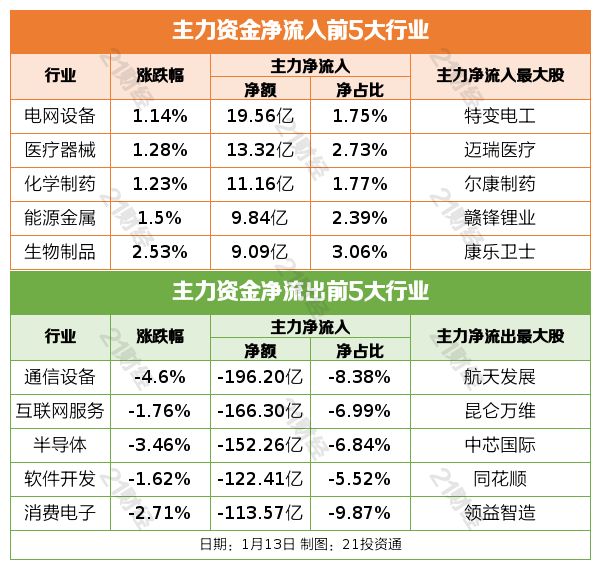
Market Overview - On January 13, major indices in China experienced collective adjustments, with the Shenzhen Component Index falling over 1% and the ChiNext Index dropping nearly 2%. The Shanghai Composite Index closed down 0.64%, the Shenzhen Component Index down 1.37%, and the ChiNext Index down 1.96%. The total trading volume in the Shanghai and Shenzhen markets reached 3.65 trillion yuan, an increase of 49.6 billion yuan compared to the previous trading day [1] - In the U.S. stock market, the three major indices also declined on January 13. The Dow Jones Industrial Average fell by 398.21 points to close at 49,191.99, a decrease of 0.80%. The S&P 500 Index dropped by 13.53 points to 6,963.74, down 0.19%, while the Nasdaq Composite Index decreased by 24.03 points to 23,709.87, a decline of 0.10% [1] Sector Performance - In the Chinese market, over 3,700 stocks declined, with the AI application concept sector rising against the trend, seeing over ten constituent stocks hitting the daily limit up. The AI medical concept remained active, while the power grid equipment sector strengthened in the afternoon. The retail sector also showed active performance. Conversely, the commercial aerospace and controllable nuclear fusion sectors experienced significant declines [1] - In the U.S., the performance of major indices reflected a general downward trend, indicating a cautious market sentiment [1] Commodity Prices - International oil prices rose on January 13. The price of light crude oil futures for February delivery on the New York Mercantile Exchange increased by $1.65 to $61.15 per barrel, a rise of 2.77%. The March delivery Brent crude oil futures price rose by $1.60 to $65.47 per barrel, an increase of 2.51% [2] Policy and Regulatory Updates - The Ministry of Commerce of China announced the continuation of anti-dumping duties on imported solar-grade polysilicon from the U.S. and South Korea, effective from January 14, 2026, for a period of five years [2] - The Ministry of Industry and Information Technology issued an action plan for the high-quality development of industrial internet platforms from 2026 to 2028, aiming for significant progress in platform development and resource connectivity by 2028 [3][4] Company-Specific Developments - The approval of NVIDIA to export its H200 AI chips to China is expected to restart shipments to Chinese customers. This decision will be overseen by the U.S. Department of Commerce, which will also impose a fee of approximately 25% on the related transactions [7]







沪股通现身20只个股龙虎榜
Zheng Quan Shi Bao Wang· 2026-01-13 14:52
Core Insights - On January 13, 2023, the Shanghai Stock Connect saw its specialized seats appear in the trading rankings of 20 stocks, indicating significant trading activity in these companies [1][2] Group 1: Net Buying Stocks - China Satellite (600118) had a net buying amount of 164.12 million yuan, with a daily increase of 4.17% and a turnover rate of 16.55% [2] - Hengwei Technology (603496) recorded a net buying of 100.21 million yuan, with a daily increase of 1.21% and a turnover rate of 29.77% [2] - Xinghuan Technology (688031) saw a net buying of 99.57 million yuan, despite a daily decrease of 0.63% and a turnover rate of 14.78% [2] - Other notable net buying stocks include Lushin Investment (600783) with 70.75 million yuan and a daily increase of 10.01%, and Guobo Electronics (688375) with 42.59 million yuan and a daily increase of 1.88% [2] Group 2: Net Selling Stocks - Shanghai Construction (600170) experienced a net selling of 73.74 million yuan, with a daily increase of 10.14% and a turnover rate of 10.89% [2] - Rongchang Biology (688331) had a net selling of 66.87 million yuan, with a significant daily increase of 20.00% and a turnover rate of 13.08% [2] - Zhongke Xingtou (688568) faced a net selling of 64.39 million yuan, with a daily increase of 6.52% and a turnover rate of 9.33% [2] - Other notable net selling stocks include Aerospace Electronics (600879) with 23.68 million yuan and a daily decrease of 10.01%, and Seli Medical (603716) with 30.54 million yuan and a daily decrease of 0.96% [2]


上海建工:2025年度新签合同情况公告
Zheng Quan Ri Bao· 2026-01-13 13:41
证券日报网讯 1月13日,上海建工发布公告称,2025年1 月至 12 月,公司及下属子公司累计新签合同金 额为人民币 2,529.42 亿元。 (文章来源:证券日报) ...
1月13日晚间重要公告一览
Xi Niu Cai Jing· 2026-01-13 10:24
Group 1 - Shoukai Co. achieved a signed area of 125.72 million square meters and a signed amount of 17.845 billion yuan in 2025 [1] - Tongda Hai expects a net loss for the year 2025 [2] - Jiuri New Materials' subsidiary has entered the trial production phase for a project with an annual capacity of 350 tons of hydroxy ketone [3] Group 2 - Jixin Technology's shareholder plans to reduce their stake by up to 1% [4] - Fulai New Materials received approval from the CSRC for a stock issuance [5] - Yaqi International plans to sign a strategic cooperation framework agreement with Zhongnong Holdings [6] Group 3 - Sanwei Co.'s controlling shareholder plans to transfer up to 5.10% of shares [7] - Lekai Film's subsidiary plans to invest 97.6675 million yuan in a TAC functional film production line [8] - China Power Construction's subsidiary signed two major contracts totaling approximately 15.589 billion yuan [9] Group 4 - Shunhao Co. plans to increase its investment in a subsidiary by 74.98 million yuan [10] - Jieneng Wind Power reported a cumulative power generation of 12.417 billion kWh in 2025, a year-on-year increase of 1.43% [11] - Zhongjian Technology's H-share issuance application has been accepted by the CSRC [12] Group 5 - Hendi Pharmaceutical expects a net profit decrease of 57.4% to 66.14% in 2025 [13] - Haopeng Technology anticipates a net profit increase of 113.69% to 141.09% in 2025 [14] - Lingang Co. expects a net loss of 1.45 billion to 1.67 billion yuan in 2025 [15] Group 6 - Chuan Investment Energy reported a cumulative power generation of 6.627 billion kWh in 2025, a year-on-year increase of 13.85% [16] - Tengyuan Cobalt expects a net profit increase of 50.02% to 69.87% in 2025 [17] - Huazhi Jie plans to repurchase shares worth 30 million to 50 million yuan [18] Group 7 - Opto has won a bid for a 120 million yuan project from GoerTek [19] - Shanghai Construction reported a new contract amount of 252.942 billion yuan in 2025, a year-on-year decrease of 34.98% [20] - Hangfa Control expects a net profit decrease of 52.02% to 58.02% in 2025 [22] Group 8 - Shimao Energy is planning a change in control and will continue to suspend trading [23] - Shenwan Hongyuan Securities received approval for a bond issuance of up to 60 billion yuan [24] - Jingjiawei signed a strategic cooperation letter of intent with Jing'an Technology [25] Group 9 - Pianzaihuang completed the first subject enrollment for a clinical trial of a new drug [26] - Placo's subsidiary received a new veterinary drug registration certificate [27] - Zhongli Co. plans to reduce its stake by up to 0.75% [28] Group 10 - Solar Energy received renewable energy subsidies of 3.318 billion yuan in 2025, a year-on-year increase of 142.9% [29] - Palm Co. has filed a lawsuit to recover 144 million yuan in project payments [30][31] - Yongjin Co. plans to invest 2.658 billion yuan in a new stainless steel project [32] Group 11 - BAIC Blue Valley plans to increase its stake by 14.5 million to 16.4 million yuan [33] - Lingyun Light's stock issuance application has been approved by the CSRC [34] - Hongbo New Materials expects a net loss in 2025 [35] Group 12 - Shanghai Pharmaceuticals received approval for the listing of a new antifungal drug [36] - Changjiang Electric reported a net profit of 34.167 billion yuan in 2025, a year-on-year increase of 5.14% [37] - Weilan Bio received a new veterinary drug registration certificate [38] Group 13 - Pingzhi Information's subsidiary is expected to win a procurement project worth approximately 37.5884 million yuan [39]


上海建工涨停,沪股通龙虎榜上净卖出7374.08万元
Zheng Quan Shi Bao Wang· 2026-01-13 10:00
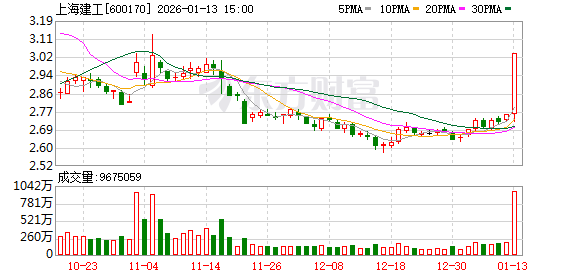
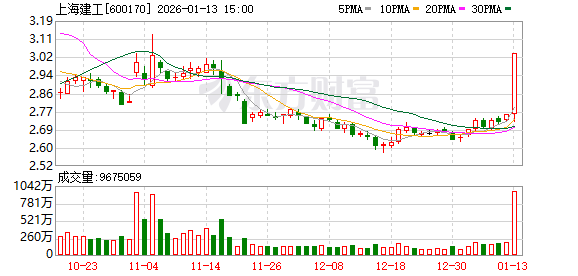
近半年该股累计上榜龙虎榜6次,上榜次日股价平均涨2.70%,上榜后5日平均跌7.11%。 上海建工(600170)今日涨停,全天换手率10.89%,成交额28.52亿元,振幅11.76%。龙虎榜数据显示, 沪股通净卖出7374.08万元,营业部席位合计净买入4156.03万元。 上交所公开信息显示,当日该股因日涨幅偏离值达10.78%上榜,沪股通净卖出7374.08万元。 证券时报·数据宝统计显示,上榜的前五大买卖营业部合计成交6.71亿元,其中,买入成交额为3.20亿 元,卖出成交额为3.52亿元,合计净卖出3218.05万元。 具体来看,今日上榜的营业部中,沪股通为第一大买入营业部及第一大卖出营业部,买入金额为1.13亿 元,卖出金额为1.87亿元,合计净卖出7374.08万元。 资金流向方面,今日该股主力资金净流入5.97亿元,其中,特大单净流入5.88亿元,大单资金净流入 869.51万元。近5日主力资金净流入5.49亿元。 | 卖二 | 国泰海通证券股份有限公司总部 | 4580.85 | | --- | --- | --- | | 卖三 | 平安证券股份有限公司北京市分公司 | 4280.84 | ...
上海建工2025年累计新签合同2529.42亿元
Zhi Tong Cai Jing· 2026-01-13 09:28
Core Viewpoint - Shanghai Construction Group (600170.SH) announced that the total new contract amount signed by the company and its subsidiaries from January to December 2025 reached 252.942 billion yuan [1] Group 1 - The total new contracts signed by Shanghai Construction Group and its subsidiaries for the year 2025 amounted to 2529.42 billion yuan [1]
上海建工(600170.SH)2025年累计新签合同2529.42亿元
智通财经网· 2026-01-13 09:23
智通财经APP讯,上海建工(600170.SH)发布公告,2025年1月至12月,公司及下属子公司累计新签合同 金额为2529.42亿元。 ...
房屋建设板块1月13日涨0.66%,上海建工领涨,主力资金净流入5.41亿元
Zheng Xing Xing Ye Ri Bao· 2026-01-13 09:06
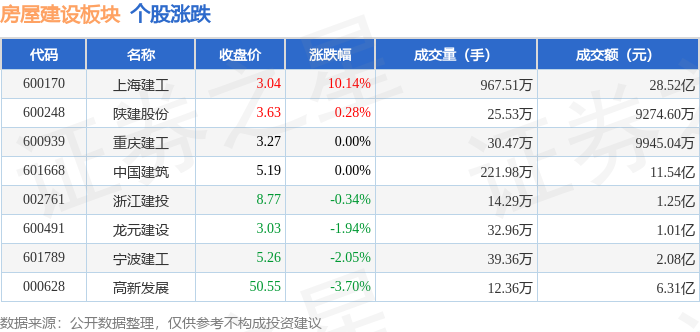
证券之星消息,1月13日房屋建设板块较上一交易日上涨0.66%,上海建工领涨。当日上证指数报收于 4138.76,下跌0.64%。深证成指报收于14169.4,下跌1.37%。房屋建设板块个股涨跌见下表: | 代码 | 名称 | 主力净流入 (元) | 主力净占比 游资净流入 (元) | | 游资净占比 散户净流入 (元) | | 散户净占比 | | --- | --- | --- | --- | --- | --- | --- | --- | | 600170 上海建工 | | 6.03亿 . | 21.14% | -2.35 Z | -8.25% | -3.68 Z | -12.90% | | 601668 中国建筑 | | 3481.18万 | 3.02% | -2561.25万 | -2.22% | -919.93万 | -0.80% | | 002761 浙江建投 | | 538.92万 | 4.29% | -82.76万 | -0.66% | -456.16万 | -3.64% | | 600248 陕建股份 | | 3.40万 | 0.04% | 299.95万 | 3.23% | -303.3 ...



上海建工(600170) - 上海建工2025年度新签合同情况公告
2026-01-13 08:45
| 证券代码:600170 | 证券简称:上海建工 | | | 公告编号:2026-003 | | --- | --- | --- | --- | --- | | 债券代码:240782 | 债券简称:24 | 沪建 | Y1 | | | 债券代码:240783 | 债券简称:24 | 沪建 | Y2 | | | 债券代码:241305 | 债券简称:24 | 沪建 | Y3 | | | 债券代码:241857 | 债券简称:24 | 沪建 | Y4 | | | 债券代码:243624 | 债券简称:25 | 沪建 | Y1 | | 上海建工集团股份有限公司 | 序号 | 工程名称 | 金额 (亿元) | | --- | --- | --- | | 1 | 金桥南区 WK10 地块厂房项目施工总承包(除桩基)工程 | 24.87 | | 2 | 东方枢纽国际商务合作区 E5 地块项目 | 21.38 | | 3 | 南北通道浦西段和越江段新建工程 2 标 | 20.13 | | 4 | 朱家角生态居住区 D2 地块项目(除桩基工程) | 18.98 | | 5 | 东方枢纽上海东站站前区 A1A-01 地块新 ...
上海建工(600170) - 上海建工关于提供担保的进展公告
2026-01-13 08:45
| 证券代码:600170 | 证券简称:上海建工 | | | 公告编号:2026-002 | | --- | --- | --- | --- | --- | | 债券代码:240782 | 债券简称:24 | 沪建 | Y1 | | | 债券代码:240783 | 债券简称:24 | 沪建 | Y2 | | | 债券代码:241305 | 债券简称:24 | 沪建 | Y3 | | | 债券代码:241857 | 债券简称:24 | 沪建 | Y4 | | | 债券代码:243624 | 债券简称:25 | 沪建 | Y1 | | 上海建工集团股份有限公司 关于提供担保的进展公告 本公司董事会及全体董事保证本公告内容不存在任何虚假记载、误导性陈述或 者重大遗漏,并对其内容的真实性、准确性和完整性承担法律责任。 重要内容提示: 一、担保情况概述 (一)2025 年 12 月,因发行公司债券、预付款保函、履约保函、投标保函、 质量保函和农民工工资保函等,上海建工集团股份有限公司(简称"公司")为资 产负债率高于 70%的 17 家子公司提供 27.18 亿元担保,为资产负债率低于 70%的 1 家子公司提供 0 ...