
GUANGHUI ENERGY(600256)

Search documents
页岩气概念上涨3.15%,6股主力资金净流入超5000万元
Zheng Quan Shi Bao Wang· 2025-10-20 09:03
Core Viewpoint - The shale gas sector has shown a significant increase, with a rise of 3.15% as of the market close on October 20, positioning it as the fourth highest gaining sector among various concepts [1] Group 1: Market Performance - Within the shale gas sector, 38 stocks experienced gains, with DeSheng Co. reaching a daily limit up of 20% [1] - Notable gainers included Diweier, Haineng Technology, and Tianhao Energy, which rose by 11.72%, 9.09%, and 8.85% respectively [1] - The stocks with the largest declines were *ST Xinchao, Jiufeng Energy, and Shangu Power, which fell by 1.44%, 0.60%, and 0.59% respectively [1] Group 2: Capital Inflow - The shale gas sector attracted a net inflow of 769 million yuan from major funds, with 24 stocks receiving net inflows [2] - China National Petroleum led the inflow with 263 million yuan, followed by ShenKong Co., Guanghui Energy, and China National Offshore Oil Corporation with net inflows of 161 million yuan, 116 million yuan, and 65.99 million yuan respectively [2] - The top stocks by net inflow ratio included ShenKong Co. at 44.51%, followed by Shihua Machinery at 24.72% and Guanghui Energy at 17.88% [3]





行业周报:煤价势如破竹至煤电均分750元,静待上穿过程-20251019
KAIYUAN SECURITIES· 2025-10-19 15:18
Investment Rating - The investment rating for the coal industry is "Positive" (maintained) [1] Core Viewpoints - The report indicates that the prices of thermal coal and coking coal have reached a turning point, with thermal coal prices expected to rebound and stabilize above the long-term contract price of around 700 CNY per ton, with a potential target of 750 CNY per ton in 2025 [6][7][16] - The report highlights that the coal market is experiencing a significant price increase, with thermal coal prices rising to 748 CNY per ton as of October 17, 2025, marking a 6.1% increase from the previous period [6][20] - The investment logic is based on two main aspects: cyclical elasticity and stable dividends, suggesting that the coal sector is at a favorable entry point for investment [8][17] Summary by Sections Investment Logic - Thermal coal is categorized as a policy-driven commodity, with prices expected to recover to long-term contract levels due to the dual-track pricing mechanism [7][16] - Coking coal prices are more influenced by supply and demand fundamentals, with target prices set based on the ratio of coking coal to thermal coal prices [7][16] Market Performance - The coal index increased by 4.17% in the week, outperforming the CSI 300 index by 6.39 percentage points [11][28] - Major coal companies showed significant price increases, with the top performers being Dayou Energy (+53.13%), Zhengzhou Coal Electricity (+15.93%), and China Coal Energy (+11.68%) [11][28] Price Indicators - As of October 17, 2025, the Qinhuangdao Q5500 thermal coal price was 748 CNY per ton, reflecting a 6.1% increase [20] - The price of coking coal at Jingtang Port reached 1710 CNY per ton, up from 1630 CNY, indicating a 4.91% increase [21][23] Investment Recommendations - The report suggests four main lines for coal stock selection: cyclical logic (e.g., Jinko Coal and Yanzhou Coal), dividend logic (e.g., China Shenhua and Zhongmei Energy), diversified aluminum elasticity (e.g., Shenhua Holdings), and growth logic (e.g., Xinji Energy and Guanghui Energy) [8][17]




铁路检修、天气北冷南暖,供需两端双发力下港口煤价大幅上涨:——煤炭开采行业周报-20251019
Guohai Securities· 2025-10-19 11:01
Investment Rating - The report maintains a "Recommended" rating for the coal mining industry [2] Core Views - The coal price at northern ports has significantly increased due to limited supply from railway maintenance and temperature differences between northern and southern regions, with the price reaching 748 RMB/ton on October 17, up 39 RMB/ton week-on-week [4][13] - The supply side remains constrained, with production capacity utilization in the Sanxi region increasing slightly, while demand from coastal and inland power plants shows mixed trends [4][13] - The overall market sentiment is supported by high cash flow and profitability of leading coal companies, with a focus on maintaining a strong dividend yield [7] Summary by Sections 1. Thermal Coal - The price of thermal coal at northern ports has risen significantly, with specific increases in pit prices in Shanxi, Inner Mongolia, and Shaanxi [4][14] - Production capacity utilization in the Sanxi region has increased by 0.31 percentage points, while coal supply remains tight due to railway maintenance [4][19] - Coastal power plants' daily consumption has increased, while inland power plants have seen a decrease [4][22] 2. Coking Coal - The production capacity utilization for coking coal has increased by 2.05 percentage points, with some recovery in production following holiday shutdowns [5][38] - The price of main coking coal at ports has risen to 1,710 RMB/ton, up 80 RMB/ton week-on-week [5][39] - Coking coal inventories at production enterprises have decreased, indicating a tightening supply [5][46] 3. Coke - The supply side for coke has tightened, with production rates declining slightly due to cost pressures and maintenance [6][49] - The average profit per ton of coke has decreased, reflecting challenges in the market [6][54] - Coke inventories at independent coking plants have decreased, indicating stable demand [6][62] 4. Anthracite - The price of anthracite remains stable, with limited supply due to production constraints in certain regions [6][66] 5. Key Companies and Profit Forecasts - The report highlights several key companies with strong investment potential, including China Shenhua, Shaanxi Coal, and Yanzhou Coal, recommending a "Buy" rating for most [8]


新疆甘肃增量项目机制电价出炉,《油气管网设施公平开放监管办法》发布
Xinda Securities· 2025-10-19 00:39
Investment Rating - The investment rating for the utility sector is "Positive" [2] Core Insights - The report highlights the recent release of mechanism electricity prices for new projects in Xinjiang and Gansu, with solar power priced at 0.235 yuan/kWh and wind power at 0.252 yuan/kWh [4] - The report indicates that the power sector is expected to see profit improvement and value reassessment following multiple rounds of supply-demand tensions in the electricity market [4] - The ongoing market reforms in electricity pricing are anticipated to lead to a gradual increase in electricity prices, benefiting power operators [4] Summary by Sections Market Performance - As of October 17, the utility sector declined by 0.7%, outperforming the broader market, which saw a 2.2% drop [11] - The electricity sector specifically saw a decrease of 0.66%, while the gas sector fell by 0.99% [13] Electricity Industry Data Tracking - The price of thermal coal at Qinhuangdao Port (Q5500) increased by 34 yuan/ton week-on-week, reaching 740 yuan/ton as of October 17 [20] - Coal inventory at Qinhuangdao Port decreased by 960,000 tons week-on-week, totaling 5.45 million tons [25] - Daily coal consumption in inland provinces was 3.107 million tons, down 312,000 tons/day from the previous week [28] Natural Gas Industry Data Tracking - The LNG ex-factory price index in Shanghai was 4,013 yuan/ton, down 20.19% year-on-year and 0.32% week-on-week [51] - The EU's natural gas supply increased by 8.8% year-on-year, reaching 6.07 billion cubic meters in week 41 of 2025 [58] Key Industry News - The mechanism electricity prices for solar and wind projects in Xinjiang were announced, with a total of 67 projects selected [4] - The release of the "Regulations on Fair and Open Supervision of Oil and Gas Pipeline Facilities" marks a significant step in China's oil and gas market reform [4] Investment Recommendations - The report suggests focusing on national coal power leaders such as Guodian Power, Huaneng International, and Huadian International, as well as regional leaders in tight supply areas [4] - For natural gas, companies with low-cost long-term gas sources and receiving station assets are expected to benefit from market conditions [4]




港口动力煤价格周涨幅创新高,多因素利好催化板块走强
ZHONGTAI SECURITIES· 2025-10-18 09:16
Investment Rating - The report maintains an "Overweight" rating for the coal industry [2][5]. Core Views - The coal price is expected to maintain a strong upward trend due to multiple factors, including supply constraints and increased demand driven by cold winter expectations and export pressures [7][8]. - The report highlights the potential for investment opportunities in the coal sector, particularly in companies with high elasticity in their stock prices [8]. Summary by Sections 1. Industry Overview - The coal industry comprises 37 listed companies with a total market capitalization of 1,954.93 billion yuan and a circulating market value of 1,915.57 billion yuan [2]. 2. Coal Price Trends - The price of thermal coal at the port increased by 43 yuan/ton week-on-week, reaching 753 yuan/ton as of October 17, 2025, marking a 6.06% increase from the previous week [8]. - The average daily production of thermal coal from 462 sample mines was 5.52 million tons, a slight decrease of 0.13% week-on-week and a 3.93% decrease year-on-year [8]. 3. Supply and Demand Dynamics - Supply constraints are expected to persist due to increased safety inspections and anticipated rainfall in major production areas, which may limit coal production and transportation [7][8]. - Demand is bolstered by expectations of a cold winter, leading to early stockpiling by power plants, and ongoing high demand from the steel industry [8]. 4. Key Companies and Recommendations - Recommended high-elasticity stocks include Yanzhou Coal Mining, Shanxi Coal International, and Jinneng Holding, among others, which are expected to benefit from the favorable market conditions [8]. - The report emphasizes the importance of monitoring companies' dividend policies and growth prospects, with several companies expected to maintain or increase their dividend payouts [13]. 5. Market Performance - The coal sector has seen significant price fluctuations, with the report indicating that the coal price is likely to remain resilient despite seasonal trends [8]. - The report notes that the coal sector's performance is expected to improve as supply-demand dynamics become more favorable [8].



伊吾广汇能源物流获评全国AAA级信用企业
Jiang Nan Shi Bao· 2025-10-16 05:25
Core Insights - Yihu Guanghui Energy Logistics Co., Ltd. has been recognized as a "National AAA Credit Enterprise," highlighting its commitment to integrity and excellence in the energy logistics sector [1][3] - The company has established a robust integrity system and operational management, which has contributed to its strong reputation in the industry [1][2] Company Overview - Yihu Guanghui Energy Logistics Co., Ltd. was founded in April 2015 and is a wholly-owned subsidiary of Guanghui Energy Co., Ltd. (stock code: 600256) [1] - The company focuses on ordinary road freight transportation and aims to strengthen the transportation foundation for regional energy supply and industrial development [1] Integrity and Operational Excellence - The company integrates integrity into its entire operational process, leveraging Guanghui Energy's abundant coal resources to fulfill its commitments [2] - It has successfully collaborated with over 40 large transportation enterprises, consolidating a fleet of more than 3,000 coal transportation vehicles [2] Commitment to Green Development - The company extends its commitment to integrity into social responsibility, actively promoting the transition to cleaner coal transportation [3] - It has introduced LNG vehicles, hydrogen vehicles, methanol fuel vehicles, and electric vehicles to enhance the environmental sustainability of its operations [3] Future Outlook - The recognition as a "National AAA Credit Enterprise" marks a new starting point for the company, which plans to deepen its integrity system and maintain its commitments in various fields [3] - The company aims to contribute to high-quality development in the energy logistics industry through more standardized management and reliable services [3]
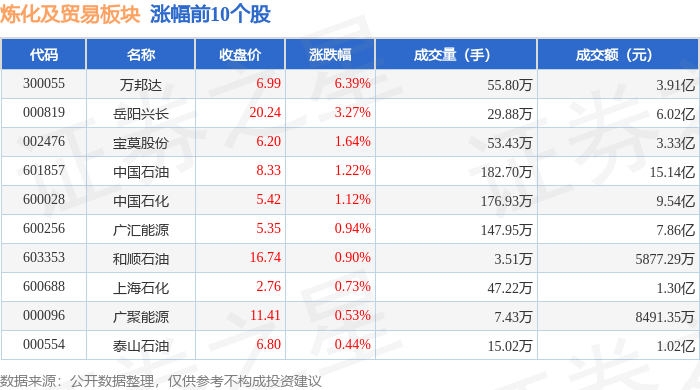
炼化及贸易板块10月14日涨0.63%,万邦达领涨,主力资金净流出1252.83万元
Zheng Xing Xing Ye Ri Bao· 2025-10-14 08:46
Market Overview - The refining and trading sector increased by 0.63% on October 14, with Wanbangda leading the gains [1] - The Shanghai Composite Index closed at 3865.23, down 0.62%, while the Shenzhen Component Index closed at 12895.11, down 2.54% [1] Stock Performance - Wanbangda (300055) closed at 6.99, up 6.39% with a trading volume of 558,000 shares and a turnover of 391 million yuan [1] - Other notable performers included Junzhu Xinchang (000819) with a 3.27% increase, Baocao Co. (002476) up 1.64%, and China Petroleum (601857) up 1.22% [1] - Conversely, stocks like Tongjing Co. (601233) and Kangputon (603798) saw declines of 4.62% and 4.23% respectively [2] Capital Flow - The refining and trading sector experienced a net outflow of 12.53 million yuan from institutional investors and 77.05 million yuan from speculative funds, while retail investors saw a net inflow of 89.58 million yuan [2] - Specific stocks such as Guanghui Energy (600256) had a net inflow of 53.47 million yuan from institutional investors, while Junzhu Xinchang (000819) saw a net outflow of 29.98 million yuan from speculative funds [3]



2025年1-8月新疆维吾尔自治区工业企业有5415个,同比增长9.66%
Chan Ye Xin Xi Wang· 2025-10-14 02:44
Core Viewpoint - The report highlights the growth of industrial enterprises in the Xinjiang Uygur Autonomous Region, indicating a significant increase in the number of large-scale industrial companies, which presents potential investment opportunities in the region's industrial sector [1] Group 1: Company Information - Listed companies mentioned include Guanghui Energy, New Natural Gas, Unified Shares, ST Haoyuan, Xinjiang Torch, Western Animal Husbandry, Tianrun Dairy, Dezhan Health, Xuefeng Technology, Chuaning Biological, Xiling Information, Lide New Energy, and Tianfu Energy [1] - The report is published by Zhiyan Consulting, a leading industry consulting firm in China, specializing in deep industry research and providing comprehensive consulting services [1] Group 2: Industry Statistics - As of January to August 2025, the number of industrial enterprises in Xinjiang reached 5,415, an increase of 477 compared to the same period last year, representing a year-on-year growth of 9.66% [1] - The industrial enterprises in Xinjiang account for 1.04% of the total number of such enterprises in the country [1] - The threshold for large-scale industrial enterprises was raised from an annual main business income of 5 million yuan to 20 million yuan starting in 2011 [1]



2025年中国LNG油改气行业政策、产业链全景、发展现状及未来发展趋势研判:重卡主导需求韧性凸显,细分市场潜力持续释放[图]
Chan Ye Xin Xi Wang· 2025-10-14 00:37
Core Viewpoint - LNG oil-to-gas conversion is a significant direction for clean energy transition, utilizing the low-temperature liquid characteristics of LNG for efficient storage and transportation, while significantly reducing pollutant emissions and fuel costs [1][2] Industry Overview - LNG oil-to-gas conversion refers to the process of retrofitting traditional fuel-driven vehicles to use liquefied natural gas (LNG) as the primary fuel, leveraging LNG's low-temperature liquid properties for efficient storage and combustion [2][3] - Compared to traditional fuels, LNG combustion results in a significant reduction in emissions, with nitrogen oxides reduced by 85% and particulate matter by 95%, while fuel costs can decrease by 30%-55% [2] Policy Analysis - China has implemented multiple top-level policies, such as the "2030 Carbon Peak Action Plan," to support the LNG oil-to-gas industry, focusing on energy structure optimization and infrastructure improvement [5][6] - Local policies, like the LNG refueling station layout plan in Hunan Province, aim to address refueling bottlenecks and enhance user confidence in LNG vehicles [5] Industry Chain - The LNG oil-to-gas industry chain consists of upstream gas source development, midstream storage and transportation infrastructure, and downstream application expansion [6] - Upstream includes natural gas extraction and importation, while midstream focuses on vehicle retrofitting and LNG refueling infrastructure [6] Current Development Status - China's energy structure shows a "rich coal, poor oil, and scarce gas" characteristic, leading to a growing supply-demand gap for natural gas [7] - LNG demand has rapidly increased due to policies promoting "coal-to-gas" and "oil-to-gas" transitions, with LNG's superior peak-shaving capabilities making it a key transitional energy source [7][8] Market Performance - The LNG oil-to-gas market is projected to grow significantly, with an estimated market size of approximately 760 billion yuan in 2024, expected to reach around 900 billion yuan by 2025 [9] - The number of LNG refueling stations is anticipated to exceed 7,000 by 2025, enhancing the refueling network across the country [8][9] Future Trends - The industry is expected to evolve towards three main trends: intelligent upgrades across the entire chain, low-carbon and hydrogen energy integration, and regional market differentiation alongside global resource integration [10][11][12] - Intelligent upgrades will enhance efficiency and safety through advanced technologies like IoT and AI, while low-carbon initiatives will focus on integrating LNG with renewable energy sources [10][11] - The market will see a differentiated layout domestically, with high-density LNG refueling networks in key regions, and internationally, Chinese companies will expand their global LNG resource footprint [12]


煤炭开采行业跟踪周报:节日期间需求较弱,港口煤价略有上涨-20251012
Soochow Securities· 2025-10-12 11:28
Investment Rating - The report maintains an "Overweight" rating for the coal mining industry [1] Core Insights - The current demand for coal is weak during the holiday period, leading to a slight increase in port coal prices. The average spot price for thermal coal at ports rose by 8 CNY/ton to 709 CNY/ton [1] - Supply remains stable, with an average daily inflow of 1.7673 million tons to the Bohai Rim ports, a slight increase of 0.46% from the previous week. However, the average daily outflow decreased by 138.36 million tons, a decline of 4.7% [1][28] - The inventory at Bohai Rim ports increased to 25.495 million tons, reflecting a 0.23% rise, indicating a slow depletion of stock due to weak demand [1][33] - The report anticipates that coal prices will maintain a volatile trend in the short term, with potential upward movement expected after mid-October as heating demand in northern regions begins to rise [1] Summary by Sections Market Overview - The Shanghai Composite Index rose by 1.80% to 3,897.03 points during the reporting period, while the coal sector index increased by 3.53% to 2,793.56 points [10] - The average daily inflow of coal to the Bohai Rim ports increased by 0.86 million tons, while the outflow decreased by 9.3 million tons [28] Price Trends - Port thermal coal prices increased slightly, while prices for coal from production areas showed mixed trends. For instance, the price for 5500 kcal thermal coal from Datong fell by 59 CNY/ton to 555 CNY/ton, while the price for 6000 kcal coal from Yanzhou dropped by 100 CNY/ton to 870 CNY/ton [17] - The Bohai Rim thermal coal price index rose by 1 CNY/ton to 681 CNY/ton [19] Recommendations - The report suggests focusing on resource stocks, particularly recommending companies like Haohua Energy and Guanghui Energy as elastic targets due to their low valuations [2][38]
