
GUANGHUI ENERGY(600256)

Search documents
石油ETF鹏华(159697)涨近1%,原油供应面临收缩风险
Sou Hu Cai Jing· 2026-02-03 02:42
Group 1 - Trump announced that Mexico will stop supplying oil to Cuba as part of increased pressure on the country, although he did not provide specific details on this decision [1] - As of January, WTI crude oil prices increased by 14% month-on-month but decreased by 11% year-on-year. OPEC+ is adjusting its production strategy between market share and price stability, with an increase in production expected starting in 2025, but facing challenges from weak demand and oversupply [1] - By early 2026, geopolitical risks affecting oil prices are expected to rise, leading to potential supply constraints [1] Group 2 - As of January 30, 2026, the National Petroleum and Natural Gas Index (399439) had its top ten weighted stocks, including China National Petroleum, China National Offshore Oil, and Sinopec, which collectively account for 66.76% of the index [2] - The Petroleum ETF Penghua closely tracks the National Petroleum and Natural Gas Index, reflecting the price changes of listed companies in the oil and gas sector on the Shanghai and Shenzhen stock exchanges [2]






每周宏观经济和资产配置研判:大宗商品风暴如何应对-20260202
Soochow Securities· 2026-02-02 07:59
Group 1: Macro Insights - The report highlights that the recent volatility in gold and silver prices is primarily driven by market momentum reversals, with silver attracting high leverage and speculative funds since November 2025 [2][5] - The report anticipates that after the appointment of the new Federal Reserve Chairman, there will be more interest rate cuts than the market expects, with short-term U.S. Treasury yields likely to decline [2][4] - The report notes that the recent decline in the manufacturing PMI does not indicate a weakening economy, as it reflects a temporary fluctuation rather than a downward trend [10] Group 2: Commodity Market Analysis - The report indicates that the recent crash in silver prices has led to liquidity risks that may spread to other commodities, particularly in the non-ferrous metals sector [5][6] - It emphasizes the importance of monitoring the support levels for gold prices, particularly the 60-day moving average, which is currently at $4,400 per ounce [5] - The report suggests that the Shanghai Futures Exchange has implemented measures to manage the risk of a one-sided market in silver futures [5] Group 3: Equity Market Outlook - The report predicts a rebound in the A-share market following the Spring Festival, driven by positive sentiment from performance forecasts and new developments in sectors like AI applications and commercial aerospace [6][10] - It advises a balanced ETF allocation in domestic equities, reflecting a cautious yet optimistic outlook for the market [11] Group 4: Bond Market Perspective - The report notes that the bond market is expected to see increased buying activity due to risk aversion and expectations of monetary easing, with 10-year yields projected to decline to around 1.80% [7][10] - It highlights that the recent adjustments in risk appetite have created trading opportunities in government bonds as a hedge against stock market volatility [4][7]



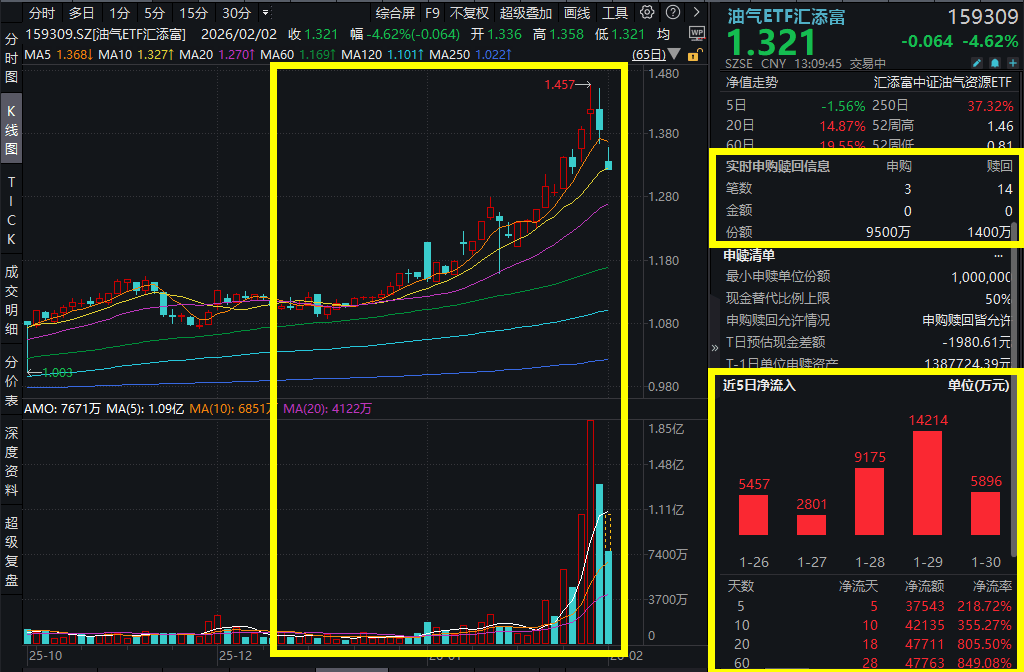
大宗商品集中宣泄,原油跌4.8%!中国海油大跌超4%!油气ETF汇添富(159309)资金逆势涌入超1亿元,连续15日吸金!“OPEC+”3月延续暂停增产
Sou Hu Cai Jing· 2026-02-02 05:45
Core Viewpoint - The A-share market is experiencing volatility and decline, particularly in the oil and gas sector, with significant net inflows into the oil and gas ETF Huatai-PineBridge (159309) despite the downturn [1][3]. Group 1: Market Performance - As of 13:22, the oil and gas ETF Huatai-PineBridge (159309) has dropped over 4%, with a net inflow of more than 106 million yuan during the day, marking a total of over 500 million yuan in inflows over the past 15 days [1]. - Major component stocks of the oil and gas ETF have mostly retreated, with Intercontinental Oil and Gas down over 9%, and China National Offshore Oil Corporation and China Petroleum down over 4% [3]. Group 2: Component Stocks - The top ten component stocks of the oil and gas ETF include: - Jerry Holdings (002353) up 1.71% - CNOOC (601857) down 3.54% - China Petroleum (600028) down 1.54% - Intercontinental Oil and Gas (600759) down 9.91% [4]. Group 3: Geopolitical and Supply Factors - Geopolitical risks have eased, with the U.S. indicating a positive relationship with Venezuela, potentially sharing oil revenues, and ongoing negotiations with Iran [5]. - OPEC+ members have agreed to maintain their production cut policies, with a commitment to market stability and low inventory levels [5]. Group 4: Industry Outlook - The medium to long-term outlook for the oil and gas industry remains positive, with expected exploration and development spending to maintain historical median levels from 2024 to 2030 [7]. - Key variables affecting the market include North American data center construction progress, OPEC+ production policies, and domestic policies on refining capacity [7]. Group 5: ETF Characteristics - The oil and gas ETF Huatai-PineBridge (159309) focuses on the oil and gas industry chain, including exploration, equipment, refining, and sales, emphasizing companies with quality reserves and low-cost advantages [8]. - The ETF has a streamlined sample size of 44 stocks, ensuring high purity with all top ten component stocks being leading oil and gas companies [8].


能源ETF广发(159945)开盘跌5.00%,重仓股中国神华跌0.67%,中国石油跌2.90%
Xin Lang Cai Jing· 2026-02-02 04:18
Group 1 - The Energy ETF Guangfa (159945) opened down 5.00%, trading at 1.253 yuan [1] - Major holdings in the Energy ETF Guangfa include China Shenhua down 0.67%, China Petroleum down 2.90%, China Petrochemical down 1.69%, Shaanxi Coal and Chemical down 1.66%, China National Offshore Oil down 4.70%, and others showing varied performance [1] - The performance benchmark for the Energy ETF Guangfa is the CSI All Share Energy Index, managed by Guangfa Fund Management Co., with a return of 31.88% since its inception on June 25, 2015, and a return of 11.60% over the past month [1]


油气ETF汇添富(159309)开盘跌3.54%,重仓股中国石油跌2.90%,中国海油跌4.70%
Xin Lang Cai Jing· 2026-02-02 04:09
油气ETF汇添富(159309)业绩比较基准为中证油气资源指数收益率,管理人为汇添富基金管理股份有 限公司,基金经理为晏阳,成立(2024-05-31)以来回报为38.77%,近一个月回报为20.14%。 声明:市场有风险,投资需谨慎。本文基于第三方数据库自动发布,不代表新浪财经观点,任何在本文 出现的信息均只作为参考,不构成个人投资建议。如有出入请以实际公告为准。如有疑问,请联系 biz@staff.sina.com.cn。 2月2日,油气ETF汇添富(159309)开盘跌3.54%,报1.336元。油气ETF汇添富(159309)重仓股方 面,中国石油开盘跌2.90%,中国海油跌4.70%,中国石化跌1.69%,杰瑞股份涨6.74%,招商轮船跌 0.53%,广汇能源跌2.32%,中远海能跌0.95%,洲际油气跌9.91%,海油工程跌3.60%,招商南油跌 2.44%。 来源:新浪基金∞工作室 ...
电煤消费规模是否已经达峰?
ZHONGTAI SECURITIES· 2026-02-02 00:45
Investment Rating - The report maintains a rating of "Buy" for key companies in the coal industry, including China Shenhua, Yanzhou Coal, Shaanxi Coal, and others, while some companies like Huayang Co. and Shanmei International are rated as "Overweight" [4]. Core Insights - The coal consumption scale has reached a peak plateau, with the demand for electricity generated from coal expected to stabilize in the coming years. The report suggests that the traditional growth model of coal-fired power generation may face a turning point due to the increasing share of clean energy [6][7]. - The transition of coal-fired power from a primary energy source to a supporting role in the new energy system is emphasized, with a significant expansion in installed capacity expected in the next few years [6][11]. Summary by Sections 1. Coal-fired Power: Transitioning to Peak Regulation and Support - The role of coal-fired power is shifting towards providing peak regulation and support, with its share in the energy mix declining but still remaining a core component of energy security [6][11]. - Installed capacity of coal-fired power is expected to continue expanding, with projections of new installations reaching 87 GW, 86 GW, and 43 GW from 2026 to 2028, respectively [6][29]. 2. Clean Energy: Becoming the Main Source of New Installations - Hydropower is expected to play a dual role in stable supply and peak regulation, with new installations projected to reach 17 GW, 18 GW, and 33 GW from 2026 to 2028 [7][39]. - Wind power is anticipated to see significant growth, with new installations expected to reach 109 GW, 161 GW, and 193 GW during the same period, reflecting its transition to a primary energy source [7][52]. - Solar energy is entering a stable development phase, with new installations projected at 192 GW, 139 GW, and 153 GW from 2026 to 2028, despite recent challenges in energy consumption and bidding processes [7][59]. 3. Investment Recommendations: Focus on Dividend and Flexibility - The report recommends focusing on companies with strong cash flow stability and dividend potential, such as China Shenhua and Shaanxi Coal, while also highlighting companies like Yanzhou Coal and Huayang Co. as having potential benefits from high coal demand [6][7][8].




煤炭行业周报:煤价回归合理才是常态,稳煤价逻辑依旧
KAIYUAN SECURITIES· 2026-02-02 00:24
Investment Rating - The industry investment rating is "Positive" (maintained) [1] Core Viewpoints - The report indicates that coal prices are expected to rebound, with a focus on the cyclical elasticity of both thermal coal and coking coal prices, which are currently at historical lows, providing room for recovery [5][15] - The report emphasizes that the price of thermal coal is influenced by supply constraints and increasing demand due to seasonal factors, while coking coal prices are more market-driven [4][5] Summary by Relevant Sections Investment Logic - Thermal coal prices are expected to rise through a four-step process: repairing central and local long-term contracts, reaching the coal-electricity profit-sharing line, and approaching the breakeven point for power plants, estimated at around 750 RMB per ton for 2025 [4][15] - Coking coal prices are determined by supply and demand fundamentals, with target prices based on the ratio of coking coal to thermal coal prices [4][15] Investment Recommendations - The report suggests a dual logic for coal stocks: cyclical elasticity and stable dividends. Key stocks to consider include: - Cyclical logic: Jin控煤业, 兖矿能源 for thermal coal; 平煤股份, 淮北矿业, 潞安环能 for metallurgical coal - Dividend logic: 中国神华, 中煤能源, 陕西煤业 - Diversification and growth logic: 神火股份, 电投能源, 新集能源, 广汇能源 [5][16] Key Market Indicators - The coal index increased by 3.68%, outperforming the Shanghai and Shenzhen 300 index by 3.6 percentage points [10][25] - As of January 30, the price of Qin港 Q5500 thermal coal was 692 RMB per ton, reflecting a slight increase of 7 RMB from the previous period [21] - The report notes a significant drop in coal inventory at ports, indicating tightening supply conditions [21][23]


煤炭行业周报:煤价回归合理才是常态,稳煤价逻辑依旧-20260201
KAIYUAN SECURITIES· 2026-02-01 14:41
Investment Rating - The industry investment rating is "Positive" (maintained) [1] Core Viewpoints - The report indicates that coal prices are expected to rebound, with a focus on the cyclical elasticity of both thermal coal and coking coal prices, which are currently at historical lows, providing room for recovery [5][15] - The report outlines a four-step process for the upward movement of thermal coal prices, including the restoration of long-term contracts and reaching a breakeven point for coal and power companies [4][15] - The report emphasizes that the overall investment logic remains unchanged, driven by a dual influence of tightening supply and increasing demand, particularly during the heating season [3][4] Summary by Sections Investment Logic - Thermal coal and coking coal prices are at a turning point, with thermal coal being a policy-driven commodity. The price recovery is expected to follow a specific process involving the restoration of long-term contracts and reaching a breakeven price of around 750 RMB per ton [4][15] - Coking coal prices are more influenced by market fundamentals, with target prices based on the ratio of coking coal to thermal coal prices, indicating potential target prices of 1608 RMB to 2064 RMB depending on thermal coal price movements [4][15] Investment Recommendations - The report suggests a dual logic for coal stocks: cyclical elasticity and stable dividends. It identifies four main lines for stock selection: 1. Cyclical logic: Jin控煤业 and 兖矿能源 for thermal coal; 平煤股份, 淮北矿业, and 潞安环能 for metallurgical coal 2. Dividend logic: 中国神华, 中煤能源, and 陕西煤业 3. Diversified aluminum elasticity: 神火股份 and 电投能源 4. Growth logic: 新集能源 and 广汇能源 [5][16] Key Market Indicators - The coal index increased by 3.68%, outperforming the Shanghai and Shenzhen 300 index by 3.6 percentage points, with notable gains from companies like 盘江股份 and 山西焦化 [10][25] - The report provides various market indicators, including port prices for thermal coal at 692 RMB per ton, reflecting a slight increase, and coking coal prices remaining stable at 1800 RMB per ton [21][23]
节前市场趋稳运行,全年中枢看涨可期
Xinda Securities· 2026-02-01 11:07
Investment Rating - The investment rating for the coal mining industry is "Positive" [2] Core Viewpoints - The current phase is seen as the beginning of a new upward cycle in the coal economy, with a resonance between fundamentals and policies, making it an opportune time to invest in the coal sector [10][11] - The coal supply is expected to tighten due to domestic supply constraints and Indonesia's reduction in coal production targets, which will support a stable recovery in coal prices throughout the year [10][11] - The investment logic of coal capacity shortages remains unchanged, with a short-term supply-demand balance and a long-term gap still present [10][11] - High-quality coal companies are characterized by high profitability, cash flow, return on equity (ROE) of 10-15%, and dividend yields exceeding 5% [10][11] - The coal sector is considered undervalued, with overall valuation expected to improve, and public funds currently underweight in coal holdings [10][11] Summary by Sections 1. Coal Prices - As of January 31, the market price for Qinhuangdao port thermal coal (Q5500) is 691 CNY/ton, up 5 CNY/ton week-on-week [3][29] - The international thermal coal offshore price for Newcastle NEWC5500 is 74.5 USD/ton, up 0.7 USD/ton week-on-week [3][29] - The price for coking coal at Jing Tang port remains stable at 1780 CNY/ton [31] 2. Coal Supply and Demand - The capacity utilization rate for sample thermal coal mines is 88.3%, down 1.3 percentage points week-on-week [10][49] - Daily coal consumption in inland provinces decreased by 8.30 thousand tons/day (-1.8%) [50] - Daily coal consumption in coastal provinces decreased by 7.70 thousand tons/day (-3.3%) [50] 3. Industry Performance - The coal sector saw a 3.98% increase this week, outperforming the broader market [13][16] - The thermal coal segment rose by 4.07%, while the coking coal segment increased by 3.92% [16] 4. Future Outlook - The coal supply bottleneck is expected to persist, necessitating new high-quality capacity planning to meet medium to long-term energy demands [11] - The coal sector is characterized by high performance, cash flow, and dividends, with a favorable long-term outlook due to macroeconomic improvements and regulatory changes [11]


全球能源价格普涨,关注煤炭配置机会
ZHONGTAI SECURITIES· 2026-01-31 14:46
Investment Rating - The report maintains an "Accumulate" rating for the coal industry, indicating a positive outlook for investment opportunities in this sector [5]. Core Insights - The report highlights a favorable supply-demand dynamic in the coal market, with expectations of stable to increasing coal prices due to ongoing high demand and tightening supply conditions [7][8]. - The report emphasizes the importance of strategic investments in coal companies with strong dividend yields and low valuations, particularly in light of the anticipated recovery in coal prices [8]. Summary by Sections 1. Industry Overview - The coal industry comprises 37 listed companies with a total market capitalization of approximately 19,847.47 billion yuan and a circulating market value of about 19,430.80 billion yuan [2]. 2. Company Performance Tracking - Key companies such as China Shenhua, Shanxi Coking Coal, and Yancoal Energy are highlighted for their robust operational performance and strategic growth plans [12][13]. - China Shenhua is expected to achieve a net profit of 495-545 billion yuan in 2025, while Shanxi Coking Coal anticipates a significant decline in profits due to market pressures [8]. 3. Coal Price Tracking - The report notes that the price of thermal coal at the port has seen a slight increase, with the average price at the Qinhuangdao port reported at 698 yuan per ton, reflecting a week-on-week increase of 8 yuan [8]. - The international coal price has also risen, with Newcastle coal futures closing at 111.75 USD per ton, marking a daily increase of 2.43% [8]. 4. Supply and Demand Dynamics - The report indicates that the daily coal consumption across 25 provinces in China reached 6.648 million tons, showing a year-on-year increase of 36.48% [8]. - Supply constraints are expected as many private coal mines prepare for seasonal shutdowns, leading to a reduction in overall coal supply [8]. 5. Investment Opportunities - The report suggests focusing on companies with strong dividend policies and growth potential, such as China Shenhua, Yancoal Energy, and others, which are expected to benefit from the anticipated recovery in coal prices [8][12]. - It also highlights the potential for companies like Lu'an Huanneng and Pingmei Shenma to rebound as market conditions improve [8].