
TMSP(600671)

Search documents
天目药业(600671) - 杭州天目山药业股份有限公司第十二届董事会第十五次会议决议公告
2025-09-02 09:45
证券代码:600671 证券简称:天目药业 公告编号:临 2025-038 本公司董事会及全体董事保证本公告内容不存在任何虚假记载、误导性陈述 或者重大遗漏,并对其内容的真实性、准确性和完整性承担法律责任。 一、董事会会议召开情况 杭州天目山药业股份有限公司(以下简称"公司")于 2025 年 9 月 1 日以现 场结合通讯表决方式召开了第十二届董事会第十五次会议。本次会议通知及会议 材料于 2025 年 8 月 29 日以电子或书面的方式送达各位董事。本次会议应出席董 事 8 名,实际出席董事 8 名。会议由董事长刘加勇先生主持,公司部分高级管理 人员列席会议。本次会议的召开符合《公司法》和《公司章程》的有关规定。本 次会议审议情况如下: 二、董事会会议审议情况 经与会董事表决,会议审议并通过了如下决议: (一)审议并通过《关于聘任公司副总经理的议案》 经公司总经理提名,董事会同意聘任韩同旻先生为公司副总经理,任期至公 司第十二届董事会届满为止。 本议案经董事会提名委员会审议通过。 具体内容详见公司同日在上海证券交易所网站(www.sse.com.cn)披露的《关 于董事兼高级管理人员辞职、调整董事会专门委 ...

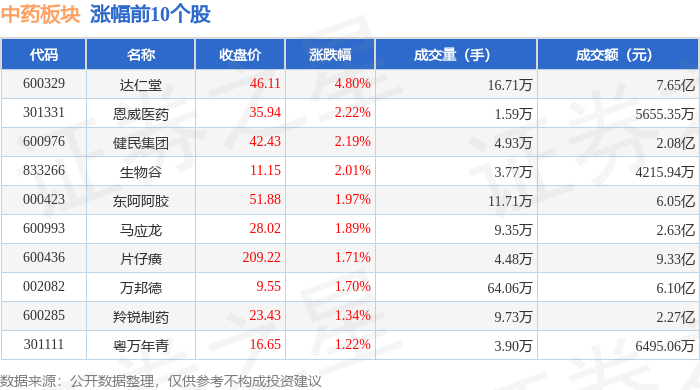
中药板块8月29日涨0.32%,达仁堂领涨,主力资金净流出5.1亿元
Zheng Xing Xing Ye Ri Bao· 2025-08-29 08:41
Market Overview - The Chinese traditional medicine sector saw a slight increase of 0.32% on August 29, with Darentang leading the gains [1] - The Shanghai Composite Index closed at 3857.93, up 0.37%, while the Shenzhen Component Index closed at 12696.15, up 0.99% [1] Top Performers - Darentang (600329) closed at 46.11, with a rise of 4.80% and a trading volume of 167,100 shares, amounting to a transaction value of 765 million [1] - Enwei Pharmaceutical (301331) increased by 2.22% to close at 35.94, with a trading volume of 15,900 shares [1] - Jianmin Group (600976) rose by 2.19% to 42.43, with a transaction value of 208 million [1] Underperformers - Qidi Pharmaceutical (000590) decreased by 3.11% to 11.84, with a trading volume of 129,400 shares and a transaction value of 155 million [2] - Tianmu Pharmaceutical (600671) fell by 2.89% to 19.81, with a transaction value of 209 million [2] - Buchang Pharmaceutical (603858) saw a decline of 2.55% to 19.51, with a trading volume of 198,400 shares [2] Capital Flow - The traditional medicine sector experienced a net outflow of 510 million from institutional investors, while retail investors saw a net inflow of 469 million [2] - The sector's overall capital flow indicates a mixed sentiment, with institutional investors pulling back while retail investors are more active [2] Individual Stock Capital Flow - Darentang had a net inflow of 77.24 million from institutional investors, but a net outflow of 59.46 million from retail investors [3] - Yunnan Baiyao (000538) saw a net inflow of 55.91 million from institutional investors, while retail investors had a net outflow of 0.83 million [3] - Zhendong Pharmaceutical (300158) experienced a net inflow of 48.61 million from institutional investors, but a significant net outflow of 79.17 million from retail investors [3]


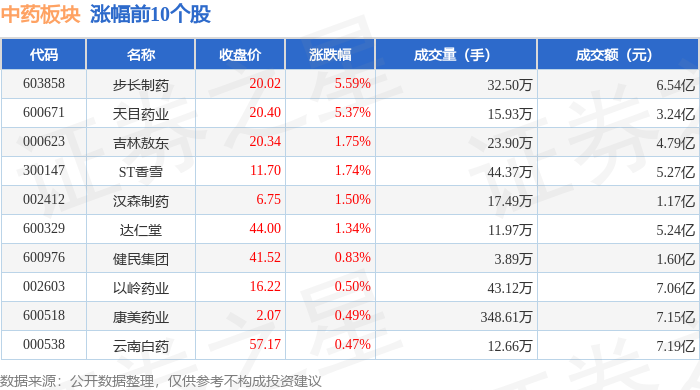
中药板块8月28日跌0.36%,新天药业领跌,主力资金净流出11.34亿元
Zheng Xing Xing Ye Ri Bao· 2025-08-28 08:43
Market Overview - The Chinese medicine sector experienced a decline of 0.36% on August 28, with Xintian Pharmaceutical leading the drop [1] - The Shanghai Composite Index closed at 3843.6, up 1.14%, while the Shenzhen Component Index closed at 12571.37, up 2.25% [1] Stock Performance - Notable gainers in the Chinese medicine sector included: - Buchang Pharmaceutical (603858) with a closing price of 20.02, up 5.59% and a trading volume of 325,000 shares, totaling 654 million yuan [1] - Tianmu Pharmaceutical (600671) closed at 20.40, up 5.37% with a trading volume of 159,300 shares, totaling 324 million yuan [1] - Jilin Aodong (000623) closed at 20.34, up 1.75% with a trading volume of 239,000 shares, totaling 479 million yuan [1] - Conversely, significant decliners included: - Xinda Pharmaceutical (002873) with a closing price of 12.00, down 4.76% and a trading volume of 304,000 shares, totaling 364 million yuan [2] - Qidi Pharmaceutical (000590) closed at 12.22, down 4.61% with a trading volume of 221,600 shares, totaling 274 million yuan [2] - Kangjia Pharmaceutical (600557) closed at 17.22, down 4.39% with a trading volume of 313,700 shares, totaling 537 million yuan [2] Capital Flow - The Chinese medicine sector saw a net outflow of 1.134 billion yuan from institutional investors, while retail investors contributed a net inflow of 930 million yuan [2] - Key stocks with significant capital flow included: - Zhendong Pharmaceutical (300158) with a net inflow of 67.58 million yuan from institutional investors [3] - Jilin Aodong (000623) with a net inflow of 13.62 million yuan from institutional investors [3] - Tianmu Pharmaceutical (600671) with a net inflow of 7.33 million yuan from institutional investors [3]


天目药业:8月26日召开董事会会议
Mei Ri Jing Ji Xin Wen· 2025-08-28 00:34
Group 1 - The company Tianmu Pharmaceutical announced the convening of its 12th Board of Directors' 14th meeting on August 26, 2025, which was held through a combination of on-site and remote voting [1] - The meeting reviewed the proposal regarding the full text and summary of the company's 2025 semi-annual report [1] Group 2 - The news highlights a significant medical advancement with the world's first successful transplantation of gene-edited pig lungs into a human [1] - A dialogue with key participants discusses the timeline and challenges for clinical application of this groundbreaking procedure [1]
天目药业上半年营收同比大增七成 净利润扭亏为盈经营能力显著改善
Zheng Quan Ri Bao Wang· 2025-08-27 12:40
Core Viewpoint - Tianmu Pharmaceutical has shown significant improvement in its financial performance for the first half of 2025, with a notable increase in revenue and a return to profitability, indicating a recovery and growth potential in the company’s operations [1][2][3] Financial Performance - The company achieved an operating income of 104 million yuan, representing a year-on-year increase of 73.97% [1] - Net profit attributable to shareholders reached 10.25 million yuan, marking a turnaround from losses, with a net profit of 5.90 million yuan after deducting non-recurring items [1] - Operating costs increased by 37.95% to 59.95 million yuan, but this was significantly lower than the revenue growth, leading to improved gross margins [1] - Management expenses decreased by 6.72%, and financial expenses dropped by 24.56%, indicating better internal management and financial structure [1] - The weighted average return on net assets turned positive to 17.82%, reflecting a recovery in the profitability of core operations [1] Balance Sheet and Cash Flow - As of June, accounts payable decreased by 15.76%, and tax payables reduced by 72.26%, alleviating pressure on debt repayment and tax obligations [2] - Net assets attributable to shareholders grew by 19.56% to 62.63 million yuan, enhancing the company's capital strength [2] - The net cash flow from operating activities was -10.87 million yuan, but this represented a significant narrowing of losses by approximately 60%, indicating improving cash flow conditions [2] Business Development - The company focuses on traditional Chinese medicine, raw materials, and health industries, implementing a "fine traditional Chinese medicine" strategy [2] - Tianmu Pharmaceutical received re-registration approval for 25 products and is advancing capacity enhancement and technical transformation projects, with the first phase expected to be operational by the end of 2026 [2] - The establishment of a GSP-certified sales platform, Jiahe Pharmaceutical, and a self-built marketing network supports nationwide expansion [3] - The health supplement segment is expanding through large marketing activities and e-commerce channels, becoming a new revenue growth point [3] - The company has officially removed "other risk warnings," indicating a return to stability after years of challenges, with improved management and capital strength [3] Strategic Outlook - Tianmu Pharmaceutical aims to strengthen its product portfolio and explore the potential of advantageous products while accelerating channel expansion in the health industry [3] - The strategic transformation in modernization and industrial upgrading of traditional Chinese medicine is expected to deepen, supported by resources from state-owned shareholders in Qingdao [3]
天目药业(600671) - 杭州天目山药业股份有限公司市值管理制度
2025-08-27 10:47
杭州天目山药业股份有限公司市值管理制度 杭州天目山药业股份有限公司 市值管理制度 第一章 总则 第一条 为加强杭州天目山药业股份有限公司(以下简称"公司" )市值管理,切实推动公司投资价值提升,增强投资者回报,维护投资 者利益,根据《中华人民共和国公司法》《中华人民共和国证券法》《 上市公司监管指引第10号——市值管理》等法律法规、规范性文件和《 杭州天目山药业股份有限公司章程》(以下简称"《公司章程》")等 规定,制定本制度。 第二条 本制度所称市值管理,是指以提高公司质量为基础,为提 升公司投资价值和股东回报能力而实施的一项长期战略管理行为。 第三条 公司应当牢固树立回报股东意识,采取措施保护投资者尤 其是中小投资者利益,诚实守信、规范运作、专注主业、稳健经营,以 新质生产力的培育和运用,推动经营水平和发展质量提升,并在此基础 上做好投资者关系管理,增强信息披露质量和透明度,必要时积极采取 措施提振投资者信心,推动上市公司投资价值合理反映上市公司质量。 第四条 公司质量是公司投资价值的基础和市值管理的重要抓手。 公司应当立足提升公司质量,依法依规运用各类方式提升公司投资价值。 第五条 市值管理的基本原则包 ...
天目药业(600671) - 杭州天目山药业股份有限公司会计师事务所选聘制度
2025-08-27 10:47
杭州天目山药业股份有限公司会计师事务所选聘制度 杭州天目山药业股份有限公司 会计师事务所选聘制度 第一章 总则 第一条 为规范杭州天目山药业股份有限公司(以下简称"公司")选 聘(含续聘、改聘,下同)会计师事务所相关行为,提高财务信息质量, 切实维护股东利益,根据《中华人民共和国公司法》(以下简称"《公司法》") 《中华人民共和国证券法》(以下简称"《证券法》")《上海证券交易所股 票上市规则》《国有企业、上市公司选聘会计师事务所管理办法》等有关 法律、法规、规章和规范性文件及《杭州天目山药业股份有限公司章程》 (以下简称"《公司章程》")结合公司实际情况,制定本制度。 第二条 本制度所称选聘会计师事务所,是指公司根据相关法律法规 要求,聘任会计师事务所对财务会计报告发表审计意见、出具审计报告的 行为。公司选聘会计师事务所从事其他专项审计业务的,视重要性程度可 参照本制度执行。 第三条 公司选聘会计师事务所应当经董事会审计委员会("审计委员 会")审核同意后,提交董事会审议,并由股东会决定。董事会不得在股 东会决定前委托会计师事务所开展工作。 第四条 公司控股股东、实际控制人不得在公司董事会、股东会审议 前向 ...
天目药业(600671) - 杭州天目山药业股份有限公司舆情管理制度
2025-08-27 10:47
杭州天目山药业股份有限公司舆情管理制度 杭州天目山药业股份有限公司 舆情管理制度 第一章 总则 第一条 为提高杭州天目山药业股份有限公司(以下简称"公司")应 对舆情管理的能力,建立快速反应和应急处置机制,及时、妥善处理各类 舆情对公司股票及其衍生品交易价格和正常经营管理活动造成的影响,切 实保护投资者合法权益,根据《上海证券交易所股票上市规则》等相关法 律法规、规范性文件和《杭州天目山药业股份有限公司章程》(以下简称 "《公司章程》")的规定,结合公司实际情况,制定本制度。 第二条 本制度所称舆情包括: (一)报刊、杂志、电视、广播、网络等媒体对公司进行的负面报道、 不实报道; (二)社会上存在的已经或将给公司造成不良影响的传言或信息; (一)重大舆情:指传播范围较广,严重影响公司公众形象或正常经 营活动,使公司已经或可能遭受损失,已经或可能造成公司股票及其衍生 品种交易价格变动的负面舆情; 杭州天目山药业股份有限公司……………………………………………………………第 - 1 - 页 杭州天目山药业股份有限公司舆情管理制度 (二)一般舆情:指除重大舆情之外的其他舆情。 第四条 基本原则 (一)及时性:快速响应 ...
天目药业: 杭州天目山药业股份有限公司第十二届董事会第十四次会议决议公告
Zheng Quan Zhi Xing· 2025-08-27 10:06
Group 1 - The company held its 14th meeting of the 12th Board of Directors on August 26, 2025, with all 9 directors present, complying with relevant laws and regulations [1] - The Board approved the 2025 semi-annual report, confirming that it accurately reflects the company's financial status and operational results, adhering to legal and regulatory requirements [2][3] - The Board decided to cancel the Supervisory Board and amend the Articles of Association to enhance corporate governance, with the powers of the Supervisory Board being transferred to the Audit Committee [2][3] Group 2 - The company plans to hold the 2025 third extraordinary general meeting of shareholders on September 12, 2025, to review the approved matters [5]
天目药业: 杭州天目山药业股份有限公司关于取消监事会并修订《公司章程》及制定和修订部分管理制度的公告
Zheng Quan Zhi Xing· 2025-08-27 10:06
Core Viewpoint - The company, Hangzhou Tianmu Mountain Pharmaceutical Co., Ltd., has decided to abolish its supervisory board and amend its articles of association to enhance corporate governance and compliance with relevant laws and regulations [2][3]. Summary by Sections Abolishment of Supervisory Board - The company plans to eliminate the supervisory board, transferring its powers to the audit committee of the board of directors. The relevant rules associated with the supervisory board will also be abolished [2][3]. - The current supervisory board members, including the chairman Liu Desheng and member Wang Lu, will be relieved of their duties. The employee supervisor will also step down after following the necessary procedures [2][3]. Amendment of Articles of Association - The company intends to revise its articles of association to align with the latest legal requirements and its operational needs. The specific amendments will be detailed in an attachment [3][4]. - The proposed changes to the articles of association will require approval from the shareholders' meeting before implementation [3][4]. Governance System Revisions - The company will revise and establish several governance systems to comply with the latest laws and regulations, including rules for shareholder meetings, board meetings, and management of related party transactions [6][7]. - The proposed revisions have been approved by the board of directors and will also need to be ratified by the shareholders' meeting to take effect [6][7]. Disclosure of Revised Articles - The full text of the revised articles of association will be disclosed on the Shanghai Stock Exchange website on August 28, 2025 [3][7].