Workflow
CATEC(600879)
icon
Search documents
福建舰三型机弹射成功,军工行业再迎DeepSeek时刻!军工含量最高的航空航天ETF天弘(159241)反弹两连阳,昨日“吸金”近4800万元
Sou Hu Cai Jing· 2025-09-23 01:50
Group 1 - Aerospace ETF Tianhong (159241) closed at a gain of 0.35% as of September 22, 2025, marking two consecutive days of increase with a turnover rate of 27.34% and a transaction volume of 120 million yuan, indicating active market trading [2] - The latest scale of Aerospace ETF Tianhong reached 491 million yuan with a total of 429 million shares, achieving a new high in nearly one month [2] - The net inflow of funds into Aerospace ETF Tianhong was 47.7466 million yuan, with a total of 51.0593 million yuan accumulated over the last five trading days [2] Group 2 - Aerospace ETF Tianhong (159241) serves as an efficient tool to capture core military aerospace opportunities, tracking the National Securities Aerospace Index, with a military attribute of 97.86%, making it the highest military content index in the market [3] - The weight of aerospace equipment in the ETF is as high as 66.8%, significantly exceeding that of the CSI Military and CSI National Defense indices [3] Group 3 - The recent successful launch and recovery training of the Navy's third type of carrier-based aircraft on the Fujian ship marks a significant breakthrough in China's aircraft carrier development, contributing to the transformation of the Navy [4] - The Navy's carrier-based aviation has accelerated its development, achieving a significant leap from single aircraft to a system, from land-based to carrier-based operations, and from conventional takeoff to electromagnetic catapult [4] Group 4 - Zhonghang Securities assesses that the military industry sector is currently in a state with ample upward potential and a solid bottom, with short-term volatility risks in rapidly rising sub-sectors and individual stocks, but a relatively low likelihood of structural deep adjustments [5] - The military industry is expected to perform better in the second half of the year compared to the first half, with emerging themes such as low-altitude economy, commercial aerospace, deep-sea technology, large aircraft, and military intelligence likely to remain active [5]
国防ETF(512670)连续三天净流入,消息面上三型舰载机“上新”福建舰
Xin Lang Cai Jing· 2025-09-23 01:37
Core Viewpoint - The successful training of multiple advanced carrier-based aircraft on China's Fujian aircraft carrier marks a significant advancement in naval capabilities, enhancing operational range and combat effectiveness [1][2]. Group 1: Military Capabilities - The Fujian aircraft carrier's strike range can cover the second island chain, with the electromagnetic catapult system enabling carrier-based aircraft to take off with full fuel and armament, thus increasing operational radius and strike power [1]. - The electromagnetic catapult system has a fast response time, improving the sortie efficiency of carrier-based aircraft and allowing for a high-intensity combat mode known as "full deck launch" [2]. - The introduction of various aircraft types, such as the KJ-600 and J-35, highlights the systemic operational advantages of the Fujian carrier, significantly enhancing its comprehensive combat capabilities against air, sea, and land targets [2]. Group 2: Market Performance - The defense and military industry is steadily rising, with the CSI Defense Index experiencing a slight increase of 0.30%, although trading volume has significantly decreased to 24.3 billion [2]. - The market's reaction to the Bashar joint defense agreement has been relatively muted, with a focus on the lack of substantial orders, indicating that breakthroughs in advanced fighter aircraft military trade orders are crucial [2]. - The CSI Defense Index's PH value has recently risen from around 10% to approximately 33%, suggesting a positive trend, while monitoring single transaction volume or transaction volume ratio may provide more effective insights at market peaks [2]. Group 3: ETF and Index Tracking - The National Defense ETF closely tracks the CSI Defense Index, which includes listed companies under the ten major military industrial groups and those providing weaponry to the armed forces [3]. - Among the 13 ETFs tracking the defense and military sector, the National Defense ETF has the lowest management and custody fees at 0.40%, making it unique in its category [3]. - As of August 29, 2025, the top ten weighted stocks in the CSI Defense Index account for 43.88%, with companies like AVIC Shenyang Aircraft (600760) and AVIC Xi'an Aircraft (000768) among the leaders [3].
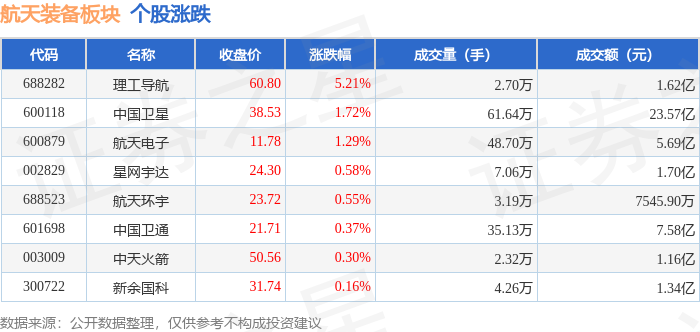
航天装备板块9月22日涨1.36%,星网宇达领涨,主力资金净流出7286.91万元
Market Performance - The aerospace equipment sector increased by 1.36% on September 22, with Xingwang Yuda leading the gains [1] - The Shanghai Composite Index closed at 3828.58, up 0.22%, while the Shenzhen Component Index closed at 13157.97, up 0.67% [1] Stock Performance - Key stocks in the aerospace equipment sector showed varied performance, with Xingwang Yuda closing at 21.35, up 3.14%, and China Satellite at 35.47, up 1.37% [1] - The trading volume and turnover for Xingwang Yuda were 142,400 shares and 304 million yuan, respectively [1] Capital Flow - The aerospace equipment sector experienced a net outflow of 72.87 million yuan from institutional investors, while retail investors saw a net inflow of 41.56 million yuan [1] - The detailed capital flow for key stocks indicates that Xingwang Yuda had a net inflow of 16.30 million yuan from institutional investors, while China Satellite had a net outflow of 10.47 million yuan [2]
双盛会!长春航空展与空军开放活动共谱蓝天华章,聚焦空天国防的航空航天ETF天弘(159241)助力布局军工板块基本面修复机遇
Sou Hu Cai Jing· 2025-09-22 03:15
Core Viewpoint - The aerospace ETF Tianhong (159241) has shown significant growth in both scale and share, indicating strong investor interest in the aerospace and defense sector [3][5]. Product Highlights - The aerospace ETF Tianhong (159241) tracks the Guozheng Aerospace Index, with a military attribute of 97.86%, making it the highest military content index in the market. The aerospace equipment weight is 66.8%, surpassing other military indices [3]. Hot Events - The 2025 Air Force Aviation Open Day commenced in Changchun, showcasing the modernization achievements of the Chinese Air Force through aerial performances and ground exercises [3]. - Concurrently, the 2025 Changchun Aviation Exhibition featured over a hundred types of equipment, focusing on emerging fields like drones and low-altitude economy, serving as a platform for technology display and industry collaboration [4]. Institutional Views - According to AVIC Securities, the military industry is expected to enter a relatively stable phase due to recent events and the completion of mid-year performance disclosures. The market shows low systemic risk, with structural rotation within the military sector [5]. - The military sector has demonstrated resilience and vitality, avoiding volatility risks associated with overheating in single areas. Improved performance in certain fields and the anticipation of new orders are expected to strengthen the market outlook [5].
航天电子涨2.01%,成交额2.45亿元,主力资金净流入1919.46万元
Xin Lang Cai Jing· 2025-09-22 02:39
Company Overview - Aerospace Electronic Technology Co., Ltd. is primarily engaged in the research, production, and sales of aerospace technology application products, including measurement and control communication, electromechanical components, integrated circuits, and inertial navigation systems [1] - The company was established on July 18, 1990, and was listed on November 15, 1995 [1] Financial Performance - As of June 30, 2025, Aerospace Electronic reported a revenue of 5.822 billion yuan, a year-on-year decrease of 24.51%, and a net profit attributable to shareholders of 174 million yuan, down 30.37% year-on-year [2] - The company has distributed a total of 1.124 billion yuan in dividends since its A-share listing, with 514 million yuan distributed in the last three years [3] Stock Performance - As of September 22, the stock price of Aerospace Electronic increased by 2.01% to 10.65 yuan per share, with a total market capitalization of 35.138 billion yuan [1] - Year-to-date, the stock has risen by 19.53%, with a recent 5-day increase of 1.14%, a 20-day decline of 10.58%, and a 60-day increase of 1.72% [1] Shareholder Information - As of June 30, 2025, the number of shareholders increased to 154,400, a rise of 13.22%, while the average circulating shares per person decreased by 11.67% to 21,368 shares [2] - Notable new institutional shareholders include the Fortune China Securities Military Industry Leader ETF and E Fund Defense Industry Mixed A, holding 50.656 million shares and 48.223 million shares, respectively [3] Industry Classification - Aerospace Electronic is classified under the defense and military industry, specifically in the aerospace equipment sector [2] - The company is involved in various concept sectors, including general aviation, military-civilian integration, space station, Beidou navigation, and commercial aerospace [2]
长春航空展正式开幕,高端装备ETF(159638)盘中一度涨超2%,成分股国睿科技10cm涨停
Xin Lang Cai Jing· 2025-09-19 03:43
Core Viewpoint - The high-end equipment sector is experiencing significant growth, with the 中证高端装备细分50指数 rising by 1.97% and notable increases in key stocks such as 国睿科技 and 中航沈飞 [1][2] Group 1: Market Performance - The high-end equipment ETF (159638) saw a rise of 1.85%, with intraday gains exceeding 2% [1] - The ETF recorded a turnover of 3.27% and a transaction volume of 35.76 million yuan during the trading session [2] - Over the past month, the ETF has averaged a daily transaction volume of 58.85 million yuan [2] - The latest scale of the high-end equipment ETF reached 1.073 billion yuan [2] - In the last 14 trading days, there were 8 days of net capital inflow, totaling 13.32 million yuan [2] - The ETF's net value increased by 42.86% over the past year [2] Group 2: Industry Outlook - The military industry is expected to see an order turning point as the "建军百年奋斗目标" enters its second half, with new technologies and products driving market direction [3] - The top ten weighted stocks in the 中证高端装备细分50指数 account for 45.6% of the index, with 中航沈飞 and 航发动力 being the most significant contributors [3][5] - The upcoming "十四五" equipment procurement tail orders are anticipated to be finalized soon, with an expected increase in upstream order growth [2]
行业军贸市场深度研究:全球百年变局激荡,我国军贸大有可为
INDUSTRIAL SECURITIES· 2025-09-16 11:07
Investment Rating - The industry investment rating is "Recommended (Maintain)" [1] Core Insights - The military trade market is significantly influenced by geopolitical factors, with advanced weaponry impacting national military capabilities and political dynamics. The U.S. and its allies dominate global military trade exports, accounting for 64.10% and 78.06% of total exports in the periods 2015-2019 and 2020-2024, respectively [2][34] - The global military trade market is characterized by high concentration, with the top ten exporting countries accounting for 89.70% of total exports from 2015-2019 and 88.60% from 2020-2024. The U.S. and France are the top two exporters in the latter period, with a combined share of 52.60% [2][34] - China's military trade share is expected to increase in the long term, aligning with its manufacturing capabilities and international influence, despite currently holding only 3.9% of the global military trade market in 2024 [2][34] Summary by Sections Military Trade Overview - Military trade, or arms trade, is a unique sector closely tied to geopolitical and military strategies, reflecting national interests and political continuity [12] - The United Nations defines military trade as the transfer of military equipment between countries, which plays a crucial role in regulating international political relations [12] Global Military Trade Landscape - According to SIPRI, global military trade has experienced stable growth, with total trade increasing from 80.82 billion TIV in 1950 to 289.38 billion TIV in 2024, reflecting a compound annual growth rate of 1.72% [30] - The military trade market has undergone three significant fluctuations since 1950, with the most recent period (2002-present) showing a recovery in trade volumes due to increased global tensions and military spending [30] Major Military Exporting Countries - The top five military exporting countries from 2015-2019 were the U.S., Russia, France, China, and Germany, with the U.S. maintaining a dominant position [34] - The military trade export figures for the U.S. rose from 503.68 billion TIV in 2015-2019 to 609.49 billion TIV in 2020-2024, marking a 21.01% increase [35] China's Military Trade Situation - China's military trade has seen fluctuations, with exports decreasing from 88.62 billion TIV in 2015-2019 to 83.85 billion TIV in 2020-2024, a decline of 5.38% [35] - The report highlights that China's military trade is expected to grow due to increasing geopolitical conflicts and the country's enhanced military capabilities [2][34]
航天装备板块9月16日跌0.04%,航天电子领跌,主力资金净流出4.33亿元
Market Overview - The aerospace equipment sector experienced a slight decline of 0.04% on September 16, with aerospace electronics leading the drop [1] - The Shanghai Composite Index closed at 3861.87, up 0.04%, while the Shenzhen Component Index closed at 13063.97, up 0.45% [1] Stock Performance - Notable stock performances in the aerospace equipment sector included: - Xingwang Yuda (002829) closed at 20.87, up 2.25% with a trading volume of 70,600 shares and a turnover of 145 million yuan - Xinyu Guoke (300722) closed at 32.61, up 1.05% with a trading volume of 40,700 shares and a turnover of 132 million yuan - Aerospace Electronics (600879) closed at 10.40, down 1.23% with a trading volume of 487,200 shares and a turnover of 507 million yuan [1] Capital Flow - The aerospace equipment sector saw a net outflow of 433 million yuan from institutional investors, while retail investors contributed a net inflow of 409 million yuan [1] - Detailed capital flow for specific stocks showed: - Aerospace Electronics (600879) had a net outflow of 86.22 million yuan from institutional investors, but a net inflow of 77.43 million yuan from retail investors [2] - China Satellite (600118) experienced a net outflow of 24 million yuan from institutional investors, with a net inflow of 22.6 million yuan from retail investors [2]
航天电子20250912
2025-09-15 01:49
Summary of Aerospace Electronics Conference Call Company and Industry Overview - **Company**: Aerospace Electronics - **Industry**: Aerospace and Defense, focusing on commercial space and unmanned systems Key Points and Arguments 1. **Market Growth**: Aerospace Electronics is expected to benefit significantly from the increase in space launch missions and deep space exploration, with the commercial low Earth orbit market projected to reach 600 billion yuan by 2028, particularly in satellite manufacturing [2][13][16] 2. **Unmanned Systems Development**: The company is the primary unit for the development of unmanned systems in the military, focusing on small to medium-sized drones and expanding into larger high-altitude, high-speed drones and underwater equipment, which is anticipated to lead to substantial performance releases driven by domestic and foreign market demand [2][3][9][22] 3. **Core Business Focus**: The company has divested non-core civilian businesses to concentrate on military products, enhancing profitability and operational efficiency. In 2023, it raised 4.1 billion yuan through a private placement for investments in inertial navigation, unmanned equipment, and special control communications [2][5][6] 4. **Financial Performance**: Since the overall restructuring in 2016, the company has maintained growth in gross margin, revenue, and net profit levels. However, there were declines in 2020 and 2022 due to losses in civilian businesses. The divestment of non-core businesses is expected to improve long-term profitability [6][23] 5. **Technological Advantages**: The company has a strong market share in FPGA and military special components, with applications across aerospace, automotive electronics, and navigation terminals. It leverages resources from key institutes to maintain robust production and research capabilities [2][10][17] 6. **Business Segmentation**: The company operates in two main segments: aerospace electronic support and unmanned drone assembly. The electronic support segment includes five key areas: measurement and control communication, inertial navigation, electromechanical components, and integrated circuits, with measurement and control communication being the core segment [7][8][11] 7. **International Market Potential**: The company’s drone products have been exported to over 10 countries, with small drones and loitering munitions showing significant potential in international markets due to their lower political sensitivity and broader application range [4][19] 8. **R&D and Pricing Flexibility**: The military trade business offers greater flexibility in R&D costs and pricing, which is expected to enhance operational direction and drive performance growth [20] 9. **Incentive Mechanisms**: The company employs equity incentive mechanisms to promote performance release, aligning the interests of core technical personnel and management with the company's long-term development [21][22] 10. **Future Growth Drivers**: The company anticipates growth driven by domestic and foreign demand, having divested its cable business to focus on military products, and aims to improve operational efficiency through lean management [23] Additional Important Insights - **Strategic Positioning**: As the only listed entity under the Aerospace Science and Technology Group's Ninth Academy, the company enjoys a unique positioning and resource advantage, which is expected to facilitate significant growth in both traditional aerospace and emerging commercial space sectors [3][14][15][17] - **Collaboration with State Entities**: The company has a high proportion of revenue from transactions with the Aerospace Science and Technology Group, enhancing its competitive edge through collaborative synergies in technology and market access [16][17]
研判2025!中国遥感测绘服务行业政策汇总、产业链、市场规模、竞争格局及发展趋势分析:在数字经济发展的背景下,遥感测绘服务需求日益增长[图]
Chan Ye Xin Xi Wang· 2025-09-15 01:13
Core Insights - The remote sensing surveying service industry in China is experiencing continuous growth due to the expanding application fields of geographic information and increasing demand for remote sensing data from downstream industries. The market size is projected to reach 23.6 billion yuan in 2024, representing an 8.8% year-on-year increase [1][7]. Industry Overview - Remote sensing surveying involves using sensors mounted on ground, aerial, and space platforms to gather electromagnetic wave signals for mapping terrain or specialized topics. The services can be categorized into ground, aerial, and space remote sensing surveying [3]. Industry Policies - A series of policies have been issued to promote the development of the remote sensing surveying service industry, including the August 2023 document aimed at enhancing the transformation and upgrading of the surveying and geographic information sector [4]. Industry Chain - The upstream of the remote sensing surveying service industry includes satellite manufacturing, aircraft manufacturing, drone manufacturing, and ground equipment manufacturing. The midstream consists of the remote sensing surveying services, while the downstream encompasses applications in autonomous driving, urban planning, traffic management, environmental monitoring, and resource investigation [5]. Industry Development - The rapid development of China's remote sensing satellite industry is evident, with the country launching over 160 remote sensing satellites in 2023, surpassing the United States for the first time. This growth supports the geographic information industry [6]. Competitive Landscape - The remote sensing surveying service industry is characterized by a large number of participants and a fragmented competitive landscape. The market has seen increased participation from private enterprises, with listed companies such as Aerospace Hongtu and Surveying and Mapping Co. entering the market [8]. Future Trends - The demand for smart city construction is expected to surge, driving the need for remote sensing surveying services for urban 3D modeling and underground pipeline digitization [10]. - Data processing in the remote sensing surveying service industry is becoming more intelligent and precise, leveraging technologies like artificial intelligence and big data [12]. - Data security and compliance requirements are becoming increasingly stringent, necessitating enhanced local data processing capabilities to ensure data safety [13].