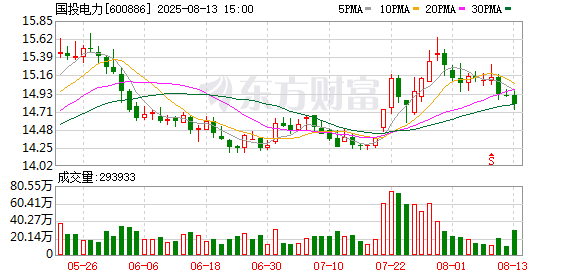
SDIC Power(600886)

Search documents
国投电力(600886) - 国投电力控股股份有限公司2025年第五次临时股东会会议材料
2025-08-20 11:00
附件 国投电力控股股份有限公司 2025 年第五次临时股东会 会议材料 2025 年 9 月 5 日 国投电力控股股份有限公司 2025 年第五次临时股东会现场会议议程 2.《关于董事会换届暨选举第十三届董事会独立董事的议案》 一、会议时间:2025 年 9 月 5 日(星期五)下午14: 00 二、会议地点:北京市西城区西直门南小街147号 207会议室 三、会议内容: (一)主持人致开幕词; (二)选举宣布监票人和计票人名单; (三)审议下列议案: 1.《关于董事会换届暨选举第十三届董事会非独立董事的议案》 (四)股东发言及回答股东提问; (五)股东审议表决; (六)清点表决票,宣布现场表决结果; (七)宣读股东会决议; (八)见证律师宣读法律意见书; (九)主持人致闭幕词。 国投电力控股股份有限公司 2025 年第五次临时股东会会议材料 议案一 国投电力控股股份有限公司 关于董事会换届暨选举第十三届董事会非独立董事的议案 各位股东及股东代表: 国投电力控股股份有限公司(以下简称公司)第十二届董事会将于 2025 年 9 月 6 日任期届满,按照《公司法》《公司章程》有关规定,公司董事会需进行换届选举。 ...

国投电力(600886) - 国投电力控股股份有限公司第十二届董事会第四十七次会议决议公告
2025-08-20 11:00
国投电力控股股份有限公司 第十二届董事会第四十七次会议决议公告 本公司董事会及全体董事保证本公告内容不存在任何虚假记载、误导性陈述 或者重大遗漏,并对其内容的真实性、准确性和完整性承担法律责任。 一、董事会会议召开情况 国投电力控股股份有限公司(以下简称公司)第十二届董事会第四十七次会 议于 2025 年 8 月 13 日以邮件方式发出通知,2025 年 8 月 20 日以通讯方式召开。 本次会议应出席董事 9 人,实际出席董事 9 人,公司董事长郭绪元先生主持本次 会议。本次会议的召集和召开符合《公司法》和《公司章程》的有关规定。 二、董事会会议审议情况 (一)审议通过了《关于董事会换届暨选举第十三届董事会非独立董事的议案》 公司第十二届董事会将于 2025 年 9 月 6 日任期届满,按照《公司法》和《公 司章程》有关规定,公司董事会须进行换届选举。 证券代码:600886 证券简称:国投电力 公告编号:2025-043 经公司股东国家开发投资集团有限公司、中国长江电力股份有限公司、全国 社会保障基金理事会提名,董事会同意推荐郭绪元、刘国军、于海淼、赵军、 高军为公司第十三届董事会董事(非独立董事、非职工 ...
沪深300电力指数报2572.78点,前十大权重包含华电国际等
Jin Rong Jie· 2025-08-19 08:06
Group 1 - The Shanghai Composite Index opened high and fluctuated, with the CSI 300 Power Index reported at 2572.78 points [1] - The CSI 300 Power Index has decreased by 3.70% in the past month, 5.87% in the past three months, and 6.77% year-to-date [1] - The CSI 300 Index is categorized into 11 primary industries, 35 secondary industries, over 90 tertiary industries, and more than 200 quaternary industries [1] Group 2 - The top ten weights in the CSI 300 Power Index are: Changjiang Electric (48.32%), China Nuclear Power (10.65%), Three Gorges Energy (8.79%), Guodian Power (5.75%), State Power Investment (5.02%), Huaneng International (4.56%), Chuanwei Energy (4.27%), China General Nuclear Power (4.15%), Zhejiang Energy (2.98%), and Huadian International (2.79%) [1] - The market segment of the CSI 300 Power Index is dominated by the Shanghai Stock Exchange at 95.49%, while the Shenzhen Stock Exchange accounts for 4.51% [1] Group 3 - In terms of industry composition within the CSI 300 Power Index, hydropower accounts for 59.96%, thermal power for 16.09%, nuclear power for 14.80%, and wind power for 9.15% [2] - The index sample is adjusted biannually, with adjustments implemented on the next trading day following the second Friday of June and December each year [2] - Weight factors are generally fixed until the next scheduled adjustment, with temporary adjustments made in response to changes in the CSI 300 Index [2]



每周股票复盘:国投电力(600886)股东大会高票通过三项修订议案
Sou Hu Cai Jing· 2025-08-16 22:47
Core Points - As of August 15, 2025, Guotou Electric Power (600886) closed at 14.7 yuan, down 2.91% from the previous week's 15.14 yuan [1] - The company's current total market capitalization is 117.666 billion yuan, ranking 8th out of 102 in the power sector and 128th out of 5152 in the A-share market [1] Company Announcements - The fourth extraordinary general meeting of shareholders for Guotou Electric Power was held on August 13, 2025, with 1132 shareholders and proxies present, representing 74.1940% of the total voting shares [1] - Three resolutions were passed at the meeting: 1. Amendment to the Articles of Association, with 99.1467% approval [1] 2. Amendment to the Rules of Procedure for Shareholders' Meetings, with 98.8031% approval [1] 3. Amendment to the Rules of Procedure for Board Meetings, with 98.7493% approval [1] - The resolutions received more than two-thirds approval from the valid voting rights held by attending shareholders [2]

国投集团在无锡成立生物制造创新研究院
Zheng Quan Shi Bao Wang· 2025-08-15 04:14
Group 1 - The establishment of Guotou Biological Manufacturing Innovation Research Institute (Wuxi) Co., Ltd. has been announced, with a registered capital of 30 million yuan [1] - The company's business scope includes research and development of bio-based materials technology, production process of biomass liquid fuels, bio-chemical products technology, and artificial intelligence theory and algorithm software development [1] - The company is jointly held by the wholly-owned subsidiary of China National Development Investment Corporation and Wuxi Life Science Industry Development Co., Ltd. [1]
哈电集团同日与三家能源央企高层会谈
Zhong Guo Dian Li Bao· 2025-08-15 01:51
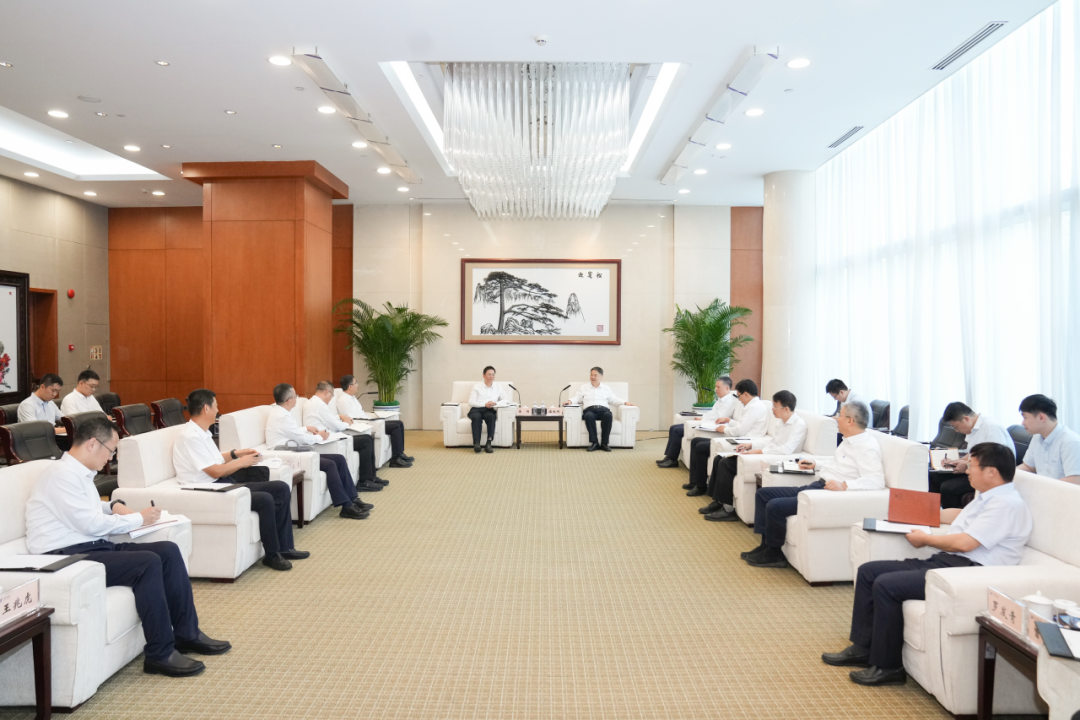
Core Viewpoint - On August 13, three major state-owned enterprises in China, including China Huaneng, State Power Investment Corporation, and China Energy Group, held high-level meetings with Harbin Electric Group to discuss deepening cooperation in energy security and technological innovation. Group 1: China Huaneng and Harbin Electric Group - China Huaneng's leadership expressed gratitude for Harbin Electric Group's long-term support and highlighted the importance of their strategic partnership [4][6] - Both parties aim to enhance collaboration in clean energy generation and low-carbon transformation of coal power, contributing to the establishment of a new energy system [4][6] Group 2: State Power Investment Corporation and Harbin Electric Group - State Power Investment Corporation's leadership acknowledged Harbin Electric Group's contributions to national energy security and expressed a desire to deepen cooperation in new coal power technologies and international business development [9][7] - Harbin Electric Group aims to leverage its strengths to support State Power Investment Corporation's high-quality development [9][7] Group 3: China Energy Group and Harbin Electric Group - China Energy Group's leadership welcomed Harbin Electric Group and emphasized the need for ongoing collaboration in energy security and technological innovation [15][13] - Both companies aim to establish a regular communication mechanism to enhance cooperation in supporting national strategies and energy transition [15][13]


国投电力(600886)8月14日主力资金净流出2315.93万元
Sou Hu Cai Jing· 2025-08-14 13:21
Group 1 - The core point of the article highlights the recent performance and financial metrics of Guotou Electric Power Co., Ltd. as of August 14, 2025, including a stock price of 14.76 yuan, a slight decline of 0.2%, and a trading volume of 179,300 hands with a transaction amount of 266 million yuan [1] - The company reported total operating revenue of 13.122 billion yuan for Q1 2025, a year-on-year decrease of 6.99%, while net profit attributable to shareholders was 2.078 billion yuan, reflecting a year-on-year increase of 2.10% [1] - The company's liquidity ratios include a current ratio of 0.791 and a quick ratio of 0.767, with a debt-to-asset ratio of 61.26% [1] Group 2 - Guotou Electric Power has made investments in 130 companies and participated in 729 bidding projects, indicating active engagement in business development [2] - The company holds 10 administrative licenses and has registered 2 patents, showcasing its operational capabilities and innovation [2]
上证可持续发展产业主题指数下跌0.88%,前十大权重包含三峡能源等
Jin Rong Jie· 2025-08-14 08:52
数据统计显示,上证可持续发展产业主题指数近一个月下跌2.38%,近三个月上涨0.03%,年至今下跌 4.66%。 金融界8月14日消息,上证指数高开低走,上证可持续发展产业主题指数 (持续产业,000114)下跌 0.88%,报1147.31点,成交额213.48亿元。 据了解,上证可持续发展产业主题指数选取可持续发展相关产业中规模大、流动性好的40只上市公司证 券作为样本,以反映可持续发展产业证券的整体表现。该指数以2011年06月30日为基日,以1000.0点为 基点。 从指数持仓来看,上证可持续发展产业主题指数十大权重分别为:长江电力(30.84%)、隆基绿能 (8.76%)、中国核电(6.86%)、特变电工(6.28%)、三峡能源(5.61%)、通威股份(4.97%)、国 投电力(3.24%)、川投能源(2.75%)、东方电气(2.21%)、晶科能源(1.96%)。 从上证可持续发展产业主题指数持仓的市场板块来看,上海证券交易所占比100.00%。 从上证可持续发展产业主题指数持仓样本的行业来看,公用事业占比51.88%、工业占比43.49%、通信 服务占比4.63%。 资料显示,指数样本每年调整一次 ...



国投电力控股股份有限公司2025年第四次临时股东大会决议公告
Shang Hai Zheng Quan Bao· 2025-08-13 18:23
Group 1 - The core viewpoint of the announcement is the successful convening of the fourth extraordinary general meeting of shareholders of Guotou Electric Power Holding Co., Ltd. on August 13, 2025, with all resolutions passed without any objections [1][2]. - The meeting was held at a designated location in Beijing, and it utilized a combination of on-site and online voting methods, complying with the relevant laws and regulations [2][3]. - The attendance included 4 out of 9 current directors and 1 out of 3 current supervisors, with some members absent due to work commitments [3]. Group 2 - Three significant resolutions were passed during the meeting, including amendments to the company's articles of association, the rules of procedure for shareholder meetings, and the rules of procedure for board meetings, all receiving over two-thirds approval from the voting shareholders [4][5]. - There were no related party shareholders that needed to abstain from voting, and no preferred shareholders participated in the voting process [5]. - The meeting was witnessed by a law firm, confirming that the procedures and voting results were in compliance with legal and regulatory requirements [5].
国投电力:2025年第四次临时股东大会决议公告
Zheng Quan Ri Bao· 2025-08-13 13:38
(文章来源:证券日报) 证券日报网讯 8月13日晚间,国投电力发布公告称,公司2025年第四次临时股东大会于2025年08月13日 召开,审议通过了《关于修订的议案》等多项议案。 ...