
Chongqing Rural Commercial Bank(601077)

Search documents
渝农商行(601077) - 重庆农村商业银行股份有限公司2025年度中期利润分配方案公告
2025-12-23 11:45
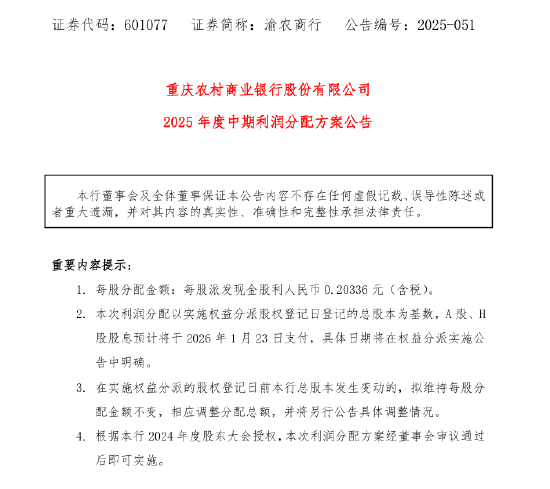
证券代码:601077 证券简称:渝农商行 公告编号:2025-051 重庆农村商业银行股份有限公司 2025 年度中期利润分配方案公告 本行董事会及全体董事保证本公告内容不存在任何虚假记载、误导性陈述或 者重大遗漏,并对其内容的真实性、准确性和完整性承担法律责任。 重要内容提示: 一、 利润分配方案内容 经毕马威华振会计师事务所(特殊普通合伙)审阅,截至 2025 年 6 月 30 日,重庆农村商业银行股份有限公司(以下简称"本行")期末归属于上市公司 股东的净利润为人民币 76.99 亿元。经董事会决议,本行 2025 年度中期拟以实 施权益分派股权登记日登记的总股本为基数分配利润。本次利润分配方案如下: 1.本行拟向全体股东每 10 股派发现金红利人民币 2.0336 元(含税)。截至 2025 年 6 月 30 日,本行总股本为 113.57 亿股,以此计算合计拟派发现金红利 人民币 23.10 亿元(含税),占本行 2025 年上半年归属于上市公司股东的净利润 比例为 30%。上述派发股息均以人民币计值,以人民币向 A 股股东发放,以港币 1. 每股分配金额:每股派发现金股利人民币 0.20336 ...
渝农商行:拟派发中期股息每10股2.0336元(含税)
Xin Lang Cai Jing· 2025-12-23 11:40
12月23日金融一线消息,渝农商行发布2025年度中期利润分配方案,拟向全体股东每10股派发现金红利 2.0336元(含税)。截至2025年6月30日,渝农商行总股本为113.57亿股,以此计算合计拟派发现金红利 人民币23.10亿元(含税),占渝农商行2025年上半年归属于上市公司股东的净利润比例为30%。 责任编辑:王馨茹 12月23日金融一线消息,渝农商行发布2025年度中期利润分配方案,拟向全体股东每10股派发现金红利 2.0336元(含税)。截至2025年6月30日,渝农商行总股本为113.57亿股,以此计算合计拟派发现金红利 人民币23.10亿元(含税),占渝农商行2025年上半年归属于上市公司股东的净利润比例为30%。 责任编辑:王馨茹 ...

渝农商行2025年度中期利润分配方案:拟10派2.0336元
Xin Lang Cai Jing· 2025-12-23 11:33
渝农商行(601077)12月23日发布2025年度中期利润分配方案,拟向全体股东每10股派发现金红利2.0336 元(含税)。 ...
渝农商行(601077) - 重庆农村商业银行股份有限公司第五届董事会第六十六次会议决议公告
2025-12-23 11:30
证券代码:601077 证券简称:渝农商行 公告编号:2025-049 重庆农村商业银行股份有限公司 第五届董事会第六十六次会议决议公告 本行董事会及全体董事保证本公告内容不存在任何虚假记载、误导性陈述或 者重大遗漏,并对其内容的真实性、准确性和完整性承担法律责任。 重庆农村商业银行股份有限公司(以下简称"本行")第五届董事会第六十 六次会议于 2025 年 12 月 23 日在本行总行 401 会议室以现场结合通讯方式召开。 本行已于 2025 年 12 月 18 日以电子邮件形式发出会议通知和材料。本次会议应 出席董事 8 名,实际出席董事 8 名(其中,现场出席董事 6 名,董事彭玉龙先生、 李明豪先生以通讯方式参会)。本行股东上海豫园旅游商城(集团)股份有限公 司质押本行股权比例超过 50%,根据监管规定对其提名的彭玉龙董事在董事会上 的表决权进行了限制。会议的召开符合法律、行政法规、部门规章、规范性文件 和本行章程的有关规定。 本次会议由执行董事隋军先生主持。本次会议审议通过了以下议案: 一、《关于聘任重庆农村商业银行股份有限公司副行长的议案》 表决情况:有效表决票 7 票,同意 7 票,反对 0 ...
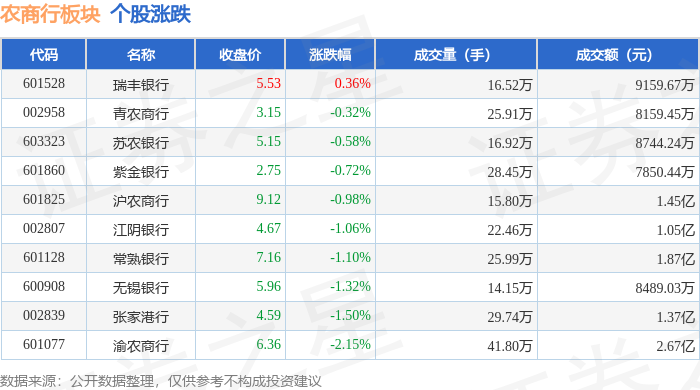
农商行板块12月23日涨0.36%,渝农商行领涨,主力资金净流入2714.89万元
Zheng Xing Xing Ye Ri Bao· 2025-12-23 09:08
Group 1 - The core viewpoint of the news is that the rural commercial bank sector experienced a slight increase of 0.36% on December 23, with Yunnan Rural Commercial Bank leading the gains [1] - The Shanghai Composite Index closed at 3919.98, up by 0.07%, while the Shenzhen Component Index closed at 13368.99, up by 0.27% [1] - A detailed table of individual stock performance within the rural commercial bank sector is provided, indicating varying levels of gains and losses [1] Group 2 - In terms of capital flow, the rural commercial bank sector saw a net inflow of 27.14 million yuan from main funds, while retail investors experienced a net outflow of 38.18 million yuan [2] - The sector also attracted a net inflow of 11.03 million yuan from speculative funds [2] - A table detailing the capital flow for individual stocks within the rural commercial bank sector is included [2]

渝农商行杭州银行齐鲁银行领跌银行板块
Zhong Guo Jing Ji Wang· 2025-12-22 09:13
(责任编辑:徐自立) 中国经济网北京12月22日讯 渝农商行(601077.SH)今日股价收报6.36元,跌幅2.15%。杭州银 行(600926.SH)今日收报15.35元,跌幅1.98%。齐鲁银行(601665.SH)今日收报5.62元,跌幅 1.92%。 今日,银行板块跌幅为0.81%,渝农商行、杭州银行、齐鲁银行股价垫底银行板块。 ...

农商行板块12月22日跌1.18%,渝农商行领跌,主力资金净流入1998.09万元
Zheng Xing Xing Ye Ri Bao· 2025-12-22 09:10
Core Viewpoint - The rural commercial bank sector experienced a decline of 1.18% on December 22, with Yunnan Rural Commercial Bank leading the drop [1] Group 1: Market Performance - The Shanghai Composite Index closed at 3917.36, up by 0.69% [1] - The Shenzhen Component Index closed at 13332.73, up by 1.47% [1] - The rural commercial bank sector saw mixed individual stock performances, with notable declines in several banks [1] Group 2: Individual Stock Performance - Wuxi Bank (600908) had a closing price of 5.96, down by 1.32%, with a trading volume of 141,500 shares and a transaction amount of 84.89 million [1] - Changshu Bank (601128) closed at 7.16, down by 1.10%, with a trading volume of 259,900 shares and a transaction amount of 187 million [1] - Yunnan Rural Commercial Bank (601077) closed at 6.36, down by 2.15%, with a trading volume of 418,000 shares and a transaction amount of 267 million [1] Group 3: Capital Flow - The rural commercial bank sector had a net inflow of 19.98 million from main funds, while retail investors saw a net outflow of 44.62 million [1] - Individual stocks within the sector showed varied capital flows, with some banks experiencing significant net outflows from retail investors [2]



机构密集调研银行股 息差改善成市场关注焦点
Zhong Guo Jing Ying Bao· 2025-12-20 04:00
Core Viewpoint - Several brokerage firms, funds, and insurance asset management institutions are evaluating listed banks to optimize asset allocation and investment strategies for the coming year, with a focus on net interest margin performance [1] Group 1: Net Interest Margin Stability - Multiple banks have indicated that net interest margins have shown signs of stabilization in Q3, with a narrowing of the overall decline and an improvement in funding costs expected over the next three years [1] - Hangzhou Bank reported that its net interest margin remained stable at the end of Q3 compared to the end of Q2, with a marginal narrowing of the annual decline expected [1] - Suzhou Bank stated that its net interest margin has narrowed less than the industry average this year, supporting growth in net interest income [2] Group 2: Strategies for Managing Interest Margin - Banks are actively exploring ways to alleviate interest margin pressure through optimizing asset-liability structures and enhancing non-interest income [1] - Chongqing Rural Commercial Bank noted that its Q3 interest margin stabilized due to a slowdown in the decline of asset yields and a faster decrease in liability interest rates [2] - Ouyang Rihui emphasized the importance of increasing the proportion of intermediary business income and investing in information technology to improve interest margin management [3] Group 3: Regional Banks' Performance - The Q3 reports of listed banks show structural differentiation in net interest margins, with some regional banks experiencing improvement [3] - A report indicated that net interest margins for city commercial banks and rural commercial banks continued to stabilize in the first three quarters of 2025, with a decrease in the cost of interest-bearing liabilities [4] - Some regional banks, such as Jiangyin Bank and Chongqing Bank, reported an increase in net interest margins at the end of Q3 compared to the end of Q2 [3][4] Group 4: Future Outlook - Some banks anticipate that the trend of improving interest margins will continue into 2026, with Qingnong Commercial Bank indicating that its interest margin is expected to remain stable [5] - Factors such as the repricing of existing loans and adjustments in deposit pricing strategies are expected to support net interest margins moving forward [5]


三地同步发力!消费贷新政落地,中小银行助力政策触达“最后一公里”
Xin Lang Cai Jing· 2025-12-19 02:50
Core Viewpoint - The consumer loan interest subsidy policy is being implemented at the local level, with provinces like Sichuan, Chongqing, and Guizhou initiating provincial subsidy programs, marking a further refinement of the national policy [2][10]. Group 1: Policy Implementation - Sichuan, Chongqing, and Guizhou have launched provincial subsidy programs for consumer loans, including local small and medium-sized banks as processing institutions [3][11]. - The subsidy period for Sichuan is from October 1, 2025, to March 31, 2026, while Chongqing's period is from September 1, 2025, to August 31, 2026, and Guizhou's is from September 1, 2025, to December 31, 2025 [3][11]. - The core standard for the subsidy is a 1% annual interest subsidy rate, not exceeding 50% of the loan contract interest rate, consistent with national standards [5][13]. Group 2: Market Impact - The inclusion of local policies is expected to create a structural impact, leading to a policy overlay effect that lowers consumer credit interest rates and stimulates demand [4][12]. - This policy shift breaks the initial trend where national subsidies primarily benefited large national banks, providing local banks with competitive tools and preventing excessive market concentration [5][13]. - The initiative encourages financial institutions to innovate products based on regional consumption characteristics, leading to a more diverse and balanced financial support network for consumption [5][13]. Group 3: Future Outlook - The Ministry of Commerce and other regulatory bodies have emphasized the need for collaboration among financial policies to guide credit funds towards key consumption areas [6][14]. - Experts predict that more provinces, especially economically significant ones, will adopt similar policies, with a focus on green and digital consumption [6][14]. - There is a strong motivation for regions with weak consumption recovery or those looking to enhance local commercial vitality to implement similar measures, creating a synergistic effect between national and local subsidies [6][14]. Group 4: Challenges for Local Banks - Local banks face both opportunities and challenges from this policy, as it provides a short-term growth window but also highlights their limitations in customer base, risk control technology, and product capabilities compared to larger banks [7][15]. - The policy's benefits may be temporary, and local banks must enhance their digital operations and service capabilities to retain customers after the policy period ends [7][15]. - Recommendations for local banks include leveraging policy benefits for rapid digital upgrades, building a "credit + scenario" ecosystem, and strengthening risk control and unique capabilities to avoid dependency on subsidies [7][15].


A股主要股指走势分化 创业板指大幅回落
Mei Ri Shang Bao· 2025-12-18 23:05
Market Overview - A-shares showed significant divergence with the Shanghai Composite Index rising by 0.16% to 3876.37 points, while the Shenzhen Component Index fell by 1.29% and the ChiNext Index dropped by 2.17% [1] - Total trading volume in the Shanghai and Shenzhen markets reached 16,770 billion, a decrease of 1,575 billion from the previous day [1] Banking Sector - The banking sector experienced a collective rebound, with major banks like Shanghai Bank and Chongqing Rural Commercial Bank rising over 3%, and others like Agricultural Bank and Industrial and Commercial Bank increasing by more than 2% [2] - The Central Economic Work Conference has set a favorable environment for banks to expand their balance sheets and provide long-term loans, while emphasizing the need to manage local and real estate risks [2] - According to CICC, listed banks are expected to see improved revenue and profit growth rates in 2026 and 2027 due to reduced net interest margin pressure and stable growth in fee income [2] - The average dividend yield for the banking sector is currently at 5.2%, significantly higher than the 10-year government bond yield, indicating a shift towards a "high dividend + high quality" investment cycle [2] AI Healthcare Sector - The AI healthcare sector saw strong gains, with stocks like Jiahe Meikang and Huaren Health hitting the daily limit of 20% increase, and others like Weining Health rising over 11% [3] - The Ant Group's AI health application "Antifufu" has seen a surge in downloads, reaching over 15 million monthly active users, indicating strong market interest [3] - The AI healthcare market in China has grown from 2 billion in 2019 to 6.4 billion in 2023, with projections to reach 224.4 billion by 2033, reflecting a compound annual growth rate of 43.1% [4] Commercial Aerospace Sector - The commercial aerospace sector experienced a surge, with companies like Xingchen Technology and Xice Testing hitting their daily limit, and others like Shunhao Co. and Tianjian Technology also seeing significant gains [5] - Xingchen Technology has reported successful delivery of products for commercial space applications, with plans for mass production starting in 2026 to meet increasing demand from private aerospace companies [6] - Recent policies and technological advancements are expected to accelerate the development of the commercial aerospace industry, with the National Space Administration promoting high-quality and safe development [7]

