
PICC(601319)

Search documents
中国人保:上半年归母净利润266.71亿元,同比增长14%
Bei Jing Shang Bao· 2025-08-27 10:20
北京商报讯(记者 李秀梅)8月27日,中国人民保险集团股份有限公司(以下简称"中国人保")发布 2025年中期业绩。上半年,中国人保实现归属于母公司股东净利润266.71亿元,同比增长14%。 中国人保表示,2025年上半年实现保险服务收入2802.5亿元,同比增长7.1%;原保险保费收入为 4546.25亿元,同比增长6.4%。 ...
中国人保(601319) - H股公告
2025-08-27 10:17
香港交易及結算所有限公司及香港聯合交易所有限公司對本公告的內容概不負責,對其 準確性或完整性亦不發表任何聲明,並明確表示,概不對因本公告全部或任何部分內容 而產生或因倚賴該等內容而引致的任何損失承擔任何責任。 (於中華人民共和國註冊成立之股份有限公司) (股份代號: ) 截至二零二五年六月三十日止六個月 之未經審核中期業績公告 中國人民保險集團股份有限公司(「本公司」或「公司」)董事會(「董事會」)宣佈本公司及子 公司(「本集團」或「集團」)截至二零二五年六月三十日止六個月未經審計合併中期業績及 上年同期比較數據如下,請一併閱覽下文管理層討論與分析: 中期簡要合併財務資料及主要附註 註: 如無特別說明,本公告中幣種均為人民幣。 中期簡要合併利潤表 截至 年 月 日止六個月期間 (除另有註明外,金額單位均為人民幣百萬元) | | | 截至 | 年 | 截至 | 年 | | --- | --- | --- | --- | --- | --- | | | | 月 | 日 | 月 | 日 | | | 附註 | 止六個月期間 | | 止六個月期間 | | | | | (未經審計) | | (未經審計) | | | 保險 ...
中国人保(601319) - H股公告
2025-08-27 10:17
1339 中國人民保險集團股份有限公司 董事會提名薪酬委員會工作規則 目 錄 第一章 總則 第一條 為規範中國人民保險集團股份有限公司(以下簡稱「公司」)董事和高級管理人員 的選聘工作,健全公司薪酬管理制度,完善考核和評價體系,根據有關法律法規、規範 性文件和《中國人民保險集團股份有限公司章程》(以下簡稱「公司章程」)、《中國人民保險 集團股份有限公司董事會議事規則》(以下簡稱「《董事會議事規則》」、《香港聯合交易所有 限公司證券上市規則》中《企業管治守則》(以下簡稱「《企業管治守則》」)的規定,設立公司 董事會(以下簡稱「董事會」)提名薪酬委員會(以下簡稱「提名薪酬委員會」),並制定本工 作規則。 第一章 總則 第二章 人員組成 第三章 職責權限 第四章 工作程序 第五章 議事規則 第六章 附則 核;研究、擬定董事和高級管理人員的薪酬方案、績效考核制度以及激勵方案,向董事 會提出建議,並監督方案或制度的實施。 第三條 提名薪酬委員會對董事會負責,並向董事會報告工作。 第二章 人員組成 第四條 提名薪酬委員會由不少於 名董事組成,獨立非執行董事過半數。 第五條 根據股東、董事長、 以上董事或半數以上(至少 名 ...
中国人民保险集团(01339.HK)上半年归母净利润266.71亿元 同比增长14.0%
Ge Long Hui· 2025-08-27 09:51
Core Viewpoint - China People's Insurance Group reported a strong financial performance for the first half of 2025, with significant growth in insurance service revenue and net profit, indicating robust operational efficiency and capital strength [1] Financial Performance - Insurance service revenue reached 280.25 billion yuan, a year-on-year increase of 7.1% [1] - Original insurance premium income was 454.63 billion yuan, reflecting a 6.4% year-on-year growth [1] - Net profit for the group was 36.155 billion yuan, up 14.8% year-on-year [1] - Net profit attributable to shareholders was 26.671 billion yuan, marking a 14.0% increase year-on-year [1] Dividend Distribution - The group plans to distribute an interim cash dividend of 0.75 yuan per 10 shares (tax included), which is a 19.0% increase compared to the previous year [1] Asset Growth - Total assets as of June 30, 2025, amounted to 1,878.102 billion yuan, a 6.3% increase from the end of the previous year [1] - Net assets reached 390.638 billion yuan, also reflecting a 6.3% growth from the previous year [1] Capital Adequacy - The comprehensive solvency adequacy ratio stood at 276%, while the core solvency adequacy ratio was 219%, indicating strong capital strength [1] Investment Performance - Total investment income was 40.758 billion yuan, showing a significant year-on-year increase of 40.2% [1] - The annualized total investment return rate was 5.0%, up by 0.9 percentage points year-on-year [1]
中国人民保险集团(01339)公布中期业绩 归母净利为266.71亿元 同比增长13.98%
智通财经网· 2025-08-27 09:49
Group 1 - The core viewpoint of the news is that China People's Insurance Group reported strong financial performance for the first half of 2025, with significant growth in revenue and net profit [1][2] - Total operating revenue reached 324.12 billion yuan, a year-on-year increase of 10.87% [1] - Net profit attributable to shareholders was 26.671 billion yuan, reflecting a year-on-year growth of 13.98% [1] - Basic earnings per share were 0.6 yuan, with an interim cash dividend of 0.75 yuan for every 10 shares [1] Group 2 - The insurance service revenue for the first half of 2025 was 280.25 billion yuan, up 7.1% year-on-year [1] - Original insurance premium income was 454.625 billion yuan, showing a year-on-year increase of 6.4% [1] - Investment assets grew steadily, surpassing 1.7 trillion yuan as of June 30, 2025, a 7.2% increase from the beginning of the year [1] Group 3 - In the property insurance sector, the market share of PICC Property and Casualty was 33.5%, maintaining the industry lead [2] - Net cash inflow from operating activities increased by 26.6% year-on-year, indicating improved liquidity [2] - The comprehensive cost ratio was 94.8%, down 1.4 percentage points year-on-year [2] Group 4 - In the life insurance segment, the new business value for PICC Life increased by 71.7% on a comparable basis [2] - The proportion of regular premium income to original insurance premium income was 79.5%, up 0.9 percentage points year-on-year [2] - The 13-month premium persistence rate was 96.4%, an increase of 0.4 percentage points year-on-year [2] Group 5 - In the health insurance sector, the new business value increased by 51.0% on a comparable basis [2] - First-year regular premium income grew by 52.3%, while first-year regular premium income from internet long-term insurance surged by 110.6% [2] Group 6 - Total investment income reached 40.758 billion yuan, a year-on-year increase of 40.2% [2] - The annualized total investment return rate was 5.0%, up 0.9 percentage points year-on-year [2] - As of June 30, 2025, total assets were 1,878.102 billion yuan, a 6.3% increase from the end of the previous year [2] - Net assets were 390.638 billion yuan, also reflecting a 6.3% increase from the end of the previous year [2] - The comprehensive solvency adequacy ratio was 276%, and the core solvency adequacy ratio was 219%, indicating strong capital strength [2]
中国人民保险集团(01339) - 截至2025年6月30日止六个月之中期股息
2025-08-27 09:40
EF001 免責聲明 發行人所發行上市權證/可轉換債券的相關信息 發行人所發行上市權證/可轉換債券 不適用 其他信息 其他信息 不適用 發行人董事 於本公告日,本公司執行董事為丁向群女士、趙鵬先生及肖建友先生,非執行董事為王少群先生、喻強先生及宋洪軍先生,獨立非 執行董事為邵善波先生、徐麗娜女士、王鵬程先生及高平陽先生。 第 2 頁 共 2 頁 v 1.1.1 第 1 頁 共 2 頁 v 1.1.1 EF001 | 香港交易及結算所有限公司及香港聯合交易所有限公司對本公告的內容概不負責,對其準確性或完整性亦不發表任何聲明,並明確表示,概不對因 | | | --- | --- | | 公告全部或任何部份內容而產生或因倚賴該等內容而引致的任何損失承擔任何責任。 | | | 股票發行人現金股息公告 | | | 發行人名稱 | 中國人民保險集團股份有限公司 | | 股份代號 | 01339 | | 多櫃檯股份代號及貨幣 | 不適用 | | 相關股份代號及名稱 | 不適用 | | 公告標題 | 截至2025年6月30日止六個月之中期股息 | | 公告日期 | 2025年8月27日 | | 公告狀態 | 新公告 | | ...
中国人民保险集团(01339) - 2025 - 中期业绩
2025-08-27 09:37
Financial Performance - Insurance service revenue for the six months ended June 30, 2025, reached RMB 280,250 million, an increase of 7.8% compared to RMB 261,629 million for the same period in 2024[4] - Net investment income increased significantly to RMB 17,398 million, up 111.5% from RMB 8,240 million year-on-year[4] - Total operating income for the period was RMB 324,122 million, reflecting a growth of 10.9% from RMB 292,342 million in the previous year[4] - Net profit attributable to shareholders for the six months ended June 30, 2025, was RMB 26,671 million, representing a 14.5% increase from RMB 23,400 million in the same period of 2024[4] - Basic earnings per share rose to RMB 0.60, up from RMB 0.53, indicating a growth of 13.2%[4] - The company reported a total comprehensive income of RMB 30,584 million for the six months ended June 30, 2025, compared to RMB 25,398 million in the previous year, representing a growth of 20.4%[6] - Net profit for the six months ended June 30, 2025, was RMB 26,671 million, compared to RMB 23,400 million for the same period in 2024, representing an increase of 9.7%[10] - Total comprehensive income for the six months ended June 30, 2025, was RMB 22,238 million, compared to RMB 18,271 million for the same period in 2024, reflecting a growth of 21.5%[11] Assets and Liabilities - Total assets as of June 30, 2025, amounted to RMB 1,878,102 million, an increase from RMB 1,766,321 million at the end of 2024[7] - Total liabilities increased to RMB 1,487,464 million from RMB 1,398,900 million, reflecting a rise of 6.3%[8] - The total equity attributable to shareholders increased to RMB 285,925 million, up from RMB 268,866 million, marking a growth of 6.4%[8] - Cash and cash equivalents decreased to RMB 38,524 million from RMB 44,132 million, a decline of 12.7%[7] - The total amount of financial assets measured at amortized cost as of June 30, 2025, was RMB 322,225 million, compared to RMB 316,231 million as of December 31, 2024, showing a slight increase of 1.3%[38] - The insurance contract liabilities reached RMB 1,199,701 million as of June 30, 2025, compared to RMB 1,122,797 million as of December 31, 2024, reflecting a rise of approximately 6.9%[42] Cash Flow - Cash inflow from operating activities for the six months ended June 30, 2025, was RMB 74,845 million, up from RMB 70,044 million in 2024, indicating a rise of 10.0%[13] - Cash outflow for investment activities for the six months ended June 30, 2025, was RMB 65,733 million, compared to RMB 44,453 million in 2024, showing an increase of 48.0%[13] - The company experienced a net cash outflow of RMB 14,567 million from financing activities for the six months ended June 30, 2025, compared to RMB 21,759 million in 2024[13] Investment Performance - The total investment income reached CNY 40.76 billion, reflecting a significant year-on-year growth of 40.2%[71] - The annualized total investment return rate was 5.0%, up by 0.9 percentage points from the previous year[76] - The average total investment return rate over the past three years was 4.5%[152] - The proportion of fixed income investments was 66.6%, with government bonds and government debt accounting for 27.6% of total investments[145][147] Business Segments - The company operates primarily in property insurance, life insurance, health insurance, and asset management, with significant contributions from subsidiaries[25] - The company’s major business segments include property insurance, life insurance, health insurance, and asset management, each contributing to overall performance[25] - Revenue and profit primarily derive from operations in mainland China, with other regions contributing less than 10% to the consolidated financial data[23] Dividends and Shareholder Returns - The company declared dividends of RMB 5,174 million to shareholders during the six months ended June 30, 2025[10] - The company plans to distribute an interim cash dividend of RMB 0.75 per 10 shares (before tax), representing a 19.0% increase compared to the previous year[55] - The total interim dividend proposed for 2025 is approximately RMB 3,317 million, with a dividend of RMB 0.075 per ordinary share, pending shareholder approval[159] Risk Management and Governance - The company has complied with corporate governance regulations and continuously improves its governance structure[170] - The company maintained a stable risk appetite with no major risk events occurring in the first half of 2025[66] - The company’s risk management ratings improved, with the comprehensive risk rating for life insurance rising to A and health insurance to AA[66] Market Position and Brand Value - The company ranked 141st in the 2025 Fortune Global 500, marking its 16th consecutive year on the list[63] - The company's brand value improved by 10 places to rank 150th in the Brand Finance 2025 Global 500, with brand strength rising 20 places to 85th[63] Innovation and Product Development - The company continues to innovate in product offerings, launching new health insurance products and enhancing service capabilities for foreign residents[131] - The company achieved a 55.3% increase in patent applications compared to the same period last year[65] Industry Overview - The insurance industry achieved a premium income of CNY 3.74 trillion in the first half of 2025, representing a year-on-year growth of 5.3%[69] - The total assets of the insurance industry reached CNY 39.22 trillion by the end of June 2025, marking a year-on-year increase of 16.1%[69] - The net assets of the insurance industry grew to CNY 3.75 trillion, reflecting a year-on-year increase of 23.4%[69]
保险板块8月27日跌2.74%,新华保险领跌,主力资金净流出15.62亿元
Zheng Xing Xing Ye Ri Bao· 2025-08-27 08:46
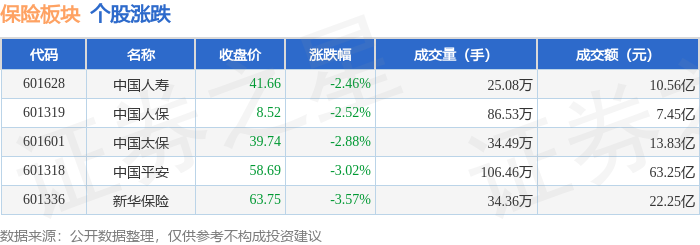
从资金流向上来看,当日保险板块主力资金净流出15.62亿元,游资资金净流入3.48亿元,散户资金净流 入12.14亿元。保险板块个股资金流向见下表: 证券之星消息,8月27日保险板块较上一交易日下跌2.74%,新华保险领跌。当日上证指数报收于 3800.35,下跌1.76%。深证成指报收于12295.07,下跌1.43%。保险板块个股涨跌见下表: | 代码 | 名称 | 收盘价 | 涨跌幅 | 成交量(手) | 成交额(元) | | | --- | --- | --- | --- | --- | --- | --- | | 601628 | 中国人寿 | 41.66 | -2.46% | 25.08万 | | 10.56 Z | | 601319 | 中国人保 | 8.52 | -2.52% | 86.53万 | | 7.45亿 | | 601601 | 中国太保 | 39.74 | -2.88% | 34.49万 | | 13.83亿 | | 601318 | 中国平安 | 58.69 | -3.02% | 106.46万 | | 63.25 7 | | 601336 | 新华保险 | 63.75 | -3 ...





中国人民保险集团(01339) - 董事会提名薪酬委员会工作规则
2025-08-27 08:45
中國人民保險集團股份有限公司 董事會提名薪酬委員會工作規則 目 錄 第一章 總則 第一條 為規範中國人民保險集團股份有限公司(以下簡稱「公司」)董事和高級管理人員 的選聘工作,健全公司薪酬管理制度,完善考核和評價體系,根據有關法律法規、規範 性文件和《中國人民保險集團股份有限公司章程》(以下簡稱「公司章程」)、《中國人民保險 集團股份有限公司董事會議事規則》(以下簡稱「《董事會議事規則》」、《香港聯合交易所有 限公司證券上市規則》中《企業管治守則》(以下簡稱「《企業管治守則》」)的規定,設立公司 董事會(以下簡稱「董事會」)提名薪酬委員會(以下簡稱「提名薪酬委員會」),並制定本工 作規則。 第二條 提名薪酬委員會是董事會設立的專門工作機構,按本工作規則協助董事會擬定 公司董事、高級管理人員的選任程序和標準,對擬任人選的任職資格和條件進行初步審 - 1 - 第一章 總則 第二章 人員組成 第三章 職責權限 第四章 工作程序 第五章 議事規則 第六章 附則 核;研究、擬定董事和高級管理人員的薪酬方案、績效考核制度以及激勵方案,向董事 會提出建議,並監督方案或制度的實施。 第三條 提名薪酬委員會對董事會負責,並向董 ...
新疆金融监管局同意中国人保财险铁厂沟镇营销服务部变更营业场所
Jin Tou Wang· 2025-08-27 08:42
Core Viewpoint - The Xinjiang Financial Regulatory Bureau has approved the relocation of the marketing service office of China People's Property Insurance Company in Urumqi, indicating regulatory support for the company's operational adjustments [1] Group 1 - The marketing service office of China People's Property Insurance Company will be moved to a new address: No. 995, Muxugou North Road, Shayibake District, Urumqi, Xinjiang [1] - The company is required to handle the change and obtain the necessary permits in accordance with relevant regulations [1]