
BROS(601339)

Search documents
险企密集“去监事会” 保险业公司治理变革深化
Jin Rong Shi Bao· 2025-12-31 01:52
Core Viewpoint - The insurance industry is undergoing a significant transformation with the "exit of the supervisory board," as many companies are abolishing this governance structure to enhance efficiency and adapt to new regulatory requirements [2][4]. Group 1: Changes in Governance Structure - As of December 25, 2023, 13 insurance companies, including China Life and China Pacific Insurance, have announced the abolition of their supervisory boards, marking a profound change in the long-standing "three meetings and one layer" governance framework [2][3]. - The trend began with Japan's insurance company in April 2023, which was the first to announce the removal of the supervisory board, followed by state-owned insurance groups [2][3]. - By December 2023, major companies like China Life and New China Life had completed the necessary regulatory approvals to officially abolish their supervisory boards [3][4]. Group 2: Policy and Regulatory Drivers - The reform is driven by the new Company Law effective July 2024, allowing state-owned companies to replace supervisory boards with audit committees, which can enhance governance efficiency [4]. - The China Banking and Insurance Regulatory Commission issued a notice in December 2024, clarifying that financial institutions can establish audit committees to perform the functions of supervisory boards [4]. Group 3: Motivations Behind the Reform - The primary motivations for abolishing supervisory boards include the need to reduce costs, improve efficiency, and address issues of overlapping functions and formalized supervision [4]. - The transition is not seen as a reduction in oversight but rather a restructuring of the supervisory system, with audit committees taking over the responsibilities of the supervisory boards [4]. - The industry anticipates that this reform will enhance compliance and risk management capabilities, contributing to the high-quality development of the insurance sector [4].



纺织服饰行业:纺织服装与轻工行业数据周报12.22-12.26-20251230
GF SECURITIES· 2025-12-30 06:03
Core Insights - The textile and apparel industry is expected to see a recovery in performance, particularly in the upstream textile manufacturing sector, with positive trends in wool prices and inventory appreciation benefiting leading companies like New Australia [5] - The report highlights potential growth in the downstream apparel and home textile sectors, driven by the rise of the sleep economy and the recovery of traditional businesses, with companies like Luolai Life and Jinhong Group being key focuses [5] - The textile and light industry sectors have shown mixed performance, with the textile sector rising by 0.91% and light industry by 2.65% during the reporting period [13][18] Textile and Apparel Industry Market Review - The Shanghai Composite Index increased by 2.31%, while the ChiNext Index rose by 3.02% during the period from December 22 to December 26, 2025 [13] - The textile and apparel sector ranked 22nd among 31 primary industries, while the light manufacturing sector ranked 11th [13] - The textile sector's latest PE (TTM) as of December 26, 2025, was 20.32X, with historical highs and lows of 57.80X and 14.44X respectively [15] Textile and Apparel Data Tracking - In the first nine months of 2025, China accounted for 17.10% of the EU's textile and apparel imports, followed by Bangladesh at 14.88% and Turkey at 6.18% [5] - The export values of Chinese cotton socks, zippers, and seamless apparel saw year-on-year declines of -3.40%, -0.65%, and -10.60% respectively in November 2025 [5] Light Industry Market Review - The light manufacturing sector's performance was bolstered by a favorable export environment, with key companies like Xiangxin Home and Yuanfei Pet showing potential for growth [5] - The report emphasizes the importance of monitoring the housing market, with a reported 8.46% year-on-year increase in transaction area for major cities during the period [5] Key Company Valuation and Financial Analysis - Notable companies in the textile and apparel sector include: - Mercury Home Textiles (603365.SH) with a target price of CNY 23.08 and a current PE of 13.38X for 2025E [6] - Anta Sports (02020.HK) with a target price of HKD 105.00 and a current PE of 17.09X for 2025E [6] - Li Ning (02331.HK) with a target price of HKD 20.22 and a current PE of 19.79X for 2025E [6]




大额买入与资金流向跟踪(20251215-20251219)
GUOTAI HAITONG SECURITIES· 2025-12-23 05:11
Quantitative Models and Construction Methods 1. Model Name: Large Order Transaction Amount Ratio - **Model Construction Idea**: This model tracks the buying behavior of large funds by calculating the proportion of large order transaction amounts to the total daily transaction amount[7] - **Model Construction Process**: 1. Use tick-by-tick transaction data to identify buy and sell orders based on bid and ask sequence numbers 2. Filter transactions by order size to identify large orders 3. Calculate the ratio of large buy order transaction amounts to the total daily transaction amount - Formula: $ \text{Large Order Transaction Amount Ratio} = \frac{\text{Large Buy Order Transaction Amount}}{\text{Total Daily Transaction Amount}} $ - **Model Evaluation**: This indicator effectively captures the buying behavior of large funds[7] 2. Model Name: Net Active Buy Amount Ratio - **Model Construction Idea**: This model measures the active buying behavior of investors by calculating the net active buy amount as a proportion of the total daily transaction amount[7] - **Model Construction Process**: 1. Use tick-by-tick transaction data to classify each transaction as either active buy or active sell based on the buy/sell flag 2. Calculate the net active buy amount by subtracting the active sell amount from the active buy amount 3. Compute the ratio of the net active buy amount to the total daily transaction amount - Formula: $ \text{Net Active Buy Amount Ratio} = \frac{\text{Active Buy Amount} - \text{Active Sell Amount}}{\text{Total Daily Transaction Amount}} $ - **Model Evaluation**: This indicator effectively captures the active buying behavior of investors[7] --- Model Backtesting Results 1. Large Order Transaction Amount Ratio - **Top 10 Stocks by 5-Day Average**: - **East Securities (601198.SH)**: 88.1%, 99.6% time-series percentile[9] - **Shanghai Kaibao (300039.SZ)**: 86.3%, 100.0% time-series percentile[9] - **Sanxiang Impression (000863.SZ)**: 86.0%, 99.6% time-series percentile[9] - **Chongqing Steel (601005.SH)**: 86.0%, 78.7% time-series percentile[9] - **Jinzhengda (002470.SZ)**: 85.7%, 89.8% time-series percentile[9] - **Wanlong Optoelectronics (300710.SZ)**: 85.6%, 99.6% time-series percentile[9] - **Yasheng Group (600108.SH)**: 85.5%, 84.4% time-series percentile[9] - **Sinochem International (600500.SH)**: 85.5%, 90.4% time-series percentile[9] - **Chongqing Water (601158.SH)**: 85.2%, 96.7% time-series percentile[9] 2. Net Active Buy Amount Ratio - **Top 10 Stocks by 5-Day Average**: - **Jiuhua Tourism (603199.SH)**: 26.2%, 100.0% time-series percentile[10] - **Bailong Oriental (601339.SH)**: 22.9%, 100.0% time-series percentile[10] - **Zijin Bank (601860.SH)**: 20.2%, 100.0% time-series percentile[10] - **Bailong Chuangyuan (605016.SH)**: 19.5%, 100.0% time-series percentile[10] - **Hengshun Vinegar (600305.SH)**: 17.8%, 100.0% time-series percentile[10] - **Qingfangcheng (600790.SH)**: 17.7%, 99.6% time-series percentile[10] - **Shandong Steel (600022.SH)**: 17.7%, 99.6% time-series percentile[10] - **Shengda Forestry (002259.SZ)**: 17.5%, 100.0% time-series percentile[10] - **Taoli Bread (603866.SH)**: 17.2%, 100.0% time-series percentile[10] - **Jiangsu Sopo (600746.SH)**: 16.8%, 100.0% time-series percentile[10] 3. Broad-Based Indices - **5-Day Average Results**: - **Shanghai Composite Index**: Large Order Ratio 73.7% (82.0% percentile), Net Active Buy Ratio 2.2% (3.7% percentile)[12] - **SSE 50**: Large Order Ratio 71.7% (58.2% percentile), Net Active Buy Ratio 5.8% (92.6% percentile)[12] - **CSI 300**: Large Order Ratio 73.0% (41.0% percentile), Net Active Buy Ratio 2.9% (20.9% percentile)[12] - **CSI 500**: Large Order Ratio 73.8% (86.9% percentile), Net Active Buy Ratio 1.5% (3.3% percentile)[12] - **ChiNext Index**: Large Order Ratio 70.5% (6.1% percentile), Net Active Buy Ratio 0.1% (14.8% percentile)[12] 4. Industry-Level Analysis - **Top Industries by 5-Day Average**: - **Steel**: Large Order Ratio 79.0% (79.1% percentile), Net Active Buy Ratio 12.7% (0.8% percentile)[13] - **Agriculture, Forestry, Animal Husbandry, and Fishery**: Large Order Ratio 77.1% (87.7% percentile), Net Active Buy Ratio 10.8% (3.3% percentile)[13] - **Food and Beverage**: Large Order Ratio 71.5% (95.5% percentile), Net Active Buy Ratio 10.1% (32.8% percentile)[13] - **Real Estate**: Large Order Ratio 78.7% (70.9% percentile), Net Active Buy Ratio 8.8% (9.8% percentile)[13] - **Consumer Services**: Large Order Ratio 75.8% (32.4% percentile), Net Active Buy Ratio 8.9% (13.9% percentile)[13] 5. ETF Analysis - **Top 10 ETFs by Large Order Ratio**: - **Haifutong Shanghai Urban Investment Bond ETF (511220.SH)**: 93.4%, 63.5% percentile[15] - **Fortune Military Industry ETF (512710.SH)**: 92.1%, 100.0% percentile[15] - **Guotai CSI A500 ETF (159338.SZ)**: 91.5%, 19.7% percentile[15] - **Guotai 10-Year Treasury ETF (511260.SH)**: 91.5%, 91.8% percentile[15] - **Penghua National Defense ETF (512670.SH)**: 90.7%, 99.6% percentile[15] - **Top 10 ETFs by Net Active Buy Ratio**: - **Huaxia Food and Beverage ETF (515170.SH)**: 18.2%, 99.6% percentile[16] - **Yinhua 5G Communication ETF (159994.SZ)**: 16.7%, 100.0% percentile[16] - **E Fund CSI 300 Non-Bank ETF (512070.SH)**: 16.0%, 95.9% percentile[16] - **Huatai-PineBridge Dividend Low Volatility ETF (512890.SH)**: 15.7%, 94.3% percentile[16] - **Fortune Agriculture ETF (159825.SZ)**: 15.2%, 96.7% percentile[16]


广发证券纺织服饰行业:纺织服装与轻工行业数据周报12.8-20251214
GF SECURITIES· 2025-12-14 14:49
Core Insights - The textile and apparel industry is experiencing a mixed performance, with a recommendation to focus on leading companies benefiting from positive trends in orders and raw material prices [5][12] - The report highlights potential investment opportunities in companies like New Australia Co., Nike's upstream supply chain, and various leading brands expected to recover in performance next year [5][12] - The light industry sector shows resilience, with recommendations for companies in home textiles and new consumer businesses that are expected to grow significantly [5][12] Textile and Apparel Industry Market Review - The Shanghai Composite Index fell by 0.34%, while the ChiNext Index rose by 2.74% during the period from December 8 to December 12, 2025. The textile and apparel sector (SW) declined by 2.81%, ranking 25th among 31 primary industries [12][13] - The report indicates that the textile and apparel industry's latest PE (TTM) is 20.01X, with historical highs and lows of 57.80X and 14.44X respectively [16][17] Textile and Apparel Export Data Tracking - In November 2025, China's textile exports increased by 1.02% year-on-year, while apparel exports decreased by 10.98% [5] - Vietnam's textile exports in November 2025 amounted to $2.97 billion, down 2.72% year-on-year, with a total export of $35.9 billion for the first 11 months, reflecting a 6.7% increase [5] Light Industry Manufacturing Market Review - The light industry sector's performance remains relatively stable, with external factors like U.S. real estate transactions expected to improve conditions for leading companies [5] - Recommendations include focusing on companies like Jiangxin Home, Yuanfei Pet, and Yiyi Co., which are expected to benefit from the ongoing recovery in the export market [5] Key Company Valuation and Financial Analysis - The report provides detailed financial metrics for key companies, including EPS, PE ratios, and ROE, indicating a generally favorable outlook for companies like Mercury Home Textiles and Anta Sports [6][25] - Notable companies with strong buy ratings include Mercury Home Textiles (closing price: CNY 20.18, target price: CNY 23.08) and Anta Sports (closing price: HKD 81.80, target price: HKD 105.00) [6][25]

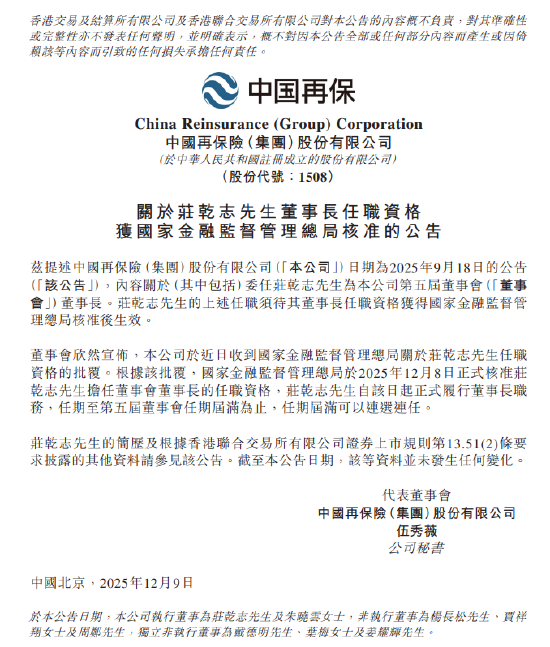
中国再保:庄乾志董事长任职资格获监管核准
Xin Lang Cai Jing· 2025-12-09 11:59
Core Viewpoint - China Reinsurance (Group) Corporation has received approval from the National Financial Supervision and Administration Commission for the appointment of Zhuang Qianzhi as the Chairman of the fifth Board of Directors, effective from December 8, 2025 [1][3]. Group 1 - Zhuang Qianzhi's term as Chairman will last until the end of the fifth Board's term, with the possibility of re-election [1][3]. - The announcement regarding Zhuang Qianzhi's appointment was initially made on September 18, 2025, pending regulatory approval [4]. - As of the date of the announcement, the executive directors of China Reinsurance include Zhuang Qianzhi and Zhu Xiaoyun, while the non-executive directors are Yang Changsong, Jia Xiangxiang, and Zhou Zheng. The independent non-executive directors are Dai Deming, Ye Mei, and Jiang Yaohui [4].

纺织制造板块12月8日跌0.11%,百隆东方领跌,主力资金净流出6278.72万元
Zheng Xing Xing Ye Ri Bao· 2025-12-08 09:04
Core Viewpoint - The textile manufacturing sector experienced a slight decline of 0.11% on December 8, with Bai Long Dong Fang leading the drop, while the overall market indices showed positive performance with the Shanghai Composite Index rising by 0.54% and the Shenzhen Component Index increasing by 1.39% [1]. Group 1: Market Performance - The Shanghai Composite Index closed at 3924.08, up 0.54% [1]. - The Shenzhen Component Index closed at 13329.99, up 1.39% [1]. - The textile manufacturing sector saw a mixed performance among individual stocks, with notable gainers and losers [1]. Group 2: Individual Stock Performance - Wan Shi Li (301066) closed at 16.93, up 10.80% with a trading volume of 182,800 shares and a transaction value of 305 million yuan [1]. - Feng Zhu Textile (600493) closed at 8.54, up 10.05% with a trading volume of 246,300 shares and a transaction value of 203 million yuan [1]. - Bai Long Dong Fang (663109) closed at 5.34, down 1.84% with a trading volume of 90,600 shares and a transaction value of 48.77 million yuan [2]. Group 3: Capital Flow Analysis - The textile manufacturing sector experienced a net outflow of 62.79 million yuan from institutional investors, while retail investors saw a net inflow of 93.39 million yuan [2]. - The capital flow for individual stocks showed varying trends, with some stocks experiencing significant net inflows from retail investors [3]. - Feng Zhu Textile had a net outflow of 39.42 million yuan from institutional investors, while retail investors contributed a net inflow of 2.10 million yuan [3].

直保公司快速响应 再保公司精准支撑
Jin Rong Shi Bao· 2025-12-03 03:17
Core Viewpoint - The insurance industry in Hong Kong has demonstrated its critical role as a stabilizer in society by effectively responding to the recent fire incident at Hongfu Garden, showcasing the importance of emergency response and claims processing in the face of major disasters [2][5][9]. Group 1: Emergency Response and Claims Processing - China Taiping Insurance (Hong Kong) has completed the first batch of home insurance claims related to the fire, paying out 5.372 million HKD [1]. - Following the fire on November 26, multiple insurance companies activated emergency claims services, including green channels for claims, rescue assistance, and simplified procedures [3][4]. - The total insured amount for the property insurance of Hongfu Garden and its public areas is 2 billion HKD, with industry assessments indicating that losses may approach this payout limit [1][5]. Group 2: Reinsurance System and Risk Management - The reinsurance system has played a vital role in sharing the risk associated with the 2 billion HKD insurance coverage, preventing any single insurer from facing overwhelming financial burdens [5][7]. - China Taiping and other reinsurers have confirmed their involvement in the reinsurance of the Hongfu Garden project, ensuring that claims processing is expedited and efficient [6][8]. - The reinsurance mechanism allows for effective risk dispersion, which is essential for maintaining market confidence during significant disaster events [7][9]. Group 3: Importance of Comprehensive Insurance Coverage - The incident highlights the necessity for building managers to prioritize adequate insurance coverage for public properties, especially during high-risk periods such as renovations [8]. - Homeowners are encouraged to recognize the importance of home insurance to protect personal belongings, as building insurance primarily covers structural and communal areas [8][9]. - The event serves as a reminder of the need for a mature and multi-layered insurance market to effectively mitigate social risks and support post-disaster recovery [8][9].

537.2万港元!香港宏福苑火灾事故首批9宗家居保险完成赔付
Guo Ji Jin Rong Bao· 2025-12-02 12:20
Core Points - China Taiping Insurance (Hong Kong) Limited has completed the first batch of home insurance claims related to the fire incident at Hong Fu Court in Tai Po, Hong Kong, paying out a total of HKD 5.372 million [1] - The fire, which occurred on November 26, resulted in 156 fatalities and approximately 30 individuals still missing as of December 2 [1] - The company has activated its emergency response mechanism and is committed to expediting the claims process under the principles of "quick compensation, full compensation, and reasonable pre-compensation" [2] Group 1 - The company has insurance coverage for various aspects of the Hong Fu Court project, including construction all-risk insurance, employee compensation insurance, third-party liability insurance, property all-risk insurance, and public liability insurance [1] - Following the fire, the China Banking and Insurance Regulatory Commission issued a notice emphasizing the need for efficient claims assessment and insurance service support [1] - Taiping Reinsurance, a subsidiary of Taiping Insurance Group, has established an emergency working group to coordinate with Taiping Hong Kong on claims solutions and ensure rapid claims processing [2][3] Group 2 - China Reinsurance Group confirmed that its subsidiary, China Re Property & Casualty Insurance, provided reinsurance coverage for the Hong Fu Court project, including property insurance and third-party liability insurance [3] - The company has initiated an emergency response mechanism to confirm loss situations and has opened a green claims channel to support local insurance companies in disaster claims [3]
探寻出海与内需的新底色:轻工纺服行业2026年度投资策略
Huachuang Securities· 2025-12-02 09:11
Group 1: New Consumption - The report emphasizes the continuous exploration of new products, channels, and brand changes within the new consumption sector, highlighting the resilience of leading companies despite market concerns about revenue growth and profit realization in 2026 [8][15][9] - Key sectors include eyewear, with a focus on AI and AR technologies, recommending companies like 康耐特光学 for their innovative approaches [18][30] - The潮玩 (trendy toys) sector is noted for its high growth potential, particularly with brands like 泡泡玛特 and their successful IP strategies [34][38] - The personal care and household cleaning segment is undergoing a transformation, driven by the rise of platforms like 抖音, which enhances brand visibility and sales conversion [54][55] Group 2: Export Chain - The report identifies the light industry export chain as a key area, emphasizing the importance of high pricing power, market diversification, and mature overseas production capabilities [10] - Recommendations include关注匠心家居, 共创草坪, and other companies that demonstrate strong performance in international markets [10] Group 3: Cyclical Opportunities - The report suggests a focus on quality leaders in the cyclical sector, particularly in home textiles and furniture, where companies like 水星家纺 and 欧派家居 are highlighted for their strong market positions [11][11] - The report notes the increasing differentiation within the home goods market, recommending companies that offer value and competitive pricing [11]



2025年1-10月全国纺织服装、服饰业出口货值为2314.2亿元,累计下滑3.7%
Chan Ye Xin Xi Wang· 2025-11-30 02:16
Core Viewpoint - The textile and apparel industry in China is experiencing a decline in export value, with significant year-on-year decreases reported for 2025 [1] Industry Summary - In October 2025, the export value of the textile and apparel industry reached 22.12 billion, marking a year-on-year decrease of 13.5% [1] - From January to October 2025, the cumulative export value was 231.42 billion, reflecting a cumulative year-on-year decline of 3.7% [1] - A statistical chart detailing the export value from 2019 to October 2025 is provided, indicating a downward trend in the industry [1] Company Summary - Listed companies mentioned include Fengzhu Textile (600493), Jiangnan High Fiber (600527), Hangmin Co., Ltd. (600987), and others, indicating a broad impact across various firms in the textile sector [1] - The report by Zhiyan Consulting highlights the investment potential and market dynamics of the textile and apparel industry from 2026 to 2032, suggesting a focus on future opportunities despite current challenges [1]


