
BROS(601339)

Search documents
百隆东方:关于变更签字注册会计师的公告
Zheng Quan Ri Bao· 2026-01-30 12:01
Group 1 - The company, Bailong Oriental, announced a change in its signing registered accountants to Tang Binbin and Ding Bosheng [2]


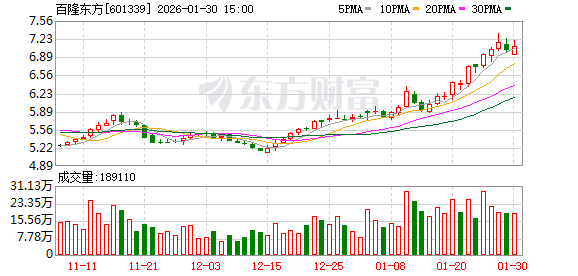
百隆东方(601339) - 百隆东方关于变更签字注册会计师的公告
2026-01-30 08:00
证券代码:601339 证券简称:百隆东方 公告编号:2026-002 百隆东方股份有限公司 关于变更签字注册会计师的公告 本公司董事会、全体董事及相关股东保证本公告内容不存在任何虚假记载、 误导性陈述或者重大遗漏,并对其内容的真实性、准确性和完整性承担法律责任。 百隆东方股份有限公司(以下简称"公司")于 2025 年 5 月 9 日召开 2024 年年度股东大会,审议通过《关于续聘天健会计师事务所(特殊普通合伙)为公 司 2025 年审计机构的议案》,同意公司聘请天健会计师事务所(特殊普通合伙) (以下简称"天健会计师事务所")担任公司 2025 年度财务报表和内部控制审计 机构,具体内容详见公司于 2025 年 4 月 16 日、5 月 10 日在上海证券交易所 (http://www.sse.com.cn)披露的《百隆东方关于续聘天健会计师事务所(特 殊普通合伙)为公司 2025 年审计机构的公告》(公告编号:2025-006)、《2024 年年度股东大会决议公告》(公告编号:2025-016)。 天健会计师事务所作为公司聘任的2025年度财务报表和2025年末财务报告 内部控制审计机构,原委派唐彬彬 ...
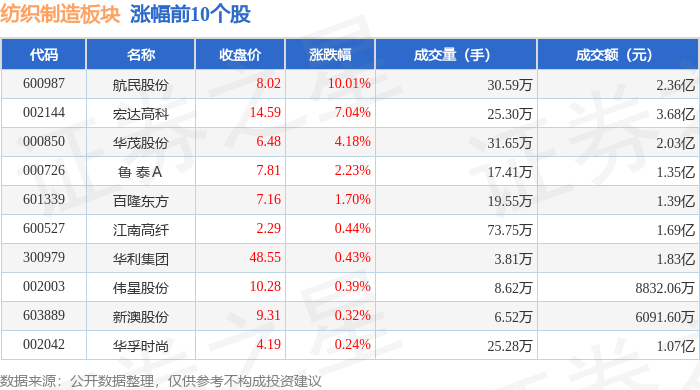
纺织制造板块1月28日涨0.01%,航民股份领涨,主力资金净流入1714.06万元
Zheng Xing Xing Ye Ri Bao· 2026-01-28 08:58
Core Viewpoint - The textile manufacturing sector experienced a slight increase of 0.01% on January 28, with Hangmin Co. leading the gains. The Shanghai Composite Index closed at 4151.24, up 0.27%, while the Shenzhen Component Index closed at 14342.9, up 0.09% [1]. Group 1: Stock Performance - Hangmin Co. (600987) closed at 8.02, with a significant increase of 10.01% and a trading volume of 305,900 shares, resulting in a transaction value of 236 million yuan [1]. - Hongda High-Tech (002144) saw a closing price of 14.59, up 7.04%, with a trading volume of 253,000 shares and a transaction value of 368 million yuan [1]. - Huamao Co. (000850) closed at 6.48, increasing by 4.18%, with a trading volume of 316,500 shares and a transaction value of 203 million yuan [1]. - Other notable performers included Lutai A (000726) with a 2.23% increase, closing at 7.81, and Bailong Oriental (665109) with a 1.70% increase, closing at 7.16 [1]. Group 2: Fund Flow Analysis - The textile manufacturing sector saw a net inflow of 17.14 million yuan from institutional investors, while retail investors contributed a net inflow of 49.03 million yuan. However, speculative funds experienced a net outflow of 66.18 million yuan [2]. - Key stocks with significant net inflows from institutional investors included Hongda High-Tech (552.67 million yuan) and Hangmin Co. (322.53 million yuan) [3]. - Retail investors showed a net inflow in stocks like Huamao Co. (549.06 million yuan), while other stocks like Hongda High-Tech and Hangmin Co. faced net outflows from retail investors [3].


25Q4 纺服基金持仓环比基本持平,12 月服装类零售额同比增长 1.2%
GUOTAI HAITONG SECURITIES· 2026-01-25 11:33
Investment Rating - The report assigns an "Overweight" rating for the textile and apparel industry [1]. Core Insights - In Q4 2025, the textile and apparel fund holdings remained stable, with a year-on-year growth of 1.2% in clothing retail sales in December, indicating a slowdown in growth compared to the previous month [3][4]. - The report highlights structural opportunities in exports and notes that the retail data from the U.S. shows resilience, with a continuous decrease in the inventory-to-sales ratio for clothing [4]. Summary by Sections Industry Data Tracking - In December 2025, the retail sales of clothing increased by 1.2%, while textile and apparel exports decreased by 7.4% [18]. - The total retail sales of consumer goods in China increased by 0.9% year-on-year, with clothing and accessories retail sales growing by 1.2% [20]. - The textile and apparel export value for December 2025 was approximately $25.992 billion, down 7.4% year-on-year [20]. Investment Recommendations - The report suggests focusing on companies with strong competitive advantages through diversified production capacity and highlights the importance of order cycle management [4]. - Recommended stocks include: - Bailing Oriental (百隆东方) [16] - Chaoying International Holdings (超盈国际控股) [16] - Anta Sports (安踏体育) [16] - Li Ning (李宁) [16] - Xtep International (特步国际) [16] - Prada (普拉达) [16] - Samsonite (新秀丽) [16] - Jiangnan Buyi (江南布衣) [16] - Taobo (滔搏) [16] - The report emphasizes the potential for mid-to-high-end product orders to show resilience and the positive outlook for cotton prices benefiting related cotton spinning enterprises [4].

2025年全国纺织业出口货值为2595.2亿元,累计下滑0.9%
Chan Ye Xin Xi Wang· 2026-01-24 02:42
Core Viewpoint - The textile industry in China is experiencing a decline in export value, with a reported decrease in both monthly and cumulative export figures for 2025 compared to the previous year [1]. Industry Summary - As of December 2025, the total export value of the textile industry in China reached 24.86 billion, reflecting a year-on-year decrease of 1% [1]. - The cumulative export value for the entire year of 2025 was 259.52 billion, showing a slight decline of 0.9% year-on-year [1]. - A statistical chart detailing the export value of the textile industry from 2019 to 2025 has been compiled based on data from the National Bureau of Statistics [1]. Company Summary - Listed companies in the textile sector include Fengzhu Textile (600493), Jiangnan High Fiber (600527), Hangmin Co., Ltd. (600987), Bailong Oriental (601339), and others [1]. - The report by Zhiyan Consulting provides an in-depth analysis of the market landscape and future prospects for the industrial textile sector in China, indicating a focus on comprehensive industry solutions for investment decisions [1].


24股获推荐,紫金矿业目标价涨幅超60%丨券商评级观察
2 1 Shi Ji Jing Ji Bao Dao· 2026-01-23 01:09
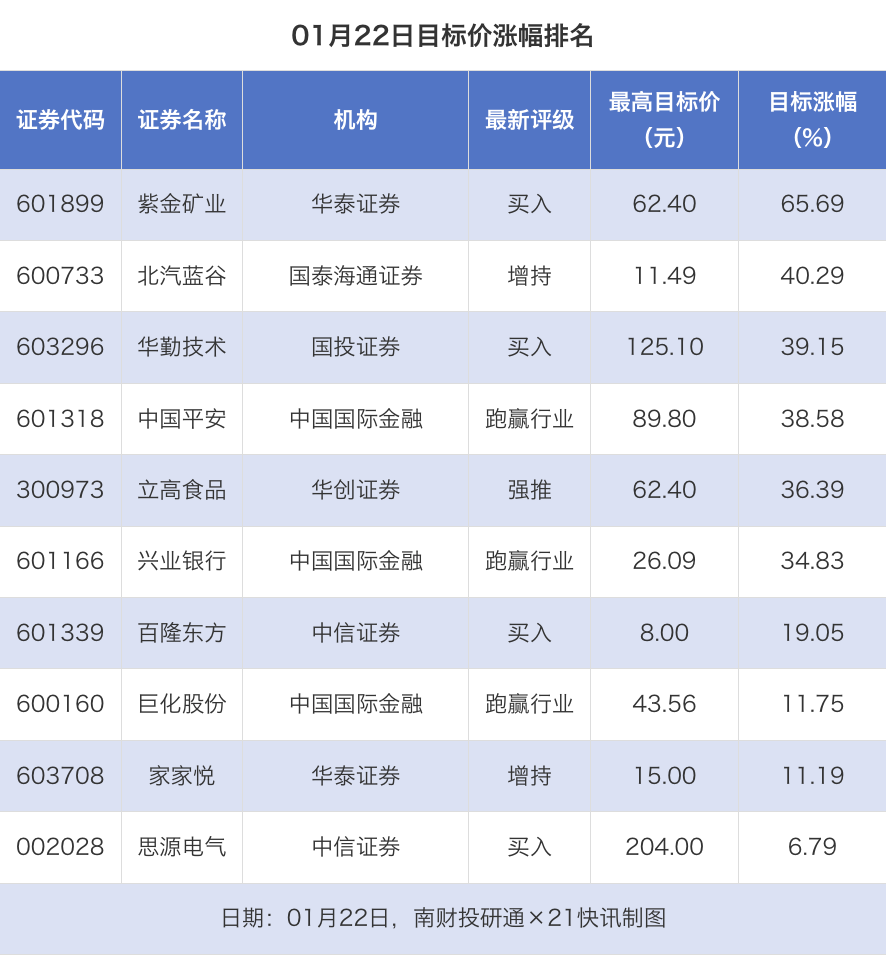
Group 1 - The core viewpoint of the article highlights the target price increases for several listed companies, with Zijin Mining, BAIC Blue Valley, and Huqin Technology leading the rankings with target price increases of 65.69%, 40.29%, and 39.15% respectively, across the industrial metals, passenger vehicles, and consumer electronics sectors [1][2]. Group 2 - On January 22, a total of 24 listed companies received recommendations from securities firms, with Lihigh Food receiving 2 recommendations, while companies like Baolong Oriental and BAIC Blue Valley received 1 recommendation each [4]. - The companies that received first-time coverage on January 22 include BAIC Blue Valley with a "Buy" rating from Guotai Junan Securities, Yanzhou Coal with an "Outperform" rating from Guosen Securities, Hezhu Intelligent with a "Buy" rating from Huayuan Securities, and Jiachih Technology with a "Buy" rating from Kaiyuan Securities [5][6].




美棉价格历史深度复盘:美国、巴西25/26产量预期双降,美棉安全边际显现
GUOTAI HAITONG SECURITIES· 2026-01-21 00:42
Report Industry Investment Rating - Not provided in the given content Core View of the Report - The global cotton supply side is experiencing a "double reduction" in exports from Brazil and the United States. The bottom characteristics of US cotton prices are clear under the dual signals of cost inversion and basis repair, and an upward channel for cotton prices is expected to open [2]. Summary by Relevant Catalogs 1. Supply - side Contraction Expectation Continues to Strengthen - **Brazil**: As the world's largest cotton exporter, it ends a 5 - year capacity expansion. The CONAB report on January 15 predicts a 6.3% year - on - year decrease in cotton production in 25/26, with continuous downward revisions since October 2025. The core producing state of Mato Grosso is expected to have a more radical production cut of 14.5% [3]. - **United States**: The latest WASDE report on January 12 significantly revises down the 25/26 cotton yield per unit by 7.8%, reduces production by 2.5%, and the inventory - to - consumption ratio drops, significantly alleviating inventory pressure [3]. 2. Hard Logic Behind the Production Cut - **Brazilian farmers' profit situation**: Brazilian cotton farmers face a loss with a cost - return rate of - 15.5%, while the competing second - season corn still has an 8.4% return, and the operating cost of corn is only one - third of that of cotton [4]. - **Sowing progress**: Brazil's current sowing rate is only 8.1% (compared to 14.2% in the same period last year). Missing the best growth period for cotton will further strengthen the production cut expectation [4]. 3. Clear Bottoming of US Cotton Prices - **Cost inversion**: The current price (~65 cents/pound) is significantly lower than the average US planting cost (~80 cents/pound) and approaches the policy mortgage interest rate (54.4 cents/pound), with very limited downward space [5]. - **Basis signal**: The basis of basic - grade cotton is at a historical low. High - quality cotton in January has shown a positive basis, which is judged as a leading signal for a medium - term upward price movement [5]. - **Investment advice**: With the implementation of the production cut expectation and the stricter traceability of clothing exports to the United States, the procurement concentration of US cotton is expected to increase. It is recommended to focus on [Bailong Eastern Co., Ltd.], and related target [Texhong International Group]. The low - cost cotton inventory held by these companies will release significant profit elasticity during the upward cycle of cotton prices, and the gross profit margin is expected to be repaired in a positive basis environment [5]. Historical US Cotton Price Analysis - The historical US cotton price has fluctuated greatly due to various factors such as events, policies, and climate. For example, in 2011, the cotton price reached a new high due to factors such as China's cotton purchase and storage policy, India's export ban, and Pakistan's floods [8]. Global Cotton Production and Export Situation - **24/25 Global Top Ten Cotton - Producing Countries**: The top four cotton - producing countries (China, India, Brazil, and the United States) account for about 73% of the total global output. China and India mainly consume their output domestically, while Brazil and the United States export their output [19]. - **24/25 Global Top Ten Cotton - Exporting Countries**: Brazil and the United States together account for nearly 60% of the global cotton export volume. The change in Brazil's supply - demand structure will have a significant impact on the trend of US cotton prices [22]. - **Production Growth of Top Ten Cotton - Exporting Countries**: From 20/21 - 24/25, the production growth rates of different countries vary. For example, Mali has a 257% growth rate, while India has a - 16% growth rate [24]. US Cotton Situation - **25/26 Production Forecast**: Despite the expected increase in the harvested area of US 25/26 cotton, the yield per unit is significantly reduced by 7.8%, resulting in a 2.5% decrease in production compared to the December forecast and a 3.4% decrease compared to 2024/25. The inventory - to - consumption ratio decreases [27]. - **Export Market Change**: In 2018, affected by the Sino - US trade friction, Vietnam became the largest importer of US cotton. In 2024, China regained the top position. It is expected that Southeast Asian countries may increase their procurement of US cotton [29]. Brazilian Cotton Situation - **25/26 Supply and Demand Forecast**: The CONAB report on January 15, 2026, predicts that Brazil's 25/26 cotton planting area will decrease by 2.8% compared to 2024/25, and the output is expected to be 3.82 million tons, a 6.3% decrease from the October 2025 forecast [31]. - **Sowing and Yield**: The sowing rate and yield of Brazilian cottonseeds in 25/26 are lower than last year. The sowing rate is 31.9%, 1.6 percentage points lower than 24/25, and the expected output of cottonseeds in 25/26 is down 6.3% year - on - year and 3.6% month - on - month [34]. - **Mato Grosso State**: The IMEA has significantly reduced the 25/26 planting area in Mato Grosso State by 7.3%, and the total lint output is expected to decrease by 14.5% due to area reduction and yield per unit returning to the average [38]. - **Profit Analysis**: Brazilian cotton planting in the 25/26 season has a cost - return rate of - 15.5%. Competing second - season corn has a better profit situation, and there is a possibility of farmers switching to corn planting. In addition, the current price of Brazilian lint is lower than the US cotton futures price, and the basis decline is widening [40].
纺织服装业行业跟踪报告巴西棉结束近5年扩产,美棉价格明确筑底
海通国际· 2026-01-21 00:30
Investment Rating - The investment rating for Bros Eastern is "Outperform" with an expected relative return exceeding the benchmark index by more than 10% over the next 12-18 months [4]. Core Insights - The report highlights a significant supply contraction in two major cotton exporting countries: the USA and Brazil, marking a turning point in global cotton supply with a "double reduction" pattern [5][6]. - The USA's cotton yield forecast has been cut by 8% to 856 pounds per acre, leading to a 2% reduction in final output, while Brazil's planting area is expected to decrease by 2.8% and production by 6.3% to 3.82 million tons, the first decline in five years [5][6]. - The report indicates that the US cotton price is showing bottoming characteristics, with current prices around 65 cents per pound, significantly below the average planting cost of 80 cents per pound, suggesting limited downside potential [6][8]. - Brazil's supply-demand changes are identified as a key variable affecting US cotton prices, with estimates indicating a 15.6% cost return rate loss for Brazilian cotton farmers, further supporting the supply contraction narrative [7][8]. Summary by Sections Supply Contraction - The USA's WASDE report indicates an increase in harvested area but a significant yield reduction, easing inventory pressure [5]. - Brazil's CONAB report predicts a decrease in both planting area and production, particularly in Mato Grosso, which accounts for 70% of Brazil's cotton output [5][6]. Price Dynamics - The ICE No. 2 cotton futures price is at a historical low, indicating a clear bottoming trend, with a significant cost inversion against planting costs [6][8]. - The basis analysis shows that the cotton basis is at historical lows, with signs of structural recovery, suggesting potential price increases in the medium term [6][8]. Investment Recommendations - The report recommends Bros Eastern due to its low-cost cotton inventory, which is expected to provide significant profit elasticity as cotton prices rise [8]. - The anticipated increase in raw material prices is expected to boost yarn sales prices and restore gross profit margins through inventory appreciation [8].
纺织服装业:巴西棉结束近5年扩产,美棉价格明确筑底
GUOTAI HAITONG SECURITIES· 2026-01-18 08:09
Investment Rating - The report assigns an "Accumulate" rating for the industry [2] Core Insights - The supply contraction from two major cotton-exporting countries has been established, with a downward revision in U.S. cotton yield and the first decline in Brazilian cotton production and area in five years [3] - U.S. cotton prices are showing significant bottoming characteristics, with ICE 2 cotton futures significantly below planting costs and basis signals confirming this trend [3] - The core variable is anchored in Brazil, with multi-dimensional data confirming the inevitability of production cuts [3] Summary by Sections Supply Dynamics - The global cotton supply is reaching a critical turning point characterized by a "double reduction" pattern. The USDA's January 2026 report indicates an 8% downward revision in U.S. cotton yield to 856 pounds per acre, leading to a 2% decrease in total production compared to December forecasts. This has alleviated inventory pressure [5] - Brazil, as the world's largest cotton exporter, is experiencing a termination of its supply expansion cycle. The CONAB report predicts a 2.8% reduction in planting area and a 6.3% decrease in production to 3.82 million tons for the 25/26 season, marking the first reduction in both area and production in five years [5] Price Dynamics - U.S. cotton prices have been in a prolonged downturn for nearly three years, with current ICE 2 cotton futures around 65 cents per pound, placing it in the 20% historical low range since 2015. The current price is significantly below the average planting cost of approximately 80 cents per pound, indicating limited downward price potential [5] - Historical data shows that the basis for U.S. cotton has reached a low point, with high-quality cotton exhibiting a positive basis in January, suggesting a structural basis recovery as a leading indicator for mid-term price increases [5] Investment Recommendations - The report is optimistic about the performance elasticity of Bailong Oriental under the upward driving force of U.S. cotton prices. The expected downward revision in U.S. cotton production and the end of Brazil's capacity expansion provide a solid foundation for U.S. cotton price support [5] - The report recommends Bailong Oriental, which holds low-cost cotton inventory that will release significant profit elasticity as cotton prices rise. The increase in raw material prices is expected to boost yarn sales prices and significantly restore gross margins through inventory appreciation in a positive basis environment [5][6]
2025中国企业ESG“金责奖”责任投资最佳保险公司奖揭晓
Xin Lang Cai Jing· 2026-01-15 07:43
Core Viewpoint - The 2025 China Enterprise ESG "Golden Responsibility Award" aims to recognize companies that excel in environmental, social, and governance (ESG) practices, promoting sustainable development in China [1][4]. Group 1: ESG Award Overview - The award selection process began in November 2025, attracting over 5,000 companies to participate [5]. - The evaluation criteria included comprehensive ESG performance, professional scoring, and online voting results [5]. - The award is intended to encourage more companies to enhance their ESG capabilities and contribute to high-quality development in China [2][5]. Group 2: Award Recipients - The "Best Responsible Investment Insurance Company" award was given to China Life Insurance, China Pacific Insurance, China Reinsurance, Sunshine Insurance, China People's Insurance, and China Ping An [2][5]. - The award committee congratulated the winning companies and expressed hope for them to lead by example in improving ESG performance [2][5]. Group 3: ESG Rating Center Introduction - The Sina Finance ESG Rating Center is the first Chinese platform dedicated to ESG information and ratings, promoting sustainable development and responsible investment [3][6]. - The center aims to establish ESG evaluation standards suitable for China's characteristics and enhance corporate ratings [3][6]. - It also publishes multiple ESG innovation indices to provide investors with more options regarding corporate ESG performance [3][6].


