CH ENERGY ENG(601868)

Search documents
“能源绿色低碳转型”看山东之肥城:精心打造能源绿色低碳转型试点样板
Zhong Guo Fa Zhan Wang· 2026-02-04 06:43
Core Viewpoint - The city of Feicheng in Shandong Province is actively promoting the development of new energy and renewable energy sectors, achieving significant progress in green and low-carbon energy transformation, particularly in salt cavern energy storage and new battery electrode materials [1] Group 1: Energy Transformation Achievements - By 2024, the energy consumption per unit of GDP in Feicheng is expected to decrease by 26.2% [1] - As of September 2025, non-fossil energy consumption is projected to account for 31.5% of the total, with installed capacity of new and renewable energy reaching 1.6292 million kilowatts, representing 63.26% of total power generation capacity [1] - Feicheng's energy transformation has led to its recognition as a "Top Ten Industry" innovation leading area in the province, with its salt cavern energy storage industry cluster being selected as a first batch future industry cluster [1] Group 2: Organizational Leadership and Support - The municipal government has prioritized new energy initiatives in its 2025 government work report and established a dedicated industrial promotion committee to oversee the development of the new energy industry chain [2] - Specialized teams have been formed to focus on the salt cavern energy storage and new battery electrode materials sectors, facilitating coordinated development and addressing specific industry challenges [2] Group 3: Resource Allocation and Planning - Feicheng is focusing on gathering quality resources such as land and funding to support the new energy industry, with a comprehensive plan for salt cavern energy storage and gas utilization [3] - The city has secured significant funding for various projects, including a 100MW new carbon dioxide energy storage project and a 350MW compressed air energy storage project [3] Group 4: Traditional and New Energy Integration - The city is committed to maintaining stable energy production, with coal production expected to reach 1.0705 million tons in 2024 and significant coal storage capacity established [4] - New energy sources are also expanding, with total installed capacity for centralized and distributed solar power reaching 650,000 kilowatts and 600,000 kilowatts respectively, alongside wind power capacity of 195,000 kilowatts [4] Group 5: Salt Cavern Energy Storage and Lithium Battery Industry - Feicheng is developing a comprehensive salt cavern energy storage industry, with plans for a new energy storage industrial demonstration base covering over 2,500 acres and 22 ongoing projects [5][6] - The city is enhancing its lithium battery industry by establishing a complete industrial chain from lithium ore processing to battery recycling, with significant investments in new projects [7] Group 6: Technological Innovation and Low-Carbon Living - The city is fostering technological innovation in the energy sector through collaborations with numerous universities and research institutions, resulting in multiple awards and recognitions [8] - Efforts to promote low-carbon living include the development of green buildings, electric public transportation, and geothermal energy projects, contributing to a sustainable urban environment [9]


中国能建涨2.08%,成交额9.94亿元,主力资金净流入3185.14万元
Xin Lang Zheng Quan· 2026-02-04 06:23
Core Viewpoint - China Energy Construction Co., Ltd. (China Energy) has shown a mixed performance in stock price and financial metrics, with a recent increase in stock price but a decline in net profit year-on-year [1][3]. Group 1: Stock Performance - On February 4, China Energy's stock price increased by 2.08%, reaching 2.45 CNY per share, with a trading volume of 9.94 billion CNY and a turnover rate of 1.27%, resulting in a total market capitalization of 102.14 billion CNY [1]. - Year-to-date, the stock price has risen by 4.26%, with a slight decline of 0.41% over the last five trading days, a 3.38% increase over the last 20 days, and a 0.41% decrease over the last 60 days [1]. Group 2: Financial Performance - For the period from January to September 2025, China Energy reported a revenue of 323.54 billion CNY, reflecting a year-on-year growth of 9.62%. However, the net profit attributable to shareholders decreased by 12.43% to 3.16 billion CNY [3]. - Since its A-share listing, China Energy has distributed a total of 4.69 billion CNY in dividends, with 3.75 billion CNY distributed over the past three years [3]. Group 3: Company Overview - China Energy, established on December 19, 2014, and listed on September 28, 2021, primarily engages in construction contracting, operating through five business segments: surveying and design, engineering construction, equipment manufacturing, civil blasting and cement production, and investment and other businesses [2]. - The revenue composition of China Energy is as follows: engineering construction accounts for 81.18%, industrial manufacturing 7.42%, investment operations 6.80%, surveying and design 4.07%, and other businesses 0.53% [2].
申万宏源证券晨会报告-20260204
Shenwan Hongyuan Securities· 2026-02-04 00:43
Core Insights - The report discusses the implementation of the "Tax Law Principle" and its implications for service industries such as internet and finance, indicating that current tax arrangements are unlikely to change significantly in the short term [2][3][12] - The real estate sector is experiencing a favorable shift in financing policies, with REITs and private placements opening new equity financing channels to alleviate financial pressures on real estate companies [3][13] Tax Law Implementation - The State Council approved the "Implementation Regulations of the Value-Added Tax Law of the People's Republic of China" on December 19, 2025, and subsequent announcements have clarified tax details, suggesting stability in tax arrangements for service industries [2][3][12] - The definition of "basic services" in telecommunications is evolving, with mobile data and internet broadband still classified as "value-added services" subject to a 6% VAT rate, while traditional voice services are recognized as "basic services" with a 9% VAT rate [2][3][12] Real Estate Sector Analysis - The financing environment for the real estate industry is improving, with a shift from debt financing to equity financing, including the introduction of REITs and private placements [3][13] - Recent regulatory changes, such as the gradual retreat from the "three red lines" policy, indicate a more supportive financing environment for real estate companies [13] - The report maintains a "positive" rating for the real estate sector, highlighting the potential for recovery in the industry as financing policies become more favorable [3][13] Investment Recommendations - The report recommends several quality real estate companies for investment, including China Jinmao, Poly Developments, and China Resources Land, among others, due to their potential for recovery and attractive valuations [13] - The report emphasizes the importance of monitoring the evolving financing landscape and the impact of government policies on the real estate market [3][13]





光热发电如何破解成本难题?
Ke Ji Ri Bao· 2026-02-04 00:35
Core Viewpoint - The development of concentrated solar power (CSP) in China is gaining momentum, with a target of reaching 15 million kilowatts of installed capacity by 2030, while addressing challenges such as high initial investment and market competitiveness [1][6]. Group 1: Current Projects and Developments - The Qinghai Energy Group's Qingyu DC Phase II 100,000 kW CSP project is continuously supplying electricity to the grid, showcasing the ongoing advancements in CSP technology [1]. - The Hami "Solar (Thermal) Storage" 1500 MW base project integrates 150 MW of CSP with 1350 MW of photovoltaic (PV) capacity, demonstrating the synergy between CSP and PV technologies [2]. - As of the end of 2025, China's operational CSP capacity is expected to reach approximately 1.62 million kW, ranking third globally, with 2.7 million kW under construction, accounting for over 90% of global CSP construction [3]. Group 2: Technological Advancements - China has successfully mastered various CSP technologies, including tower, trough, and Fresnel systems, with ongoing innovations such as the 800 MW PV + 100 MW CSP integrated project in Tibet [4]. - The development of the "four towers and one machine" supercritical 350 MW unit is underway, aiming for over 3000 hours of annual electricity generation [5]. - The domestic production rate of equipment and materials for CSP is nearing 100%, positioning China as a leader in the global CSP market [5]. Group 3: Cost Challenges and Policy Support - The average total investment for CSP projects of 100 MW and above is approximately 15,000 yuan per kW, which is about three times that of equivalent PV projects, leading to financial losses under current pricing conditions [6]. - The recent policy document proposes compensation for reliable capacity of qualifying CSP projects, which could significantly enhance the cost competitiveness of CSP [6]. - Qinghai Province has set a fixed grid price of 0.55 yuan per kWh for CSP projects included in its development plan from 2024 to 2028, providing a degree of certainty for the industry [6]. Group 4: Future Outlook and Strategic Recommendations - The industry is exploring various avenues for cost reduction, including expanding unit sizes, developing new types of molten salts, and optimizing mirror field designs, with potential cost reductions of 0.13 yuan per kWh in the next 3-5 years [7]. - To achieve the target of 15 million kW, efforts must focus on planning, implementation, and ensuring support for land, finance, and policy [7]. - CSP is expected to transition from a backup option to a key support role in the energy system, contributing to carbon reduction in conjunction with coal power and providing green electricity for various industries [7].
光热发电如何破解成本难题?
Ke Ji Ri Bao· 2026-02-03 23:30
Core Viewpoint - The article discusses the development and challenges of solar thermal power generation in China, highlighting the government's goal to reach a total installed capacity of approximately 15 million kilowatts by 2030, with the cost of electricity per kilowatt-hour aiming to be comparable to coal power [1][9]. Group 1: Current Developments - The Qinghai Energy Group's solar thermal project is actively supplying electricity to the grid, showcasing the ongoing advancements in solar thermal technology [1]. - The "Several Opinions on Promoting the Large-Scale Development of Solar Thermal Power Generation" outlines ambitious targets for the industry, emphasizing the need for cost reduction and market competitiveness [1][9]. - As of 2025, China's operational solar thermal power capacity is expected to reach approximately 1.62 million kilowatts, ranking third globally, with a significant portion of the world's ongoing projects [5][8]. Group 2: Technical Aspects - Solar thermal power generation involves three main steps: concentrating sunlight, heating and storing energy, and generating electricity, which allows for stable and continuous power supply [4]. - The technology has evolved to include various methods such as tower, trough, and Fresnel systems, with significant advancements in efficiency and cost reduction [7][8]. - The integration of solar thermal with photovoltaic systems is being explored to enhance energy storage and conversion efficiency [4][7]. Group 3: Economic Considerations - Despite the promising outlook, the high initial investment remains a significant barrier, with costs for large-scale projects being approximately three times that of equivalent photovoltaic systems [9]. - The government has proposed compensation for reliable capacity in solar thermal projects, which could significantly improve the economic viability of these projects [9]. - Technological innovations and optimization strategies are expected to further reduce the cost of electricity generated from solar thermal power, potentially lowering it to around 0.53 yuan per kilowatt-hour for larger plants [10]. Group 4: Future Outlook - The article emphasizes the importance of policy support and technological advancements in expanding the application of solar thermal power, positioning it as a critical component in China's energy transition [9][10]. - The development of solar thermal power is seen as a key strategy for achieving a stable and reliable new energy system in China [10].

建筑装饰行业2025年报前瞻题:投资趋缓,利润承压
Shenwan Hongyuan Securities· 2026-02-03 13:12
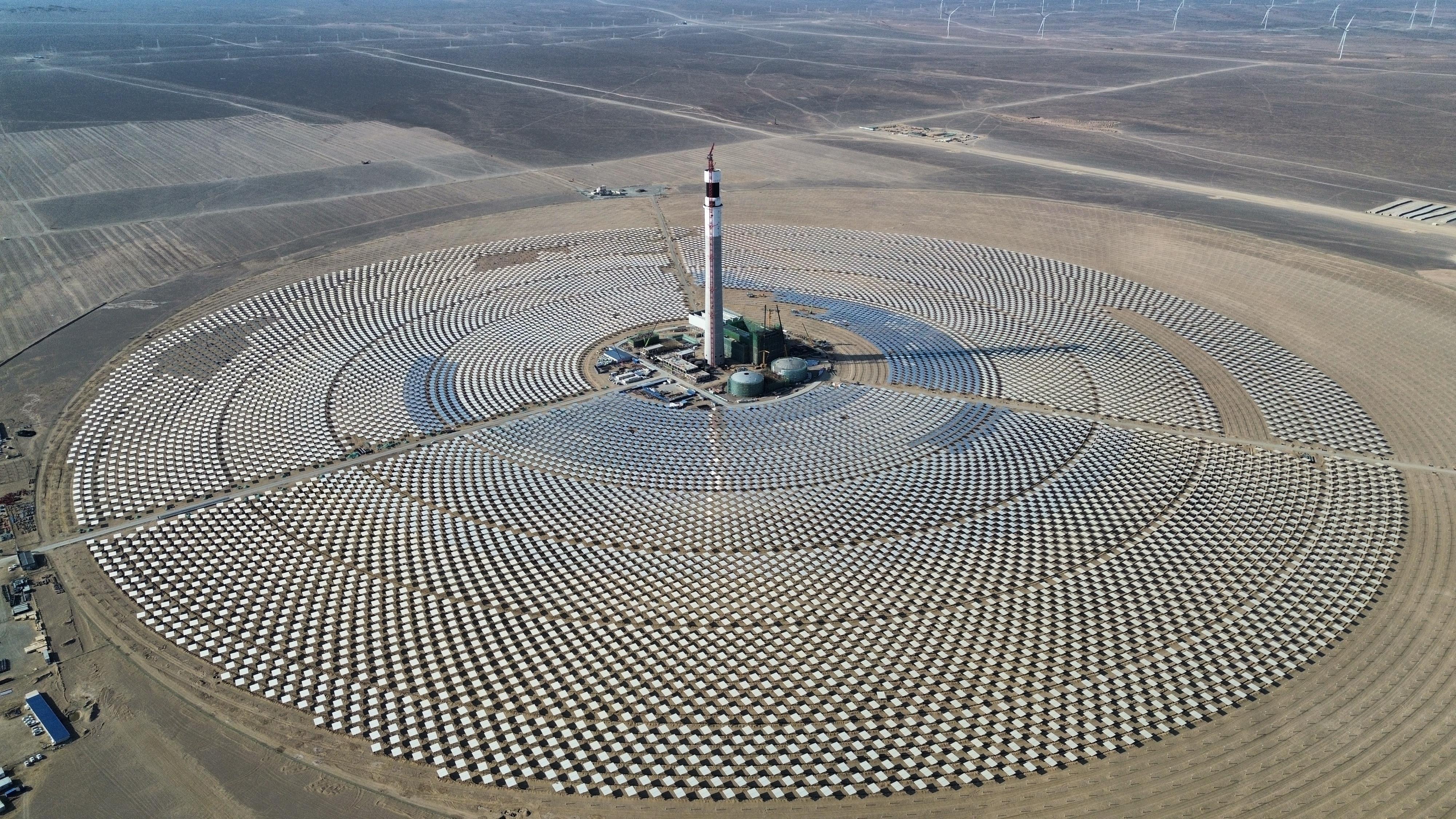
Investment Rating - The report rates the construction and decoration industry as "Overweight" for 2025, indicating an expectation for the industry to outperform the overall market [2][10]. Core Insights - Fixed asset investment growth is slowing, with infrastructure, manufacturing, and real estate facing pressures. In 2025, infrastructure investment (full caliber) is expected to decline by 1.5% year-on-year, while investment excluding electricity is projected to decrease by 2.2% [4][5]. - The report anticipates that corporate profits will face slight pressure due to the slowdown in fixed asset investment and a focus on project quality. Key companies are expected to have varying profit growth rates, with some projected to decline by over 10% [4][5]. - There is a strong expectation for policy support to catalyze valuation recovery for construction companies. The current price-to-earnings (PE) ratio is 13.4X and price-to-book (PB) ratio is 0.83X as of February 3, 2026 [4][5]. - The report suggests that 2026, as the starting year of the "14th Five-Year Plan," presents a favorable investment window, particularly in the steel structure sector and among undervalued state-owned enterprises [4][5]. Summary by Sections Investment Environment - The report highlights a slowdown in fixed asset investment growth, with specific declines in various sectors, including transportation and public facilities [4]. - The central government's focus on stabilizing investment and addressing local government debt is expected to provide some support for future investments [4]. Profit Forecasts - Profit growth forecasts for key companies in 2025 show a range from declines of over 10% to increases of over 20%, indicating a mixed outlook across the industry [5]. - Companies such as China Railway and China Communications Construction are expected to see significant profit declines, while others like Jinggong Steel and Zhizhi New Materials may experience substantial growth [5]. Valuation and Investment Recommendations - The report emphasizes the potential for valuation recovery in the construction sector, driven by optimistic expectations regarding economic stimulus policies and debt resolution efforts [4]. - Specific companies to watch include Honglu Steel Structure, Jinggong Steel Structure, and China Chemical Engineering, among others, as they are positioned to benefit from the anticipated recovery [4].






基础建设板块2月3日涨1.49%,国晟科技领涨,主力资金净流入1.9亿元
Zheng Xing Xing Ye Ri Bao· 2026-02-03 09:03
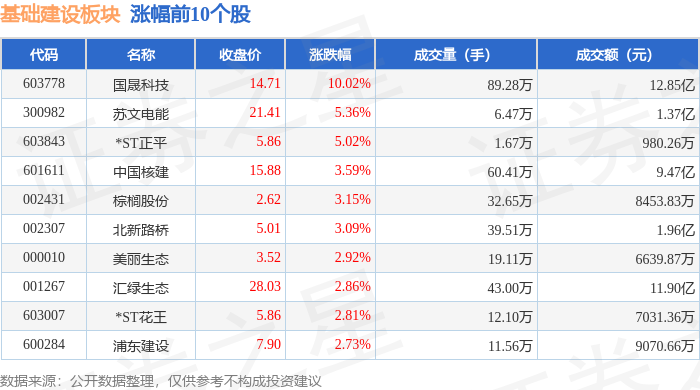
Market Overview - The infrastructure sector increased by 1.49% compared to the previous trading day, with Guosheng Technology leading the gains [1] - The Shanghai Composite Index closed at 4067.74, up 1.29%, while the Shenzhen Component Index closed at 14127.1, up 2.19% [1] Key Stocks Performance - Guosheng Technology (603778) closed at 14.71, up 10.02% with a trading volume of 892,800 shares [1] - Suwen Electric Power (300982) closed at 21.41, up 5.36% with a trading volume of 64,700 shares [1] - China Nuclear Engineering (601611) closed at 15.88, up 3.59% with a trading volume of 604,100 shares [1] - Other notable stocks include Palm Holdings (002431) up 3.15% and Beixin Road and Bridge (002307) up 3.09% [1] Capital Flow Analysis - The infrastructure sector saw a net inflow of 190 million yuan from institutional investors, while retail investors experienced a net outflow of 38.83 million yuan [2] - Major stocks like China Railway (601390) had a net inflow of 138 million yuan from institutional investors [3] - Guosheng Technology (603778) had a net inflow of 87.57 million yuan from institutional investors, but a net outflow of 69.54 million yuan from retail investors [3] Trading Volume and Value - The trading volume for Guosheng Technology reached 12.85 billion yuan, indicating strong investor interest [1] - The total trading value for the infrastructure sector was significant, with China Electric Power (601669) recording a trading value of 1.1 billion yuan [2]



广东首个200千伏构网型独立储能项目开工
Zhong Guo Hua Gong Bao· 2026-02-03 06:37
Core Viewpoint - The commencement of the 200 MW/400 MWh independent energy storage project in Shishan, Nanhai District, Foshan, Guangdong, marks a significant step in the region's energy infrastructure development, aiming to enhance energy regulation and stability in the power grid [1] Group 1: Project Details - The project is the first large-scale grid-connected energy storage station in Guangdong Province, utilizing a 220 kV voltage level [1] - It will employ advanced technologies such as liquid cooling systems and intelligent operation and maintenance [1] - Upon completion, the facility will provide a daily power regulation capacity of 400 MWh, serving as an "energy regulator" and "safety stabilizer" for the Foshan power grid [1] Group 2: Company Initiatives - The company has been actively expanding its new energy storage business by constructing various demonstration projects, including flywheel and electrochemical energy storage [1] - It aims to optimize energy structure and ensure power safety through the development of transmission, transformation, and new energy projects in Guangdong [1] - The company plans to concentrate its resources and expertise to create high-quality benchmark projects, ensuring timely production and stable operation [1]
基建ETF华夏(159635)涨1.24%,半日成交额811.13万元
Xin Lang Cai Jing· 2026-02-03 03:39
Group 1 - The core viewpoint of the article highlights the performance of the Infrastructure ETF Huaxia (159635), which rose by 1.24% to 1.140 yuan with a trading volume of 8.1113 million yuan as of the midday close on February 3 [1] - The major holdings of the Infrastructure ETF Huaxia include several companies, with notable increases in stock prices: XCMG Machinery up 2.75%, Zoomlion up 4.40%, and Sany Heavy Industry up 2.20% [1] - The performance benchmark for the Infrastructure ETF Huaxia is the CSI Infrastructure Index return, managed by Huaxia Fund Management Co., Ltd. Since its establishment on June 28, 2022, the fund has achieved a return of 12.52%, with a monthly return of 0.75% [1]




世界500强企业中国能建在海南布局首个矿山项目
Hai Nan Ri Bao· 2026-02-02 08:37
Core Viewpoint - China Energy Construction Group (China Energy) is launching its first mining project in Hainan, focusing on technological innovation to empower traditional industries and aiming to create a "future mine" that is smart and green [4][10]. Investment Overview - The total investment for the Daling granite mining project in Ding'an County is approximately 2.045 billion yuan, covering an area of 0.71 square kilometers with a recoverable reserve of over 33.2 million cubic meters, expected to be operational by the end of March 2025 [5][6]. - The project benefits from Hainan's free trade port policies, which include zero tariffs on imported production equipment, significantly reducing operational costs [6]. Technological Empowerment - The project features nine unmanned electric mining trucks that operate efficiently through the integration of 5G and AI technologies, achieving three times the transportation efficiency compared to traditional methods [8][9]. - AI-driven systems enable automated loading, intelligent inspections, and real-time monitoring, reducing the workforce by over 50% and increasing production efficiency by over 30% [9]. Sustainability Initiatives - The mining project incorporates a green energy utilization model, combining distributed energy sources with intelligent management, aiming for an annual power generation of approximately 4.05 million kWh and a reduction of 3,260 tons of CO2 emissions per year [10][11]. - A carbon emission management platform has been established to monitor and analyze energy consumption and carbon emissions throughout the mining process, achieving a 70% reduction in unit energy consumption compared to industry averages [11]. Environmental Impact - The project has improved vegetation coverage from less than 10% to 85% by planting over 4,200 economic crops and implementing a 3D model for resource planning and ecological restoration [11]. - The project has been recognized as a provincial-level green mine, reflecting its commitment to ecological and economic benefits [11].