
CHINT ELECTRICS(601877)

Search documents
未来电器:公司主要客户群体集中在低压电器行业,包括正泰电器、良信股份、常熟开关等
Mei Ri Jing Ji Xin Wen· 2025-09-19 03:53
Group 1 - The company primarily serves the low-voltage electrical industry, with major clients including well-known domestic and international enterprises such as Chint Electric, Liangxin, Changshu Switch, Delixi, Xiamen Hongfa, Taiyong Changzheng, Shou Rui Tianjin, Schneider, ABB, Siemens, and Eaton, as well as State Grid and Southern Power Grid [1] - The main products of the company include frame circuit breaker accessories, plastic shell circuit breaker accessories, and smart terminal electrical devices, with some products applied in data center power protection scenarios through downstream customer applications [1]


正泰电器9月17日获融资买入6601.94万元,融资余额6.90亿元
Xin Lang Cai Jing· 2025-09-18 01:27
Core Viewpoint - On September 17, 2023, Zhejiang Chint Electrics Co., Ltd. experienced a stock price increase of 1.88% with a trading volume of 582 million yuan, indicating active market interest and trading activity in the company’s shares [1]. Financing Summary - On the same day, Chint Electrics recorded a financing purchase amount of 66.02 million yuan, while the financing repayment was 70.26 million yuan, resulting in a net financing outflow of 4.24 million yuan [1]. - As of September 17, the total financing and securities lending balance for Chint Electrics was 691 million yuan, with the financing balance accounting for 1.14% of the circulating market value, which is above the 70th percentile level over the past year, indicating a relatively high financing level [1]. Securities Lending Summary - On September 17, Chint Electrics had a securities lending repayment of 3,900 shares and a securities lending sale of 4,800 shares, amounting to a selling value of 135,000 yuan based on the closing price [1]. - The remaining securities lending volume was 46,900 shares, with a securities lending balance of 1.32 million yuan, also exceeding the 70th percentile level over the past year, suggesting a high level of short selling activity [1]. Company Overview - Chint Electrics, established on August 5, 1997, and listed on January 21, 2010, is located in the Chint Industrial Park in Zhejiang Province. The company specializes in low-voltage electrical equipment and electronic products, including power distribution, terminal equipment, control equipment, and solar energy products [2]. - The revenue composition of Chint Electrics includes 32.76% from photovoltaic power station engineering contracting, 18.79% from power station operation, and various other segments contributing to the overall revenue [2]. Financial Performance - For the first half of 2025, Chint Electrics reported a revenue of 29.62 billion yuan, reflecting a year-on-year growth of 2.18%, while the net profit attributable to shareholders was 2.55 billion yuan, marking a significant year-on-year increase of 32.90% [2]. Shareholder Information - As of June 30, 2025, the number of shareholders for Chint Electrics was 88,400, a decrease of 9.07% from the previous period, with an average of 24,312 circulating shares per shareholder, which is an increase of 9.97% [3]. - The company has cumulatively distributed 15.65 billion yuan in dividends since its A-share listing, with 3.32 billion yuan distributed over the past three years [3].
正泰电器涨2.06%,成交额4.30亿元,主力资金净流入966.16万元
Xin Lang Zheng Quan· 2025-09-17 06:55
Core Viewpoint - The stock of Zhejiang Chint Electric Co., Ltd. has shown a significant increase in price and trading volume, indicating positive market sentiment and investor interest in the company [1][3]. Company Overview - Zhejiang Chint Electric Co., Ltd. was established on August 5, 1997, and went public on January 21, 2010. The company specializes in low-voltage electrical equipment, electronic instruments, and automation control systems, among other products [2]. - The main revenue sources for the company include photovoltaic power station engineering contracting (32.76%), power station operation (18.79%), terminal electrical equipment (13.01%), and distribution electrical equipment (11.23%) [2]. Financial Performance - As of June 30, 2025, Chint Electric reported a revenue of 29.619 billion yuan, representing a year-on-year growth of 2.18%. The net profit attributable to shareholders was 2.554 billion yuan, showing a significant increase of 32.90% year-on-year [3]. - The company has distributed a total of 15.650 billion yuan in dividends since its A-share listing, with 3.319 billion yuan distributed in the last three years [4]. Shareholder Information - As of June 30, 2025, the number of shareholders decreased to 88,400, with an average of 24,312 circulating shares per person, which is an increase of 9.97% from the previous period [3]. - The top ten circulating shareholders include Hong Kong Central Clearing Limited, which holds 132 million shares, an increase of 16.2443 million shares from the previous period [4].
山东省市场监督管理局公布2025年断路器产品质量省级监督抽查结果
Zhong Guo Zhi Liang Xin Wen Wang· 2025-09-16 06:24
Core Points - The Shandong Provincial Market Supervision Administration recently announced the results of the provincial quality supervision inspection for circuit breaker products in 2025, with a total of 23 batches inspected, including 1 batch from the production stage and 22 batches from the sales stage [3][4] Group 1: Inspection Standards and Results - The inspection was conducted based on several national standards, including GB/T 14048.2-2020 and GB/T 10963.1-2020, focusing on various performance tests such as tripping limits, short-circuit capacity, temperature rise, and dielectric strength [3] - No non-compliant items were found during the inspection, indicating a positive outcome for the circuit breaker products tested [4] Group 2: Summary of Inspected Products - A total of 23 circuit breaker products were inspected, with all passing the quality checks. Notable manufacturers included Shandong Taikai Electric Co., Ltd. and Schneider Electric [5][6] - The inspection covered various types of circuit breakers, including plastic shell circuit breakers and residual current circuit breakers, with specifications ranging from 16A to 250A [5][6]


长三角出海中东对接会签约超1亿美元
Mei Ri Shang Bao· 2025-09-15 22:24
Group 1 - The event "2025 Yangtze River Delta (Jiaxing) Cooperation and Exchange with the Middle East" aims to enhance economic and trade exchanges between Zhejiang and Middle Eastern countries, injecting new momentum into their cooperation [1] - In 2024, the trade volume between Zhejiang and Middle Eastern countries reached 83.1 billion USD, accounting for 18.45% of China's total trade with the region, maintaining the top position nationally [1] - From January to June 2025, the trade volume reached 43.4 billion USD, showing a year-on-year growth of 4.3%, with the national share increasing to 18.99% [1] Group 2 - Zhejiang enterprises have cumulatively invested over 100 billion CNY in the Middle East, with notable projects including a 10GW battery and component project by Jinko Solar in Saudi Arabia, and a 1,800MW solar power project by Chint Group in the UAE [2] - The Zhejiang Provincial Council for the Promotion of International Trade has established 104 local branches and has built friendly cooperative relationships with 190 business associations in 85 countries and regions [2] - Jordan's ambassador to China expressed the potential for cooperation in energy and information technology, highlighting that China is now Jordan's second-largest trading partner [2] Group 3 - The establishment of the "Jiaxing Enterprises Going Global New Silk Road (Middle East) Service Alliance" and the launch of the Haining Chaolai Cross-Border Trade Center aim to support enterprises in their international trade efforts [3] - Five foreign trade projects were signed on-site, totaling 105 million USD, covering various sectors including photovoltaic manufacturing, textiles, and organic agriculture [3]


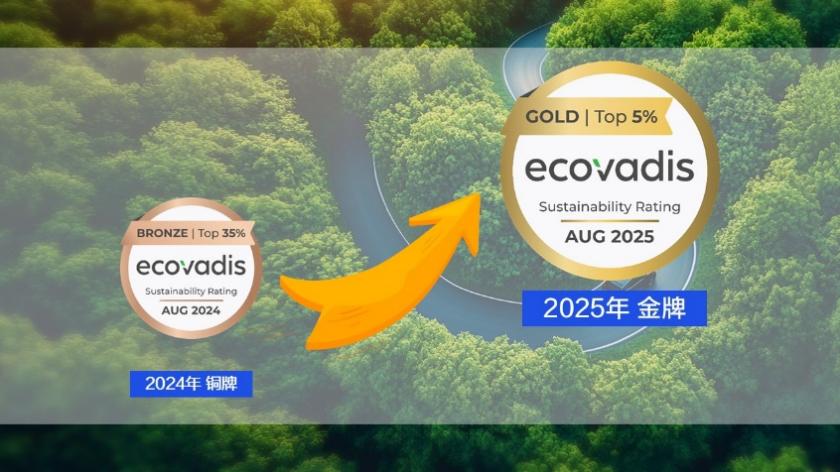
正泰电气荣膺EcoVadis全球前5%金牌认证,正泰集团可持续战略取得卓越实证
Zhong Guo Jing Ji Wang· 2025-09-15 09:05
Core Insights - Chint Electric, a core subsidiary of Chint Group, has achieved EcoVadis Gold Certification, ranking among the top 5% of companies evaluated globally, marking a significant milestone in its sustainable development efforts [1][11] - This certification serves as an international recognition of Chint Electric's sustainability capabilities and reflects substantial progress in the four key areas outlined in Chint Group's 2030 Sustainable Development Strategy [1] Environmental Management - Chint Group's sustainable strategy emphasizes "climate change response" and "clean technology opportunities," with clear carbon reduction goals and pathways for clean technology application [3] - Chint Electric has established a three-tier governance structure covering decision-making, execution, and supervision to enhance strategy formulation, risk management, and target identification [3] Labor and Human Rights - Key actions focus on "employee rights protection, diversity, equity, and inclusion (DEI), and occupational health and safety," integrating these principles into the workplace environment [5] - By 2024, the management team is expected to have over 20% female representation, with 100% coverage in employee training and health check-ups, ensuring employee interests and values are safeguarded [5] Business Ethics - Chint Group emphasizes high standards for compliance and anti-corruption, with Chint Electric completing the establishment of anti-corruption management systems and achieving 100% coverage in board training on integrity [7] - The robust business ethics management mechanism has significantly contributed to EcoVadis's high evaluation in this dimension [7] Sustainable Supply Chain - Chint Electric is committed to building a resource-saving and environmentally friendly supply chain, promoting efficiency across procurement, production, recycling, and logistics [9] - The "2341" supply chain ecosystem strategy aims for 20% strategic partners, 30% core suppliers, 40% industry general suppliers, and 10% project supporting suppliers, fostering close collaboration with upstream enterprises [9] Overall Impact - The upgrade from EcoVadis Bronze to Gold certification is seen as a "green passport" for global trade and a demonstration of how Chinese manufacturing can translate top-level strategies into international influence [11] - The ongoing deepening of Chint Group's "EMPOWER" model is expected to gradually transform ESG concepts into a sustainable ecosystem for corporate transformation, empowering the entire value chain of business development [11]
自由现金流ETF(159201)近1月日均成交3.43亿元,排名可比基金第一
Xin Lang Cai Jing· 2025-09-15 02:14
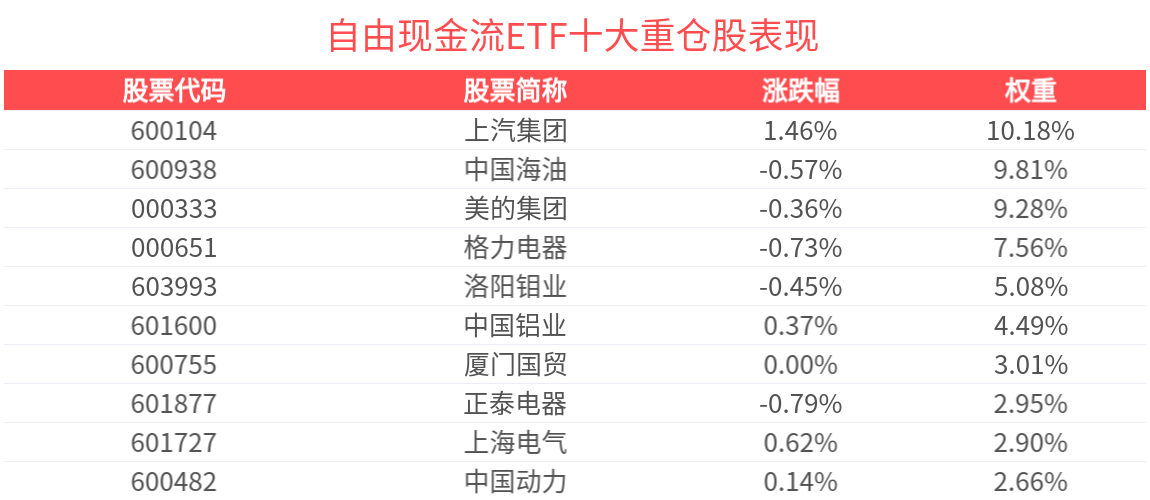
Group 1 - The core viewpoint of the news is the performance and characteristics of the National Index of Free Cash Flow and its corresponding ETF, highlighting the positive trends in liquidity and returns [1][2] - As of September 12, 2025, the Free Cash Flow ETF has seen a net inflow of 97.92 million yuan over the last 10 trading days, with 7 days of net inflow [1] - The Free Cash Flow ETF has achieved a net value increase of 12.46% over the past 6 months, with a maximum monthly return of 7% since its inception [1] Group 2 - The National Index of Free Cash Flow closely tracks the performance of companies with high and stable free cash flow levels in the Shanghai and Shenzhen stock exchanges [2] - The top ten weighted stocks in the National Index of Free Cash Flow as of August 29, 2025, include SAIC Motor, China National Offshore Oil Corporation, Midea Group, and others, accounting for 57.95% of the index [2] - The performance of individual stocks within the top ten includes SAIC Motor with a 1.46% increase and China National Offshore Oil Corporation with a 0.57% decrease [4]





正泰电器跌2.03%,成交额3.76亿元,主力资金净流出4939.00万元
Xin Lang Cai Jing· 2025-09-12 03:23
Company Overview - Zhejiang Chint Electric Co., Ltd. is located in Yuhuan City, Zhejiang Province, and was established on August 5, 1997. The company went public on January 21, 2010. Its main business includes research, production, and sales of low-voltage electrical appliances, electronic instruments, and automation control systems, among others [2]. - The revenue composition of Chint Electric includes: 32.76% from photovoltaic power station engineering contracting, 18.79% from power station operation, 13.01% from terminal electrical appliances, 11.23% from distribution electrical appliances, and other segments contributing smaller percentages [2]. Financial Performance - As of June 30, 2025, Chint Electric reported a revenue of 29.619 billion yuan, representing a year-on-year growth of 2.18%. The net profit attributable to shareholders was 2.554 billion yuan, showing a significant increase of 32.90% year-on-year [3]. - The company has distributed a total of 15.650 billion yuan in dividends since its A-share listing, with 3.319 billion yuan distributed over the past three years [4]. Stock Market Activity - On September 12, Chint Electric's stock price decreased by 2.03%, trading at 27.99 yuan per share with a total transaction volume of 376 million yuan and a turnover rate of 0.62%. The company's total market capitalization is 60.150 billion yuan [1]. - Year-to-date, the stock price has increased by 22.70%, with a recent decline of 3.42% over the last five trading days, a 14.95% increase over the last 20 days, and a 25.85% increase over the last 60 days [1]. Shareholder Information - As of June 30, 2025, the number of shareholders for Chint Electric was 88,400, a decrease of 9.07% from the previous period. The average circulating shares per person increased by 9.97% to 24,312 shares [3]. - Among the top ten circulating shareholders, Hong Kong Central Clearing Limited holds 132 million shares, an increase of 16.2443 million shares from the previous period. Huatai-PB CSI 300 ETF is a new shareholder, holding 19.1505 million shares [4].
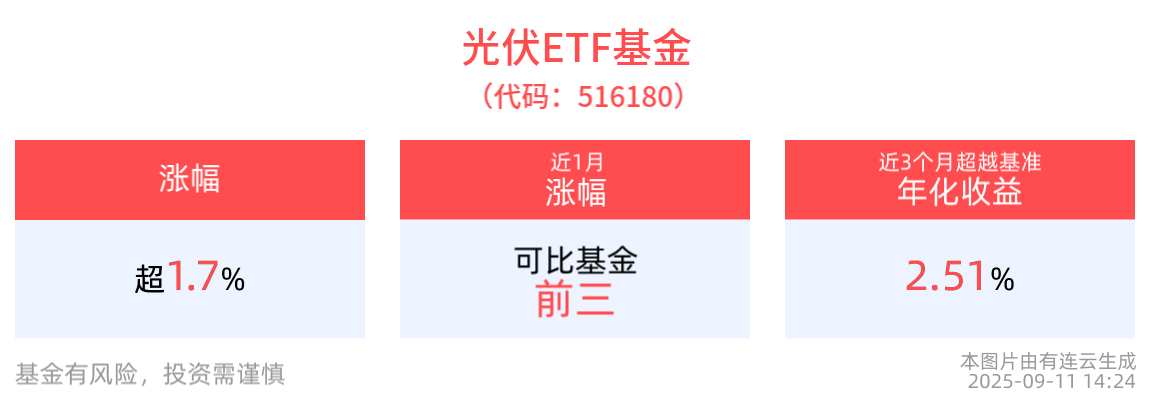
涨超2.0%,光伏ETF基金(516180)近1周涨幅排名可比基金头部
Sou Hu Cai Jing· 2025-09-11 06:43
Group 1 - The Zhongzheng Photovoltaic Industry Index (931151) has shown a strong increase of 2.50% as of September 11, 2025, with significant gains in constituent stocks such as Juhe Materials (688503) up by 11.56% and Kehua Data (002335) up by 10.01% [2] - The Photovoltaic ETF Fund (516180) has risen by 1.80%, with the latest price reported at 0.74 yuan, and has accumulated a weekly increase of 4.78% as of September 10, 2025, ranking 3rd among comparable funds [2] - The Zhongzheng Photovoltaic Industry Index selects up to 50 representative listed companies from the photovoltaic industry chain to reflect the overall performance of these securities [2] Group 2 - As of August 29, 2025, the top ten weighted stocks in the Zhongzheng Photovoltaic Industry Index include Yangguang Electric (300274), Longi Green Energy (601012), and TCL Technology (000100), collectively accounting for 56.14% of the index [3] - The weight and performance of the top stocks are as follows: Yangguang Electric at 10.51% with a rise of 4.61%, Longi Green Energy at 9.97% with a slight increase of 0.17%, and TCL Technology at 9.42% with a rise of 1.37% [5]




正泰电器(601877):优质资产助力业绩增长,公司渠道优势与规模优势双领先
Guoxin Securities· 2025-09-09 14:12
Investment Rating - The investment rating for the company is "Outperform the Market" [6][18][19] Core Views - The company achieved a net profit attributable to shareholders of 2.554 billion yuan in the first half of 2025, representing a year-on-year increase of 32.90%. The total revenue for the same period was 29.619 billion yuan, up 2.18% year-on-year [1][8] - The household photovoltaic subsidiary, Zhengtai Aneng, reported a revenue of 14.798 billion yuan in the first half of 2025, a year-on-year growth of 15.58%, with net profit increasing by 49.80% [2][15] - The low-voltage electrical business showed steady growth with a revenue of 11.97 billion yuan in the first half of 2025, reflecting a year-on-year increase of 4.2% [3][17] Summary by Sections Financial Performance - In Q2 2025, the company recorded a revenue of 15.060 billion yuan, a year-on-year increase of 15.22% and a quarter-on-quarter increase of 3.44%. The net profit attributable to shareholders was 1.391 billion yuan, up 65.32% year-on-year and 19.59% quarter-on-quarter [1][8] - The company expects net profits for 2025-2027 to be 4.946 billion, 5.506 billion, and 5.941 billion yuan respectively, with year-on-year growth rates of 48%, 14%, and 15% [4][18] Business Segments - The household photovoltaic segment is a core profit driver, with total installed capacity reaching 27.84 GW, a year-on-year increase of 41.28%. The revenue from electricity sales was 4.888 billion yuan, up 43.48% year-on-year [2][15] - The low-voltage electrical business is benefiting from a robust sales network and strategic partnerships, achieving a stable gross margin of 29.42% [3][17] Market Position and Strategy - The company maintains a leading position in the low-voltage electrical and household photovoltaic sectors, supported by a strong channel and scale advantage [3][17] - The company is focusing on high-potential industries and expanding its overseas presence, particularly in the Asia-Pacific and Middle Eastern markets [3][17]