
自由现金流ETF

Search documents
正名之后,更见底色,华夏基金ETF背后的“长期主义”
点拾投资· 2026-03-23 03:14
Core Viewpoint - The article discusses the unprecedented "renaming battle" in China's ETF market, where over 1,400 ETFs must complete renaming by the end of March, marking the end of the "name dividend" era and the beginning of a standardized branding phase for ETF products [1]. Group 1: Historical Context and Development - In 2004, China’s first ETF, the Huaxia SSE 50 ETF, was launched by Huaxia Fund, marking the beginning of the ETF market in China [3]. - Huaxia Fund took five years to develop the ETF, conducting extensive investor education and outreach, which laid the groundwork for the future growth of the ETF market [3]. - By January 2026, Huaxia Fund's ETF management scale exceeded 1 trillion yuan, making it the first fund manager in China to reach this milestone [3]. Group 2: Product Strategy and Market Position - Huaxia Fund's ETF product lineup has grown to 122, covering a wide range of categories including core broad-based, popular industry themes, cross-border markets, and Smart Beta strategies [7]. - The "asset management Lego" concept allows investors to construct portfolios flexibly, with flagship products providing stability and growth opportunities [7]. - Huaxia Fund has shown a keen ability to capture emerging industries, with significant growth in ETFs related to robotics and artificial intelligence [8]. Group 3: Service and Innovation - The launch of the "Red Rocket" platform in 2024 represents Huaxia Fund's commitment to investor education and service, providing a comprehensive online service for index investment [11]. - The platform has served over 15 million users and attracted thousands of professional financial advisors, indicating its broad market appeal [11]. Group 4: Competitive Landscape and Fee Strategy - The collective renaming of ETFs aligns with Huaxia Fund's strategy of standardization and transparency, which aims to lower investment decision-making barriers for investors [13]. - Huaxia Fund has reduced management fees for 35 ETFs to the lowest market rate of 0.15% per year, demonstrating its competitive edge and commitment to investor benefits [13]. - This low-fee strategy is based on a scale effect, where larger scale leads to higher operational efficiency and lower fees, benefiting investors [13]. Group 5: Global Positioning - By 2025, China's ETF market surpassed 6 trillion yuan, becoming the largest in Asia and the second largest globally, with Huaxia Fund's international ranking improving to 18th among global ETF providers [16]. - The rise of Huaxia Fund reflects the broader growth of China's asset management industry on the global stage, challenging established players in the ETF market [16].


自由现金流ETF一周年之际的随笔
Sou Hu Cai Jing· 2026-02-26 00:54
Core Viewpoint - The article emphasizes the significance of free cash flow (FCF) as a critical metric for evaluating companies, highlighting its role in ensuring sustainable dividends and investment opportunities in the context of the evolving financial market in China [1][5][27]. Group 1: Free Cash Flow Strategy - The free cash flow strategy has shown remarkable performance, with the National Free Cash Flow Index achieving an annualized return of 17.2% since its inception, significantly outperforming other indices [22][25]. - The index's performance from 2021 to 2025 indicates substantial annual growth rates, with 2024 recording a 32.44% increase and 2025 a 17.85% increase [4][24]. - The strategy focuses on companies with strong cash generation capabilities, ensuring that they can sustain dividends and reinvest in growth opportunities [8][9][11]. Group 2: Index Composition and Selection Criteria - The National Free Cash Flow Index excludes financial and real estate sectors due to their differing cash flow structures, ensuring a focus on more stable industries [16]. - Companies must meet specific criteria, including positive operating cash flow over the past three years and a free cash flow to enterprise value ratio that is positive, ensuring financial sustainability [17][19]. - The index employs a quarterly rebalancing mechanism to adapt to market conditions, enhancing its potential for excess returns by selecting undervalued stocks in growth phases [19][22]. Group 3: Market Context and Future Outlook - The article suggests that in a low-interest-rate environment, assets with stable cash flows and strong dividend potential are likely to attract long-term capital [28]. - The free cash flow strategy is positioned as a foundational approach for long-term value investing, offering a pathway to financial freedom for investors [27][28]. - The increasing adoption of free cash flow strategies among Chinese investors reflects a growing recognition of the importance of cash flow in investment decisions [29].
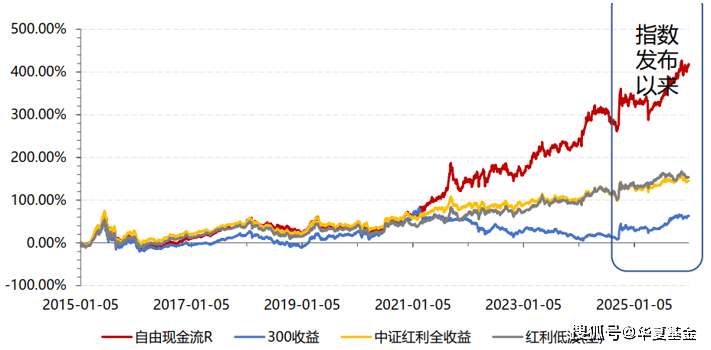
自由现金流ETF(159201)近9天获得连续资金净流入,合计“吸金”17.32亿元
Xin Lang Cai Jing· 2026-02-24 02:13
Group 1 - The core viewpoint of the news is the strong performance of the National Index of Free Cash Flow, which has seen significant increases in both the index and its constituent stocks, indicating a positive market trend [1] - As of February 24, 2026, the National Index of Free Cash Flow (980092) rose by 2.38%, with notable increases in constituent stocks such as Silver Nonferrous (+9.93%), Fenghuo Communication (+8.19%), and Yuntianhua (+7.46%) [1] - The Free Cash Flow ETF (159201) also experienced a rise of 2.15%, with a latest price of 1.33 yuan and a trading volume of 3.44 billion yuan [1] Group 2 - The Free Cash Flow ETF has shown strong performance metrics, including a highest single-month return of 9.25% and a longest consecutive monthly increase of 6 months, with an average monthly return of 3.96% [2] - The ETF closely tracks the National Index of Free Cash Flow, which reflects the price changes of listed companies with high and stable free cash flow levels [2] - As of January 30, 2026, the top ten weighted stocks in the National Index of Free Cash Flow accounted for 50.3% of the index, including companies like China National Offshore Oil Corporation and Gree Electric Appliances [2]
2月11日持仓过节的资金在买入哪些ETF?
Mei Ri Jing Ji Xin Wen· 2026-02-12 02:10
Group 1 - The Shanghai Composite Index experienced a seven-day rise, but trading volume continued to shrink, leading to a significant "seesaw" effect in capital allocation and accelerated sector rotation [1] - Ahead of the Spring Festival holiday, funds are divided into two camps: one showing cautious sentiment favoring dividend and free cash flow ETFs, while the other is positioning for a rebound after the holiday [1] - Major ETFs that received significant net subscriptions from external funds include the ChiNext ETF and the CSI 1000 ETF, with industry-specific ETFs like satellite, robotics, AI, semiconductor equipment, and chemical ETFs also seeing strong inflows [1] Group 2 - According to Wang Bo from Huaxia Fund, the reduction in trading volume before the holiday is normal, and there is a general optimistic expectation for the February market, although a short-term recovery in market sentiment will take time [2] - The investment strategy suggested includes maintaining a balanced allocation across technology, cyclical, and consumer sectors through broad-based ETFs like the Hu-Shen 300 ETF [2] - The recent increase in January PPI by 0.4% month-on-month has catalyzed price increases in the chemical sector, while positive developments in robotics and AI models are also emerging [1][2]
自由现金流ETF(159201)连续5日合计“吸金”9.89亿元,最新规模达132.06亿元
Xin Lang Cai Jing· 2026-02-10 02:33
Group 1 - The core index, the National Certificate Free Cash Flow Index (980092), experienced a decline of 0.12% as of February 10, 2026, with mixed performance among constituent stocks [1] - Leading stocks included Fenghuo Communication, Qianjin Pharmaceutical, and Anfu Technology, while stocks such as Silver Nonferrous, ShouLü Hotel, and Jiashitang lagged [1] - The Free Cash Flow ETF (159201) also saw a decrease of 0.15%, with the latest price at 1.31 yuan [1] Group 2 - The Free Cash Flow ETF recorded a net inflow of 9.89 billion yuan over the past five days, reaching a total share count of 10.063 billion and a total scale of 13.206 billion yuan, both marking new highs since inception [1] - The ETF's financing net purchase on the previous trading day was 4.6439 million yuan, with the latest financing balance at 172 million yuan [1] - The ETF has shown strong performance, with a maximum monthly return of 9.25% since inception and a historical holding period profit probability of 100% over six months [1] Group 3 - The National Certificate Free Cash Flow Index reflects the price changes of listed companies with high and stable free cash flow levels in the Shanghai and Shenzhen stock exchanges [2] - The top ten weighted stocks in the index as of January 30, 2026, include China National Offshore Oil Corporation, Gree Electric Appliances, and SAIC Motor, collectively accounting for 50.3% of the index [2] - The management fee for the Free Cash Flow ETF is 0.15%, and the custody fee is 0.05%, which are among the lowest in comparable funds [2]
超110亿 加仓
Zhong Guo Ji Jin Bao· 2026-02-09 04:56
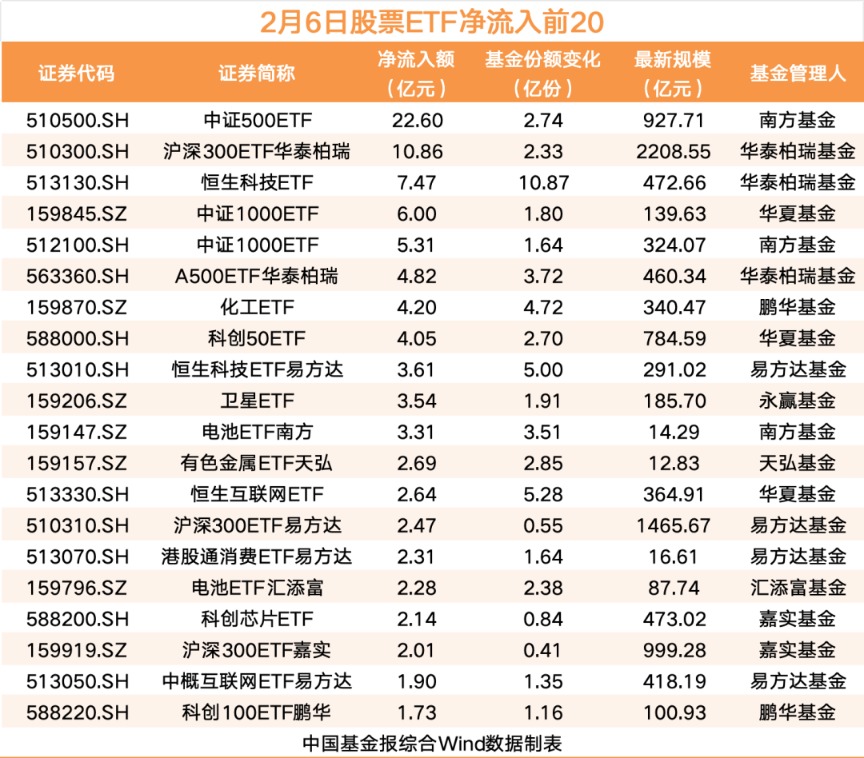
Core Viewpoint - The A-share market experienced a collective decline on February 6, with significant net inflows into stock ETFs, exceeding 11 billion yuan on that day [1]. Group 1: ETF Market Overview - As of February 6, the total scale of 1,333 stock ETFs in the market reached 4.1 trillion yuan, with a net inflow of 11.764 billion yuan and an increase of 9.347 billion fund shares [3]. - The leading categories for net inflows were broad-based ETFs and Hong Kong stock ETFs, with inflows of 7.112 billion yuan and 2.518 billion yuan, respectively [3]. - The CSI 500 Index ETF saw the highest net inflow at 2.585 billion yuan, while the Hang Seng Technology Index ETF and the Sci-Tech 50 Index ETF attracted over 11.2 billion yuan and 5 billion yuan, respectively, over the past five trading days [3]. Group 2: Top ETFs by Net Inflow - On February 6, 35 ETFs recorded net inflows exceeding 1 billion yuan, with the top three being the CSI 500 ETF (2.26 billion yuan), the CSI 300 ETF by Huatai-PB (1.086 billion yuan), and the Hang Seng Technology ETF (747 million yuan) [4]. - Notable inflows were also observed in the China Securities 1000 ETF and the Sci-Tech 50 ETF, with net inflows of 600 million yuan and 405 million yuan, respectively [5]. Group 3: ETFs with Net Outflows - The gold stock ETF experienced the largest net outflow, totaling 812 million yuan on February 6 [5]. - Other ETFs with significant outflows included the Tongwen Stock ETF (-559 million yuan), the SSE 50 ETF (-331 million yuan), and the Food and Beverage ETF (-324 million yuan) [6]. Group 4: Market Outlook - Fund managers from E Fund expressed optimism about the domestic macroeconomic outlook, expecting continued stability and progress, with emerging industries likely to see further development [7]. - Bosera Fund noted that financial conditions remain favorable for equity assets, suggesting that ETF outflows may have reached a turning point, with a potential return to growth in financing balances [7].
自由现金流ETF(159201)连续4天合计“吸金”9.31亿元,最新规模达129.58亿元,创成立以来新高
Xin Lang Cai Jing· 2026-02-09 02:11
Group 1 - The core index, the National Certificate Free Cash Flow Index (980092), has seen a strong increase of 1.2% as of February 9, 2026, with notable stock performances including Zhejiang Longsheng up 9.7%, Anfu Technology up 5.5%, and Weichai Power up 5.13% [1] - The Free Cash Flow ETF (159201) has also risen by 1%, with the latest price reported at 1.31 yuan, and has achieved a record high in both share count at 10.019 billion and total scale at 12.958 billion yuan [1] - Over the past four days, the Free Cash Flow ETF has experienced continuous net inflows totaling 931 million yuan, indicating strong investor interest [1] Group 2 - The top ten weighted stocks in the National Certificate Free Cash Flow Index as of January 30, 2026, include China National Offshore Oil Corporation, Gree Electric Appliances, SAIC Motor, and others, collectively accounting for 50.3% of the index [2] - The management fee for the Free Cash Flow ETF is 0.15%, and the custody fee is 0.05%, which are among the lowest in comparable funds [2] - The Free Cash Flow ETF has demonstrated strong performance metrics, with a maximum monthly return of 9.25% since inception and a historical holding period profitability rate of 100% over six months [1]
大力发展ETF市场,引导增量资金入市
Xin Lang Cai Jing· 2026-02-07 14:38
Core Insights - The report highlights the rapid growth and development of the ETF market in 2025, driven by various government policies aimed at enhancing market efficiency and attracting long-term capital [1][2][3] Global ETF Development Overview - By the end of 2025, the global ETF market reached an asset size of over $19.7 trillion, marking a 31% increase from the previous year [6][10] - The U.S. ETF market accounted for approximately $13.5 trillion, representing about 68% of the global market [10][11] - Stock ETFs dominated the asset categories, comprising about 77.7% of the total ETF market [7][9] Domestic ETF Market Development - The domestic ETF market in China surpassed ¥6 trillion by the end of 2025, becoming the largest ETF market in Asia [1][18] - The number of listed ETFs in China reached 1,381, a 35.7% increase from 2024 [18] - The net inflow of funds into domestic ETFs exceeded ¥1.16 trillion, with bond ETFs attracting the highest net inflow of ¥552.7 billion [18][19] Shanghai Stock Exchange ETF Development - The Shanghai Stock Exchange ETF market saw its size grow from ¥2.72 trillion to ¥4.22 trillion, a 55% increase [21][22] - The number of new ETF products listed on the Shanghai Stock Exchange doubled compared to 2024, with significant contributions from broad-based ETFs [22][25] - Institutional investors held 65% of the ETF market by the end of 2025, indicating a shift towards more stable, long-term investment strategies [22][32] Product Innovation and Market Structure - The report emphasizes the continuous innovation in ETF products, including the introduction of 355 new ETFs in 2025, with a focus on broad-based and thematic ETFs [19][26] - The development of green ETFs and products related to state-owned enterprises reflects a strategic alignment with national priorities [29][27] Future Outlook for the ETF Market - The ETF market is expected to continue its growth trajectory, with a focus on enhancing product offerings and improving market mechanisms to attract long-term capital [35][36] - The Shanghai Stock Exchange aims to strengthen its international presence and regulatory framework to support the sustainable development of the ETF market [41][40]
《上交所ETF行业发展报告(2026)》:大力发展ETF市场,引导增量资金入市
Xin Lang Cai Jing· 2026-02-07 14:01
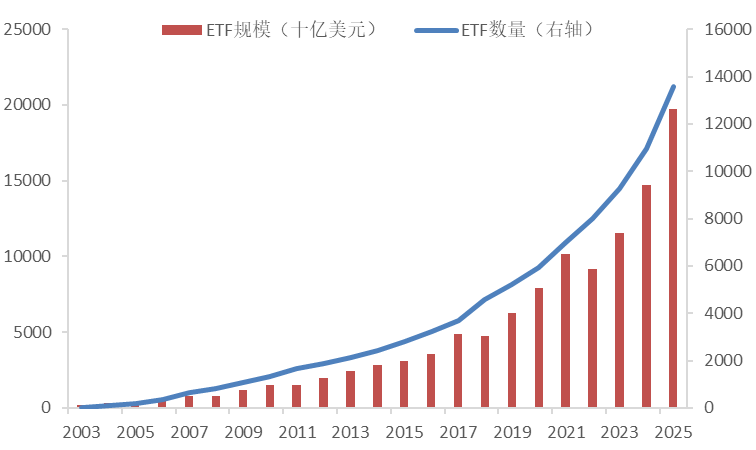
Core Insights - The report highlights the rapid growth and structural optimization of the ETF market in China, which has surpassed Japan to become the largest ETF market in Asia, with total assets exceeding 6 trillion yuan by the end of 2025 [1][12]. Global ETF Development Overview - By the end of 2025, the global ETF market reached a total asset size of over 19.7 trillion USD, marking a 31% increase from the previous year [3][42]. - The U.S. ETF market accounts for approximately 68% of the global total, with a market size of about 13.5 trillion USD [11][48]. - Stock ETFs dominate the asset categories, comprising about 78% of the total, while bond ETFs account for over 16% [8][42]. Domestic ETF Market Development - The domestic ETF market in China saw a significant increase, with the total scale reaching 6.02 trillion yuan, a 61.4% growth from 2024 [20][57]. - The number of listed ETFs in China rose to 1,381, reflecting a 35.7% increase year-on-year [20][57]. - In 2025, the net inflow of funds into domestic ETFs exceeded 1.16 trillion yuan, with bond ETFs attracting the highest net inflow of 552.7 billion yuan [20][57]. Shanghai Stock Exchange ETF Development - The Shanghai Stock Exchange's ETF market size grew from 2.72 trillion yuan to 4.22 trillion yuan, a 55% increase [24][61]. - The number of listed ETFs on the Shanghai Stock Exchange increased from 602 to 797, more than doubling the new listings compared to 2024 [61][62]. - Institutional investors held 65% of the ETF market by the end of 2025, indicating a shift towards more stable, long-term investment strategies [62][63]. Product Supply and Investor Demand - In 2025, 355 new ETF products were launched in the domestic market, with a total issuance scale of 273 billion yuan [21][58]. - The demand for ETFs from internet and banking channels is strong, with the scale of ETF-linked funds exceeding 900 billion yuan, growing over 40% from the previous year [59]. - The report emphasizes the importance of broadening the investor base and enhancing liquidity in the ETF market [62][63]. Future Outlook for the ETF Market - The report outlines plans for 2026 to further enrich the ETF product supply and optimize market mechanisms, aiming to enhance the role of ETFs in wealth management and long-term capital allocation [37][39]. - The focus will be on developing a multi-layered ETF market system that aligns with national strategies and promotes sustainable economic growth [37][39].
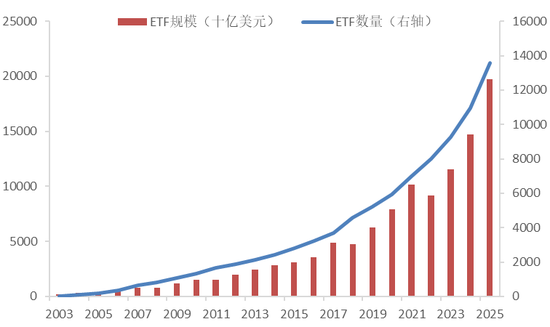
境内ETF市场规模突破6万亿元
Shang Hai Zheng Quan Bao· 2026-02-06 18:36
Group 1 - The core viewpoint of the articles emphasizes the continuous development and expansion of the ETF market in China, particularly focusing on enhancing product offerings and investor engagement [1][2][3] Group 2 - Institutional investors (excluding ETF-linked funds) hold 65% of the Shanghai Stock Exchange (SSE) ETF market, a 6 percentage point increase year-on-year, with approximately 10 million accounts participating in the SSE ETF market, and nearly 30% of holdings by investors born in the 1980s [1] - The SSE has strengthened its ETF product layout, with broad-based ETFs growing to 1.9 trillion yuan, accounting for 70% of the stock ETF market, and the total scale of Sci-Tech Innovation Board ETFs reaching 297.7 billion yuan, covering various key sectors [1] - The SSE is expanding low-risk, stable-return products to support wealth management, with bond ETFs growing to 601.63 billion yuan, a 291% year-on-year increase, and the number of billion-yuan products increasing to 25 [1] - By 2025, the scale of cross-border ETF products on the SSE is expected to reach 54.4 billion yuan, a 95% year-on-year increase, covering markets such as Japan, Singapore, Hong Kong, and Brazil [1] - The SSE aims to enhance the quality of ETF products by developing a more comprehensive index system and promoting collaboration among various indices and ETFs, while also focusing on low-risk, stable-return products [2] - The SSE plans to optimize market mechanisms for ETFs, including post-trade fixed price transactions and improving the market maker mechanism, as well as facilitating the inclusion of Sci-Tech Innovation Board ETFs in fund platforms [2] - The SSE is committed to expanding its investor base through enhanced promotion and services for ETFs, addressing barriers for long-term capital entry into the market [2] - The SSE emphasizes high-level institutional openness to enhance the competitiveness of the Chinese market, promoting cross-border connectivity and attracting foreign long-term capital [2] - The SSE is focused on strengthening regulatory measures to monitor and manage risks associated with ETFs, leveraging technology to improve regulatory efficiency and maintain a fair market environment [3]