
CNCB(601998)

Search documents
回购增持再贷款超1500亿元:工行发放最多,机构期待名单扩容
2 1 Shi Ji Jing Ji Bao Dao· 2025-10-24 12:09
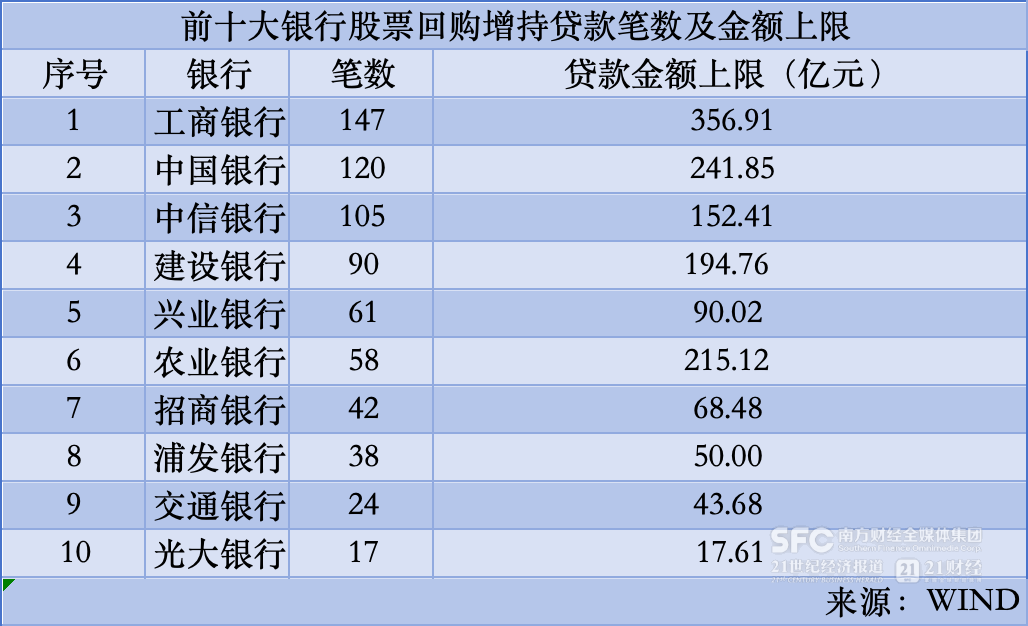
Core Insights - The People's Bank of China and multiple departments issued a notification regarding the establishment of stock repurchase and increase loans, marking one year since its implementation, with significant participation from listed companies and state-owned enterprises [1][6][8] Summary by Sections Policy Overview - The policy was officially launched on October 18, 2024, with a total re-loan quota of 300 billion yuan and an interest rate of 1.75%, aimed at providing low-cost credit support for stock repurchase and increase activities [6][7] - Over the past year, 712 listed companies have disclosed 754 repurchase or increase loan plans, with a total loan amount ceiling of 1,524.84 billion yuan [1][8] Participation and Impact - Major state-owned banks have been the primary participants, with Industrial and Commercial Bank of China leading with 147 loan plans totaling 356.91 billion yuan, followed by Bank of China and CITIC Bank [2][3] - The policy has effectively acted as a stabilizer in the capital market, particularly during periods of market volatility, enhancing investor confidence and liquidity [8][9] Market Response and Future Directions - The market has shown a positive response, with significant increases in stock indices, indicating the effectiveness of the policy in stabilizing market sentiment [9][10] - There is a growing demand for expanding the participant base to include local small and medium-sized banks, which could enhance service coverage and efficiency [5][11] - Future improvements are suggested, including optimizing loan mechanisms, expanding the range of eligible participants, and ensuring compliance and risk management [6][11]




股份制银行板块10月24日跌0.48%,民生银行领跌,主力资金净流出8.35亿元
Zheng Xing Xing Ye Ri Bao· 2025-10-24 08:27
Market Overview - On October 24, the share price of the joint-stock bank sector fell by 0.48%, with Minsheng Bank leading the decline [1] - The Shanghai Composite Index closed at 3950.31, up 0.71%, while the Shenzhen Component Index closed at 13289.18, up 2.02% [1] Individual Bank Performance - Huaxia Bank closed at 7.02, with a slight increase of 0.29% and a trading volume of 1.434 million shares, totaling 1.012 billion yuan [1] - Pudong Development Bank closed at 12.98, up 0.08%, with a trading volume of 1.833 million shares, totaling 2.383 billion yuan [1] - CITIC Bank closed at 7.94, down 0.25%, with a trading volume of 738,100 shares, totaling 586 million yuan [1] - Everbright Bank closed at 3.53, down 0.28%, with a trading volume of 3.765 million shares, totaling 1.335 billion yuan [1] - Ping An Bank closed at 11.56, down 0.60%, with a trading volume of 980,500 shares, totaling 1.138 billion yuan [1] - China Merchants Bank closed at 41.95, down 0.69%, with a trading volume of 698,800 shares, totaling 2.939 billion yuan [1] - Industrial Bank closed at 20.60, down 0.77%, with a trading volume of 871,100 shares, totaling 1.802 billion yuan [1] - Zheshang Bank closed at 3.10, down 0.96%, with a trading volume of 2.049 million shares, totaling 638 million yuan [1] - Minsheng Bank closed at 4.12, down 0.96%, with a trading volume of 7.145 million shares, totaling 2.968 billion yuan [1] Fund Flow Analysis - The joint-stock bank sector experienced a net outflow of 835 million yuan from institutional investors, while retail investors saw a net inflow of 528 million yuan [1] - The following banks had notable fund flows: - Huaxia Bank saw a net inflow of 39.617 million yuan from institutional investors, but a net outflow of 22.272 million yuan from speculative funds [2] - Industrial Bank had a net outflow of 24.775 million yuan from institutional investors, with a net inflow of 9.616 million yuan from speculative funds [2] - Minsheng Bank experienced a significant net outflow of 99.226 million yuan from institutional investors, while retail investors contributed a net inflow of 51.070 million yuan [2] - China Merchants Bank had a net outflow of 21.4 million yuan from institutional investors, with a net inflow of 117 million yuan from speculative funds [2]



中国银行业_2025 年三季度预览_大型国有银行同比增长势头可能延续-China Banks_ Q325 preview_ Positive YoY growth momentum for large SOE banks likely to continue
2025-10-23 13:28
Summary of Key Points from the Conference Call Industry Overview - **Industry**: Chinese Banking Sector - **Context**: The conference call discusses the upcoming Q3 earnings results for large state-owned enterprises (SOE) banks, joint stock banks (JSBs), and regional banks in China, highlighting expected performance trends and key metrics. Core Insights and Arguments - **Positive Growth Momentum**: Large SOE banks are expected to continue showing positive year-over-year (YoY) growth in revenue, profit before provisions (PPOP), and net profit, driven by strong non-interest income, particularly from investment and trading activities. However, net interest income (NII) may decline on average YoY [2][3][4] - **Joint Stock Banks Performance**: Select JSBs are anticipated to report positive net profit growth, aided by reduced impairment charges, although revenue and PPOP growth may remain subdued [2][3] - **Regional Banks Challenges**: Most regional banks are likely to experience a slowdown in both revenue and net profit growth, attributed to weakened investment and trading income [2][3] - **Key Operating Metrics**: - NIM (Net Interest Margin) is projected to decline slightly by 2 basis points (bps) on average across all bank types. - Loan growth YoY is expected to remain stable for large SOE and regional banks, while select JSBs may see a slight increase of 3.6% YoY. - Credit costs are expected to decline YoY, with large SOE banks, JSBs, and regional banks recording reductions of 8, 11, and 6 bps respectively [2][3] Investment Sentiment - **Market Performance**: MSCI China Banks and MSCI China Banks-A have gained 21.3% and 12.4% year-to-date as of October 17, 2025, but have underperformed the broader MSCI China index, which rose by 32.7% [3] - **Investor Preferences**: Investors are likely to favor banks with sustained positive YoY net profit growth and improving NIM and asset quality trends. The performance of investment and trading income, along with credit costs, will be critical differentiators in the upcoming earnings season [3][4] Bank-Specific Expectations - **ICBC**: Expected to show the largest improvement in net profit growth, with a YoY increase of 2.5% in Q3 compared to 1.4% in Q2. It is highlighted as a preferred stock with a dividend yield of 5.8% for 2025E [4] - **ABC**: Anticipated to have the highest YoY net profit after tax (NPAT) growth among large SOE banks at 3.6% in Q3, outperforming the average of 2.1% [4] - **CITIC**: Expected to lead JSBs with a YoY NPAT growth of 6.6% in Q3, significantly above the average of 2.1% for select JSBs [4] - **Regional Banks**: BONJ is flagged for robust growth, while BOCD may face notable deceleration [4] Defensive Investment Strategy - **Defensive Names**: Given the soft macro conditions and trade uncertainties, there is a constructive outlook on defensive bank stocks. Dividend yields have become attractive, exceeding 5% for H-shares and 4% for A-shares [6] Financial Forecasts - **Q325E Forecasts**: - Core earnings for major banks show varied performance, with ICBC expected to decline by 2.7%, CCB increasing by 2.1%, and ABC decreasing by 1.5% YoY. - NII is projected to decline for most banks, with ICBC at -4.5% and ABC at -3.7% YoY. - Non-interest income is expected to see significant growth for some banks, with estimates of 110% for certain institutions [7] Additional Insights - **Credit Cost Trends**: The average credit cost across banks is expected to decline, with ICBC at 0.43% and CCB at 0.56% for 2025E, indicating improved asset quality [9] - **NIM Trends**: The quarterly NIM for major banks is projected to decline, with ICBC at 1.24% and CCB at 1.36% for Q325E, reflecting ongoing pressure on interest margins [8] This summary encapsulates the key points discussed in the conference call, providing insights into the performance expectations and investment sentiment within the Chinese banking sector.

金价大幅波动!多家银行,密集提示!
Zheng Quan Shi Bao· 2025-10-23 09:43
Group 1 - Recent fluctuations in precious metal prices have led several banks to raise the investment threshold for gold accumulation business to above 1000 RMB [1] - On October 21, Industrial Bank announced an increase in the minimum purchase amount for its gold accumulation business from 1000 RMB to 1200 RMB, while the weight-based purchase threshold remains unchanged at 1 gram [1] - Ping An Bank also adjusted its gold accumulation business, raising the minimum investment amount for its regular investment plan from 900 RMB to 1100 RMB starting October 24, 2025 [1] Group 2 - A number of banks had already issued risk warnings regarding precious metal market fluctuations in early October, with China Construction Bank issuing its third warning since late September on October 17 [2] - Other banks, including China Merchants Bank, Minsheng Bank, Everbright Bank, and CITIC Bank, have also joined in issuing risk alerts related to gold prices [2] - Bank staff have been actively informing clients about price volatility risks, emphasizing the importance of rational investment in gold products [2] Group 3 - In addition to adjustments in gold accumulation business, several banks have ceased to provide personal precious metal business services, with Postal Savings Bank announcing the termination of its related services [3] - On October 21, international precious metal markets experienced significant adjustments, with notable declines in gold and silver prices due to various factors, including profit-taking and shifts in macroeconomic policy expectations [3] - Despite the volatility, gold retains its status as a safe-haven asset, and investors are advised to monitor market changes closely and allocate assets wisely without impulsively chasing price movements [3]



中信银行焦作分行联合人行焦作市分行开展境外人员支付服务宣传活动
Zhong Guo Jin Rong Xin Xi Wang· 2025-10-23 08:29
Core Viewpoint - The event aims to enhance the payment convenience for foreign visitors in China during the 12th China Jiaozuo International Tai Chi Competition and the 2025 Yuntai Mountain Tourism Festival, showcasing various payment tools and services [1] Group 1: Payment Services Promotion - The bank conducted promotional activities at foreign currency exchange points and competition venues, introducing payment tools such as QR code payments and mobile banking [1] - A consultation desk for foreign payment services was set up outside the opening ceremony venue, providing multilingual payment service guides to foreign athletes, tourists, and staff [1] - Staff demonstrated mobile payment processes on-site to help foreign visitors quickly learn how to use mobile payment methods [1] Group 2: Financial Services Strategy - Optimizing payment services and enhancing payment convenience have become significant initiatives in China's financial sector to meet diverse payment needs and stimulate consumption and economic growth [1] - The bank has a history of providing efficient overseas remittance and visa processing services for clients with study abroad and travel needs, indicating a commitment to comprehensive outbound financial services [1] - The bank plans to continue improving payment service levels to support high-quality regional economic development [1]
股份制银行板块10月23日涨0.79%,民生银行领涨,主力资金净流入1.7亿元
Zheng Xing Xing Ye Ri Bao· 2025-10-23 08:20
Market Performance - The banking sector saw an increase of 0.79% on October 23, with Minsheng Bank leading the gains [1] - The Shanghai Composite Index closed at 3922.41, up 0.22%, while the Shenzhen Component Index closed at 13025.45, also up 0.22% [1] Individual Bank Performance - Minsheng Bank's stock price rose by 2.72% to 4.16, with a trading volume of 9.1 million shares and a transaction value of 374.2 million [1] - Industrial Bank's stock increased by 1.76% to 20.76, with a trading volume of 1.29 million shares and a transaction value of 2.669 billion [1] - China Everbright Bank's stock rose by 1.14% to 3.54, with a trading volume of 4.34 million shares and a transaction value of 1.529 billion [1] - Ping An Bank's stock price increased by 0.95% to 11.63, with a trading volume of 1.37 million shares and a transaction value of 1.593 billion [1] - China Merchants Bank's stock rose by 0.69% to 42.24, with a trading volume of 713,200 shares and a transaction value of 3.005 billion [1] Fund Flow Analysis - The banking sector experienced a net inflow of 170 million from institutional investors, while retail investors saw a net outflow of 80.92 million [1] - The detailed fund flow for individual banks shows varying levels of net inflow and outflow among different banks [2] Individual Bank Fund Flow - Ping An Bank had a net inflow of 11.5 million from institutional investors, but a net outflow of 61.34 million from retail investors [2] - China Merchants Bank saw a net inflow of 73.01 million from institutional investors, with a net outflow of 84.46 million from retail investors [2] - Minsheng Bank had a net inflow of 40.1 million from institutional investors, while retail investors contributed a net inflow of 62.56 million [2] - Industrial Bank experienced a net outflow of 37.22 million from institutional investors and a net outflow of 71.06 million from retail investors [2]


多家银行,密集提示!
券商中国· 2025-10-23 03:45
Core Viewpoint - Recent fluctuations in precious metal prices have led several banks to issue risk alerts and increase the investment threshold for gold accumulation products to above 1000 yuan [1][2]. Group 1: Market Trends - There has been a noticeable increase in the popularity of gold investments, with a rise in customer inquiries and purchases of related products [2]. - On October 21, Industrial Bank announced an adjustment to its gold accumulation business, raising the minimum purchase amount from 1000 yuan to 1200 yuan for monetary transactions, while maintaining a minimum of 1 gram for weight-based transactions [2]. - Similarly, Ping An Bank announced an increase in the minimum investment amount for its gold accumulation plan from 900 yuan to 1100 yuan, effective from October 24, 2025 [2]. Group 2: Risk Management - Banks are adjusting the minimum investment amounts in response to rapid increases in gold prices, which serves as a risk alert for investors [2][3]. - A number of banks, including China Construction Bank, have issued multiple risk warnings regarding gold prices since late September, with the latest warning on October 17 [2][3]. - Financial institutions are emphasizing the importance of risk awareness among clients, particularly regarding the non-refundable nature of gold products once sold [3]. Group 3: Market Dynamics - On October 21, the international precious metals market experienced significant adjustments, with notable declines in gold and silver prices due to various factors, including profit-taking and shifts in macroeconomic policy expectations [3]. - The global political, military, and economic landscape remains complex, suggesting that gold will continue to have strong safe-haven attributes, although high volatility in gold prices is expected [4].

中信银行焦作分行优化支付服务 提升支付便利性
Huan Qiu Wang· 2025-10-23 03:05
Core Viewpoint - The event highlighted the collaboration between CITIC Bank's Jiaozuo branch and the People's Bank of China to enhance payment services for foreign visitors in China during the 12th China Jiaozuo International Tai Chi Competition and the 2025 Yuntai Mountain Tourism Festival [1] Group 1: Payment Services Enhancement - The bank conducted promotional activities at foreign currency exchange points and competition venues to inform foreign visitors about various payment tools and services, including QR code payments and mobile banking [1] - A consultation desk was set up outside the opening ceremony venue to provide multilingual payment service guides to foreign athletes, tourists, and staff, detailing commonly used payment methods in China [1] - The initiative aims to optimize payment services and improve convenience, addressing the diverse payment needs of different groups to stimulate consumption and economic growth [1] Group 2: Future Commitment - The bank plans to continue its commitment to enhancing payment services, aligning with the national goal of serving the public through improved payment solutions, thereby supporting high-quality regional economic development [1]
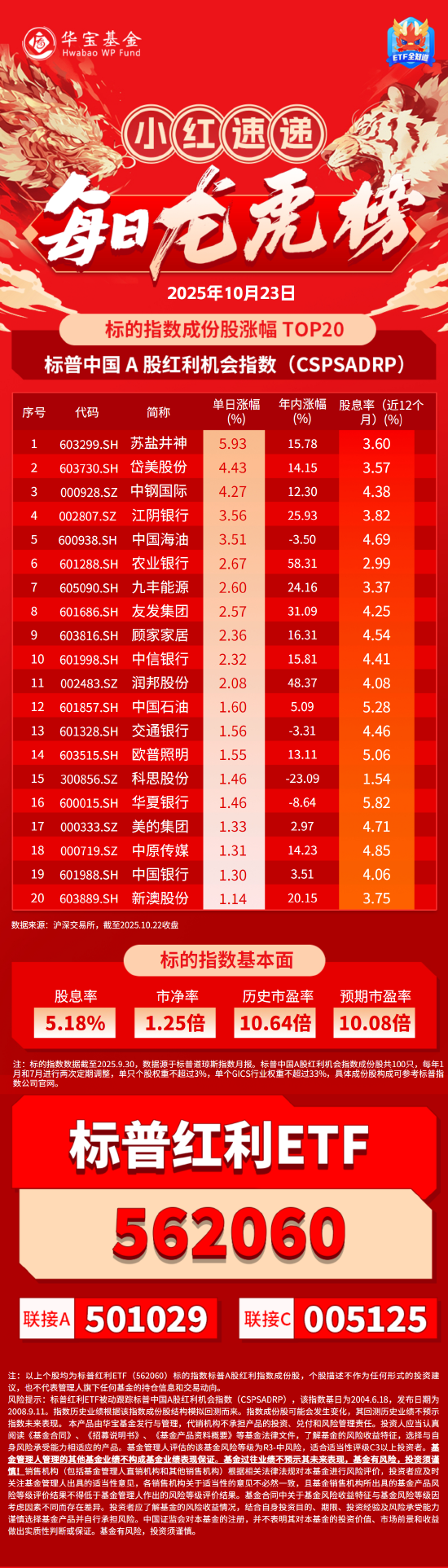
小红日报 | 红利或再成A股上涨引擎!标普红利ETF(562060)标的指数收涨0.17%三连阳!
Xin Lang Ji Jin· 2025-10-23 02:36
Core Insights - The article highlights the top-performing stocks in the S&P China A-Share Dividend Opportunity Index, showcasing significant daily and year-to-date gains along with dividend yields [1] Group 1: Stock Performance - The top stock, Su Yan Jing Shen (603299 SH), experienced a daily increase of 5.93% and a year-to-date increase of 15.78%, with a dividend yield of 3.60% [1] - Dai Mei Co., Ltd. (603730.SH) saw a daily rise of 4.43% and a year-to-date rise of 14.15%, with a dividend yield of 3.57% [1] - China Steel International (000928.SZ) reported a daily increase of 4.27% and a year-to-date increase of 12.30%, with a dividend yield of 4.38% [1] - Jiangyin Bank (002807.SZ) had a daily increase of 3.56% and a year-to-date increase of 25.93%, with a dividend yield of 3.82% [1] - China National Offshore Oil Corporation (600938.SH) increased by 3.51% daily but has a year-to-date decline of 3.50%, with a dividend yield of 4.69% [1] Group 2: Additional Notable Stocks - Agricultural Bank of China (601288.SH) showed a daily increase of 2.67% and a remarkable year-to-date increase of 58.31%, with a dividend yield of 2.99% [1] - Jiufeng Energy (605090 SH) had a daily rise of 2.60% and a year-to-date rise of 24.16%, with a dividend yield of 3.37% [1] - Youfa Group (601686.SH) reported a daily increase of 2.57% and a year-to-date increase of 31.09%, with a dividend yield of 4.25% [1] - Gujia Home Furnishing (603816.SH) increased by 2.36% daily and 16.31% year-to-date, with a dividend yield of 4.54% [1] - CITIC Bank (601998 SH) had a daily increase of 2.32% and a year-to-date increase of 15.81%, with a dividend yield of 4.41% [1]





一板块异动!多股迅速涨停
Shang Hai Zheng Quan Bao· 2025-10-23 02:29
Group 1: Coal Industry - The coal industry has shown a positive trend with a 2.65% increase, reaching a total of 12,931.58 [1] - Notable stocks in the coal sector include: - Shaanxi Black Cat (601015) with a price of 4.57, up 10.12% - Yunnan Coal Energy (600792) at 5.14, up 10.06% - Zhengzhou Coal Electricity (600121) at 5.60, up 10.02% - Dayou Energy (600403) at 9.67, up 10.01% [1] Group 2: Banking Sector - The banking sector has also seen an upward movement, with Agricultural Bank achieving a 15-day consecutive rise to a new high [1] - Key banks experiencing stock price increases include: - Postal Savings Bank at 5.97, up 4.19% - Qingdao Bank at 5.28, up 1.93% - Industrial Bank at 20.78, up 1.86% - Agricultural Bank at 8.24, up 1.85% [3] Group 3: Port Concept Stocks - Port concept stocks have experienced significant movements, with Xiamen Port reaching a peak increase of 7.23% [3] - Other ports such as Nanjing Port, Yantian Port, and Beibu Gulf Port have also shown positive trends [3]





