Suzhou Rural Commercial Bank(603323)

Search documents
上市银行1H25业绩总结:营收利润边际改善,看好板块配置价值有限
Dongxing Securities· 2025-09-05 09:38
Investment Rating - The report maintains a positive outlook on the banking sector's allocation value, suggesting continued investment interest in the sector [4][10]. Core Viewpoints - The performance of listed banks in the first half of 2025 shows a marginal improvement in revenue and profit margins, with year-on-year growth of 1.0% in revenue and 0.8% in net profit attributable to shareholders [4][5]. - The recovery in the bond market during the second quarter has alleviated some of the pressures on bond investment returns, contributing to the overall performance improvement [4][5]. - The report anticipates that the banking sector's revenue and net profit growth will remain around 1% year-on-year for 2025, despite ongoing pressures on the banking fundamentals [4][10]. Summary by Sections Performance Overview - In the first half of 2025, listed banks experienced a year-on-year revenue growth of 1.0% and a net profit growth of 0.8%, with quarter-on-quarter improvements of 2.8 percentage points and 2 percentage points respectively [4][5]. - The growth in interest-earning assets was 9.7% year-on-year, with a stable credit growth of 8% and a significant increase in financial investments by 14.9% [4][11]. - The net interest margin for the first half of 2025 was 1.33%, showing a year-on-year decline of 13 basis points, which is less than the decline seen in the same period last year [4][5]. Non-Interest Income - Non-interest income showed a positive trend, with a year-on-year increase of 10.8% in other non-interest income and a 3.1% increase in fee income [4][5][10]. - The report highlights that the recovery in the capital market has contributed to the improvement in non-interest income [4][10]. Asset Quality - The report notes that while the non-performing loan ratio remains stable, there is an increase in the generation rate of overdue and non-performing loans, particularly in retail banking [4][10]. - The provision coverage ratio remained stable, with an increase in provisioning efforts during the first half of 2025 [4][10]. Future Outlook - The banking sector is expected to face continued pressure in 2025, but signs of a potential turning point are emerging, with improved net interest margins and non-interest income [4][10]. - The report suggests that the demand for bank stocks will increase from long-term funds, driven by favorable policies encouraging investment in the banking sector [4][10].






农商行板块9月5日跌0.73%,江阴银行领跌,主力资金净流入3366.67万元
Zheng Xing Xing Ye Ri Bao· 2025-09-05 08:56
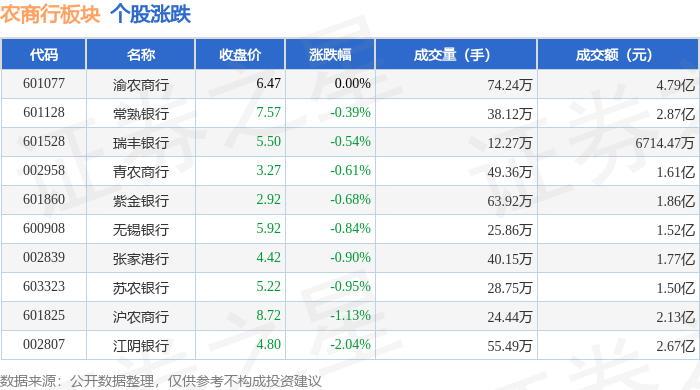
Market Performance - The rural commercial bank sector experienced a decline of 0.73% on September 5, with Jiangyin Bank leading the drop [1] - The Shanghai Composite Index closed at 3812.51, up 1.24%, while the Shenzhen Component Index closed at 12590.56, up 3.89% [1] Individual Stock Performance - The closing prices and changes for key rural commercial banks are as follows: - Yunnan Rural Commercial Bank: 6.47, unchanged - Changshu Bank: 7.57, down 0.39% - Ruifeng Bank: 5.50, down 0.54% - Qingnong Bank: 3.27, down 0.61% - Zijin Bank: 2.92, down 0.68% - Wuxi Bank: 5.92, down 0.84% - Zhangjiagang Bank: 4.42, down 0.90% - Sunong Bank: 5.22, down 0.95% - Hunan Rural Commercial Bank: 8.72, down 1.13% - Jiangyin Bank: 4.80, down 2.04% [1] Capital Flow Analysis - The rural commercial bank sector saw a net inflow of 33.67 million yuan from main funds, while retail funds experienced a net outflow of 29.91 million yuan [1] - The detailed capital flow for individual banks indicates: - Zijin Bank: Main net outflow of 26.33 million yuan, retail net outflow of 3.10 million yuan - Sunong Bank: Main net inflow of 12.23 million yuan, retail net outflow of 7.43 million yuan - Wuxi Bank: Main net inflow of 6.05 million yuan, retail net inflow of 2.68 million yuan - Jiangyin Bank: Main net outflow of 10.44 million yuan, retail net inflow of 7.44 million yuan [2]



A股银行股普跌,邮储银行、中信银行跌超2%
Ge Long Hui A P P· 2025-09-05 02:52
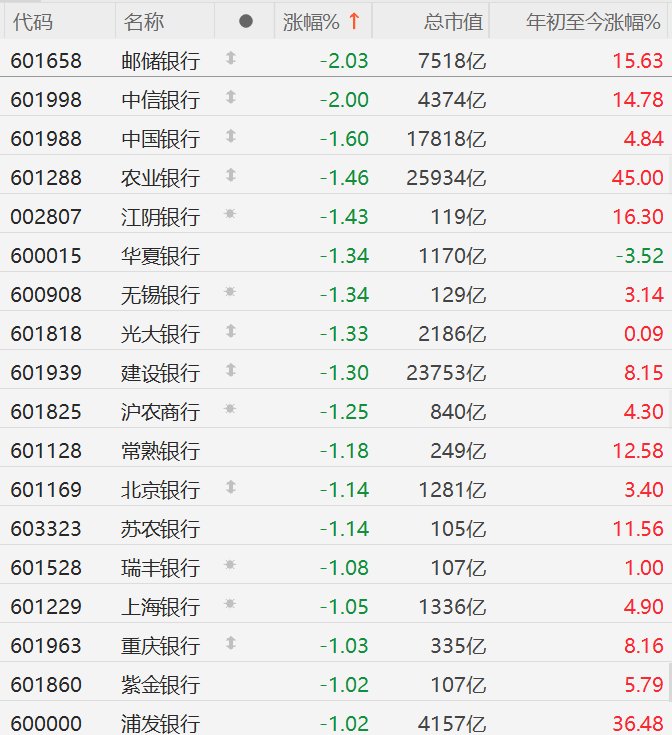
Core Viewpoint - The A-share market experienced a widespread decline in bank stocks, with several major banks seeing significant drops in their share prices [1][2]. Group 1: Stock Performance - Postal Savings Bank of China saw a decrease of 2.03%, with a total market capitalization of 751.8 billion [2]. - CITIC Bank's shares fell by 2.00%, with a market value of 437.4 billion [2]. - Bank of China experienced a decline of 1.60%, with a market capitalization of 1.7818 trillion [2]. - Agricultural Bank of China dropped by 1.46%, holding a market value of 2.5934 trillion [2]. - Other banks such as Everbright Bank, Construction Bank, and Shanghai Pudong Development Bank also reported declines of over 1% [1]. Group 2: Year-to-Date Performance - Agricultural Bank of China has the highest year-to-date increase at 45.00% [2]. - Postal Savings Bank of China and CITIC Bank have year-to-date increases of 15.63% and 14.78%, respectively [2]. - Shanghai Pudong Development Bank has a notable year-to-date increase of 36.48% despite the recent decline [2].




透视A股上市农商行中期“成绩单”:营收持续分化,非利息收入扛起增长“大旗”
Mei Ri Jing Ji Xin Wen· 2025-09-04 14:40
Core Viewpoint - The financial performance of listed rural commercial banks in China is showing a trend of increasing differentiation, with significant revenue growth observed in specific banks like Changshu Bank and Jiangyin Bank, while others lag behind [1][2][3]. Group 1: Revenue Performance - In the first half of 2025, the top two performing banks were Chongqing Rural Commercial Bank and Shanghai Rural Commercial Bank, with revenues of 14.741 billion and 13.444 billion respectively, both nearing 15 billion [2]. - Changshu Bank and Qingnong Bank followed with revenues exceeding 6 billion, while the remaining banks had revenues below 3 billion [2]. - Changshu Bank and Jiangyin Bank reported significant year-on-year revenue growth, both exceeding 10%, which is notably higher than other banks [3]. Group 2: Non-Interest Income - In a declining net interest margin environment, listed rural commercial banks are increasingly relying on non-interest income to stabilize revenue [5]. - Investment income has become a crucial component of non-interest income, with most banks reporting significant increases compared to the previous year, particularly Zijin Bank and Jiangyin Bank, which saw increases of 95.41% and 81.44% respectively [5]. - Chongqing Rural Commercial Bank was the only bank to report a decrease in investment income year-on-year, while its interest income ratio increased, helping maintain stable overall revenue [5][6]. Group 3: Mid-Year Dividends - Several listed rural commercial banks announced their first-ever mid-year dividend plans, including Changshu Bank, which proposed a cash dividend of 0.15 yuan per share, totaling 497 million yuan [7]. - Jiangyin Bank and Su Nong Bank also introduced mid-year dividends, aiming to enhance investor returns and boost long-term holding confidence [7][8]. - The overall trend indicates a shift towards more frequent dividend distributions, moving from annual to semi-annual payouts, which is expected to improve dividend yields in the coming years [8].
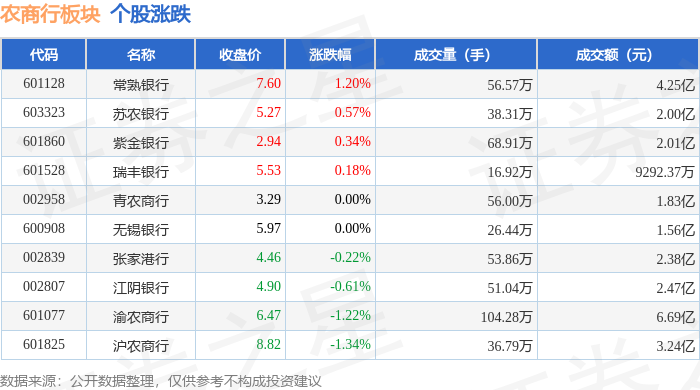
农商行板块9月4日跌0.61%,沪农商行领跌,主力资金净流入38.47万元
Zheng Xing Xing Ye Ri Bao· 2025-09-04 08:48
Market Overview - On September 4, the rural commercial bank sector declined by 0.61% compared to the previous trading day, with Hu Nong Bank leading the decline [1] - The Shanghai Composite Index closed at 3765.88, down 1.25%, while the Shenzhen Component Index closed at 12118.7, down 2.83% [1] Individual Stock Performance - Among the rural commercial banks, Changshu Bank saw a closing price of 7.60 with a gain of 1.20%, while Hu Nong Bank closed at 8.82, down 1.34% [1] - The trading volume and turnover for various banks were reported, with Changshu Bank having a trading volume of 565,700 shares and a turnover of 4.25 billion yuan [1] Capital Flow Analysis - The rural commercial bank sector experienced a net inflow of 384,700 yuan from institutional investors, while retail investors saw a net inflow of 11.7 million yuan [1] - The table of capital flow indicates that the majority of the funds were flowing into certain banks, with Yu Nong Bank receiving a net inflow of 73.51 million yuan from institutional investors [2] Detailed Capital Flow by Bank - Yu Nong Bank had a net inflow of 73.51 million yuan from institutional investors, while it faced a net outflow of 41.89 million yuan from speculative funds [2] - Changshu Bank experienced a net inflow of 19.16 million yuan from institutional investors, but a significant outflow of 51.75 million yuan from speculative funds [2] - Other banks like Zijin Bank and Su Nong Bank also reported net outflows from institutional and speculative funds, indicating varied investor sentiment across the sector [2]
中期分红队伍持续壮大
Jin Rong Shi Bao· 2025-09-04 03:03
Core Viewpoint - The recent announcements of interim dividend plans by A-share listed banks highlight a trend towards increased shareholder returns, with a total proposed dividend amount exceeding 200 billion yuan from major state-owned banks and several joint-stock banks [1][4]. Group 1: State-Owned Banks - Six major state-owned banks have announced their interim dividend plans for 2025, with a total proposed dividend amount exceeding 200 billion yuan [1]. - Industrial and Commercial Bank of China leads with a proposed dividend of 1.414 yuan per 10 shares, totaling 503.96 billion yuan [1]. - Other state-owned banks, including Agricultural Bank of China, Bank of China, China Construction Bank, Bank of Communications, and Postal Savings Bank, have proposed dividends of 418.23 billion yuan, 352.50 billion yuan, 486.05 billion yuan, 138.11 billion yuan, and 147.72 billion yuan respectively [1]. Group 2: Joint-Stock Banks - Several joint-stock banks, including China Merchants Bank, CITIC Bank, Minsheng Bank, Ping An Bank, and Huaxia Bank, have confirmed their interim dividend plans for 2025 [1][2]. - China Merchants Bank announced its first interim profit distribution plan since its listing, with a cash dividend amounting to 35% of its net profit attributable to ordinary shareholders for the first half of 2025 [1][2]. - CITIC Bank plans to increase its interim dividend payout ratio to 30.7%, enhancing investor return expectations [2]. Group 3: New Participants in Interim Dividends - New entrants to the interim dividend group include Ningbo Bank, Changsha Bank, Su Nong Bank, and Jiangyin Bank, indicating a growing trend among listed banks to adopt interim dividends [2][4]. - Su Nong Bank announced its first interim dividend plan, proposing a cash dividend of 0.9 yuan per 10 shares, totaling 1.82 billion yuan [2][3]. Group 4: Overall Market Trends - A total of 23 A-share listed banks implemented interim dividends in 2024, distributing over 250 billion yuan, with the number of banks participating expected to increase in 2025 [4]. - The push for interim dividends is seen as a response to regulatory guidance aimed at enhancing shareholder returns and stabilizing market expectations [5].

苏农银行9月3日获融资买入3477.54万元,融资余额9.83亿元
Xin Lang Zheng Quan· 2025-09-04 01:25
Group 1 - On September 3, Su Nong Bank's stock fell by 1.50%, with a trading volume of 172 million yuan [1] - The margin trading data showed that on the same day, Su Nong Bank had a financing purchase amount of 34.77 million yuan and a financing repayment of 27.39 million yuan, resulting in a net financing purchase of 7.38 million yuan [1] - As of September 3, the total margin trading balance of Su Nong Bank was 985 million yuan, with a financing balance of 983 million yuan, accounting for 9.29% of the circulating market value, indicating a high level compared to the past year [1] Group 2 - As of June 30, the number of shareholders of Su Nong Bank was 32,900, an increase of 7.96% from the previous period [2] - For the first half of 2025, Su Nong Bank reported an operating income of 0.00 yuan and a net profit attributable to shareholders of 1.178 billion yuan, representing a year-on-year growth of 5.23% [2] Group 3 - Since its A-share listing, Su Nong Bank has distributed a total of 2.239 billion yuan in dividends, with 962 million yuan distributed in the last three years [3] - As of June 30, 2025, Hong Kong Central Clearing Limited was the third-largest circulating shareholder of Su Nong Bank, holding 113 million shares, an increase of 14.18 million shares from the previous period [3]
农商行板块9月2日涨2.83%,渝农商行领涨,主力资金净流出653.88万元
Zheng Xing Xing Ye Ri Bao· 2025-09-02 08:59
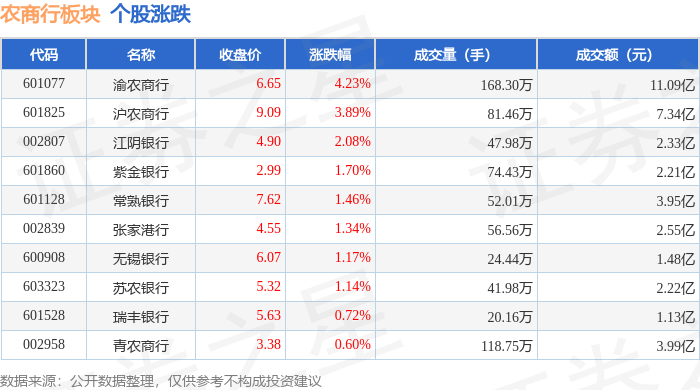
Core Insights - The rural commercial bank sector experienced a rise of 2.83% on September 2, with Chongqing Rural Commercial Bank leading the gains [1] - The Shanghai Composite Index closed at 3858.13, down 0.45%, while the Shenzhen Component Index closed at 12553.84, down 2.14% [1] Stock Performance - Chongqing Rural Commercial Bank (601077) closed at 6.65, up 4.23%, with a trading volume of 1.68 million shares and a transaction value of 1.11 billion [1] - Shanghai Rural Commercial Bank (601825) closed at 60.6, up 3.89%, with a trading volume of 814,600 shares and a transaction value of 734 million [1] - Jiangyin Bank (002807) closed at 4.90, up 2.08%, with a trading volume of 479,800 shares and a transaction value of 233 million [1] - Other notable performances include Zijin Bank (601860) up 1.70%, Changshu Bank (601128) up 1.46%, and Zhangjiagang Bank (002839) up 1.34% [1] Fund Flow Analysis - The rural commercial bank sector saw a net outflow of 6.54 million from institutional investors, while retail investors experienced a net outflow of 102 million [1] - Speculative funds recorded a net inflow of 109 million [1] - Detailed fund flow for Chongqing Rural Commercial Bank shows a net inflow of 11.57 million from institutional investors, but a net outflow of 88.18 million from retail investors [2] - Shanghai Rural Commercial Bank had a net inflow of 14.69 million from institutional investors and a net inflow of 49.14 million from speculative funds [2] - Other banks like Zijin Bank and Su Nong Bank experienced significant net outflows from institutional investors, indicating a mixed sentiment in the sector [2]
7家上市银行,首次公布!
Jin Rong Shi Bao· 2025-09-02 07:36
Core Viewpoint - The recent announcements of interim dividend plans by A-share listed banks highlight a significant trend towards enhancing shareholder returns, with major state-owned banks leading the way in dividend payouts exceeding 200 billion yuan in total [1][4]. Group 1: State-Owned Banks - Six major state-owned banks have announced their interim dividend plans for 2025, with a total proposed payout exceeding 200 billion yuan [1]. - Industrial and Commercial Bank of China (ICBC) leads with a proposed dividend of 1.414 yuan per 10 shares, totaling 503.96 billion yuan [1]. - Other state-owned banks, including Agricultural Bank of China, Bank of China, China Construction Bank, Bank of Communications, and Postal Savings Bank, have also outlined their respective dividend amounts [1]. Group 2: Joint-Stock Banks - China Merchants Bank, known as the "King of Retail," has announced its first interim profit distribution plan since its listing, proposing a cash dividend of 35% of its net profit attributable to ordinary shareholders for the first half of 2025 [2]. - Citic Bank plans to increase its interim dividend payout ratio to 30.7%, aiming to enhance investor returns and market confidence [2]. - Other joint-stock banks, including Ping An Bank, Minsheng Bank, and Huaxia Bank, have also confirmed their interim dividend plans with specific payout amounts [2]. Group 3: New Participants in Interim Dividends - Several banks, such as Changshu Bank, Ningbo Bank, and Su Nong Bank, have joined the ranks of those announcing interim dividends for the first time [3]. - Su Nong Bank plans to distribute 0.9 yuan per 10 shares, totaling 1.82 million yuan, marking its inaugural interim dividend [3]. - The focus on interim dividends is seen as a strategy to enhance shareholder satisfaction and align with regulatory expectations [3]. Group 4: Market Trends and Regulatory Influence - The introduction of the "National Nine Articles" has encouraged listed companies to adopt more frequent dividend distributions, with 23 A-share listed banks implementing interim dividends in 2024, totaling over 250 billion yuan [4]. - The trend towards interim dividends is viewed as a means to improve the stability and sustainability of dividend payouts, enhancing liquidity and cash flow certainty for investors [4][5]. - Analysts suggest that the shift towards interim dividends reflects a robust operational foundation and a commitment to shareholder returns, positively influencing market sentiment [5].

2375亿!17家上市银行中期分红大手笔
Shen Zhen Shang Bao· 2025-09-01 16:41
Core Viewpoint - The listed banks in China have shown strong performance in the first half of the year and are preparing to reward investors with significant mid-term dividends, reflecting their profitability and commitment to shareholder returns [2][4]. Group 1: Dividend Distribution - Among the 42 listed banks in A-shares, nearly half will implement mid-term dividends for 2025, with 17 banks already disclosing their plans, totaling 237.54 billion yuan [2]. - The six major state-owned banks lead in dividend distribution, with Industrial and Commercial Bank of China (ICBC) at the forefront, distributing 50.396 billion yuan, followed by China Construction Bank and Agricultural Bank of China with 48.605 billion yuan and 41.823 billion yuan respectively [2]. - The total dividends from the six major state-owned banks account for 86% of the total dividends announced by the 17 banks [2]. Group 2: Specific Bank Plans - Among joint-stock banks, CITIC Bank, Minsheng Bank, Ping An Bank, and Huaxia Bank have announced their mid-term dividend plans, with CITIC Bank proposing a total of 10.461 billion yuan [3]. - In the city and rural commercial banks, seven banks have announced mid-term dividends, including Ningbo Bank and Shanghai Bank, with Shanghai Bank proposing a cash dividend of 3 yuan per 10 shares [3]. - Four banks have a dividend payout ratio exceeding 30%, including Shanghai Bank and Postal Savings Bank, indicating a strong commitment to returning value to shareholders [3]. Group 3: Market Implications - The expansion of banks implementing mid-term dividends and their willingness to distribute reflects the resilience of the banking sector's profitability and a positive response to shareholder return demands [4]. - This trend indicates improved cash flow and capital management capabilities among certain banks, which may help boost market confidence and attract long-term value investors [4].