NANJING LES INFORMATION TECHNOLOGY CO.(688631)

Search documents
低空经济概念震荡走强,上工申贝拉升封板
Mei Ri Jing Ji Xin Wen· 2025-09-24 06:50
Group 1 - The low-altitude economy concept is experiencing strong fluctuations, with several companies showing significant stock price increases [1] - Shangong Shenbei has seen its stock price rise and hit the upper limit, while Guangyang Co. previously reached a trading limit [1] - Companies such as Zongheng Co., Shangluo Electronics, Lais Information, and Xingwang Yuda have all increased by over 6% [1]



【盘中播报】153只个股跨越牛熊分界线
Zheng Quan Shi Bao Wang· 2025-09-24 06:28
Market Overview - The Shanghai Composite Index closed at 3853.44 points, above the annual line, with a gain of 0.83% [1] - The total trading volume of A-shares reached 1,894.457 billion yuan [1] Stocks Breaking Annual Line - A total of 153 A-shares have surpassed the annual line today, with notable stocks including Yunnan City Investment, Maiwei Co., and Dongsoft Zhaibo, showing significant deviation rates of 7.64%, 7.27%, and 5.57% respectively [1] - Stocks with smaller deviation rates that have just crossed the annual line include Jiuyuan Yinhai, Jida Communication, and Shanghai Jiubai [1] Top Stocks by Deviation Rate - Yunnan City Investment (600239) reported a daily increase of 10.16% with a deviation rate of 7.64% [1] - Maiwei Co. (300751) saw an 8.63% increase and a deviation rate of 7.27% [1] - Dongsoft Zhaibo (300183) increased by 5.91% with a deviation rate of 5.57% [1] Additional Notable Stocks - Nanjing Public Utilities (000421) increased by 5.03% with a deviation rate of 4.79% [1] - Suzhou High-tech (600736) rose by 4.86% with a deviation rate of 4.69% [1] - Other stocks with notable performance include Shunyu Co. (301519) and Leshi Xin (688631) with increases of 5.40% and 6.79% respectively [1]




基金最新动向:走访这26家公司
Zheng Quan Shi Bao Wang· 2025-09-19 04:11
Group 1 - A total of 44 companies were investigated by institutions on September 18, with 26 companies specifically targeted by funds, indicating a strong interest in these firms [1] - The most popular company among funds was Lais Information, which had 13 participating funds, followed by Demingli and Rilian Technology, each with 12 funds [1] - The companies investigated are distributed across various sectors, with the electronics and banking sectors having the highest representation, each featuring three stocks [1] Group 2 - Among the companies investigated, three had a total market capitalization exceeding 50 billion yuan, with Ningbo Bank and Changan Automobile exceeding 100 billion yuan [1] - In terms of market performance, 15 stocks among the investigated companies saw an increase in the last five days, with the highest gains recorded by Meilixin (30.49%), Demingli (28.45%), and Mona Lisa (15.68%) [1][2] - Conversely, 11 stocks experienced declines, with the largest drops seen in Langxin Group (-9.86%), Qingdao Bank (-7.28%), and Ningbo Bank (-6.69%) [1][2] Group 3 - The net inflow of funds in the last five days was positive for eight stocks, with Lais Information receiving the highest net inflow of approximately 86.84 million yuan [2] - Other companies with significant net inflows included Mona Lisa (63.13 million yuan) and Oriental Electronics (45.62 million yuan) [2] - The detailed list of companies investigated includes their respective codes, number of funds participating, latest closing prices, and five-day price changes, providing a comprehensive overview of market interest [2][3]



莱斯信息(688631) - 中信证券股份有限公司关于南京莱斯信息技术股份有限公司2025年半年度持续督导跟踪报告
2025-09-18 10:01
中信证券股份有限公司 关于南京莱斯信息技术股份有限公司 2025 年半年度持续督导跟踪报告 中信证券股份有限公司(以下简称"中信证券"或"保荐人")作为南京莱 斯信息技术股份有限公司(以下简称"莱斯信息"或"公司"或"上市公司") 首次公开发行股票并在科创板上市的保荐人。根据《证券发行上市保荐业务管理 办法》、《上海证券交易所科创板股票上市规则》等相关规定,中信证券履行持 续督导职责,并出具本持续督导半年度跟踪报告。 一、持续督导工作概述 1、保荐人制定了持续督导工作制度,制定了相应的工作计划,明确了现场 检查的工作要求。 2、保荐人已与公司签订保荐协议,该协议已明确了双方在持续督导期间的 权利义务,并报上海证券交易所备案。 3、本持续督导期间,保荐人通过与公司的日常沟通、现场回访等方式开展 持续督导工作,并于 2025 年 8 月 7 日对公司进行了现场检查。 4、本持续督导期间,保荐人根据相关法规和规范性文件的要求履行持续督 导职责,具体内容包括: (1)查阅公司章程、三会议事规则等公司治理制度、三会会议材料; (2)查阅公司财务管理、会计核算和内部审计等内部控制制度等文件; (3)查阅公司与控股股东、实 ...
莱斯信息涨2.13%,成交额1.06亿元,主力资金净流入626.97万元
Xin Lang Cai Jing· 2025-09-17 02:43
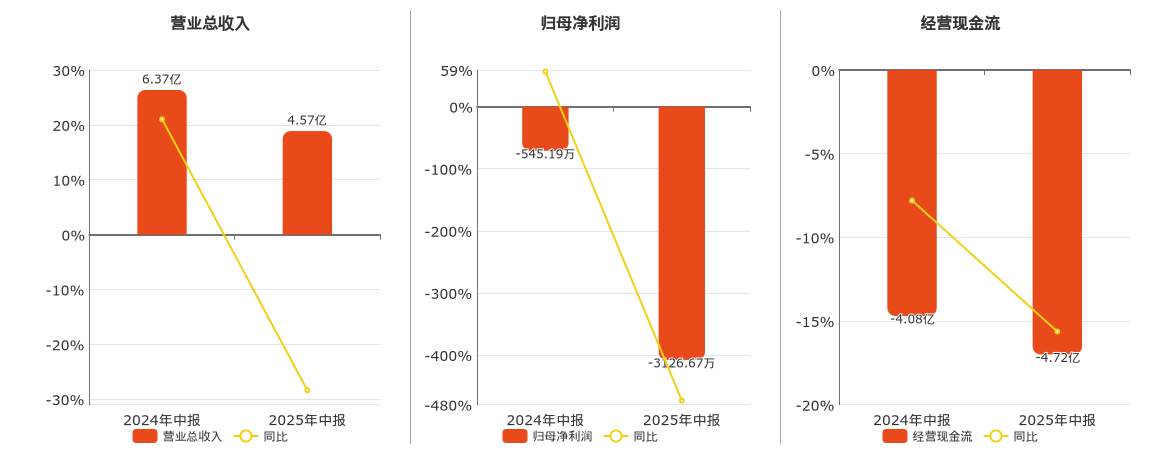
Core Viewpoint - 莱斯信息's stock price has shown fluctuations with a recent increase of 2.13%, reflecting a total market capitalization of 14.335 billion yuan and a trading volume of 106 million yuan [1] Company Overview - 南京莱斯信息技术股份有限公司, established on July 16, 1988, is located in Nanjing, Jiangsu Province. The company specializes in providing comprehensive solutions for civil command information systems, focusing on air traffic management, urban traffic management, and urban governance [1] - The main revenue sources for 莱斯信息 include: 86.62% from information system development, 10.39% from operation and technical services, 2.55% from product sales, and 0.44% from other sources [1] Financial Performance - For the first half of 2025, 莱斯信息 reported a revenue of 457 million yuan, a year-on-year decrease of 28.37%, and a net profit attributable to shareholders of -31.27 million yuan, a significant decline of 473.50% [2] - Since its A-share listing, 莱斯信息 has distributed a total of 132 million yuan in dividends [3] Shareholder Structure - As of June 30, 2025, 莱斯信息 had 9,573 shareholders, a decrease of 2.22% from the previous period, with an average of 6,776 circulating shares per shareholder, an increase of 8.34% [2] - The top ten circulating shareholders include 永赢低碳环保智选混合发起A and 长城久嘉创新成长混合A, with notable changes in their holdings [3]
软件开发板块9月12日跌0.49%,安博通领跌,主力资金净流出31.11亿元
Zheng Xing Xing Ye Ri Bao· 2025-09-12 08:37
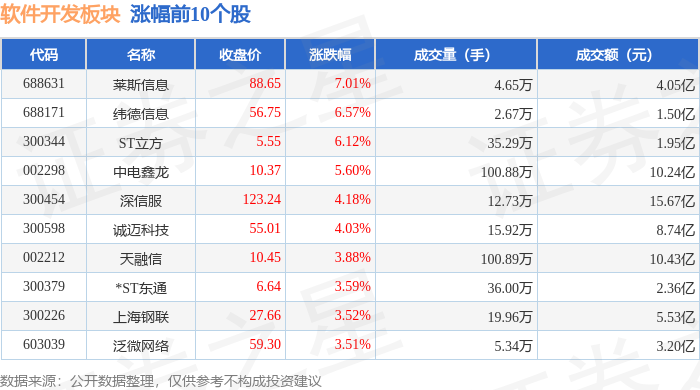
Market Overview - On September 12, the software development sector declined by 0.49%, with Anbotong leading the drop [1] - The Shanghai Composite Index closed at 3883.69, up 0.22%, while the Shenzhen Component Index closed at 12996.38, up 0.13% [1] Top Gainers in Software Development Sector - Cais Information (688631) closed at 88.65, up 7.01% with a trading volume of 46,500 shares and a turnover of 405 million [1] - Weide Information (688171) closed at 56.75, up 6.57% with a trading volume of 26,700 shares and a turnover of 150 million [1] - ST Lifang (300344) closed at 5.55, up 6.12% with a trading volume of 352,900 shares and a turnover of 195 million [1] - Zhongdian Xinlong (002298) closed at 10.37, up 5.60% with a trading volume of 1,008,800 shares and a turnover of 1.024 billion [1] - Deepin Technology (300454) closed at 123.24, up 4.18% with a trading volume of 127,300 shares and a turnover of 1.567 billion [1] Top Decliners in Software Development Sector - Anbotong (688168) closed at 100.67, down 8.96% with a trading volume of 34,600 shares and a turnover of 35.4 million [2] - ST Guangdao (839680) closed at 10.15, down 8.89% with a trading volume of 87,800 shares and a turnover of 91.995 million [2] - Jingwei Hengrun (688326) closed at 114.45, down 3.50% with a trading volume of 14,100 shares and a turnover of 162 million [2] Capital Flow Analysis - The software development sector experienced a net outflow of 3.111 billion from institutional investors, while retail investors saw a net inflow of 2.08 billion [2][3] - Major stocks like Deepin Technology (300454) had a net inflow of 1.79 billion from institutional investors, but a net outflow of 2.23 billion from retail investors [3] - Anbotong (688168) had a net inflow of 590.45 million from institutional investors, but also saw significant outflows from retail investors [3]


今日50只个股突破半年线
Zheng Quan Shi Bao Wang· 2025-09-12 07:52
Market Overview - The Shanghai Composite Index closed at 3870.60 points, slightly above the six-month moving average, with a change of -0.12% [1] - The total trading volume of A-shares reached 25,483.12 billion yuan [1] Stocks Breaking the Six-Month Line - A total of 50 A-shares have surpassed the six-month moving average today, with notable stocks including Shanghai Construction, Yihualu, and Runjian Shares, showing divergence rates of 9.89%, 9.08%, and 9.07% respectively [1] - Stocks with smaller divergence rates that just crossed the six-month line include Zhuhai Port, Zhongzhou Special Materials, and Nanjing Chemical Fiber [1] Top Performers - Shanghai Construction (600170) saw a price increase of 9.96% with a turnover rate of 6.20% and a divergence rate of 9.89% [1] - Yihualu (300212) increased by 10.90% with a turnover rate of 12.71% and a divergence rate of 9.08% [1] - Runjian Shares (002929) rose by 9.99% with a turnover rate of 10.76% and a divergence rate of 9.07% [1] Additional Notable Stocks - Other significant gainers include Huafu Times (600169) with a 10.08% increase and a divergence rate of 7.82%, and Shang (002042) with a 10.06% increase and a divergence rate of 7.70% [1] - The stock of Fule New Materials (605488) rose by 10.01% with a divergence rate of 6.93% [1] Stocks with Lower Divergence Rates - Stocks like Zhonghuan Hailu (301040) and Baitong Energy (001376) showed increases of 1.91% and 1.55% respectively, with divergence rates of 1.09% and 1.00% [2] - Longyuan Construction (600491) increased by 1.91% with a divergence rate of 0.97% [2]





莱斯信息(688631):业绩短期承压,“天牧”系统持续拓展
HTSC· 2025-08-31 10:31
Investment Rating - The report maintains an "Accumulate" rating for the company with a target price of RMB 96.42 per share [1][5][24] Core Views - The company's performance in the first half of 2025 was under pressure, with revenue and net profit declining significantly due to seasonal factors and delayed payments from government projects [1][2] - The company is positioned as a leader in low-altitude information services, with ongoing expansion of its "Tianmu" system across various provinces and cities, which is expected to improve performance in the second half of the year [1][2] - The report highlights the company's strong gross margin improvement and increased R&D investment, indicating a focus on innovation and high-margin business segments [3][4] Summary by Sections Financial Performance - In 1H25, the company reported revenue of RMB 4.57 million and a net loss of RMB 0.31 million, representing a year-on-year decline of 28.4% and an expanded loss [1] - The gross margin for 1H25 was 26.65%, an increase of 4.76 percentage points year-on-year, attributed to a shift towards higher-margin business segments [3] Business Segments - The company's information system development business generated RMB 3.96 million in revenue in 1H25, down 30% year-on-year, with notable contributions from civil aviation and urban traffic management sectors [2] - The report emphasizes the successful implementation of the "Tianmu" solution in various cities and the acquisition of a national-level project, enhancing the company's market position [2] Future Outlook - The company is expected to consolidate its core business and advance local low-altitude information construction, with significant market opportunities projected in the civil aviation sector [4] - The report forecasts a compound annual growth rate (CAGR) for the civil aviation control business of 31.34% from 2024 to 2026, indicating strong growth potential [5][19] Valuation - The report employs a sum-of-the-parts (SOTP) valuation method, projecting a target market value of RMB 157.63 billion for the company, corresponding to a target price of RMB 96.42 per share [5][24]
莱斯信息(688631):发布“天牧”大模型深度参与电科低空计划 积极拓展传统业务新方向
Xin Lang Cai Jing· 2025-08-29 13:20
Financial Performance - In the first half of 2025, the company achieved revenue of 457 million yuan, a year-on-year decrease of 28.37% [1] - The net profit attributable to shareholders was -31 million yuan, a significant decline of 473.5% year-on-year [1] - For Q2 2025, revenue was 348 million yuan, down 11.44% year-on-year, with a net profit of -16 thousand yuan, reflecting a year-on-year decrease of 258.83% [1] Business Challenges - The company's performance was pressured by a reduction in urban governance and road traffic business, along with delays in revenue recognition [1] - The company recognized credit impairment losses and asset impairment losses totaling 22.44 million yuan, with accounts receivable bad debt losses amounting to 25.43 million yuan [1] - Despite challenges, core projects are expected to be accepted in the second half of the year, which may stabilize overall performance [1] Research and Development - The company increased its R&D investment, with R&D expenses amounting to 71 million yuan, a year-on-year increase of 3.93% [1] - The R&D expense ratio was 15.56%, up 4.84 percentage points year-on-year [1] Low-altitude Projects - The company has made significant progress in low-altitude projects, launching the "Tianmu" model to support the Electric Science and Technology low-altitude plan [2] - The company has implemented multiple low-altitude projects in various cities, including a low-altitude flight service platform in Nanjing capable of supporting 50,000 flight operations [2] - The "Tianmu" series of low-altitude products has been integrated with DeepSeek, resulting in the release of China's first aviation transportation model [2] Market Expansion - The company is expanding its civil aviation air traffic control business, achieving a breakthrough with the self-developed runway status light control system at Shenzhen Airport [2] - The company is actively pursuing new directions in urban and transportation business, including projects in cities like Nanjing, Suzhou, and Fuzhou [3] - The company is also advancing military-civilian integration projects, focusing on building a new generation of national defense mobilization information system [3] Profit Forecast - The company is expected to see revenue growth in the low-altitude sector and maintain a technological lead in civil aviation air traffic control [4] - Revenue projections for 2025-2027 are 1.739 billion yuan, 1.93 billion yuan, and 2.153 billion yuan, respectively, with net profits of 167 million yuan, 234 million yuan, and 294 million yuan [4] - The projected price-to-earnings ratios are 91, 65, and 51 times for the respective years [4]
莱斯信息(688631.SH):2025年中报净利润为-3126.67万元,同比亏损扩大
Xin Lang Cai Jing· 2025-08-29 01:19
Core Points - The company reported a total revenue of 457 million yuan, ranking 51st among disclosed peers, which is a decrease of 181 million yuan or 28.37% year-on-year [1] - The net profit attributable to shareholders was -31.27 million yuan, ranking 74th among peers, a decrease of 25.81 million yuan compared to the same period last year [1] - The net cash inflow from operating activities was -47.2 million yuan, ranking 117th among peers, a decrease of 63.85 million yuan year-on-year [1] Financial Ratios - The latest debt-to-asset ratio is 44.61%, ranking 95th among peers, an increase of 0.40 percentage points from the previous quarter, but a decrease of 3.31 percentage points year-on-year [3] - The latest gross profit margin is 26.65%, ranking 98th among peers, a decrease of 9.87 percentage points from the previous quarter, but an increase of 6.12 percentage points year-on-year [3] - The latest return on equity (ROE) is -1.71%, ranking 76th among peers, a decrease of 1.40 percentage points year-on-year [3] Earnings Per Share and Turnover Ratios - The diluted earnings per share is -0.19 yuan, ranking 92nd among peers, a decrease of 0.16 yuan compared to the same period last year [3] - The latest total asset turnover ratio is 0.13 times, ranking 63rd among peers, a decrease of 0.05 times year-on-year, representing a decline of 27.76% [3] - The latest inventory turnover ratio is 1.00 times, ranking 81st among peers, a decrease of 0.14 times year-on-year, representing a decline of 12.42% [3] Shareholder Information - The number of shareholders is 9,573, with the top nine shareholders holding 123 million shares, accounting for 75.49% of the total share capital [3] - The largest shareholder is China Electric Rais Information System Co., Ltd., holding 60.3% of shares [3] - Other significant shareholders include China Jianyin Investment Co., Ltd. (9.62%) and CITIC Bank Corporation Limited (1.47%) [3]