
Wuhan Healthgen Biotechnology Corp.(688765)

Search documents
81只A股筹码大换手(11月10日)


Zheng Quan Shi Bao Wang· 2025-11-10 08:22
Market Overview - As of November 10, the Shanghai Composite Index closed at 4018.60 points, up 21.04 points, with a gain of 0.53% [1] - The Shenzhen Component Index closed at 13427.61 points, up 23.56 points, with a gain of 0.18% [1] - The ChiNext Index closed at 3178.83 points, down 29.38 points, with a loss of 0.92% [1] Stock Performance - A total of 81 A-shares had a turnover rate exceeding 20% on this day, indicating significant trading activity [1] - Notable stocks with high turnover rates included: - Haili Heavy Industry (002255) with a turnover rate of 54.19% and a closing price of 14.86 CNY, up 3.34% [1] - Zhongneng Electric (300062) with a turnover rate of 52.40% and a closing price of 11.12 CNY, down 2.28% [1] - Xue Ren Group (002639) with a turnover rate of 50.85% and a closing price of 15.00 CNY, up 7.45% [1] Notable Stocks with High Turnover Rates - The following stocks also exhibited significant turnover rates: - C Daming (603376) at 49.12% turnover, closing at 46.12 CNY, down 9.50% [1] - Qing Shui Yuan (300437) at 46.35% turnover, closing at 17.59 CNY, up 19.99% [1] - Zhongzhi Technology (301361) at 46.11% turnover, closing at 40.68 CNY, up 4.33% [1] Additional High Turnover Stocks - Other stocks with notable turnover rates included: - C Delijia (603092) at 44.10% turnover, closing at 72.82 CNY, up 3.26% [1] - Haike New Source (301292) at 43.80% turnover, closing at 48.50 CNY, up 14.33% [1] - Bluefeng Biochemical (002513) at 42.39% turnover, closing at 8.86 CNY, up 0.34% [1]
禾元生物-U换手率30.81% 营业部龙虎榜净卖出6968.41万元
Zheng Quan Shi Bao Wang· 2025-11-07 14:30
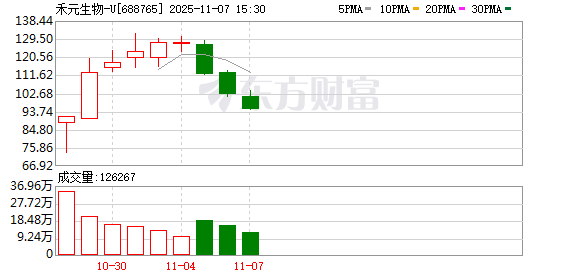
Group 1 - The closing price of He Yuan Bio-U (688765) on November 7 was 94.96 yuan, down 7.09%, with a turnover rate of 30.81% and an amplitude of 10.05%, resulting in a transaction amount of 1.249 billion yuan [2] - The stock was listed on the trading alert due to a daily turnover rate exceeding 30% [2] - The top five trading departments accounted for a total transaction amount of 359 million yuan, with a net sell of 69.68 million yuan [2] Group 2 - The main buying department was Goldman Sachs (China) Securities Co., Ltd. Shanghai Pudong New Area Century Avenue Securities Department, with a buying amount of 47.9998 million yuan [3] - The main selling department was also Goldman Sachs (China) Securities Co., Ltd. Shanghai Pudong New Area Century Avenue Securities Department, with a selling amount of 61.1624 million yuan [3] - The overall net outflow of funds for the stock was 200 million yuan on that day [3]

科创板活跃股排行榜(11月7日)
Zheng Quan Shi Bao Wang· 2025-11-07 09:54
Market Performance - The Sci-Tech 50 Index fell by 1.47%, closing at 1415.69 points, with a total trading volume of 4.188 billion shares and a turnover of 188.988 billion yuan, resulting in an average turnover rate of 2.20% [1] - Among the tradable stocks on the Sci-Tech Board, 185 stocks closed higher, with 5 stocks rising over 10% and 17 stocks rising between 5% and 10%. Conversely, 401 stocks closed lower, with 1 stock declining over 10% [1] Turnover Rate Analysis - The turnover rate distribution shows that 2 stocks had a turnover rate exceeding 20%, 20 stocks had a turnover rate between 10% and 20%, and 37 stocks had a turnover rate between 5% and 10% [1] - The stock with the highest turnover rate was He Yuan Biological, which closed down by 7.09% with a turnover rate of 30.81% and a transaction amount of 1.249 billion yuan. Wanrun New Energy rose by 15.28% with a turnover rate of 22.99% and a transaction amount of 1.727 billion yuan [1] Sector Performance - In terms of sector performance, the electronics sector had the most stocks with a turnover rate exceeding 5%, totaling 18 stocks, followed by the power equipment and computer sectors with 15 and 7 stocks, respectively [2] Capital Flow - Among the high turnover stocks, 34 stocks experienced net inflows of main funds, with the highest net inflows recorded for Purun Co., Wanrun New Energy, and Huahong Company, amounting to 190 million yuan, 157 million yuan, and 101 million yuan, respectively [2] - Conversely, stocks with significant net outflows included He Yuan Biological, Baiwei Storage, and Xi'an Yicai, with net outflows of 200 million yuan, 95.678 million yuan, and 91.679 million yuan, respectively [2] Leverage Fund Movements - A total of 30 stocks received net purchases from leveraged funds, with notable increases in financing balances for Artis, Jinpan Technology, and He Yuan Biological, which increased by 735 million yuan, 239 million yuan, and 189 million yuan, respectively [2] - Stocks with the largest decreases in financing balances included Huahong Company, Yuanjie Technology, and Jingyi Equipment, which decreased by 293 million yuan, 156 million yuan, and 130 million yuan, respectively [2]


今年以来科创板股首发募资金额达177.46亿元
Zheng Quan Shi Bao Wang· 2025-11-07 08:39
Core Insights - The total amount raised by companies on the Sci-Tech Innovation Board (STAR Market) this year has reached 17.746 billion yuan, with an average fundraising of 1.613 billion yuan per company [1][2] - The company with the highest fundraising amount is Xi'an Yicai, which raised 4.636 billion yuan, primarily for its silicon industry base project [1] - The average initial offering price of the issued stocks is 20.23 yuan, with the highest price being 47.27 yuan for Ying Shi Innovation [1][2] Fundraising Overview - A total of 11 companies have issued new shares on the STAR Market this year, with 7 companies raising over 1 billion yuan, 3 companies raising between 500 million and 1 billion yuan, and 1 company raising less than 500 million yuan [1] - The companies with significant fundraising amounts include He Yuan Biological (2.599 billion yuan) and Yi Tang Co., Ltd. (2.497 billion yuan) [1] Pricing and Valuation - The average issuance price of the stocks is 20.23 yuan, with the highest issuance price at 47.27 yuan for Ying Shi Innovation and the lowest at 8.45 yuan for Yi Tang Co., Ltd. [1] - The issuance price-to-earnings (P/E) ratio ranges from 6.14 to 71.42, with an average of 35.20 and a median of 33.41 [2] Regional Distribution - The majority of the issued companies are concentrated in Beijing, Hubei, and Guangdong, each having 2 companies [2] - The top fundraising regions are Shaanxi (4.636 billion yuan), Hubei (3.767 billion yuan), and Guangdong (3.538 billion yuan) [2]
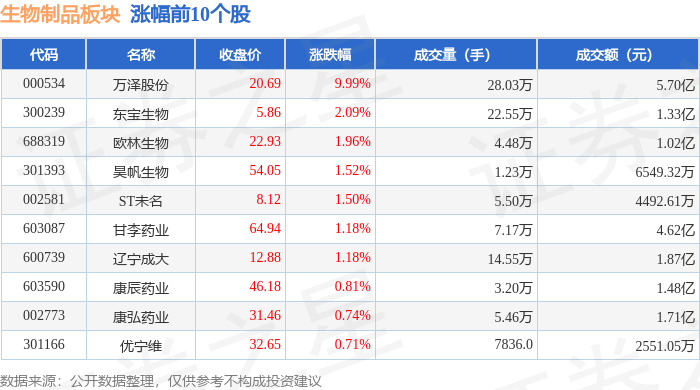
生物制品板块11月7日跌0.37%,禾元生物领跌,主力资金净流出6.79亿元
Zheng Xing Xing Ye Ri Bao· 2025-11-07 08:37
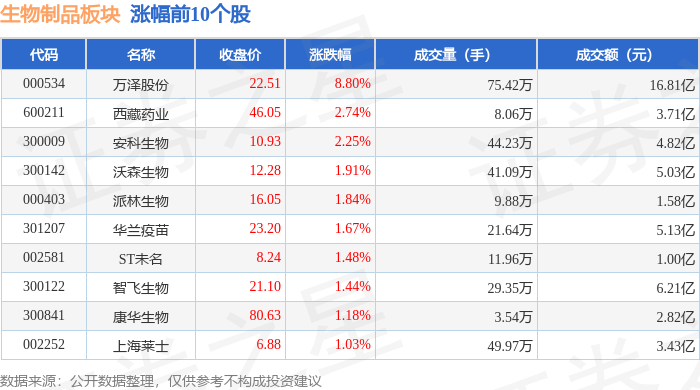
Core Viewpoint - The biopharmaceutical sector experienced a decline of 0.37% on November 7, with He Yuan Bio leading the drop. The Shanghai Composite Index closed at 3997.56, down 0.25%, while the Shenzhen Component Index closed at 13404.06, down 0.36% [1]. Group 1: Stock Performance - Wan Ze Co. (000534) saw a significant increase in stock price, closing at 22.51 with an 8.80% rise and a trading volume of 754,200 shares, amounting to 1.681 billion yuan [1]. - Tibet Pharmaceutical (600211) closed at 46.05, up 2.74%, with a trading volume of 80,600 shares, totaling 371 million yuan [1]. - Anke Bio (300009) increased by 2.25%, closing at 10.93 with a trading volume of 442,300 shares, amounting to 482 million yuan [1]. - The overall biopharmaceutical sector saw a net outflow of 678 million yuan from institutional investors, while retail investors had a net inflow of 304 million yuan [2][3]. Group 2: Capital Flow - The main capital inflow was observed in Tibet Pharmaceutical, with a net inflow of 26.13 million yuan from institutional investors, while retail investors had a net outflow of 36.64 million yuan [3]. - Anke Bio also experienced a net inflow of 23.91 million yuan from institutional investors, with retail investors seeing a net outflow of 13.09 million yuan [3]. - The overall trend indicates a mixed sentiment in the biopharmaceutical sector, with institutional investors pulling back while retail investors showed some interest [2][3].



禾元生物-U换手率39.70% 营业部龙虎榜净买入5473.28万元
Zheng Quan Shi Bao Wang· 2025-11-06 14:49
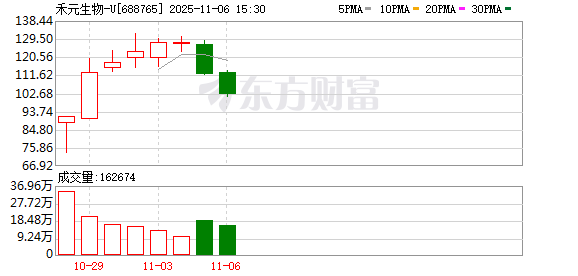
资金流向方面,该股今日全天主力资金净流出2.82亿元。(数据宝) | 买入营业部名称 | 买入金额(万元) | | --- | --- | | 高盛(中国)证券有限责任公司上海浦东新区世纪大道证券营业部 | 8257.67 | | 中信证券股份有限公司上海分公司 | 6306.95 | | 中信证券股份有限公司北京紫竹院路证券营业部 | 5441.16 | | 瑞银证券有限责任公司上海花园石桥路证券营业部 | 5237.99 | | 中信证券股份有限公司深圳深南中路中信大厦证券营业部 | 3445.24 | | 卖出营业部名称 | 卖出金额(万元) | | 高盛(中国)证券有限责任公司上海浦东新区世纪大道证券营业部 | 5244.71 | | 国泰海通证券股份有限公司重庆观音桥步行街证券营业部 | 5184.33 | | 国泰海通证券股份有限公司上海浦东新区陆家嘴东路证券营业部 | 5143.77 | | 招商证券股份有限公司上海娄山关路证券营业部 | 3877.20 | | 中信建投证券股份有限公司成都市南一环路证券营业部 | 3765.72 | 证券时报·数据宝统计显示,上榜的前五大买卖营业部合计成交5. ...
医药生物行业资金流出榜:禾元生物-U等5股净流出资金超亿元
Zheng Quan Shi Bao Wang· 2025-11-06 10:10
Market Overview - The Shanghai Composite Index rose by 0.97% on November 6, with 19 out of 28 sectors experiencing gains, led by the metals and electronics sectors, which increased by 3.05% and 3.00% respectively [2] - The media and social services sectors saw the largest declines, with decreases of 1.35% and 1.11% respectively [2] Capital Flow - The net inflow of capital in the two markets was 6.174 billion yuan, with 12 sectors receiving net inflows [2] - The electronics sector had the highest net inflow of capital at 12.224 billion yuan, while the metals sector followed with a net inflow of 3.647 billion yuan [2] Pharmaceutical and Biological Industry - The pharmaceutical and biological sector experienced a slight decline of 0.03%, with a net outflow of capital amounting to 3.299 billion yuan [3] - Out of 477 stocks in this sector, 181 stocks rose, while 275 stocks fell [3] - The top three stocks with the highest net inflow were Wanzhe Co. (1.08 billion yuan), Hailin Pharmaceutical (682.184 million yuan), and Renfu Pharmaceutical (561.307 million yuan) [3] Capital Inflow and Outflow in Pharmaceutical Sector - The top stocks with capital inflow included: - Wanzhe Co. with a rise of 9.99% and a capital flow of 107.9805 million yuan [4] - Hailin Pharmaceutical with a decline of 0.83% and a capital flow of 68.2184 million yuan [4] - Renfu Pharmaceutical with a rise of 0.25% and a capital flow of 56.1307 million yuan [4] - The stocks with the highest capital outflow included: - Heyuan Biological-U with a decline of 8.74% and a capital outflow of 281.6923 million yuan [5] - Sunflower with a decline of 7.99% and a capital outflow of 167.9643 million yuan [5] - Changshan Pharmaceutical with a decline of 2.09% and a capital outflow of 156.2317 million yuan [5]


38只科创板活跃股获主力资金净流入
Zheng Quan Shi Bao Wang· 2025-11-06 10:10
Core Points - The Sci-Tech Innovation Board (STAR Market) index rose by 3.34%, closing at 1436.86 points, with a total trading volume of 4.16 billion shares and a turnover of 217.87 billion yuan [1] - Among the tradable stocks on the STAR Market, 405 stocks closed higher, with 10 stocks rising over 10%, including Changguang Huaxin and Huasheng Lithium, which hit the daily limit [1] - The turnover rate for STAR Market stocks showed that 3 stocks had a turnover rate exceeding 20%, while 16 stocks had a turnover rate between 10% and 20% [1] Trading Performance - The stocks with the highest turnover rates included Heyuan Biological, which closed down 8.74% with a turnover rate of 39.70%, and Bibet, which closed down 5.14% with a turnover rate of 22.78% [1][3] - The top gainers included Changguang Huaxin and Huasheng Lithium, both up by 20.00%, while the largest decliners were Aerospace Hongtu and Heyuan Biological, down by 15.92% and 8.74%, respectively [2] Sector Analysis - The electronics sector had the most stocks with a turnover rate exceeding 5%, totaling 21 stocks, followed by the power equipment and defense sectors with 15 and 6 stocks, respectively [2] - In terms of capital flow, 38 stocks experienced net inflows from main funds, with the highest inflows seen in Canxin Technology, Western Superconducting, and Purun Technology, amounting to 267 million yuan, 198 million yuan, and 195 million yuan, respectively [2] Leverage Fund Movements - A total of 33 stocks received net purchases from leveraged funds, with the largest increases in financing balances seen in Artis, GuoDun Quantum, and Trina Solar, which increased by 544 million yuan, 395 million yuan, and 274 million yuan, respectively [2]



生物制品板块11月6日跌0.2%,禾元生物领跌,主力资金净流出7.75亿元
Zheng Xing Xing Ye Ri Bao· 2025-11-06 08:51
| 代码 | 名称 | 收盘价 | 涨跌幅 | 成交量(手) | 成交额(元) | | --- | --- | --- | --- | --- | --- | | 688765 | 不元生物 | 102.21 | -8.74% | 16.27万 | 17.29亿 | | 920344 | 三元基因 | 28.00 | -3.85% | 2.60万 | 7364.32万 | | 301207 | 世兰店面 | 22.82 | -3.55% | 19.61万 | 4.55 乙 | | 688670 | 金迪克 | 17.58 | -2.82% | - 3.12万 | 5541.95万 | | 920547 | 元锡晶海 | 27.12 | -2.69% | 1.24万 | 3375.61万 | | 300485 | 赛升药业 | 12.00 | -2.28% | 10.77万 | 1.29亿 | | 920575 | 康乐卫士 | 13.84 | -2.19% | 3.16万 | 4401.44万 | | 688488 | 艾迪药业 | 14.67 | -2.13% | 4.11万 | 6059.41万 | | ...
禾元生物龙虎榜:营业部净卖出829.76万元
Zheng Quan Shi Bao Wang· 2025-11-05 15:00
Core Viewpoint - He Yuan Bio (688765) experienced a significant decline in stock price, closing at 112.00 yuan, down 12.55% on November 5, with a trading volume of 2.206 billion yuan and a turnover rate of 45.34% [1] Trading Activity - The stock was listed on the daily trading list due to a turnover rate exceeding 30% [1] - The top five trading departments accounted for a total transaction of 666 million yuan, with a net selling amount of 8.2976 million yuan [1] - The largest buying department was Goldman Sachs (China) Securities, with a purchase amount of 94.6042 million yuan, followed by CITIC Securities Shanghai Branch at 65.3993 million yuan [1] - The leading selling department was CITIC Jiantou Securities Anhui Branch, with a selling amount of 86.9655 million yuan [1] Fund Flow - The stock saw a net outflow of 277 million yuan in main funds throughout the day [1]