
CHANGHONG HUAYI(000404)

Search documents
多家航司宣布日本航线继续免费退票
2 1 Shi Ji Jing Ji Bao Dao· 2025-12-05 13:23
Core Viewpoint - The ticket refund and change policy for flights to and from Japan has been extended by several Chinese airlines, allowing free modifications and cancellations for tickets purchased before December 5, 2025, for travel dates between November 15, 2025, and March 28, 2026 [1][13]. Group 1: Airlines Involved - Major airlines such as Air China, China Southern Airlines, China Eastern Airlines, Hainan Airlines, and Shandong Airlines have announced the extension of their free refund and change policy for Japan routes [1][13]. - The policy applies to tickets purchased or exchanged before December 5, 2025, for flights to Tokyo, Osaka, Nagoya, Fukuoka, Sendai, Hiroshima, Sapporo, and Okinawa [1]. Group 2: Ticket Change and Refund Rules - For Air China, the first change to a flight on the same route incurs no fee, and refunds are also free of charge for eligible tickets [1]. - China Southern Airlines has similar rules, allowing the first change without a fee and refunds without charge for tickets that meet the specified criteria [4][5]. - Hainan Airlines and Shandong Airlines have also implemented comparable policies, allowing free changes and refunds under certain conditions [9][11]. Group 3: Impact on Flight Operations - As of November 30, 2023, the number of one-way flights from China to Japan has decreased from 4,703 to 3,537, a reduction of 1,166 flights or 25% [13]. - The total seating capacity has also dropped from 884,148 to 672,568, representing a 24% decrease [13]. - The future flight arrangements for the next three months remain uncertain, with only some airlines announcing adjustments extending into March 2026 [13].




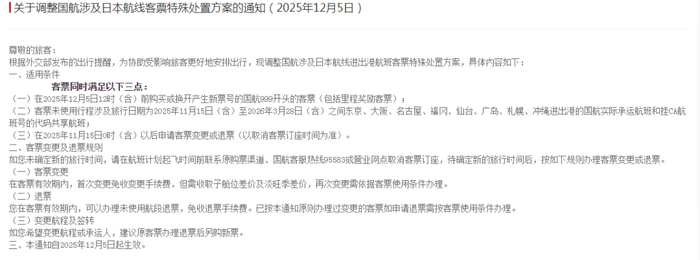
多家航司宣布日本航线继续免费退票
21世纪经济报道· 2025-12-05 13:02
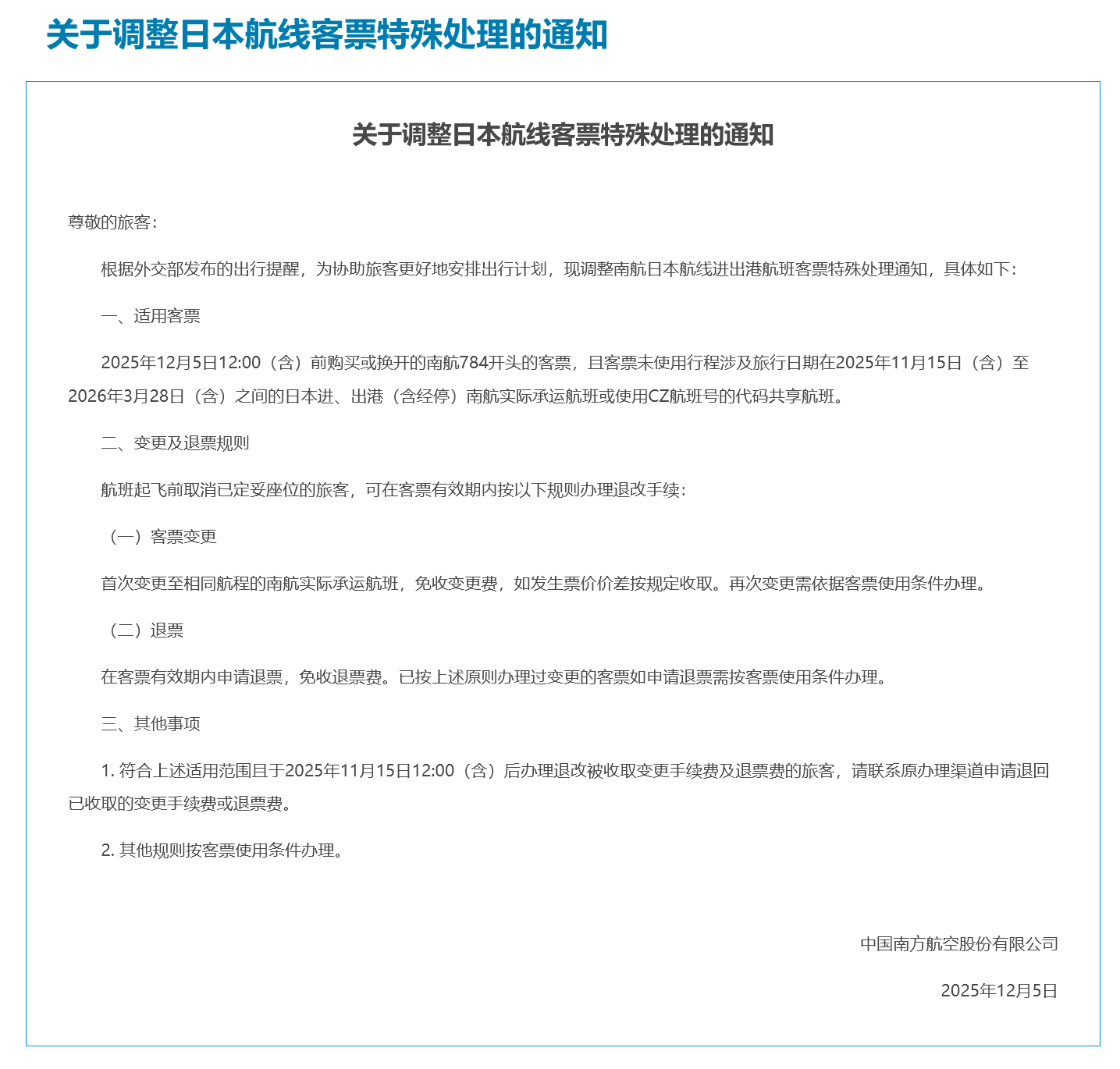
Core Viewpoint - The article discusses the extension of the free ticket change and refund policy for flights between China and Japan, allowing travelers to adjust their plans without incurring fees due to ongoing reductions in flight availability [1][12]. Group 1: Policy Changes - Multiple Chinese airlines, including Air China, China Southern Airlines, and Hainan Airlines, have announced that tickets purchased before December 5, 2025, for flights to and from Japan can be changed or refunded without fees if the travel dates fall between November 15, 2025, and March 28, 2026 [1][3][8]. - The policy applies to specific ticket types, including those issued under certain flight numbers and those that have not been used [1][3][8]. Group 2: Flight Reductions - Data from AeroRoutes indicates a significant reduction in flights from China to Japan, with the number of one-way flights decreasing from 4,703 in mid-November to 3,537 by the end of November, representing a 25% reduction [12]. - The total number of available seats has also decreased from 884,148 to 672,568, marking a 24% drop in capacity [12]. Group 3: Implementation Details - The airlines have specified that the first change to a new flight on the same route will not incur a fee, although fare differences may apply [4][9]. - Refund requests made within the ticket's validity period will also be processed without a fee, provided the ticket has not been previously changed [5][9].
多家航司公告:中日航线免费退改签延长至明年3月28日
Guan Cha Zhe Wang· 2025-12-05 11:51
Core Viewpoint - Multiple Chinese airlines have extended their free ticket change and refund policy for flights to Japan due to recent geopolitical tensions, allowing passengers to adjust their travel plans without incurring fees [1][6]. Group 1: Policy Adjustments - Airlines including Air China, China Eastern, China Southern, Hainan Airlines, Spring Airlines, Shandong Airlines, Xiamen Airlines, and Shenzhen Airlines have announced changes to their ticket handling policies for flights to Japan [1]. - The new policy allows free changes and refunds for tickets purchased or exchanged before December 5, 2025, for travel dates between November 15, 2025, and March 28, 2026 [1]. - For example, Air China's policy specifies that tickets must be purchased before December 5, 2025, and must involve flights to or from specific Japanese cities [1]. Group 2: Impact on Flight Operations - Following the diplomatic tensions, as of November 27, 2023, Chinese airlines had canceled 904 flights on 72 routes to Japan, representing 16% of the planned 5,548 flights, equating to approximately 156,000 seats [6]. - The reduction in Chinese tourists traveling to Japan is expected to significantly impact Japan's GDP, with estimates suggesting a decrease of 0.36% and an economic loss of about 2.2 trillion yen (approximately 101.16 billion yuan) [8].
多家航空公司发布通知
Xin Lang Cai Jing· 2025-12-05 10:57
Group 1 - Multiple domestic airlines have extended the free cancellation and change policy for flights involving Japan until March 28, 2026 [1] - The policy adjustment comes in response to controversial remarks made by Japan's new Prime Minister, which have drawn significant criticism and led to a warning from Chinese authorities for citizens to avoid traveling to Japan [1] - Following the announcement on November 15, over 40% of planned flights from China to Japan have been canceled, totaling more than 1,900 flights [1] Group 2 - The number of travelers to Japan has significantly decreased, with a reported drop of approximately 23% in passenger volume on November 25 compared to November 15 [1] - Airlines are currently monitoring market demand and evaluating the situation regarding passenger cancellations and changes [1]
部分经济舱锁座率达一半以上!这是变相薅羊毛行为
Sou Hu Cai Jing· 2025-12-03 15:43
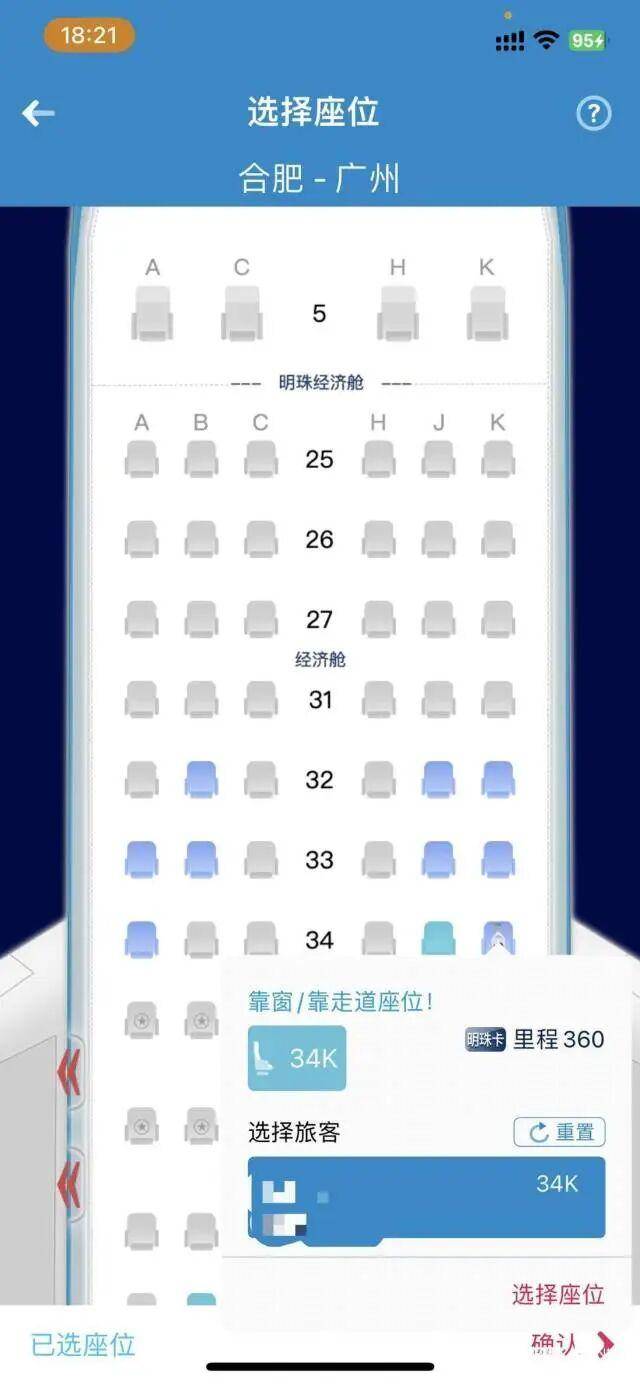
Core Viewpoint - The excessive "seat locking" behavior by airlines is identified as a practice that limits consumer choice and increases passenger costs, which has been highlighted in a recent consumer survey report by the Jiangsu Provincial Consumer Protection Committee [1][3][12]. Group 1: Seat Locking Practices - A survey of 10 major domestic airlines revealed that the proportion of locked seats in economy class ranges from 19.9% to 62.1%, with an average of 38.7% [1][8]. - Airlines typically restrict access to preferred seats (such as those in the front row, window, and aisle) while only offering less desirable seats for free selection, effectively forcing consumers to pay for better options [1][8][12]. - The practice of locking seats is often justified by airlines as necessary for safety and special service needs, but the extent of seat locking suggests it has become a revenue-generating service [3][10]. Group 2: Consumer Rights and Complaints - Many consumers express frustration over the inability to select preferred seats without incurring additional costs, which they believe undermines their rights as ticket holders [4][5]. - The lack of transparency regarding the criteria for seat locking and the absence of clear communication about free selection options violate consumer rights, including the right to know and the right to fair trading [10][12]. - The Jiangsu Provincial Consumer Protection Committee has initiated discussions with the airlines and expects them to address consumer complaints and ensure equal seat selection opportunities for all passengers [3][12]. Group 3: Regulatory Response - The Jiangsu Provincial Consumer Protection Committee has mandated that the airlines submit written rectification plans within 15 working days to address the issues related to seat locking [12]. - Continuous monitoring of the airlines' compliance with the rectification requirements will be conducted by the consumer protection authority [12].

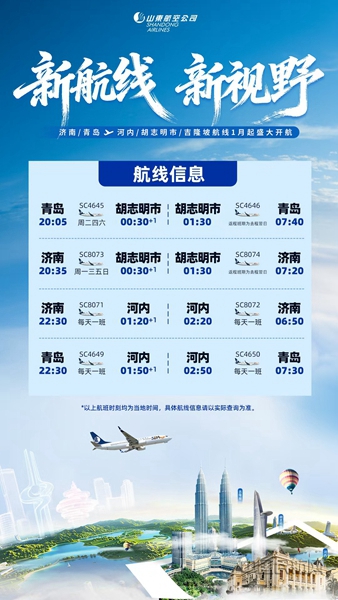
山航河内、胡志明市、吉隆坡航线1月开航
Zhong Guo Min Hang Wang· 2025-12-03 10:09
Group 1 - Shandong Airlines will launch direct flights from Jinan and Qingdao to Hanoi, Ho Chi Minh City in Vietnam, and Kuala Lumpur in Malaysia starting January 2026, reflecting the company's response to the Belt and Road Initiative and the increasing demand for travel between China and Southeast Asia [1] - The new routes will enhance connectivity between major hubs in Vietnam, including the capital Hanoi and the economic center Ho Chi Minh City, as well as the modern and culturally diverse Kuala Lumpur [1] - The Qingdao-Ho Chi Minh City route will commence on January 1, 2026, with three flights per week, while the Jinan-Ho Chi Minh City route will start on January 16, 2026, with four flights per week [1] Group 2 - Shandong Airlines is offering promotional products such as early bird discounts and buy-one-get-one-free offers for travelers, who can purchase tickets through the airline's official website and various online travel agencies [1] - The airline emphasizes safety, efficiency, and comfort in its services, aiming to build an "air silk road" connecting Shandong and surrounding markets to Southeast Asia, thereby promoting regional connectivity and bilateral exchanges [2]

10家航司被调查 揭开乘机选座“潜规则”
2 1 Shi Ji Jing Ji Bao Dao· 2025-12-02 01:55
Core Viewpoint - The issue of "seat locking" and paid seat selection services by airlines has sparked widespread discussion among consumers, with many reporting that desirable seats in economy class are often locked and require additional fees to select [1] Group 1: Investigation Results - The Jiangsu Provincial Consumer Rights Protection Committee conducted a survey of 10 domestic airlines, including China Southern Airlines, Air China, Hainan Airlines, Xiamen Airlines, Shenzhen Airlines, Shandong Airlines, Sichuan Airlines, Eastern Airlines, Spring Airlines, and Juneyao Airlines [1] - The survey revealed that all 10 airlines engage in seat locking practices, with Xiamen Airlines having a seat locking rate as high as 42.5%, while most airlines reported seat locking rates exceeding 30%, and some even surpassing 50% [1] - The Jiangsu Provincial Consumer Rights Protection Committee has issued clear rectification requirements to the 10 airlines regarding the seat locking issue, demanding written reports on corrective actions within 15 working days [1]
优质座位大量被“锁” 10家航司被调查 揭开乘机选座“潜规则”
Yang Shi Xin Wen· 2025-12-01 19:11
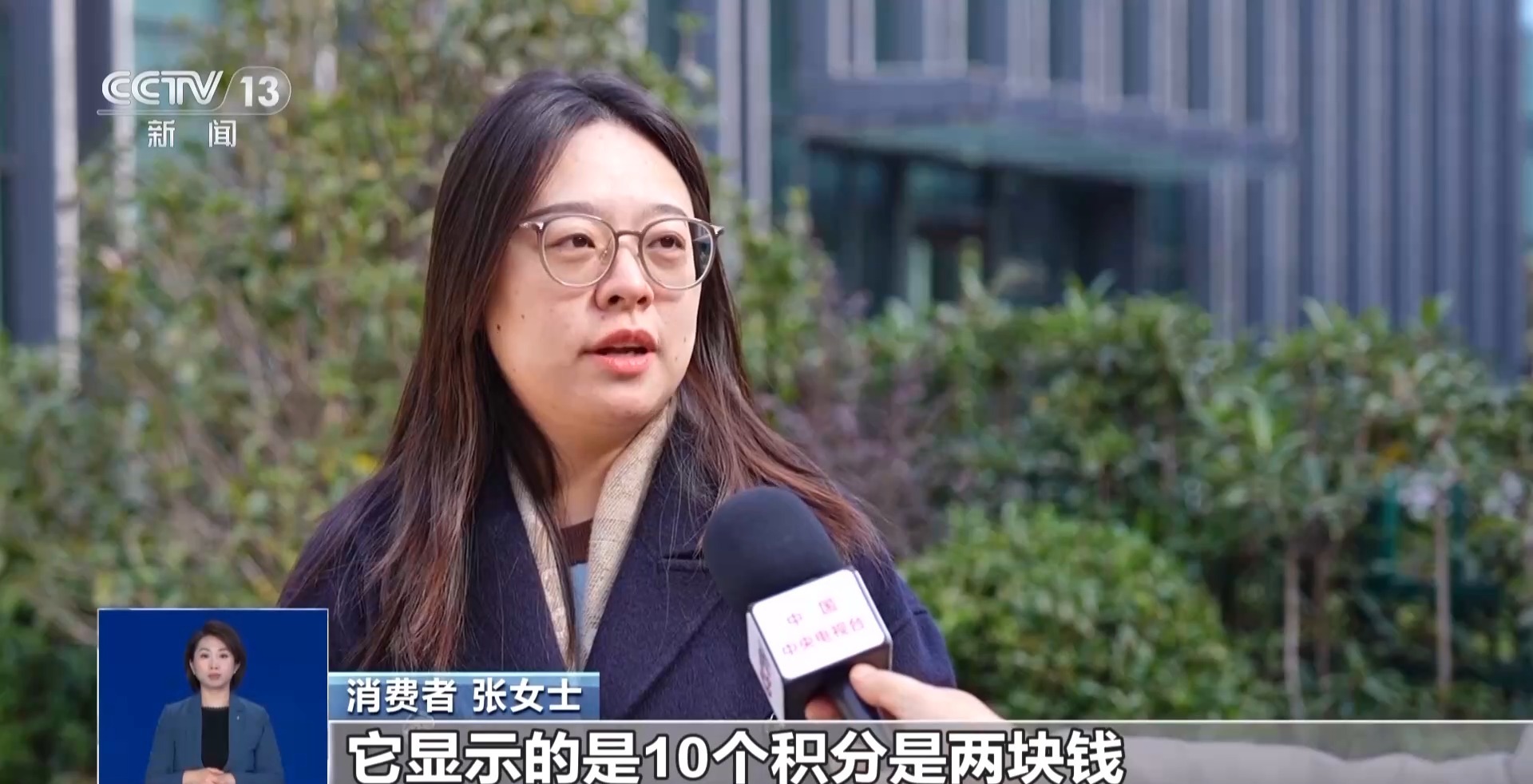
Core Viewpoint - The recent practice of airlines locking seats and charging for seat selection has sparked widespread consumer dissatisfaction, with many feeling that their rights to choose seats are being unfairly restricted [1][19]. Group 1: Consumer Feedback - Many consumers, like Ms. Zhang, have experienced locked seats and expressed frustration over the additional costs required to select preferred seats, which they believe should be included with the purchase of an economy class ticket [3][19]. - The investigation revealed that consumers are often required to use points or pay extra fees to unlock desirable seats, which they feel is an unfair practice [11][13]. Group 2: Investigation Findings - The Jiangsu Provincial Consumer Protection Committee conducted an investigation into 10 domestic airlines, finding that all had locked seats in economy class, with the locking rate ranging from 19.9% to 62.1%, averaging 38.7% [4][5]. - The investigation highlighted that the locked seats are primarily located in the front rows and preferred window or aisle positions, limiting consumer choices to less desirable seats [9][11]. Group 3: Airline Justifications - Airlines have provided various justifications for locking seats, such as reserving them for special passengers or maintaining flight balance, but these reasons have been contradicted by the investigation results showing high locking rates [15][16]. - The lack of a unified standard for seat locking across airlines has led to significant discrepancies in how and why seats are locked [16]. Group 4: Legal and Regulatory Concerns - The practice of locking seats has been deemed to infringe upon multiple consumer rights, including the right to know, the right to choose, and the right to fair trade [19][22]. - Experts have pointed out that airlines' failure to clearly communicate seat selection policies and locking criteria violates consumer protection laws [20][22]. Group 5: Regulatory Actions - The Jiangsu Provincial Consumer Protection Committee has called for the 10 airlines to rectify their practices, specifically addressing the excessive locking of seats and the imposition of fees for seat selection [23][24]. - Airlines are required to ensure transparency in their policies, provide equal selection opportunities for all passengers, and respect consumer rights [27][29].
长虹华意:累计回购约1090万股
Mei Ri Jing Ji Xin Wen· 2025-12-01 08:51
(记者 王晓波) 每经AI快讯,长虹华意(SZ 000404,收盘价:6.9元)12月1日晚间发布公告称,截至2025年11月30 日,公司通过回购专用证券账户以集中竞价交易方式累计回购股份约1090万股,占公司目前总股本的 1.57%,最高成交价为7.19元/股,最低成交价为7元/股,成交总金额约为7728万元。 每经头条(nbdtoutiao)——5年期大面积下线,3年期利率低至1.5%仍一单难求:要么"售罄"要么"额度 紧张"!中长期大额存单为何在消失? 2025年1至6月份,长虹华意的营业收入构成为:通用设备制造占比99.15%,其他业务占比0.85%。 截至发稿,长虹华意市值为48亿元。 ...
长虹华意(000404.SZ):累计回购1.57%股份
Ge Long Hui A P P· 2025-12-01 08:51
格隆汇12月1日丨长虹华意(000404.SZ)公布,截至2025年11月30日,公司通过回购专用证券账户以集中 竞价交易方式累计回购股份10,902,050股,占公司目前总股本的1.57%,最高成交价为7.19元/股,最低 成交价为7.00元/股,成交总金额为77,284,492元(不含交易费用)。 ...