Hainan Jingliang (000505)

Search documents
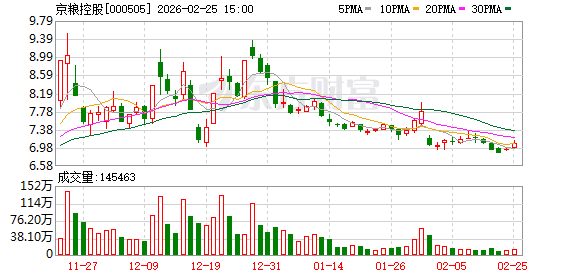
京粮控股:截至2026年2月13日公司A股股东总户数约为5.1万户
Zheng Quan Ri Bao· 2026-02-25 12:07
证券日报网讯 2月25日,京粮控股在互动平台回答投资者提问时表示,经查询,截至2026年2月13日, 公司A股股东总户数约为5.1万户。 (文章来源:证券日报) ...


京粮控股:截至2026年2月10日A股股东总户数约为5.16万户
Zheng Quan Ri Bao Wang· 2026-02-24 11:12
证券日报网讯2月24日,京粮控股(000505)在互动平台回答投资者提问时表示,截至2026年2月10日, 公司A股股东总户数约为5.16万户。 ...
京粮控股(000505.SZ): 未涉及漫剧业务,也没有相关布局
Ge Long Hui· 2026-02-24 07:05
格隆汇2月24日丨京粮控股(000505.SZ)在投资者互动平台表示,公司主业为油脂及食品加工, 未涉及漫 剧业务,也没有相关布局。 ...
京粮控股股价创60日新低,业绩预亏与行业压力成主因
Jing Ji Guan Cha Wang· 2026-02-13 10:27
Company Performance - Jingliang Holdings expects a net profit loss of 230 million to 320 million yuan for the year 2025, marking a shift from profit to loss year-on-year [2] - The main reasons for the loss include pressure on the oil and food segments, with the oil segment facing unstable quality of imported soybeans and rising crushing costs, while the food segment suffers from declining sales due to shrinking traditional channels and online competition [2] - The company plans to recognize impairment provisions of approximately 110 million to 160 million yuan for goodwill and receivables, further exacerbating the loss [2] Industry Environment - The oil processing industry is under pressure from raw material price fluctuations and intensified homogenization competition, with the CBOT soybean inventory-to-consumption ratio reaching a five-year high in 2025, leading to sustained pressure on crushing profits [3] - The company's financial structure has deteriorated, with a debt-to-asset ratio rising to 59.77% and a low inventory turnover rate of only 2.09 times, indicating weak short-term solvency [3] - Although the net cash flow from operating activities improved to 149 million yuan, it is insufficient to offset the impact of declining profitability [3] Market Sentiment - On February 13, the main funds experienced a net outflow of 3.46 million yuan, reflecting insufficient market confidence as the stock price declined alongside a decrease in financing balance [4] - The agricultural product processing industry index fell by 0.73% on the same day, with the company's stock decline exceeding the industry average [4] Future Outlook - Attention is required on the delay of the Hainan Yangpu project to 2027, fluctuations in raw material prices, and regulatory adjustments that may impact long-term operations [5]
京粮控股:截至2026年1月20日公司股东总户数约5.8万户
Zheng Quan Ri Bao Zhi Sheng· 2026-02-10 12:36
(编辑 袁冠琳) 证券日报网讯 2月10日,京粮控股在互动平台回答投资者提问时表示,截至2026年1月20日,公司股东 总户数约5.8万户,其中A股股东总户数约5.23万户,B股股东总户数约0.57万户。 ...
京粮控股:截至2026年1月31日,公司股东总户数约6.27万户
Zheng Quan Ri Bao Zhi Sheng· 2026-02-10 12:08
(编辑 楚丽君) 证券日报网讯 2月10日,京粮控股在互动平台回答投资者提问时表示,截至2026年1月31日,公司股东 总户数约6.27万户,其中A股股东总户数约5.7万户,B股股东总户数约0.57万户。 ...
2025年A股1442家公司预亏,行业“亏损王”浮出
Di Yi Cai Jing Zi Xun· 2026-02-04 15:12
Core Insights - Nearly 50% of the 2957 A-share listed companies that disclosed their 2025 annual performance forecasts are expected to incur losses [2][3] - The real estate sector is identified as the most affected, with Vanke A (000002.SZ) being the largest loss-maker, projecting a net loss of approximately 82 billion yuan [6][7] Provincial Distribution of Losses - The provinces with the highest proportion of companies expecting losses are Hainan (44.44%), Jilin (41.67%), and Qinghai (40%) [4][5] - Guangdong has the highest number of companies expecting losses at 257, followed by Beijing (172), Jiangsu (160), and Zhejiang (133) [3][4] Industry Analysis - The IT services and software development sectors have the highest number of companies forecasting losses, with 60 companies each, followed by the real estate sector with 54 companies [6] - The top ten companies with the highest expected losses include five from the real estate sector, with Vanke A leading the list [6][7] Notable Loss-Makers - Vanke A is projected to incur a net loss of about 82 billion yuan due to decreased project settlement scale and increased business risks [6][7] - Other significant loss-makers in the real estate sector include China Fortune Land Development (华夏幸福) with expected losses between 16 billion to 24 billion yuan and Greenland Holdings (绿地控股) with losses of 16 billion to 19 billion yuan [7] - In the retail sector, M.K. Home (美凯龙) is expected to report a loss of 15 billion to 22.5 billion yuan, primarily due to investment property valuation losses [7][8] Sector-Specific Losses - The home appliance sector's largest loss-maker is Shenzhen Konka (深康佳A), projecting losses of 12.58 billion to 15.57 billion yuan [8] - The vaccine leader Zhifei Biological Products (智飞生物) is also expected to report a first-time loss of 10.7 billion to 13.73 billion yuan due to decreased public vaccination willingness [8] - In the photovoltaic sector, Tongwei Co. (通威股份) is projected to incur losses of 9 billion to 10 billion yuan due to industry oversupply and rising raw material costs [9]




海南自贸港新春强势出圈!金融跨境结算实现突破 文旅消费持续火爆,物流增速亮眼,海南成万众向往宜居家园
Xin Lang Cai Jing· 2026-02-04 12:20
Group 1 - Intercontinental Oil and Gas focuses on oil exploration and development, with significant operations in Kazakhstan and the Malacca Strait, benefiting from the Hainan Free Trade Port's zero-tariff policy which will reduce equipment import costs and enhance cross-border energy trade efficiency, with a projected 30% increase in trade scale over the next three years [1][34] - Jinpan Technology, a leading manufacturer of high-end power distribution equipment, will benefit from reduced raw material costs and a 15% corporate income tax reduction, enhancing profitability and enabling expansion into the ASEAN power equipment market [2][35] - Hainan Airlines, a major player in the aviation sector, expects a significant increase in passenger traffic due to the visa-free policy for 86 countries and duty-free upgrades, with projected passenger volume exceeding 80 million by 2026 [3][36] Group 2 - Junda Co., a top photovoltaic cell manufacturer, anticipates growth in its solar business due to reduced equipment costs and tax incentives, with plans to participate in Hainan's integrated wind and solar storage projects [4][37] - Caesar Travel, a comprehensive tourism service provider, expects a doubling of cross-border tourism business and a significant increase in tourist arrivals, with projections of 180 million visitors by 2026 [5][38] - Xinda A, a diversified company focusing on motorcycle manufacturing and coal mining, aims to leverage the zero-tariff policy to enhance profitability and expand into the electric vehicle market [6][39] Group 3 - ST Huluwawa, a leading pediatric pharmaceutical company, will benefit from reduced raw material costs and tax incentives, with plans to expand into the ASEAN pharmaceutical market [8][40] - Hainan Ruize, a construction industry leader, anticipates a surge in infrastructure demand with projected investments exceeding 100 billion by 2026, benefiting from the Hainan Free Trade Port's policies [9][42] - Hainan Airport, a key player in airport operations, expects a doubling of cargo business and significant passenger growth due to the visa-free policy and duty-free upgrades [10][43] Group 4 - Hainan Development, an investment platform, anticipates a substantial increase in duty-free sales, projected to exceed 100 billion by 2026, benefiting from the Hainan Free Trade Port's policies [11][45] - Hainan Highway, a major highway operator, expects a significant increase in traffic volume, projected to exceed 200 million vehicles by 2026, benefiting from the integration of tourism and real estate [20][56] - Hainan Rubber, the world's largest natural rubber producer, aims to expand its market presence in ASEAN due to favorable trade policies and tax incentives [21][57]


农产品加工板块2月4日涨0.19%,保龄宝领涨,主力资金净流出4117.4万元
Zheng Xing Xing Ye Ri Bao· 2026-02-04 08:49
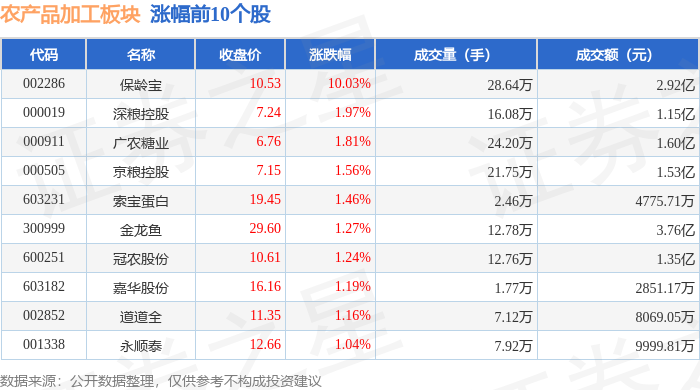
Group 1 - The agricultural processing sector increased by 0.19% on February 4, with Baolingbao leading the gains [1] - The Shanghai Composite Index closed at 4102.2, up 0.85%, while the Shenzhen Component Index closed at 14156.27, up 0.21% [1] - Baolingbao's stock price rose by 10.03% to 10.53, with a trading volume of 286,400 shares and a transaction value of 292 million yuan [1] Group 2 - The agricultural processing sector experienced a net outflow of 41.17 million yuan from institutional investors, while retail investors saw a net inflow of 58.53 million yuan [2] - The top stocks by net inflow included Baolingbao with 56.68 million yuan from institutional investors, while it faced a net outflow of 41.12 million yuan from retail investors [3] - Other notable stocks included Guangnong Sugar Industry with a net inflow of 9.79 million yuan from institutional investors and a net outflow of 934,190 yuan from retail investors [3]


农产品加工板块2月2日跌4.74%,广农糖业领跌,主力资金净流出3.11亿元
Zheng Xing Xing Ye Ri Bao· 2026-02-02 09:07
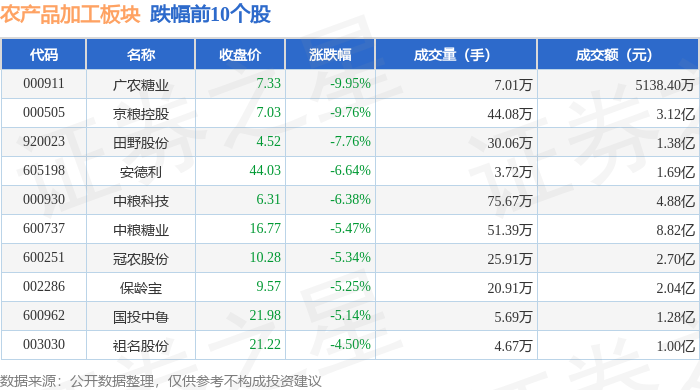
Market Overview - The agricultural processing sector experienced a decline of 4.74% on February 2, with Guangnong Sugar leading the drop [1] - The Shanghai Composite Index closed at 4015.75, down 2.48%, while the Shenzhen Component Index closed at 13824.35, down 2.69% [1] Individual Stock Performance - Guangnong Sugar (000911) closed at 7.33, down 9.95% with a trading volume of 70,100 shares and a turnover of 51.38 million yuan [1] - Jingliang Holdings (000505) closed at 7.03, down 9.76% with a trading volume of 440,800 shares and a turnover of 312 million yuan [1] - Tianye Co. (920023) closed at 4.52, down 7.76% with a trading volume of 300,600 shares and a turnover of 138 million yuan [1] - Other notable declines include Andeli (605198) down 6.64%, COFCO Technology (000930) down 6.38%, and COFCO Sugar (600737) down 5.47% [1] Capital Flow Analysis - The agricultural processing sector saw a net outflow of 311 million yuan from institutional investors, while retail investors had a net inflow of 251 million yuan [1] - The table of capital flow indicates that retail investors were more active, with significant inflows despite the overall sector decline [1] Detailed Capital Flow for Selected Stocks - ST Zhongji (000972) had a net inflow of 930,300 yuan from institutional investors, while retail investors had a net outflow of 125,280 yuan [2] - Morning Light Bio (300138) saw a net inflow of 35,340 yuan from institutional investors, but a significant outflow of 849,840 yuan from retail investors [2] - Andeli (605198) experienced a net outflow of 376,320 yuan from institutional investors, while retail investors had a net inflow of 648,990 yuan [2]