
JILIN AODONG(000623)

Search documents
云南白药、片仔癀跌超1%,中药ETF(560080)跌近1%,连续8日"吸金"!融资余额逼近历史新高!机构:渠道调整接近尾声,看好年底旺季需求回暖
Sou Hu Cai Jing· 2025-10-13 10:06
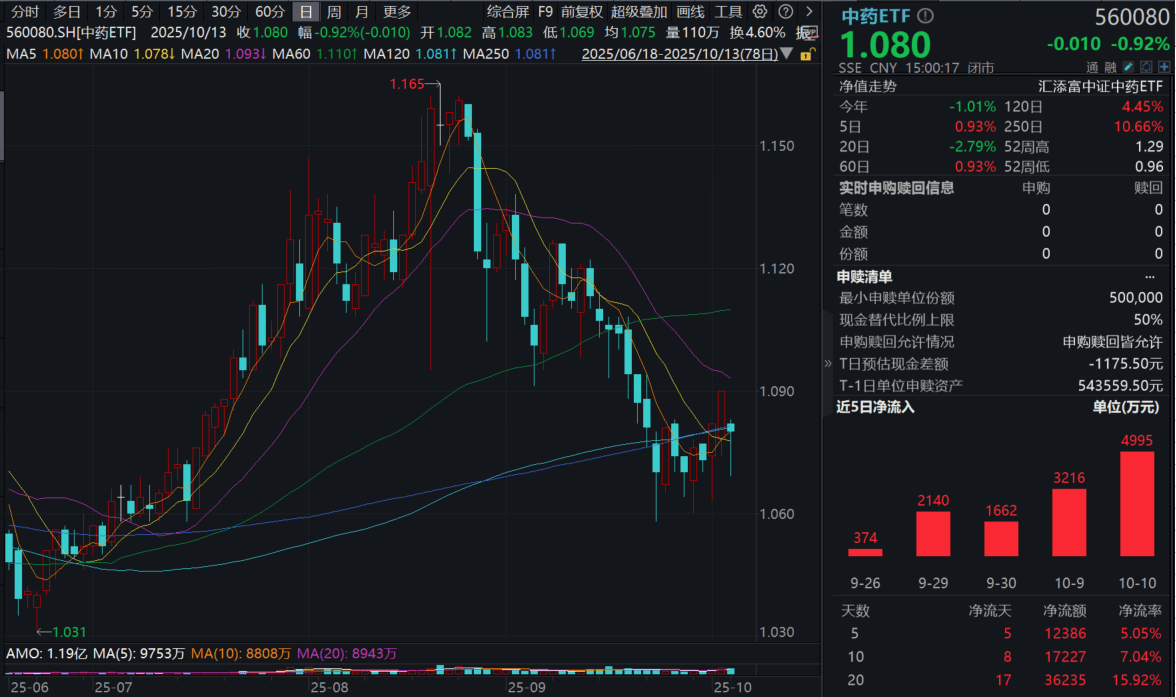
Core Viewpoint - The Chinese Medicine ETF (560080) has shown resilience despite a recent market downturn, with significant capital inflow and a leading position in its category [1][7]. Market Performance - The Chinese Medicine ETF (560080) experienced a nearly 1% decline after a significant opening drop, with a total trading volume exceeding 110 million yuan [1]. - The ETF has seen a net inflow of over 170 million yuan in the last 10 days, bringing its total size to nearly 2.4 billion yuan, leading its peers [1]. Component Stocks - Most component stocks of the Chinese Medicine ETF (560080) closed in the red, with notable declines including Jilin Aodong (-1.44%), Yunnan Baiyao (-1.01%), and Dong'e Ejiao (-1.22%) [3][4]. Yearly Index Performance - The Chinese Medicine Index has shown negative returns year-to-date, with a decline of 3.27% this year and an 8.13% drop in 2024, marking a four-year streak of negative annual performance [4]. Valuation Metrics - The TTM price-to-earnings ratio for the Chinese Medicine ETF (560080) stands at 25.11, which is at the 22.28% percentile of the past decade, indicating a more favorable valuation [6]. Leverage and Financing - Financing activities remain robust, with the latest financing balance for the ETF exceeding 84 million yuan, maintaining historical highs [7]. Industry Outlook - According to CITIC Securities, channel adjustments in the Chinese medicine sector are nearing completion, with expectations for demand recovery in the fourth quarter [9]. - The demand for traditional Chinese medicine products is anticipated to stabilize, with a gradual recovery expected as external pressures ease [9]. New Drug Developments - The number of new drug applications in the Chinese medicine sector is on the rise, with 92 new IND applications and 42 NDA applications reported in the first nine months of 2025 [10][12]. - Recent approvals for new drugs from companies like Fangsheng Pharmaceutical and Tianzhihui are expected to contribute positively to their growth [12].


AH医药再陷调整,医疗ETF止步三连阳,港股通创新药ETF(520880)失守所有均线,该抄底还是离场?
Xin Lang Ji Jin· 2025-10-12 11:48
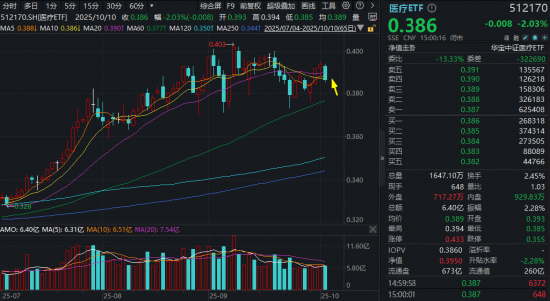
Core Viewpoint - The A-share and Hong Kong stock markets experienced significant fluctuations, with the A-share medical sector facing downward pressure, particularly in the CXO segment, while the innovative drug sector remains a focal point for investors despite recent adjustments [1][5][7]. Group 1: A-share Market Performance - The A-share medical sector opened lower and continued to decline, with major player WuXi AppTec leading the drop at 7.2%, and the largest medical ETF (512170) falling by 2.03% [1]. - The overall trend for the medical sector has been a recent upward movement, indicating potential for rebound despite short-term corrections [1]. Group 2: Hong Kong Market Performance - The Hong Kong medical sector initially showed signs of recovery but faced renewed selling pressure, with innovative drug stocks like Rongchang Bio and Innovent Biologics dropping over 11% [1][5]. - The Hong Kong innovative drug ETF (520880) experienced a decline of 2.25%, losing all moving averages, with a trading volume of 3.69 billion [1][5]. Group 3: Innovative Drug Sector Insights - The innovative drug sector, despite entering a phase of adjustment since September, continues to attract significant investor interest, with the Hong Kong innovative drug ETF (520880) raising over 675 million in the last 20 days [5][7]. - Analysts suggest that the innovative drug sector may see renewed opportunities in Q4, driven by upcoming academic conferences and policy implementations that could support domestic innovation [7]. Group 4: Investment Strategies - Investment strategies in the medical sector are focusing on two main lines: identifying companies with strong Q3 performance and exploring opportunities in innovative drugs for potential rebounds [7]. - The fund manager of the Hong Kong innovative drug ETF (520880) emphasizes the importance of balancing investments within the sector, including medical devices and services that may gain market attention [7].


中药板块10月10日涨0.96%,万邦德领涨,主力资金净流入2.12亿元
Zheng Xing Xing Ye Ri Bao· 2025-10-10 08:46
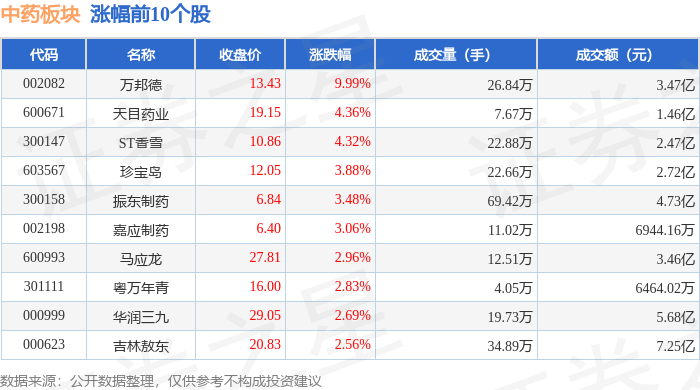
Core Insights - The traditional Chinese medicine sector saw a rise of 0.96% on October 10, with Wanbangde leading the gains. In contrast, the Shanghai Composite Index fell by 0.94% and the Shenzhen Component Index dropped by 2.7% [1] Group 1: Market Performance - The closing price of Wanbangde was 13.43, with a significant increase of 9.99% and a trading volume of 268,400 shares, amounting to a transaction value of 347 million yuan [1] - Other notable performers included Tianmu Pharmaceutical, which closed at 19.15 with a 4.36% increase, and ST Xiangxue, which rose by 4.32% to close at 10.86 [1] - The overall trading volume for the traditional Chinese medicine sector was substantial, with individual stocks showing varied performance in terms of price changes and trading volumes [1] Group 2: Capital Flow - The traditional Chinese medicine sector experienced a net inflow of 212 million yuan from institutional investors, while retail investors saw a net outflow of 153 million yuan [2] - The capital flow data indicates that while some stocks attracted institutional investment, others faced significant selling pressure from retail investors [3] - Wanbangde had a net outflow of 64.05 million yuan from institutional investors, despite its price increase, indicating a complex market sentiment [3]


中药概念持续拉升,万邦德涨停,康芝药业、天目药业、珍宝岛、吉林敖东等跟涨。
Xin Lang Cai Jing· 2025-10-10 02:34
Group 1 - The Chinese medicine concept continues to rise, with Wanbangde hitting the daily limit, and companies such as Kangzhi Pharmaceutical, Tianmu Pharmaceutical, Zhenbaodao, and Jilin Aodong also experiencing gains [1]


吉林敖东涨2.15%,成交额2.92亿元,主力资金净流入823.28万元
Xin Lang Zheng Quan· 2025-10-09 03:08
Core Viewpoint - Jilin Aodong's stock price has shown significant growth this year, with a 20.41% increase, and the company is actively involved in various sectors including traditional Chinese medicine and health products [1][2]. Financial Performance - For the first half of 2025, Jilin Aodong reported a revenue of 1.126 billion yuan, a year-on-year decrease of 20.21%, while the net profit attributable to shareholders was 1.282 billion yuan, reflecting a year-on-year increase of 138.44% [2]. - Cumulative cash dividends since the company's A-share listing amount to 4.43 billion yuan, with 1.647 billion yuan distributed over the past three years [3]. Stock Market Activity - As of October 9, Jilin Aodong's stock price was 20.44 yuan per share, with a market capitalization of 24.444 billion yuan. The stock has seen a trading volume of 292 million yuan and a turnover rate of 1.23% [1]. - The stock has experienced a net inflow of 8.2328 million yuan from main funds, with significant buying and selling activity noted [1]. Shareholder Structure - As of June 30, 2025, the number of shareholders decreased to 66,000, with an average of 18,059 circulating shares per person, an increase of 1.62% [2]. - The top ten circulating shareholders include Hong Kong Central Clearing Limited and Southern CSI 500 ETF, with notable increases in their holdings [3].
医药生物行业今日涨1.40%,主力资金净流入9.84亿元
Zheng Quan Shi Bao Wang· 2025-09-30 08:50
Market Overview - The Shanghai Composite Index rose by 0.52% on September 30, with 19 out of 28 sectors experiencing gains, led by the non-ferrous metals and defense industries, which increased by 3.22% and 2.59% respectively [1] - The pharmaceutical and biological industry saw an increase of 1.40% [1] - The sectors with the largest declines were telecommunications and non-bank financials, which fell by 1.83% and 1.14% respectively [1] Capital Flow Analysis - The main capital outflow from the two markets totaled 32.303 billion yuan, with only four sectors seeing net inflows [1] - The defense industry had the highest net inflow of 2.059 billion yuan, while the non-ferrous metals sector followed with a net inflow of 1.984 billion yuan [1] - The non-bank financial sector experienced the largest net outflow, totaling 11.405 billion yuan, followed by telecommunications with a net outflow of 5.936 billion yuan [1] Pharmaceutical and Biological Sector Performance - The pharmaceutical and biological sector had a net inflow of 984 million yuan, with 310 out of 475 stocks rising, including two hitting the daily limit [2] - The top three stocks by net inflow were WuXi AppTec with 1.113 billion yuan, followed by Hengrui Medicine and Yong'an Pharmaceutical with 431 million yuan and 134 million yuan respectively [2] - Nine stocks in this sector saw net outflows exceeding 50 million yuan, with C Jianfa Zhi leading at 896.727 million yuan [3] Top Gainers in Pharmaceutical Sector - WuXi AppTec increased by 6.42% with a turnover rate of 2.86% and a main capital flow of 1.112 billion yuan [2] - Hengrui Medicine rose by 3.40% with a turnover rate of 0.91% and a main capital flow of 431 million yuan [2] - Yong'an Pharmaceutical saw a rise of 6.92% with a turnover rate of 16.56% and a main capital flow of 134 million yuan [2] Top Losers in Pharmaceutical Sector - C Jianfa Zhi decreased by 15.04% with a turnover rate of 52.49% and a main capital flow of -896.727 million yuan [3] - Xiangrikui rose by 2.00% but had a net outflow of 854.806 million yuan [3] - Jilin Aodong fell by 1.91% with a net outflow of 797.945 million yuan [3]



维生素概念下跌0.18%,18股主力资金净流出超千万元
Zheng Quan Shi Bao Wang· 2025-09-29 08:51
Core Insights - The vitamin sector experienced a decline of 0.18% as of the market close on September 29, with *ST Suwu hitting the daily limit down, while stocks like Jilin Aodong, Keyuan Pharmaceutical, and Haixin Co. saw gains of 6.69%, 1.93%, and 1.83% respectively [1][2][3] Market Performance - The vitamin sector ranked among the top decliners, with significant losses observed in stocks such as *ST Suwu (-4.76%), Jincheng Pharmaceutical (-4.49%), and Huaheng Biological (-3.59%) [1][2] - Conversely, Jilin Aodong led the gains in the sector with a notable increase of 6.69%, followed by Keyuan Pharmaceutical and Haixin Co. [1][3] Capital Flow - The vitamin sector saw a net outflow of 374 million yuan, with 54 stocks experiencing net outflows, and 18 stocks seeing outflows exceeding 10 million yuan [1] - The stock with the highest net outflow was Angel Yeast, with 78.26 million yuan, followed by Jincheng Pharmaceutical and New Hecheng with outflows of 39.04 million yuan and 26.95 million yuan respectively [1][2] - In contrast, the stocks with the highest net inflows included Jilin Aodong (106 million yuan), Chuaning Biological (6.01 million yuan), and Shuoshi Biological (5.10 million yuan) [1][3]



医药生物行业资金流出榜:恒瑞医药、广生堂等净流出资金居前
Zheng Quan Shi Bao Wang· 2025-09-29 08:51
Market Overview - The Shanghai Composite Index rose by 0.90% on September 29, with 26 out of 28 sectors experiencing gains, led by non-bank financials and non-ferrous metals, which increased by 3.84% and 3.78% respectively [1] - The pharmaceutical and biological sector saw a modest increase of 0.17% [1] - The coal and banking sectors were the biggest losers, declining by 0.84% and 0.46% respectively [1] Capital Flow Analysis - The net inflow of capital in the two markets was 9.527 billion yuan, with 13 sectors receiving net inflows [1] - The non-bank financial sector had the highest net inflow of 12.348 billion yuan, corresponding to its 3.84% increase [1] - The non-ferrous metals sector followed with a net inflow of 2.986 billion yuan and a daily increase of 3.78% [1] - Conversely, 18 sectors experienced net outflows, with the electronics sector leading at a net outflow of 2.811 billion yuan, followed by the defense and military sector with 1.882 billion yuan [1] Pharmaceutical and Biological Sector - The pharmaceutical and biological sector had a net outflow of 1.640 billion yuan, with 285 out of 475 stocks in the sector rising, while 169 fell, including 2 hitting the daily limit down [2] - Notable stocks with significant net inflows included Jilin Aodong (10.565 million yuan), Sino Medical (10.067 million yuan), and Mindray Medical (9.186 million yuan) [2] - Major stocks with significant net outflows included Hengrui Medicine (-333.586 million yuan), Guangsheng Tang (-160.353 million yuan), and Hanyu Pharmaceutical (-138.282 million yuan) [4] Top Gainers in Pharmaceutical Sector - Jilin Aodong saw a price increase of 6.69% with a turnover rate of 4.00% and a net inflow of 10.565 million yuan [2] - Sino Medical increased by 4.82% with a turnover rate of 7.00% and a net inflow of 10.067 million yuan [2] - Mindray Medical had a slight increase of 0.19% with a turnover rate of 0.68% and a net inflow of 9.186 million yuan [2] Top Losers in Pharmaceutical Sector - Hengrui Medicine decreased by 1.26% with a turnover rate of 1.02% and a net outflow of 333.586 million yuan [4] - Guangsheng Tang experienced a decline of 6.18% with a turnover rate of 11.07% and a net outflow of 160.353 million yuan [4] - Hanyu Pharmaceutical had a minor increase of 0.24% but still faced a net outflow of 138.282 million yuan [4]



中药板块9月29日涨0.27%,吉林敖东领涨,主力资金净流出2.44亿元
Zheng Xing Xing Ye Ri Bao· 2025-09-29 08:46
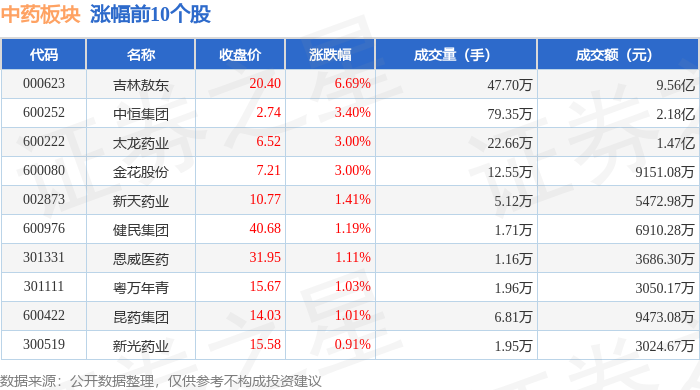
Core Insights - The traditional Chinese medicine sector saw a slight increase of 0.27% on September 29, with Jilin Aodong leading the gains [1] - The Shanghai Composite Index closed at 3862.53, up 0.9%, while the Shenzhen Component Index closed at 13479.43, up 2.05% [1] Stock Performance - Jilin Aodong (000623) closed at 20.40, with a rise of 6.69% and a trading volume of 477,000 shares, amounting to a transaction value of 956 million yuan [1] - Other notable performers included: - Zhongheng Group (600252) at 2.74, up 3.40% with a volume of 793,500 shares [1] - Tailong Pharmaceutical (600222) at 6.52, up 3.00% with a volume of 226,600 shares [1] - Jinhua Co., Ltd. (600080) at 7.21, up 3.00% with a volume of 125,500 shares [1] Fund Flow Analysis - The traditional Chinese medicine sector experienced a net outflow of 244 million yuan from institutional investors, while retail investors saw a net inflow of 204 million yuan [2] - The main fund inflows and outflows for specific stocks included: - Jilin Aodong had a net inflow of 91.59 million yuan from institutional investors [3] - Yunnan Baiyao saw a net inflow of 26.21 million yuan from institutional investors [3] - Taikang Group (600129) had a net inflow of 6.25 million yuan from institutional investors [3]


吉林敖东股价涨5.23%,南方基金旗下1只基金位居十大流通股东,持有1424.79万股浮盈赚取1424.79万元
Xin Lang Cai Jing· 2025-09-29 05:58
Group 1 - Jilin Aodong Pharmaceutical Group Co., Ltd. experienced a stock price increase of 5.23%, reaching 20.12 CNY per share, with a trading volume of 419 million CNY and a turnover rate of 1.80%, resulting in a total market capitalization of 24.061 billion CNY [1] - The company, established on March 20, 1993, and listed on October 28, 1996, specializes in the research, development, manufacturing, and sales of traditional Chinese medicine and biochemical drugs, while also expanding into health foods, food, breeding, and planting sectors [1] - The revenue composition of Jilin Aodong includes traditional Chinese medicine at 60.90%, wholesale and retail of chain pharmacies at 16.59%, chemical drugs at 12.73%, food at 7.39%, and other products at 1.76% [1] Group 2 - Southern Fund's Southern CSI 500 ETF (510500) is among the top ten circulating shareholders of Jilin Aodong, having increased its holdings by 1.9148 million shares in the second quarter, totaling 14.2479 million shares, which represents 1.2% of the circulating shares [2] - The Southern CSI 500 ETF (510500) has a current scale of 113.438 billion CNY, with a year-to-date return of 28.25%, ranking 1796 out of 4221 in its category, and a one-year return of 48.6%, ranking 1589 out of 3836 [2] Group 3 - The Southern CSI 500 Enhanced Strategy ETF (560100) holds 29,800 shares of Jilin Aodong, accounting for 0.63% of the fund's net value, making it the ninth-largest holding [4] - The Southern CSI 500 Enhanced Strategy ETF (560100) has a current scale of 80.4132 million CNY, with a year-to-date return of 27.63%, ranking 1852 out of 4221 in its category, and a one-year return of 45.75%, ranking 1710 out of 3836 [4]