
GF SECURITIES(000776)

Search documents
广发证券(000776) - 关于向专业投资者公开发行永续次级公司债券获得中国证监会注册批复的公告
2026-01-19 13:01
证券代码:000776 证券简称:广发证券 公告编号:2026-005 广发证券股份有限公司 关于向专业投资者公开发行永续次级公司债券 获得中国证监会注册批复的公告 本公司及董事会全体成员保证信息披露的内容真实、准确、完整,没有虚 假记载、误导性陈述或重大遗漏。 1 近日,广发证券股份有限公司(以下简称"公司")收到中国证券监督管理 委员会《关于同意广发证券股份有限公司向专业投资者公开发行永续次级公司债 券注册的批复》(证监许可〔2026〕41 号),批复主要内容如下: 一、同意公司向专业投资者公开发行面值总额不超过 200 亿元永续次级公司 债券的注册申请。 二、本次发行永续次级公司债券应严格按照报送深圳证券交易所的募集说明 书进行。 三、批复自同意注册之日起 24 个月内有效,公司在注册有效期内可以分期 发行永续次级公司债券。 四、自同意注册之日起至本次永续次级公司债券发行结束前,公司如发生重 大事项,应及时报告并按有关规定处理。 公司将按照有关法律法规和上述批复文件的要求及公司股东会的授权办理 本次永续次级公司债券发行的相关事宜,并及时履行信息披露义务。 特此公告。 二〇二六年一月二十日 广发证券股份有 ...
广发证券:获证监会批复发行不超200亿元永续次级公司债
Xin Lang Cai Jing· 2026-01-19 12:59
Core Viewpoint - The company has received approval from the China Securities Regulatory Commission to publicly issue perpetual subordinated corporate bonds totaling no more than 20 billion yuan [1] Group 1 - The bond issuance is aimed at professional investors and will be conducted according to the prospectus submitted to the Shenzhen Stock Exchange [1] - The approval for the bond issuance is valid for 24 months from the date of registration [1] - The company has the option to issue the bonds in multiple tranches [1] Group 2 - The company is required to report and address any significant events that occur before the completion of the issuance [1] - The company will handle the issuance-related matters as authorized and disclose information in a timely manner [1]
广发证券(01776) - 海外监管公告 - 广发証券股份有限公司2026年面向专业投资者公开发行次...
2026-01-19 12:58
香港交易及結算所有限公司及香港聯合交易所有限公司對本公告的內容概不負責,對其準確性 或完整性亦不發表任何聲明,並明確表示,概不對因本公告全部或任何部份內容而產生或因倚 賴該等內容而引致的任何損失承擔任何責任。 GF SECURITIES CO., LTD. 廣發証券股份有限公司 (於中華人民共和國註冊成立的股份有限公司) (股份代號:1776) 海外監管公告 2026 年面向专业投资者公开发行次级债券(第一期) 本公告乃根據香港聯合交易所有限公司證券上市規則第13.10B條刊發。 根據中華人民共和國的有關法例規定,廣發証券股份有限公司(「本公司」)在深圳 證券交易所網站( http://www.szse.cn )刊發的《廣發証券股份有限公司2026年面向專 業投資者公開發行次級債券(第一期)發行結果公告》。茲載列如下,僅供參閱。 承董事會命 廣發証券股份有限公司 林傳輝 董事長 中國,廣州 2026年1月19日 於本公告日期,本公司董事會成員包括執行董事林傳輝先生、秦力先生、孫曉燕 女士及肖雪生先生;非執行董事李秀林先生、尚書志先生及郭敬誼先生;獨立非 執行董事梁碩玲女士、黎文靖先生、張闖先生及王大樹先生。 ...
广发证券(000776) - 广发证券股份有限公司2026年面向专业投资者公开发行次级债券(第一期)发行结果公告
2026-01-19 09:16
发行结果公告 证券代码:524627 证券简称:26 广发 C1 广发证券股份有限公司 2026 年面向专业投资者公开发行次级债券(第一期) 认购本期债券的投资者均符合《公司债券发行与交易管理办法》《深圳证券 交易所公司债券上市规则(2023 年修订)》《深圳证券交易所债券市场投资者适 当性管理办法(2023 年修订)》及《关于进一步规范债券发行业务有关事项的通 知》等各项有关要求。 本公司及董事会全体成员保证公告的内容真实、准确、完整,没有虚假记 载、误导性陈述或者重大遗漏。 特此公告。 广发证券股份有限公司(以下简称"发行人")公开发行不超过人民币 200 亿元(含)次级公司债券已获得中国证券监督管理委员会证监许可〔2024〕1258 号文注册。根据《广发证券股份有限公司 2026 年面向专业投资者公开发行次级 债券(第一期)发行公告》,广发证券股份有限公司 2026 年面向专业投资者公开 发行次级债券(第一期)(以下简称"本期债券")发行规模为不超过 33.9 亿元 (含),发行价格为每张 100 元,采取网下面向专业机构投资者询价配售的方式 发行。 (本页以下无正文) 本期债券发行时间为 2026 年 ...
证券板块1月19日跌0.22%,华林证券领跌,主力资金净流出18.66亿元
Zheng Xing Xing Ye Ri Bao· 2026-01-19 08:58
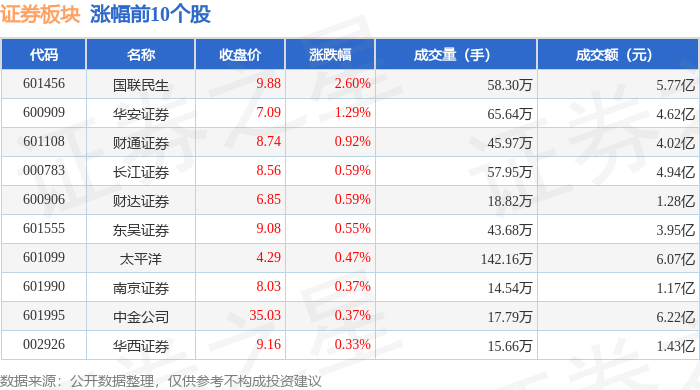
Market Overview - On January 19, the securities sector declined by 0.22%, with Huayin Securities leading the drop [1] - The Shanghai Composite Index closed at 4114.0, up 0.29%, while the Shenzhen Component Index closed at 14294.05, up 0.09% [1] Individual Stock Performance - Guolian Minsheng (601456) closed at 9.88, up 2.60% with a trading volume of 583,000 shares and a turnover of 577 million yuan [1] - Huayin Securities (002945) closed at 17.47, down 1.74% with a trading volume of 339,700 shares and a turnover of 594 million yuan [2] - Dongfang Caifu (300059) closed at 23.50, down 1.63% with a trading volume of 2,997,400 shares and a turnover of 7.065 billion yuan [2] Capital Flow Analysis - The securities sector experienced a net outflow of 1.866 billion yuan from institutional investors, while retail investors saw a net inflow of 1.136 billion yuan [2] - Major stocks like Guotai Junan (601211) had a net inflow of 118 million yuan from institutional investors, while retail investors had a net outflow of 66.72 million yuan [3] - The overall trend indicates a mixed sentiment among different investor types, with institutional investors pulling back while retail investors are more active [2][3]







广发证券(000776) - 广发证券股份有限公司2025年面向专业投资者公开发行公司债券(第一期)2026年付息公告
2026-01-19 08:52
2025 年面向专业投资者公开发行公司债券(第一期) 债券代码:524121 债券简称:25 广发 01 债券代码:524122 债券简称:25 广发 02 广发证券股份有限公司 3、债券发行批准机关及文号:中国证券监督管理委员会证监许可〔2024〕 1010 号文。 4、发行期限、规模和利率:本期债券品种一发行期限为 3 年,发行规模为 16 亿元,票面利率为 1.83%;品种二发行期限为 5 年,发行规模为 15 亿元,票 面利率为 1.90%。 5、起息日:2025 年 1 月 21 日。 6、付息日:本期债券品种一付息日为 2026 年至 2028 年每年的 1 月 21 日, 品种二付息日为 2026 年至 2030 年每年的 1 月 21 日(如遇法定节假日或休息日, 2026 年付息公告 本公司及董事会全体成员保证公告的内容真实、准确、完整,没有虚假记载、 误导性陈述或者重大遗漏。 特别提示: 由广发证券股份有限公司(以下简称"本公司")发行的广发证券股份有限公 司 2025 年面向专业投资者公开发行公司债券(第一期)(以下简称"本期债券") 将于 2026 年 1 月 21 日支付 2025 ...
证券类App,最新月活排名出炉
中国基金报· 2026-01-19 08:13
Core Insights - The monthly active users (MAU) of securities apps reached 175 million in December 2025, marking a 1.75% month-on-month increase and a 2.26% year-on-year increase, achieving a new monthly high for the year [4][3] - Throughout 2025, the MAU of securities apps experienced a recovery after a dip in the middle of the year, with a significant rebound in November leading to a peak at year-end [4][2] - The competition for traffic between third-party platforms and brokerage self-operated apps intensified, with brokerages accelerating the integration of AI technology in advisory and trading scenarios to enhance service models and user experience [4][12] Monthly Active Users Overview - In December 2025, the MAU for securities apps was 175.32 million, with notable monthly changes: November had 172.30 million (up 2.06% month-on-month) and October had 168.82 million (down 3.38% month-on-month) [5][4] - The MAU trend for 2025 showed a starting point of 161.84 million in January, peaking in December after a recovery phase post-May [4][5] Leading Apps and Market Dynamics - The top three securities apps by MAU in December were Tonghuashun (36.70 million), Dongfang Caifu (18.22 million), and Dazhihui (12.97 million) [6][5] - Among brokerage self-operated apps, Huatai's Zhangle Wealth reached over 12 million MAU, followed by Guotai Haitong Junhong with 10.40 million [6][5] - The number of brokerage apps with an average monthly active user count exceeding 6 million increased to 14 in 2025, indicating a growing concentration in the market [8][7] AI Technology Integration - The application of AI technology in the securities industry has accelerated, with multiple brokerages launching intelligent tools across key areas such as intelligent research, trading, and advisory services [12][11] - Notable advancements include the upgrade of trading robots by Galaxy Securities and the introduction of AI advisory platforms by various brokerages, enhancing service efficiency and user experience [13][12] - Despite the current limitations of AI tools in guaranteeing stable investment returns, their functionality is expanding, addressing various investment challenges and improving investors' capabilities in data analysis and strategy formulation [12][13]



广发证券:首部衍生品规章出台 打开券商杠杆提升空间
智通财经网· 2026-01-19 03:39
2026年1月16日,证监会发布《衍生品交易监督管理办法(试行)(征求意见稿)》,反馈截止时间为2026年 2月16日。首部衍生品市场部门规章公开征求意见,意在支持衍生品市场稳步发展,鼓励衍生品交易发 挥管理风险、配置资源、服务实体经济的功能。 智通财经APP获悉,广发证券发布研报称,25年12月吴主席表态"对优质机构进一步优化风控指标,适 度打开资本空间和杠杆限制,提升资本利用效率"、26年1月《衍生品交易监督管理办法(试行)(征求意见 稿)》出台,政策脉络延续,头部机构当前杠杆仍有较大提升空间,看好在增量资金持续入市、行业利 好政策落地背景下券商估值补涨与杠杆、盈利空间打开。创新性业务行业格局清晰,建议关注自身资产 负债表空间充足、交易能力突出、境内外机构客户覆盖广泛的证券公司。 广发证券主要观点如下: 事件 衍生品业务对接机构/企业客户,天然链接投行、做市、财富等多条线,有助于形成综合服务解决方 案,提升境内外客户黏性。作为高阶服务,具备交易定价、对冲、风控能力的券商可形成"强者恒强"的 护城河,有助于行业格局优化。衍生品业务凭借非方向性收益有助于打开券商杠杆提升空间,提高资金 利用效益,推动券商ROE ...
广发证券:2026年新能源乘用车单车带电量提升几何?
智通财经网· 2026-01-19 03:20
Core Viewpoint - The report from GF Securities predicts a 15.0% year-on-year increase in the battery capacity of new energy passenger vehicles in 2026, driven by changes in policy, supply, and demand [1]. Group 1: Key Drivers for Battery Capacity Increase - The first driver for the increase in PHEV battery capacity is the new energy vehicle purchase tax adjustment requirements and the launch of long-range PHEVs priced below 200,000 yuan, which will enhance user experience by reducing charging frequency [2]. - The second driver for PHEV battery capacity increase is the concentration of supply for large battery PHEVs priced above 200,000 yuan, as consumers in this segment are less price-sensitive and prefer better daily usage experiences [2]. - For EVs, the first driver is the decrease in the proportion of low-end pure electric vehicles due to the subsidy policy, while the second driver is the competitive strategy of leading manufacturers to "enhance features and raise prices" in response to rising raw material costs [2]. Group 2: Investment Recommendations - The report suggests focusing on right-side targets in the passenger vehicle chain, including Geely, BYD, Chery, Seres, Li Auto, Xpeng, and Leap Motor, while left-side targets include Great Wall Motors and Changan Automobile [3]. - For upstream and downstream chains, right-side targets include Minth Group, Yinlun, Bertli, Top Group, Aikodi, Fuyao Glass, and others, while left-side targets include Yongda Automobile and New Coordinates [3]. - Companies at an inflection point include SAIC Motor, with potential opportunities identified in various segments of the industry [3].
开源证券:衍生品监管透明化 规模限制有望放松利好头部券商
智通财经网· 2026-01-19 03:20
Core Viewpoint - The report from Kaiyuan Securities expresses optimism about the brokerage sector, highlighting the sustained growth of brokerage performance and the pressure on the funding side, indicating a significant lag in the brokerage sector [1] Group 1: Regulatory Developments - On January 16, the China Securities Regulatory Commission (CSRC) solicited opinions on the draft of the "Supervision and Management Measures for Derivative Transactions (Trial) (Draft for Comments)" [2] - The policy aims to strengthen the standardized management of the derivatives market, clarifying the CSRC's regulatory scope and emphasizing enhanced monitoring and cross-market regulation [3] - The policy supports the steady development of the derivatives market, encouraging risk management activities and limiting excessive speculation [3] Group 2: Impact on Brokerage Firms - The enhanced transparency in derivatives regulation is expected to benefit the long-term development of brokerage firms' derivatives business, providing a more stable operational framework for brokers and investors [4] - The derivatives business is highly concentrated, with top-tier brokers holding significant advantages; as of November 2023, the market share of the top five firms in swap and OTC options was 66% and 59%, respectively [4] - Top-tier brokers, such as CITIC Securities and Guotai Junan, can directly engage in stock hedging transactions, while secondary brokers are limited in their trading capabilities [4] Group 3: Market Stability and Investment Recommendations - Derivative tools are seen as beneficial for stabilizing market fluctuations, with the potential for relaxed scale restrictions favoring leading brokers [5] - The CSRC's commitment to a robust monitoring system for derivatives trading is expected to facilitate high-quality development in the derivatives business, contributing to market stability [5] - Investment recommendations include top brokers with strong international business and undervalued stocks, such as Huatai Securities and Guotai Junan, as well as firms with significant wealth management advantages like GF Securities [5]

