Metersbonwe(002269)
Search documents
对话美特斯邦威周成建:走过弯路,目标重回市场“牌桌”
Guan Cha Zhe Wang· 2025-10-29 03:07
Core Insights - The article discusses the transformation of Metersbonwe under the leadership of founder Zhou Chengjian, who emphasizes a "zero-based" mindset to reconnect with consumers and revitalize the brand [1][2][25] - The company aims to regain its position in the Asian market and enhance its brand appeal among younger consumers while maintaining its historical identity [2][25] Group 1: Brand Transformation - Metersbonwe is undergoing a comprehensive transformation, focusing on product line expansion and a new retail model that integrates online and offline channels [1][2] - The brand is returning to its roots, emphasizing its "academy style" while adapting to modern trends and consumer preferences [5][25] - Zhou Chengjian has personally engaged in market research, visiting various cities to understand consumer needs and preferences [1][5] Group 2: Market Strategy - The company is adopting a multi-tiered management approach, with direct sales in first-tier cities and a franchise model in lower-tier cities [12][13] - Metersbonwe plans to establish "next main stores" in key shopping areas to enhance brand visibility and consumer engagement [12][25] - The brand aims to balance its physical store presence with online strategies, ensuring a seamless shopping experience for consumers [14][25] Group 3: Product Development - The new product strategy focuses on inclusivity, offering styles that cater to various body types, age groups, and occasions [6][10] - Metersbonwe seeks to differentiate itself by providing versatile clothing that allows for cross-style and cross-scenario combinations [9][10] - The brand is committed to evolving its product offerings while retaining its core identity, such as the classic academy style [25][26] Group 4: Brand Communication - Zhou Chengjian has taken an active role in brand communication, including live streaming to share the company's transformation journey with consumers [16][17] - The brand aims to create a narrative that resonates with consumers, focusing on storytelling rather than merely promoting products [16][17] - Metersbonwe recognizes the importance of professional marketing teams to effectively convey its brand message in the future [17][21]
服装家纺板块10月28日涨0.03%,罗莱生活领涨,主力资金净流出1.47亿元
Zheng Xing Xing Ye Ri Bao· 2025-10-28 08:34
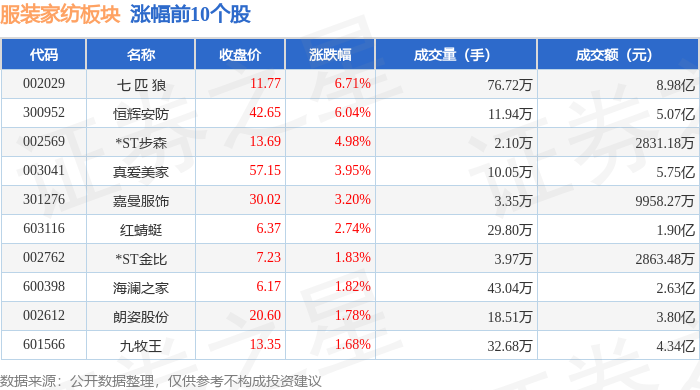
Market Overview - The apparel and home textile sector increased by 0.03% compared to the previous trading day, with Luolai Life leading the gains [1] - The Shanghai Composite Index closed at 3988.22, down 0.22%, while the Shenzhen Component Index closed at 13430.1, down 0.44% [1] Top Performers - Luolai Life (002293) closed at 9.40, up 5.86% with a trading volume of 356,400 shares and a turnover of 339 million yuan [1] - Shengtai Group (605138) closed at 7.91, up 4.91% with a trading volume of 165,300 shares and a turnover of 132 million yuan [1] - Xinhe Shares (003016) closed at 8.84, up 4.49% with a trading volume of 289,500 shares and a turnover of 254 million yuan [1] Underperformers - ST Erya (600107) closed at 8.77, down 4.98% with a trading volume of 160,200 shares and a turnover of 144 million yuan [2] - Ribo Fashion (603196) closed at 23.12, down 4.93% with a trading volume of 60,300 shares and a turnover of 141 million yuan [2] - Anzheng Fashion (603839) closed at 8.91, down 3.47% with a trading volume of 117,000 shares and a turnover of 106 million yuan [2] Capital Flow - The apparel and home textile sector experienced a net outflow of 147 million yuan from institutional investors, while retail investors saw a net inflow of 125 million yuan [2] - The sector's overall capital flow indicates a mixed sentiment, with institutional investors withdrawing funds while retail investors are actively buying [2][3] Individual Stock Capital Flow - Wanlima (300591) had a net inflow of 29.27 million yuan from institutional investors, while it saw a net outflow of 2.39 million yuan from retail investors [3] - Shengtai Group (605138) experienced a net inflow of 15.85 million yuan from institutional investors, but a net outflow of 23.59 million yuan from retail investors [3] - Seven Wolves (002029) had a net inflow of 18.53 million yuan from institutional investors, with a net outflow of 1.03 million yuan from retail investors [3]
服装家纺板块10月22日涨0.08%,中胤时尚领涨,主力资金净流出2.99亿元
Zheng Xing Xing Ye Ri Bao· 2025-10-22 08:20
Market Overview - The apparel and home textile sector increased by 0.08% compared to the previous trading day, with Zhongyin Fashion leading the gains [1] - The Shanghai Composite Index closed at 3913.76, down 0.07%, while the Shenzhen Component Index closed at 12996.61, down 0.62% [1] Stock Performance - Zhongyin Fashion (300901) closed at 18.42, up 5.38% with a trading volume of 109,100 shares and a turnover of 200 million yuan [1] - Langsha Co., Ltd. (600137) closed at 20.45, up 3.39% with a trading volume of 61,800 shares and a turnover of 125 million yuan [1] - Other notable performers include: - Bingshi Co., Ltd. (001209) up 3.14% - Jihua Group (601718) up 2.93% - Tianchuang Fashion (603608) up 2.52% [1] Capital Flow - The apparel and home textile sector experienced a net outflow of 299 million yuan from institutional investors, while retail investors saw a net inflow of 306 million yuan [2] - The detailed capital flow for selected stocks shows: - Meibang Apparel (002269) had a net inflow of 20.42 million yuan from institutional investors [3] - Langsha Co., Ltd. (600137) had a net inflow of 9.46 million yuan from institutional investors [3] - Other stocks like Tanshijia (300005) and Jinhao Group (603518) also showed varying net inflows and outflows [3]
超1.7万家实体店,倒在2025上半年
Sou Hu Cai Jing· 2025-10-11 03:27
Retail Industry Overview - The total retail sales of consumer goods in China reached 24.55 trillion yuan in the first half of the year, with a year-on-year growth of 5.0%, slightly up from 3.7% in the same period last year [2] - Online retail sales amounted to 7.43 trillion yuan, growing by 8.5%, while offline retail sales were 17.12 trillion yuan, with a growth of 3.75%, indicating a shift in consumer shopping habits towards online platforms [2][5] Store Closures - In the first half of 2025, at least 1.71 million stores closed across various sectors, including major brands like Walmart, Starbucks, and Haidilao [2] - The supermarket sector saw at least 720 store closures, including national and regional brands such as Yonghui Supermarket and Hema [3][4] - The restaurant industry faced nearly 10,000 closures, while the apparel sector saw around 4,500 stores shut down [2][6] Supermarket Sector Challenges - Traditional supermarkets are experiencing accelerated closures due to increased competition from e-commerce and the rise of instant retail, which has grown from 36.6 billion yuan in 2017 to 650 billion yuan in 2023 [6] - Many supermarkets are closing underperforming stores and focusing on online business to adapt to changing consumer preferences [6][7] Department Store and Shopping Center Decline - The department store sector reported a year-on-year growth of only 1.2%, with at least 23 department stores and shopping centers closing in the first half of 2025 [8][9] - The decline is attributed to outdated business models and a lack of unique product offerings, leading to decreased foot traffic [11][12] Tea and Coffee Shop Closures - The tea and coffee sectors saw significant closures, with at least 6,673 tea and coffee shops shutting down in the first half of 2025 [13] - Brands like Heytea and Nayuki faced substantial store reductions, reflecting a market consolidation where only strong brands survive [15][20] Apparel Industry Adjustments - The apparel sector experienced a 3.1% year-on-year growth, with at least 4,563 clothing stores closing, including major brands like Semir and GU [21][24] - The closures are driven by high inventory levels, brand aging, and a shift towards larger store formats, which require higher operational efficiency [24][25][27] Cinema Industry Struggles - The cinema industry is facing a crisis, with a high vacancy rate of 30-40% and at least 38 cinemas closing in the first half of 2025 [28][30] - Factors contributing to this decline include high fixed costs, reliance on blockbuster films, and competition from streaming services [30][31][32] Other Industries - Various other sectors, including pet care, home improvement, and education, also experienced closures, indicating a broader trend of market contraction [34]
服装家纺板块9月29日涨0.12%,爱慕股份领涨,主力资金净流入248.83万元
Zheng Xing Xing Ye Ri Bao· 2025-09-29 08:39
Market Overview - The apparel and home textile sector increased by 0.12% on September 29, with Aimer leading the gains [1] - The Shanghai Composite Index closed at 3862.53, up 0.9%, while the Shenzhen Component Index closed at 13479.43, up 2.05% [1] Top Gainers - The following companies showed significant gains: - Yuancao Co., Ltd. (603511) closed at 16.43, up 3.33% with a trading volume of 52,700 shares and a turnover of 85.94 million yuan [1] - Explorer (300005) closed at 8.82, up 3.28% with a trading volume of 295,100 shares and a turnover of 256 million yuan [1] - Bingshi Co., Ltd. (001209) closed at 20.83, up 3.12% with a trading volume of 204,900 shares and a turnover of 444 million yuan [1] Top Losers - The following companies experienced notable declines: - Hongdou Co., Ltd. (600400) closed at 3.04, down 6.46% with a trading volume of 2,063,000 shares and a turnover of 629 million yuan [2] - Taimusi (001234) closed at 27.43, down 5.35% with a trading volume of 106,200 shares and a turnover of 29.4 million yuan [2] - Seven Wolves (002029) closed at 7.97, down 5.34% with a trading volume of 686,600 shares and a turnover of 552 million yuan [2] Capital Flow - The apparel and home textile sector saw a net inflow of 2.49 million yuan from institutional investors, while retail investors contributed a net inflow of 74.56 million yuan [2][3] - The sector experienced a net outflow of 77.04 million yuan from speculative funds [2][3] Individual Stock Capital Flow - Meibang Apparel (002269) had a net outflow of 51.37 million yuan from institutional investors, with a 12.65% share of the total [3] - Semir Apparel (002563) saw a net inflow of 30.10 million yuan from institutional investors, representing 10.42% of the total [3] - Hongdou Co., Ltd. (600400) had a net inflow of 13.71 million yuan from institutional investors, accounting for 2.18% of the total [3]
60岁霸总跳团舞,“美特斯邦威们”艰难自救
3 6 Ke· 2025-09-24 11:27
Core Viewpoint - The article discusses the recent efforts of Metersbonwe and its founder Zhou Chengjian to revitalize the brand through innovative marketing strategies, including live streaming and a new retail model, amidst ongoing financial struggles and industry challenges [1][12][26]. Company Overview - Zhou Chengjian, the founder of Metersbonwe, returned to the company in January 2024 after a seven-year hiatus, aiming to reverse the brand's declining fortunes [3][12]. - Metersbonwe has faced significant financial difficulties, with a cumulative loss of nearly 3.2 billion yuan since 2015, and only one year of positive net profit during that period [3][12]. Marketing and Sales Strategies - The brand's recent live streaming event on Douyin attracted over 200,000 viewers and resulted in a stock price surge, indicating a positive market response to Zhou's return [3][12]. - Metersbonwe has implemented a "5.0 new retail model," integrating online and offline sales through promotional vouchers and live streaming, which has generated over 100 million yuan in sales within 40 days of its launch [11][12]. Financial Performance - Despite the new strategies, Metersbonwe's financial performance remains concerning, with a 49.79% year-on-year decline in total revenue for 2024, amounting to 681 million yuan, and a net loss of 195 million yuan [12][16]. - In the first half of 2025, the company reported a revenue of 227 million yuan, down 45.23% from the previous year, and a net profit of 993,000 yuan, a decrease of 87.07% [12][16]. Industry Context - Metersbonwe is not alone in its struggles; other brands like Semir and Yishion are also facing challenges in adapting to changing consumer preferences and market dynamics [17][21]. - The article highlights the broader trend of traditional casual wear brands grappling with the need for transformation in response to evolving consumer behavior and competition from fast fashion and e-commerce [26].
美邦服饰跌2.38%,成交额1.15亿元,主力资金净流出870.69万元
Xin Lang Cai Jing· 2025-09-24 02:20
Company Overview - Meibang Fashion Co., Ltd. is located in Shanghai and was established on December 6, 2000, with its listing date on August 28, 2008. The company primarily engages in the design and sales of the Meibang brand casual clothing [1][2] - The main revenue composition includes men's clothing at 50.38%, women's clothing at 27.48%, other products at 12.96%, and additional products at 9.18% [1] Stock Performance - As of September 24, Meibang's stock price decreased by 2.38% to 2.46 CNY per share, with a total market capitalization of 6.181 billion CNY [1] - Year-to-date, Meibang's stock price has increased by 20.59%, but it has seen a decline of 15.75% over the last five trading days. In the last 20 days, the stock rose by 25.51%, and over the last 60 days, it increased by 33.70% [1] Financial Performance - For the first half of 2025, Meibang reported a revenue of 227 million CNY, a year-on-year decrease of 45.23%. The net profit attributable to shareholders was 9.93 million CNY, down 87.07% year-on-year [2] - The company has cumulatively distributed 3.138 billion CNY in dividends since its A-share listing, with no dividends distributed in the last three years [3] Shareholder Information - As of June 30, 2025, Meibang had 119,300 shareholders, a decrease of 3.86% from the previous period. The average number of circulating shares per shareholder increased by 4.02% to 21,064 shares [2] - Among the top ten circulating shareholders, Hong Kong Central Clearing Limited is the fourth largest, holding 15.8121 million shares as a new shareholder [3] Market Activity - In terms of capital flow, there was a net outflow of 8.7069 million CNY from main funds, with significant buying and selling activity recorded [1] - Meibang has appeared on the trading leaderboard seven times this year, with the most recent appearance on September 15, where it recorded a net buy of -4.7495 million CNY [1]
服装家纺板块9月22日跌0.56%,中胤时尚领跌,主力资金净流出1103.31万元
Zheng Xing Xing Ye Ri Bao· 2025-09-22 08:46
Market Overview - The apparel and home textile sector experienced a decline of 0.56% on September 22, with Zhongyin Fashion leading the drop [1] - The Shanghai Composite Index closed at 3828.58, up 0.22%, while the Shenzhen Component Index closed at 13157.97, up 0.67% [1] Stock Performance - Notable gainers in the apparel sector included: - Hongdou Co., Ltd. (600400) with a closing price of 3.66, up 9.91% and a trading volume of 1.1057 million shares, totaling 402 million yuan [1] - Wanlima (300591) closed at 11.58, up 5.75%, with a trading volume of 869,200 shares, totaling 996 million yuan [1] - ST Jinbi (002762) closed at 8.50, up 4.94%, with a trading volume of 71,500 shares, totaling 59.96 million yuan [1] - Major decliners included: - Zhongyin Fashion (300901) closed at 15.25, down 10.77%, with a trading volume of 201,500 shares, totaling 341 million yuan [2] - Taimusi (001234) closed at 36.14, down 9.99%, with a trading volume of 206,200 shares, totaling 764 million yuan [2] - Taihu Snow (838262) closed at 26.81, down 4.79%, with a trading volume of 26,300 shares, totaling 70.59 million yuan [2] Capital Flow - The apparel and home textile sector saw a net outflow of 11.0331 million yuan from institutional investors and a net outflow of 94.8674 million yuan from retail investors, while individual investors contributed a net inflow of 106 million yuan [2] Individual Stock Capital Flow - Meibang Apparel (002269) had a net inflow of 82.2762 million yuan from institutional investors, while retail investors saw a net outflow of 16.6016 million yuan [3] - Semir Apparel (002563) experienced a net inflow of 79.2673 million yuan from institutional investors, with a significant net outflow of 82.1396 million yuan from retail investors [3] - Zhongyin Fashion (300901) had a net inflow of 25.0134 million yuan from institutional investors, with a net outflow of 21.9603 million yuan from retail investors [3]
美邦服饰今日大宗交易平价成交1330万股,成交额3617.6万元
Xin Lang Cai Jing· 2025-09-19 09:00
Group 1 - On September 19, Meibang Fashion executed a block trade of 13.3 million shares, with a transaction value of 36.176 million yuan, accounting for 6.19% of the total transaction value for that day [1][2] - The transaction price was 2.72 yuan per share, which was in line with the market closing price of 2.72 yuan [1][2]
服装家纺板块9月19日涨0.74%,万里马领涨,主力资金净流入9323.28万元
Zheng Xing Xing Ye Ri Bao· 2025-09-19 08:47
Market Overview - The apparel and home textile sector increased by 0.74% on September 19, with Wanlima leading the gains [1] - The Shanghai Composite Index closed at 3820.09, down 0.3%, while the Shenzhen Component Index closed at 13070.86, down 0.04% [1] Top Performers - Wanlima (300591) closed at 10.95, up 11.62% with a trading volume of 955,500 shares and a transaction value of 1.009 billion [1] - Baoxini (002154) closed at 4.68, up 10.12% with a trading volume of 3,231,300 shares and a transaction value of 1.448 billion [1] - Taicaoshi (001234) closed at 40.15, up 10.00% with a trading volume of 15,300 shares and a transaction value of 61.4192 million [1] - Hongdou (600400) closed at 3.33, up 9.90% with a trading volume of 2,912,700 shares and a transaction value of 937 million [1] Underperformers - Meibang Apparel (002269) closed at 2.72, down 9.93% with a trading volume of 1,980,800 shares [2] - Jihua Group (601718) closed at 3.72, down 3.38% with a trading volume of 1,002,500 shares [2] - Henghui Security (300952) closed at 32.73, down 3.17% with a trading volume of 130,200 shares [2] Capital Flow - The apparel and home textile sector saw a net inflow of 93.2328 million in main funds, while retail funds experienced a net outflow of 27.766 million [2][3] - The main funds' net inflow for Baoxini was 250 million, while it faced a net outflow of 130 million from retail funds [3] - Wanlima had a main fund net inflow of 132 million but a net outflow of 28.2409 million from retail funds [3]