
ACCELINK(002281)

Search documents
国信通信·行业专题报告:数据中心互联技术专题:AI变革推动OCS新技术快速发展
Guoxin Securities· 2026-02-26 13:02
Investment Rating - The report maintains an "Outperform" rating for the industry [2] Core Viewpoints - Optical Circuit Switch (OCS) technology enables direct switching of optical signals between fiber ports without optical-electrical-optical (O/E/O) conversion, significantly reducing latency and power consumption, with potential power savings of over 30% for AI computing clusters and data center interconnect systems [3][4][92] - The OCS market is expected to grow rapidly, with a projected market size exceeding $2.5 billion by 2029, driven by increasing demand for AI data centers and enhanced customer penetration [4][79] - OCS technology has four main technical routes: MEMS, liquid crystal, piezoelectric, and silicon waveguide, with MEMS being the fastest to commercialize, primarily led by Google [4][14][92] Summary by Sections 1. OCS as a New Photonic Interconnect Technology - OCS technology avoids traditional bandwidth bottlenecks and power losses associated with electrical switching, offering high bandwidth capacity and low latency [3][13] - The four main technical routes for OCS are MEMS, liquid crystal, piezoelectric, and silicon waveguide, each with different cost, performance, and technical difficulty trade-offs [14][92] 2. OCS Applications for AI Data Centers - Google has been at the forefront of developing ASIC chips, with the TPU reaching its seventh generation, indicating a strong push towards integrating OCS technology in data centers [51][64] - The TPU architecture utilizes OCS technology to interconnect thousands of TPU chips, enhancing performance and efficiency [64][71] 3. OCS Industry Chain Company Layout - Various companies are positioned within the OCS industry chain, including Silex, Tengjing Technology, and Zhongji Xuchuang, each focusing on different aspects of OCS technology and components [83][84] - Companies like Lumentum and Coherent are key suppliers for MEMS and liquid crystal OCS solutions, indicating a robust supply chain for OCS technology [4][14][84] 4. Investment Recommendations - The report suggests focusing on companies within the OCS supply chain, particularly those with deep collaborations with leading global firms, such as Zhongji Xuchuang and Guangxun Technology, as they are expected to benefit from the growth in OCS technology [4][90]



行业研究|行业周报|通信设备III:通信周观点:算力硬件满载扩产,AI模型SOTA投资升温-20260226
Changjiang Securities· 2026-02-26 11:02
Investment Rating - The industry investment rating is "Positive" and maintained [12] Core Insights - The communication sector saw a 2.35% increase in the 6th-7th week of 2026, ranking 6th among primary industries in the Yangtze River region; since the beginning of 2026, it has risen by 0.44%, ranking 27th [2][6] - Tower's silicon photonics revenue doubled, with a high demand for 1.6T, and capacity expansion plans have been adjusted with prepayments secured; silicon photonics modules continue to penetrate the market [2][10] - Vertiv's orders and backlog reached new highs, with a shipment-to-order ratio rising to 2.9 times [2][10] - ByteDance's Seedance 2.0 has industry-leading generation availability, while Google's Gemini 3.1 Pro tops the charts, and Anthropic's annual revenue is growing rapidly at $14 billion [2][10] - OpenAI's cumulative computing expenditure is expected to exceed $600 billion by 2030, with an upward revision of revenue forecasts [2][10] Summary by Sections Market Performance - In the 6th-7th week of 2026, the communication sector increased by 2.35%, ranking 6th among primary industries; since the start of 2026, it has risen by 0.44%, ranking 27th [2][6] - Among companies with a market capitalization above 8 billion, the top three gainers this week were Dawei Technology (+39.4%), Shengke Communication (+31.7%), and Shenling Environment (+29.6%); the top three decliners were Tongyu Communication (-11.7%), Dingtong Technology (-9.7%), and Xinke Mobile (-9.3%) [6] Company Highlights - **Tower**: In Q4 2025, revenue reached $440 million, a year-on-year increase of 13.7%, with GAAP net profit of $80 million, up 45.3%. The company expects silicon photonics revenue to reach $228 million in 2025, doubling from 2024, and has raised its capacity target from 3 times to over 5 times the Q4 2025 shipment [7] - **Vertiv**: In Q4 2025, revenue was $2.88 billion, a year-on-year increase of 22.7%, with GAAP net profit of $450 million, up 203.1%. The company reported a significant increase in organic orders, with a year-on-year growth of 252% [7] AI Model Developments - On February 12, ByteDance launched Seedance 2.0, achieving industry-leading performance in complex scenarios with a high generation availability rate [8] - Anthropic completed a $30 billion Series G financing round with a post-money valuation of $380 billion, reporting an annual revenue of approximately $14 billion [8] - On February 19, Google released Gemini 3.1 Pro, which ranked first in AI analysis, showing significant improvements in reasoning capabilities [8] Future Projections - OpenAI updated its financial outlook, projecting cumulative computing-related expenditures to exceed $600 billion by 2030, with training costs expected to rise significantly in 2025 and 2026 [9]



英伟达算力架构持续迭代升级,行业高景气度不断夯实,高速光模块需求确定性极强,CPO步入实质落地阶段
Xin Lang Cai Jing· 2026-02-26 10:27
Group 1 - Zhongji Xuchuang (300308) is a leading global player in the high-speed optical module sector, deeply tied to major North American cloud providers like Nvidia, Microsoft, and Google, making it a core beneficiary during the AI computing power explosion [1][24] - The company maintains a strong position in the global market for 800G and 1.6T high-speed optical module shipments, with a continuous upgrade in product structure towards high-end offerings, leading to steady improvements in gross margin and profitability [1][24] - With the large-scale rollout of Nvidia's GB300 and Rubin next-generation computing platforms, the demand for optical modules per machine has significantly increased, driving a sustained high growth in orders for the company [1][24] Group 2 - Xinyi Technology (300502) focuses on the research, production, and sales of high-speed optical modules, ranking among the few domestic companies with global competitiveness, particularly in the 400G and 800G high-end module sectors [2][25] - The company has a high proportion of overseas revenue and is closely tied to major global cloud providers and equipment manufacturers, resulting in high order visibility and outstanding delivery capabilities [2][25] - Benefiting from the accelerated construction of AI data centers and the explosive demand for high-speed interconnects, the company is seeing a continuous increase in the proportion of high-end products and an ongoing optimization of profitability [2][25] Group 3 - Luxshare Precision (002475) has rapidly entered the high-speed optical module market, becoming an important partner for leading international companies like Nvidia, leveraging its advanced manufacturing and supply chain integration capabilities [3][26] - The company has significant advantages in optical module structural components, packaging processes, and thermal solutions, allowing it to quickly respond to large-volume orders from major clients [3][26] - As AI computing demand continues to surge, the optical module business is emerging as a new growth curve for the company, supported by stable cash flow and technological synergies from its experience in consumer and automotive electronics [3][26] Group 4 - Shengyi Technology (600183) is a global leader in the field of copper-clad laminates and high-frequency materials, serving as a core upstream supplier for optical modules, servers, and data center hardware [4][27] - The demand for high-frequency and high-speed copper-clad laminates is continuously increasing due to the growth of high-speed optical modules, with the company maintaining a leading position in related materials technology and comprehensive customer coverage [4][27] - The company benefits from the accelerated construction of AI computing infrastructure and the rapid iteration of data center hardware, leading to a steady improvement in profitability [4][27] Group 5 - Pengding Holdings (002938) is a global leader in high-end printed circuit board (PCB) research, production, and sales, holding a significant position in the PCB market for high-speed communication, servers, and optical modules [5][28] - The requirements for PCB layers, precision, and signal integrity have significantly increased due to 800G and 1.6T high-speed optical modules, with the company demonstrating industry-leading technical strength and process levels [5][28] - The company is experiencing rapid growth in high-speed PCB demand as AI data center construction accelerates, leading to improvements in revenue and gross margin [5][28] Group 6 - Hengtong Optic-Electric (600487) has become a domestic industry leader by leveraging its advantages across the entire optical communication industry chain, with core competitiveness in optical modules, optical fibers, and marine communications [6][29] - The company’s high-speed optical module products cover 400G and 800G high-speed rates, achieving bulk shipments in data centers and computing interconnect scenarios [6][29] - With significant investments in silicon photonics and CPO co-packaging optical technology, the company is well-positioned to benefit from the increased global investment in computing infrastructure and the explosive demand for optical modules [6][29]


2月26日晚间重要公告一览
Xi Niu Cai Jing· 2026-02-26 10:14
Group 1 - Hehe Information achieved operating revenue of 1.81 billion yuan in 2025, a year-on-year increase of 25.83%, and net profit of 454 million yuan, a year-on-year increase of 13.39% [1] - Shengyi Technology announced that Guangxin Group and Chen Renxi have completed their share reduction plan, with Guangxin Group reducing its shares by 24.29 million, accounting for 1% of the total share capital [2] - Huaci Co., Ltd. received approval from the China Securities Regulatory Commission for its stock issuance to specific targets [3] Group 2 - New Nuo Wei plans to transfer 30.07% of its shares in Guoxin Huijin to Shiyao Holdings for 230 million yuan, with a valuation increase of 94.85% [4] - Tianli Lithium Energy has completed the scheduled maintenance of its lithium iron phosphate production line and resumed production [5] - Jinchuan Electric reported a net profit of 81.218 million yuan in 2025, a year-on-year decrease of 10.87% [6] Group 3 - Shenzhou Taiyue reported a net profit of 798 million yuan in 2025, a year-on-year decrease of 44.09% [7] - Jingwei Hengrun achieved a net profit of 99.5375 million yuan in 2025, reversing a loss from the previous year [8] - Keheng Technology signed a maximum pledge contract worth 450 million yuan to support its supply chain procurement [9] Group 4 - Zhongchu Media reported a net loss of 20.2858 million yuan in 2025, with operating revenue of 157 million yuan, a year-on-year decrease of 18.99% [10] - Tongde Chemical's subsidiary is involved in a lawsuit with a claim amount of approximately 49.1824 million yuan [12] - Jichuan Pharmaceutical signed an exclusive commercialization rights agreement for a new eczema treatment, with payments not exceeding 190 million yuan [13] Group 5 - Tianli Lithium Energy reported a net loss of 211 million yuan in 2025, with operating revenue of 408 million yuan, a year-on-year decrease of 20.20% [14] - Fortune Trend achieved a net profit of 315 million yuan in 2025, a year-on-year increase of 3.62% [15] - CITIC Securities received approval to publicly issue corporate bonds totaling no more than 80 billion yuan [16] Group 6 - Yongshan Lithium Industry reported a reduction of 23 million shares by Ningbo Jutai, decreasing its total shareholding from 13.24% to 4.52% [17] - Taifu Pump Industry achieved a net profit of 17.5631 million yuan in 2025, a year-on-year increase of 38.78% [18] - Longxun Co., Ltd. reported a net profit of 172 million yuan in 2025, a year-on-year increase of 19.05% [19] Group 7 - Duori Pharmaceutical's acquisition offer period has expired, and the company's stock will resume trading [20] - Tianhao Energy obtained a loan commitment letter for stock repurchase from a financial institution, with a loan amount not exceeding 90 million yuan [21] - Lijun Co., Ltd. reported a net profit of 57.545 million yuan in 2025, a year-on-year decrease of 52.09% [22] Group 8 - Zhongchumai reported a net profit of 212 million yuan in 2025, a year-on-year increase of 45.55% [23] - Kangxino reported a net profit of 27.8727 million yuan in 2025, reversing a loss from the previous year [24] - Baiao Saitu achieved a net profit of 173 million yuan in 2025, a year-on-year increase of 416.37% [25] Group 9 - Guangxun Technology's private placement application was approved by the Shenzhen Stock Exchange [26] - Sandam Membrane reported a net profit of 378 million yuan in 2025, a year-on-year increase of 19.95% [27] - Shangsheng Electronics reported a net profit of 184 million yuan in 2025, a year-on-year decrease of 21.71% [28] Group 10 - Xin'an Century reported a net profit of 79.2904 million yuan in 2025, reversing a loss from the previous year [29] - Zhenlei Technology achieved a net profit of 133 million yuan in 2025, a year-on-year increase of 582.01% [30] - Fuan Pharmaceutical's subsidiary received approval for a new drug application [32] Group 11 - Baotai reported a net loss of 336 million yuan in 2025, with operating revenue of 934 million yuan [33] - Aohua Endoscope reported a net profit of 11.4619 million yuan in 2025, a year-on-year decrease of 45.45% [34] - Maide Medical reported a net profit of 65.2599 million yuan in 2025, reversing a loss from the previous year [35] Group 12 - Chip Original Co. reported a net loss of 528 million yuan in 2025, with operating revenue of 3.152 billion yuan [36] - Zhongwei Semiconductor set a preliminary transfer price of 43.35 yuan per share for its inquiry [37] - Tieke Railway reported a net profit of 171 million yuan in 2025, a year-on-year decrease of 20.09% [38] Group 13 - Changjiang Electric announced a cash dividend distribution plan of 2.1 yuan per 10 shares for the 2025 fiscal year [39] - Kunheng Shunwei reported a net profit of 46.7676 million yuan in 2025, a year-on-year increase of 26.28% [40] - Ailis reported a net profit of 2.181 billion yuan in 2025, a year-on-year increase of 52.55% [41] Group 14 - Aerospace Software reported a net loss of 11.3126 million yuan in 2025, with operating revenue of 1.216 billion yuan [42] - Qizhong Technology reported a net profit of 266 million yuan in 2025, a year-on-year decrease of 15.16% [43] - Guotou Zhonglu plans to acquire 70% of Luochuan Lingxian Company for 74.8745 million yuan [44] Group 15 - Aokema plans to acquire 45% of its subsidiary for 253 million yuan [45] - ST Dali signed a procurement framework agreement worth 88.8794 million yuan with a leading new energy company [46] - Zhifei Biological received clinical trial approval for a new mRNA vaccine [47]



光迅科技:非公开发行股票申请获得深交所审核通过
Mei Ri Jing Ji Xin Wen· 2026-02-26 08:40
每经AI快讯,光迅科技2月26日晚间发布公告称,武汉光迅科技股份有限公司于2026年2月26日收到深 圳证券交易所出具的《关于武汉光迅科技股份有限公司申请向特定对象发行股票的审核中心意见告知 函》。深交所发行上市审核机构对公司向特定对象发行股票的申请文件进行了审核,认为公司符合发行 条件、上市条件和信息披露要求,后续深交所将按规定报中国证券监督管理委员会履行相关注册程序。 (记者 张明双) 每经头条(nbdtoutiao)——超10万人挤爆服务器,围观8家房企抢"马场":9小时竞价243轮,236亿元 成交!广州楼面价新地王诞生:8.5万元/㎡ ...
光迅科技:定增申请获深交所审核通过
Mei Ri Jing Ji Xin Wen· 2026-02-26 08:28
每经AI快讯,2月26日,光迅科技(002281)(002281.SZ)公告称,公司于2026年2月26日收到深交所出 具的《关于武汉光迅科技股份有限公司申请向特定对象发行股票的审核中心意见告知函》。深交所发行 上市审核机构认为公司符合发行条件、上市条件和信息披露要求,后续深交所将按规定报中国证监会履 行相关注册程序。公司本次向特定对象发行股票事项尚需获得中国证监会同意注册后方可实施。 ...
光迅科技:向特定对象发行股票申请获深交所审核通过
Xin Lang Cai Jing· 2026-02-26 08:26
Core Viewpoint - The company has received approval from the Shenzhen Stock Exchange for its application to issue shares to specific investors, indicating compliance with issuance, listing, and information disclosure requirements [1] Group 1 - The company received a notice from the Shenzhen Stock Exchange on February 26, 2026, regarding the approval of its share issuance application [1] - The Shenzhen Stock Exchange will submit the application to the China Securities Regulatory Commission for registration procedures [1] - The issuance is subject to approval from the China Securities Regulatory Commission, and the final outcome and timing remain uncertain [1]
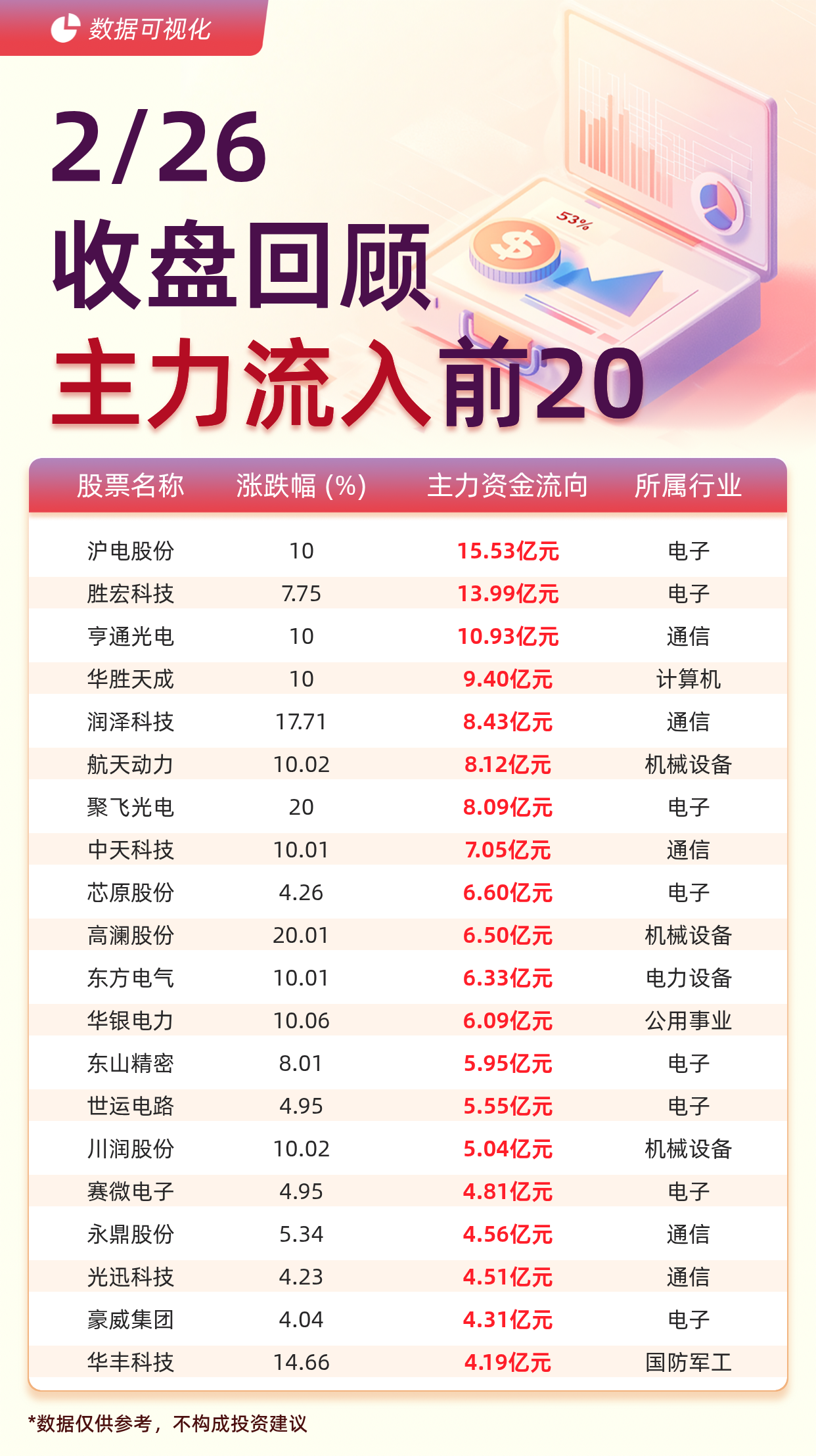
主力资金流入前20:沪电股份流入15.53亿元、胜宏科技流入13.99亿元


Jin Rong Jie· 2026-02-26 07:11
Group 1 - The top 20 stocks with significant capital inflow as of February 26 include: Huadian Co., Ltd. (1.55 billion), Shenghong Technology (1.40 billion), Hengtong Optic-Electric (1.09 billion), and others [1] - Huadian Co., Ltd. experienced a price increase of 10% with a capital inflow of 1.55 billion [2] - Shenghong Technology saw a price rise of 7.75% with a capital inflow of 1.40 billion [2] Group 2 - Hengtong Optic-Electric had a 10% increase in stock price with a capital inflow of 1.09 billion [2] - Huasheng Technology's stock rose by 10% with a capital inflow of 940 million [2] - Runze Technology achieved a significant price increase of 17.71% with a capital inflow of 843 million [2] Group 3 - Aerospace Power's stock increased by 10.02% with a capital inflow of 812 million [2] - Jufei Optoelectronics saw a remarkable 20% increase in stock price with a capital inflow of 809 million [2] - Zhongtian Technology's stock rose by 10.01% with a capital inflow of 705 million [2] Group 4 - Chipone Technology experienced a 4.26% increase with a capital inflow of 660 million [2] - Gaolan Co., Ltd. had a significant price increase of 20.01% with a capital inflow of 650 million [2] - Dongfang Electric's stock rose by 10.01% with a capital inflow of 633 million [3] Group 5 - Huayin Electric saw a 10.06% increase with a capital inflow of 609 million [3] - Dongshan Precision's stock increased by 8.01% with a capital inflow of 595 million [3] - Shiyun Circuit experienced a 4.95% increase with a capital inflow of 555 million [3] Group 6 - Chuanrun Co., Ltd. had a 10.02% increase with a capital inflow of 504 million [3] - Saiwei Electronics saw a 4.95% increase with a capital inflow of 481 million [3] - Yongding Co., Ltd. experienced a 5.34% increase with a capital inflow of 456 million [3]

CPO概念震荡拉升,多股涨停
Mei Ri Jing Ji Xin Wen· 2026-02-26 02:30
Group 1 - The CPO concept experienced significant fluctuations, with companies such as Jufei Optoelectronics and Jepu Technology reaching a 20% limit-up [1] - Other companies including Guanghe Technology, Zhongtian Technology, and Hengtong Optoelectronics also hit the limit-up [1] - Additional firms like Tianfu Communication, Yongding Co., Zhongfu Circuit, Guangxun Technology, and Taicheng Light followed with notable increases [1]


光迅科技(002281)披露2025年度向特定对象发行股票募集说明书(申报稿),2月24日股价上涨4.74%
Sou Hu Cai Jing· 2026-02-24 09:38
Core Viewpoint - Wuhan Guangxun Technology Co., Ltd. plans to raise up to 3.5 billion yuan through a private placement of shares to fund various projects and supplement working capital [1] Group 1: Stock Performance - As of February 24, 2026, Guangxun Technology's stock closed at 73.34 yuan, up 4.74% from the previous trading day, with a total market capitalization of 59.162 billion yuan [1] - The stock opened at 71.74 yuan, reached a high of 74.99 yuan, and a low of 71.5 yuan, with a trading volume of 3.636 billion yuan and a turnover rate of 6.33% [1] Group 2: Fundraising Details - The company intends to issue shares to no more than 35 specific investors, including its actual controller, China Xinke Group, with the total number of shares not exceeding 242 million, which is within 30% of the pre-issue total share capital [1] - The raised funds will be allocated for the construction of computing center optical connections and high-speed optical transmission products, as well as research and development of high-speed optical interconnection and emerging optoelectronic technologies [1] - The issuance will not result in a change of control of the company and is subject to approval by the Shenzhen Stock Exchange and registration with the China Securities Regulatory Commission [1]