ACCELINK(002281)

Search documents
光迅科技(002281):公司动态研究报告:打造AI全栈光互连解决方案,持续加码核心能力建设
Huaxin Securities· 2026-03-30 09:25
Investment Rating - The report assigns a "Buy" investment rating for the company, marking its first coverage [8]. Core Insights - The company has significantly expanded its sales scale, achieving a revenue of 8.532 billion yuan in the first three quarters of 2025, representing a year-on-year growth of 58.65%. The net profit attributable to shareholders reached 719 million yuan, up 54.95% year-on-year, driven by sales expansion and profit growth [4]. - The company is actively enhancing its core capabilities, with sales expenses amounting to 198 million yuan, a 45.19% increase year-on-year, and R&D expenses of 672 million yuan, up 31.83% year-on-year, which are expected to support future business growth [4]. - The company showcased its AI full-stack optical interconnection solutions at the OFC Global Optical Communication Conference, including a 3.2T NPO and a 320×320 OCS all-optical switch, addressing key scenarios in cluster interconnection and computing resource scheduling [5]. - The company plans to raise no more than 3.5 billion yuan for projects related to optical connections and high-speed optical transmission, focusing on next-generation pluggable optical modules and advanced optical engine technologies [6]. Financial Projections - Revenue projections for 2025, 2026, and 2027 are 11.757 billion yuan, 15.687 billion yuan, and 19.615 billion yuan, respectively, with corresponding EPS of 1.35 yuan, 1.90 yuan, and 2.48 yuan. The current stock price corresponds to P/E ratios of 63, 44, and 34 times for these years [8][10]. - The company is expected to maintain strong growth rates, with revenue growth rates of 42.1% in 2025, 33.4% in 2026, and 25.0% in 2027 [10]. - The net profit attributable to shareholders is projected to grow to 1.086 billion yuan in 2025, 1.536 billion yuan in 2026, and 1.999 billion yuan in 2027, with growth rates of 64.2%, 41.5%, and 30.1%, respectively [10]. Market Position - The company is positioned to benefit from the rapid development of the optical communication industry, driven by data center upgrades, the explosion of AI technology, and deep coverage of telecom networks [6]. - The company is focusing on high-end products with significant demand and high technical barriers, aiming to enhance its core competitiveness through product structure optimization [6].

通信周观点:GTC/OFC光互联技术迸发,国内云厂商AI服务调价-20260326
Changjiang Securities· 2026-03-26 10:12
Investment Rating - The industry investment rating is "Positive" and maintained [12] Core Insights - The communication sector rose by 1.96% in the 11th week of 2026, ranking first among major industries, and has increased by 6.8% since the beginning of the year, ranking seventh [2][5] - GTC 2026 sees NVIDIA's introduction of the "Five Cabinet" inference solution, leading to significant growth in Scale-out optical interconnects [6] - OFC 2026 anticipates exponential growth in the AI-driven optical communication industry, with leading companies accelerating capacity expansion and multiple technology paths such as CPO, NPO, OCS, and XPO being implemented [7][10] - Domestic cloud providers are adjusting AI service pricing due to surging AI demand and rising supply chain costs [9] Summary by Sections Market Performance - In the 11th week of 2026, the communication sector's performance was highlighted, with significant individual stock movements, including a 26.8% increase for Yuanjie Technology and a 15.5% decrease for Fenghuo Communication [5] GTC 2026 Developments - NVIDIA forecasts that orders for the Blackwell and Rubin platforms will reach $1 trillion by 2027, doubling the previous estimate of $500 billion for 2026 [6] - The hardware aspect includes the release of Groq 3 LPU chips and Groq 3 LPX inference cabinets, achieving a total cabinet computing power of 315 PFLOPS [6] OFC 2026 Projections - The optical communication industry is expected to grow exponentially, with AI optical communication's total addressable market (TAM) projected to increase from $18 billion to over $90 billion from 2025 to 2030, reflecting a CAGR of approximately 40% [7] - InP chip demand is expected to grow at a CAGR of 85% from 2026 to 2030, with significant capacity expansions planned by major players [7] Technology Advancements - The industry is on the brink of entering the single-channel 400G era, with companies like Zhongji Xuchuang and Xinyi Sheng launching new optical modules and products [8] Pricing Adjustments by Cloud Providers - Major cloud providers in China, including Tencent Cloud and Alibaba Cloud, have significantly raised prices for AI services, with increases ranging from 5% to 34% [9]




中金 | 光通信深度(2)之OFC 2026观察:迈入光互联超级周期
中金点睛· 2026-03-23 23:37
Core Viewpoint - The OFC 2026 conference highlighted the confidence of industry players in the AI cycle, emphasizing trends such as Scale up CPO/NPO, Scale across, and OCS in the optical communication sector [1] Group 1: CPO and NPO Trends - The trend towards scaling up CPO (Co-Packaged Optics) is clear, with NPO (Near-Packaged Optics) expected to see early volume growth. Chinese companies are leading in FAU, ELS modules, and OE optical engine packaging, while Japanese and American firms showcase innovations in optical chips and connectors [2][5] - Despite challenges in large-scale commercialization, CPO is recognized for its significance in scale-up scenarios due to higher requirements for beachfront density and bandwidth power consumption. A consensus exists that CPO will see clear volume growth in scale-up scenarios, expected between 2H27 and 2028 [2][7] - NPO is anticipated to see scale-up orders from certain CSP clients in 2027, benefiting from advantages in maintenance costs, reliability, and supply chain replication [2][5] Group 2: AI Cluster Expansion and Scale Across - The expansion of AI clusters is expected to drive accelerated growth in scale across connectivity demands. Cisco estimates that the bandwidth required for connecting 1 million xPUs is approximately 14 times that of WAN/DCI networks [3][21] - Achieving high capacity, reliability, and low latency in scale across transmission necessitates higher requirements for optical devices, fibers, and modules, with technologies like Multi rail and Coherent-Lite poised for accelerated development [3][23] Group 3: OCS Technology - Optical Circuit Switches (OCS) are gaining traction, with various manufacturers showcasing OCS solutions at OFC. OCS technology offers performance benefits such as low latency and low power consumption, significantly reducing the number of switches needed [30][31] - The OCS market is projected to grow significantly, with estimates suggesting it could exceed $2.5 billion by 2029, driven by AI demand [38] Group 4: Thin-Film Lithium Niobate Innovations - Thin-Film Lithium Niobate (TFLN) is emerging as a key material for high-speed optical signal modulation, offering advantages in bandwidth, low driving voltage, and high linearity compared to traditional materials [40][43] - The TFLN industry chain is entering the initial stages of commercialization, with several companies demonstrating advancements in TFLN applications at OFC 2026 [46]




通信行业周报:GTC、OFC总结:光互联、全液冷大时代
KAIYUAN SECURITIES· 2026-03-23 00:45
Investment Rating - The industry investment rating is "Positive" (maintained) [2] Core Insights - The GTC 2026 conference showcased Nvidia's new Rubin system, which utilizes TSMC's 3nm EUV process and HBM4 memory, significantly enhancing performance and reducing costs [4][12] - The OFC 2026 conference highlighted advancements in AI optical interconnects, with multiple technical paths emerging, indicating a strong trend towards AI optical interconnects [5][16] - The concept of "Token Factory Economics" was introduced, suggesting that tokens will become a new commodity with tiered pricing based on performance, potentially leading to Nvidia's AI chip demand reaching at least $1 trillion by 2027 [15][24] Summary by Sections GTC Conference Highlights - Nvidia introduced seven new chips and five system architectures, with the LPU showing significant performance improvements and a tenfold reduction in token costs [12][13] - The next-generation Feynman architecture was previewed, designed for "world models," featuring a 1.6nm process and substantial performance gains [14] - The commercialization of tokens is anticipated, with Nvidia projecting substantial revenue growth driven by AI chip demand [15] OFC Conference Highlights - The XPO MSA was launched, addressing key bottlenecks in AI data center optical interconnects, with significant improvements in bandwidth density [16][17] - NPO technology was highlighted as a transitional solution for AI interconnects, with major manufacturers releasing high-performance products [18][19] - CPO technology is advancing, with major firms accelerating production and achieving significant energy efficiency improvements [20][21] - OCS technology is moving towards commercial scalability, supported by major tech companies, enhancing AI data center connectivity [22] - Hollow-core fiber technology was showcased, achieving significant reductions in loss and latency, positioning domestic manufacturers as leaders [23] Investment Recommendations - The report recommends focusing on four main investment lines: "Optical, Liquid Cooling, Domestic Computing Power, and Satellite" [6] - Specific recommended stocks include: Zhongji Xuchuang, Xinyi Sheng, Yingweike, and Huagong Technology among others [6][25][26]


科技行业_全球 AI 趋势追踪-Technology Sector_ Global AI Trend Tracker
2026-03-22 14:35
Summary of Key Points from the Conference Call Industry Overview - The conference focused on the **AI hardware, software, and cloud sectors** in China, highlighting the global AI investment cycle and its implications for various sectors and stocks [1][2][6]. Core Insights 1. **Global AI Investment Cycle**: - Investors are keen on identifying sectors and stocks that are well-positioned to benefit from the ongoing global AI investment cycle [1]. - The discussion emphasized the potential of **CPO (Co-package optics)** as a megatrend, with debates on its ability to replace traditional pluggable transceivers and copper cables in AIDC networking [1][2]. 2. **China's AI Value Chain**: - Investors are looking for opportunities in China's AI value chain, particularly in companies that are less exposed to geopolitical risks [1][6]. - Key beneficiaries identified include **Zhongji InnoLight (300308 CH)**, **Shengyi Technology (600183 CH)**, **Victory Giant (300476 CH)**, **Accelink (002281 CH)**, and **Shennan Circuits (002916 CH)**, all rated as "Buy" [1][11]. 3. **CPO Market Dynamics**: - CPO is expected to have a larger Total Addressable Market (TAM) in scale-up networks, but it is not anticipated to disrupt transceiver companies in scale-out networks [2]. - Leading transceiver companies like **InnoLight** and **Eoptolink** are expected to maintain strong fundamentals, with investors showing interest in the CPO value chain beneficiaries [2]. 4. **PCB/CCL Sector**: - The PCB/CCL sector in China is projected to benefit from volume upticks driven by GPU and ASIC platform upgrades starting in the second half of 2026 [3]. - Concerns about competition and stretched valuations were noted, with interest in both leading players and smaller companies that may gain market share [3][5]. 5. **China's Domestic AI Supply Chain**: - Investors are focusing on "local champions" in China's AI supply chain, which are less affected by the "de-coupling" trend [6]. - Companies like **Cambricon (688256 CH)** and LLM developers such as **Zhipu (2513 HK)** and **MiniMax (0100 HK)** are highlighted as potential investment opportunities [6]. 6. **Software Sector Concerns**: - There is a prevailing caution among investors regarding the software sector, particularly concerning the impact of LLMs on traditional software business models [7]. - While some believe the "LLM killing software" narrative is exaggerated, concerns about growth outlook and valuations persist [7]. Additional Important Insights - **Valuation Concerns**: Many investors expressed worries about stretched valuations across various sectors, particularly in optical components and software [2][3][7]. - **Supply Chain Bottlenecks**: Investors are actively seeking insights into supply bottlenecks and key beneficiaries in the upstream supply chain, especially in light of shortages in materials like glass fiber and copper foil [5][6]. - **Investment Timing**: Investors are waiting for more favorable entry points in the software sector, looking for signs of accelerating top-line growth and margin improvements before committing [7]. This summary encapsulates the key discussions and insights from the conference call, providing a comprehensive overview of the current landscape in the AI and related sectors in China.



首次将光通信引入芯片间互联!英伟达Feynman架构助力CPO概念股走强,天孚通信涨超6%
Ge Long Hui· 2026-03-18 02:51
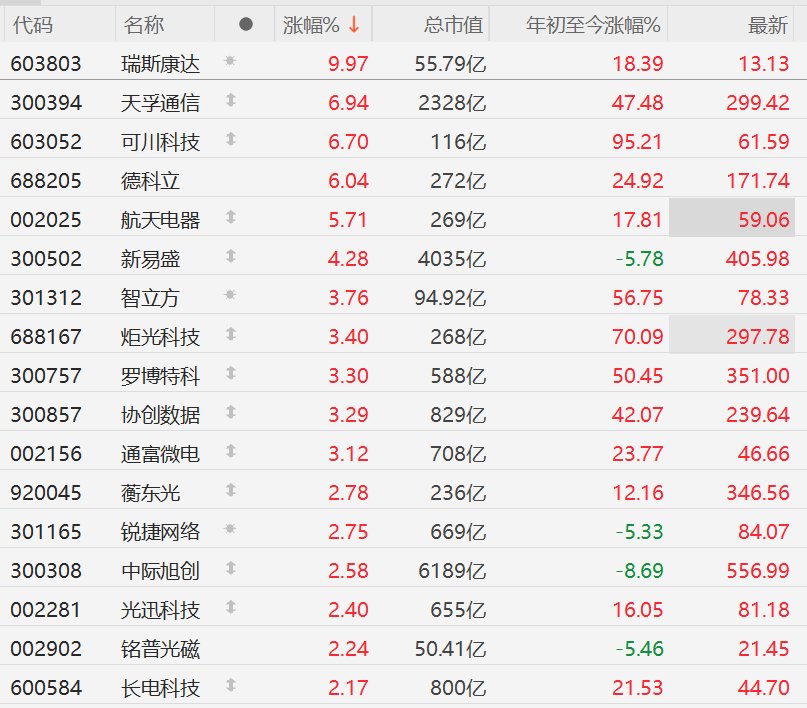
Core Viewpoint - The CPO concept stocks in the A-share market have shown strong performance, particularly following the announcement of NVIDIA's Feynman chip, which integrates optical communication to significantly reduce energy consumption in AI data center communications by over 70% [1]. Group 1: Stock Performance - Resconda (603803) saw a price increase of 9.97%, with a total market capitalization of 5.579 billion and a year-to-date increase of 18.39% [2]. - Tianfu Communication (300394) rose by 6.94%, with a market cap of 232.8 billion and a year-to-date increase of 47.48% [2]. - Kechuan Technology (603052) increased by 6.70%, with a market cap of 1.16 billion and a year-to-date increase of 95.21% [2]. - Dekeli (688205) experienced a 6.04% rise, with a market cap of 2.72 billion and a year-to-date increase of 24.92% [2]. - Aerospace Electric (002025) rose by 5.71%, with a market cap of 2.69 billion and a year-to-date increase of 17.81% [2]. - Xinyi Technology (300502) increased by 4.28%, with a market cap of 40.35 billion and a year-to-date decrease of 5.78% [2]. - Other notable stocks include Zhili Fang (301312) up 3.76%, Juguang Technology (688167) up 3.40%, and Luobotek (300757) up 3.30% [2]. Group 2: Market Trends - The overall trend in the CPO concept stocks indicates a positive market sentiment, driven by technological advancements in optical communication [1]. - The introduction of NVIDIA's Feynman chip is expected to have a significant impact on the energy efficiency of AI data centers, which may further boost investor interest in related stocks [1].


韩国股民热买中国资产:最爱“HALO”与新兴赛道
证券时报· 2026-03-17 14:54
Group 1 - The article highlights that Chinese assets are attracting significant attention from overseas investors, particularly in the context of increased global market volatility and geopolitical risks, due to their unique "cost-performance" advantage [1][12]. - Recent data shows that South Korean investors have net bought A-share securities, including major companies like Sany Heavy Industry, China Power Construction, and Ganfeng Lithium, with net purchases exceeding $1 million for each [1][3]. - The "HALO" assets, which are traditional industrial leaders, are favored by South Korean investors as they are seen as having low replacement risk and are essential for infrastructure in energy transition and high-end manufacturing [4][5]. Group 2 - South Korean investors have shown strong interest in China's "HALO" assets and emerging sectors like semiconductors, with significant net purchases recorded for companies such as Sany Heavy Industry (over $630,000), China Power Construction (over $440,000), and XJ Electric (over $1.3 million) [3][4]. - The semiconductor sector has also attracted attention, with net purchases for leading companies like JCET Group and Accelink Technologies exceeding $150,000 [6]. - The investment environment for South Korean investors has improved, with a stable RMB exchange rate enhancing the attractiveness of Chinese assets [7]. Group 3 - The article discusses the increasing use of ETFs by overseas investors to access quality A-share assets, with notable net purchases in semiconductor ETFs [9][10]. - The two leading ETFs focused on robotics, Tiger China Humanoid Robot ETF and Kodex China Humanoid Robot ETF, are gaining traction among South Korean investors, providing a diversified investment approach [9]. - ETFs lower the barriers for foreign investors by simplifying the investment process and reducing transaction costs, making it easier to invest in Chinese high-tech sectors [10]. Group 4 - The article emphasizes that despite some recovery in A-shares and Hong Kong stocks, the valuation of major indices remains low, while sectors like technology and manufacturing are expected to see strong profit growth by 2026 [12]. - The comprehensive advantages of China's AI and robotics sectors, supported by clear industrial policies, make them attractive for long-term investment [12]. - The article concludes that the Chinese capital market is becoming a preferred choice for global investors seeking quality assets, especially in the context of a weak dollar and low correlation with international geopolitical risks [12].





光模块设备行业深度:AI发展带动光模块需求爆发,看好封装测试设备商充分受益
Soochow Securities· 2026-03-16 05:24
Investment Rating - The report maintains a positive investment outlook on the optical module equipment industry, highlighting significant growth potential driven by AI developments and technological upgrades in packaging and testing equipment [2]. Core Insights - The demand for optical modules is experiencing explosive growth due to the expansion of AI computing power, with a shift from 400G to 800G and accelerating towards 1.6T, indicating a high demand cycle for equipment [2][23]. - The core value segments in the optical module packaging process are die bonding, coupling, and testing, which together account for over 60% of the value, with increasing precision and automation requirements [2][58]. - Domestic substitution, automation upgrades, and the introduction of advanced packaging present structural opportunities for equipment manufacturers, particularly in high-precision areas still dominated by foreign suppliers [2][32]. Summary by Sections Section 1: AI Development and Optical Module Demand - AI advancements are driving a surge in optical module demand, with a transition towards higher specifications like CPO and OIO expected to shape future trends [4][23]. - The optical module market is projected to see significant growth, with 800G and 1.6T modules expected to reach over 52 million units shipped by 2026 [24][26]. Section 2: Core Packaging and Testing Equipment - The main processes in optical module packaging include die bonding, coupling, and testing, which are critical for ensuring high performance and reliability [53][55]. - The report emphasizes the importance of high-precision die bonding and coupling processes, which are essential for achieving optimal optical performance [70][74]. Section 3: Key Companies and Investment Recommendations - The report recommends focusing on companies such as Robotech (coupling equipment), Keri Technology (die bonding), and others that are well-positioned to benefit from the industry's growth [2][32]. - It highlights the potential of companies like Lumentum and Coherent, which are expanding their production capacities to meet rising demand [33][32].



连涨12天!光模块跑出新龙头
格隆汇APP· 2026-03-14 07:56
Core Viewpoint - The article discusses the shifting dynamics in the optical module market, particularly focusing on the rise of Micro LED technology and CPO (Co-Packaged Optics) as a potential game-changer in AI data centers, which could disrupt traditional copper cable solutions and reshape the value distribution within the industry [2][10][20]. Group 1: Market Trends and Dynamics - The A-share market is oscillating between technology cycles and defensive sectors in 2026 [2]. - Leading companies in the optical module sector, such as Zhongji Xuchuang, Xinyi Technology, and Tianfu Communication, have seen cumulative gains exceeding 300% over the past two years [4]. - Valuations for these leading firms have reached historical highs, with Zhongji Xuchuang at a P/E ratio of 70, Xinyi Technology at 52, and Tianfu Communication at 138 [5]. Group 2: Emerging Opportunities - Funds are actively seeking new opportunities, leading to significant gains for second-tier suppliers like Huagong Technology and Guangxun Technology, with Huagong Technology's stock rising over 80% in 12 consecutive trading days [6]. - The recent hype around "light replacing copper" has driven a surge in Micro LED stocks, with a single-day increase of 8% and 20 companies hitting their upper trading limits [11]. Group 3: Technological Innovations - Micro LED technology has found new applications in AI computing through CPO, which threatens the market share of traditional copper cables [12][16]. - CPO technology significantly reduces signal loss and power consumption compared to traditional copper solutions, with Nvidia's Spectrum-X CPO switch demonstrating only 4dB signal loss and 9 watts of power consumption [16]. Group 4: Industry Structure and Value Redistribution - The shift to CPO architecture may lead to a reallocation of profits within the optical module supply chain, moving value upstream to core optical component suppliers [20][22]. - High-end chip markets are dominated by companies like Broadcom and Coherent, with domestic production rates only at 4%-10% [24]. - Nvidia's strategic investment of $4 billion in Lumentum and Coherent aims to secure long-term supply of advanced laser and optical components, addressing the current supply constraints [25]. Group 5: Company Performance and Projections - Huagong Technology and Guangxun Technology have demonstrated strong growth, with Huagong's optical module business revenue increasing by nearly 50% and Guangxun's revenue growing by 58.65% [32][29]. - The price of 1.6T optical modules has surged over 70%, from $1,200 to over $2,000, due to rising demand [32]. - The market for CPO in AI data centers is projected to grow significantly, with estimates suggesting a penetration rate of 35% by 2030 [19].

“北向+机构+游资” 集体出逃光迅科技,量化资金、一线游资联手抢筹化工人气股
摩尔投研精选· 2026-03-13 10:42
Core Viewpoint - The article highlights the trading activities and capital flows in the Shanghai and Shenzhen stock markets, emphasizing significant movements in specific stocks and sectors, particularly in the construction and chemical industries. Group 1: Trading Volume and Key Stocks - The total trading volume of the Shanghai and Shenzhen Stock Connect reached 295.245 billion, with Cambricon Technologies and CATL leading in trading volume for the Shanghai and Shenzhen markets, respectively [1][2]. - The top ten stocks by trading volume included Cambricon Technologies (30.59 billion) and CATL (38.66 billion) [2][4]. Group 2: Sector Performance - The construction engineering sector saw the highest net inflow of capital, amounting to 17.46 billion, with a net inflow rate of 2.08% [6]. - Other sectors with notable net inflows included power equipment (9.18 billion) and household appliances (8.08 billion) [6]. Group 3: Capital Outflows - The computer sector experienced the largest net outflow of capital, totaling -150.51 billion, with a net outflow rate of -8.09% [7][8]. - Other sectors with significant outflows included the new energy sector (-135.45 billion) and non-ferrous metals (-125.34 billion) [7]. Group 4: Individual Stock Capital Flows - The top stocks with net capital inflows included China Construction (20.38 billion) and NewEase (15.88 billion) [9]. - Conversely, the stocks with the highest net outflows included Huagong Technology (-19.64 billion) and Huasheng Tiancheng (-16.34 billion) [10][11]. Group 5: ETF Trading Activity - The A500 ETF Fund (512050) had the highest trading volume among ETFs, reaching 98.105 billion, with a 5.31% increase from the previous trading day [13]. - The Green Power ETF (159625) saw a remarkable 195% increase in trading volume compared to the previous day [14]. Group 6: Institutional and Retail Investor Activity - Institutional investors were active, with significant buy and sell transactions in stocks like Daikin Heavy Industries and Yingke Medical [16]. - Retail investors showed reduced activity, particularly in stocks like Guangxun Technology, which faced substantial selling pressure [17]. Group 7: Quantitative Fund Activity - Quantitative funds were notably active, with significant purchases in stocks like Chuanjin Nuo and Hongbaoli [18].