HIKVISION(002415)

Search documents
441项!2026年度“尖兵领雁+X”科技计划项目立项清单
仪器信息网· 2026-01-04 09:27
Core Viewpoint - The Zhejiang Provincial Department of Science and Technology has announced the project list for the 2026 "Pioneer Leading Goose + X" technology plan, which includes a total of 441 projects, comprising 69 "Pioneer" projects, 309 "Leading Goose" projects, and 63 technology cooperation projects [1][2]. Group 1: Project Overview - The 2026 "Pioneer Leading Goose + X" technology plan includes 441 projects in total [1][2]. - The projects are categorized into three types: "Pioneer" projects, "Leading Goose" projects, and technology cooperation projects [1][2]. Group 2: Project Details - The "Pioneer" projects include advanced technologies such as high-consistency diamond NV sensor mass production technology and quantum sensor preparation research [5][6]. - The "Leading Goose" projects focus on environmental technology, including key technologies for the treatment of new pollutants in various industries [8][9]. Group 3: Implementation Guidelines - Project units are required to submit project task books through the Zhejiang Provincial Science and Technology Management Platform by specified deadlines, with penalties for late submissions [3][4]. - The management of funds must adhere to specific regulations to ensure proper allocation and usage [4].




海康威视观澜编码新技术:破解存储困局,释放视频核心价值
Jin Rong Jie· 2026-01-04 03:13
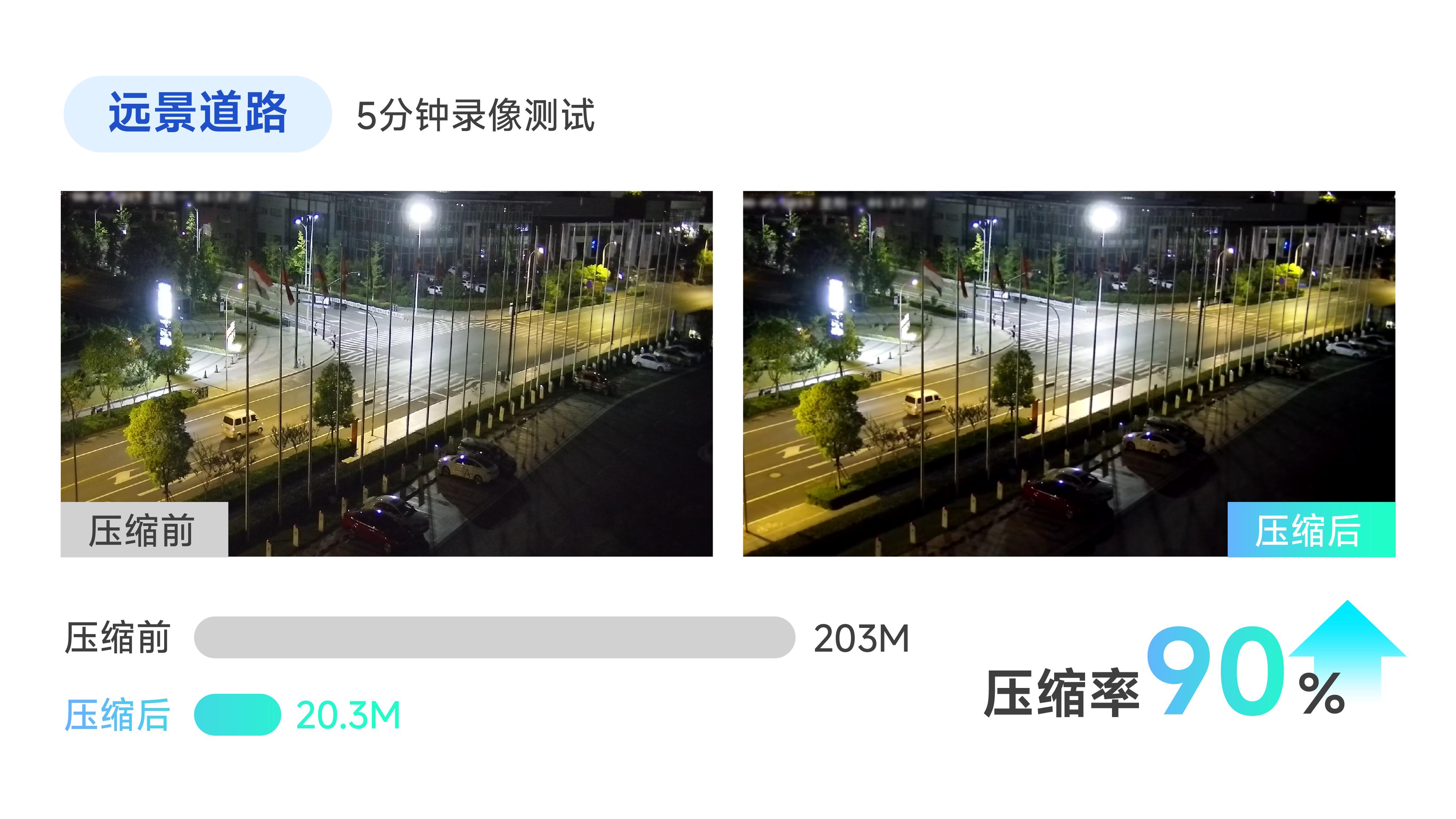
Core Insights - The article highlights the challenges of video storage in the security industry, noting that approximately 70% of surveillance footage consists of static or low-value images, leading to wasted storage resources and increased operational costs [1] - Hikvision has introduced a new encoding technology, "Guanlan Encoding," which aims to optimize storage efficiency without compromising video quality, addressing the industry's long-standing dilemma of balancing quality and storage efficiency [1][3] Technology Accumulation - Hikvision's advancements in video value extraction stem from years of technological iteration and practical experience, including the integration of deep learning algorithms in 2015 and the launch of an AI Cloud architecture in 2017 [2] - The company has developed a three-tier system for video understanding algorithms, focusing on enhancing video semantic understanding and expanding target recognition capabilities [2] Technology Upgrade - Traditional encoding methods can achieve 30% to 70% storage optimization but are limited by their reliance on object motion detection, which can misidentify non-critical movements [3] - The new Guanlan Encoding technology combines deep understanding capabilities with pixel-level segmentation to create a comprehensive optimization system that enhances both storage and video quality [3] Efficiency Improvement - The Guanlan technology allows for precise identification of high-value targets, achieving a recognition accuracy significantly higher than traditional algorithms, with the ability to support up to 64 targets simultaneously [12] - By employing refined ROI segmentation, the technology separates foreground from background, ensuring high-quality encoding for important details while optimizing storage for less critical areas, resulting in a bitrate reduction of 20% to 90% [12] Scene Adaptation - The Guanlan Encoding technology features a dynamic adaptation system that adjusts encoding based on scene complexity, ensuring optimal resource allocation for both dynamic and static scenes [14][15] - For example, in a park entrance scenario, the system can maintain high detail during peak hours while significantly reducing storage needs during off-peak times [15] Cost Savings - Using the Guanlan intelligent encoding solution for 2000 channels of 1080P video over 90 days can lead to a 60% reduction in hard drive requirements, 60% less space needed in server rooms, and a 50% decrease in electricity costs over five years, effectively lowering project costs while maintaining efficiency [22] Industry Evolution - Hikvision's commitment to enhancing video value has driven the security industry from passive recording to proactive intelligence, transforming video data from redundant to precise and efficient [29] - The Guanlan Encoding technology is set to be integrated into both front-end and back-end products, with a product launch anticipated soon [29]
研判2025!中国视频交换系统行业概述、市场规模、企业及行业趋势分析:5G-A/6G与超高清驱动,视频交换系统迈向基础设施新阶段[图]
Chan Ye Xin Xi Wang· 2026-01-04 01:17
Core Insights - The Chinese video exchange system industry is entering a new phase of development driven by technology, with a market size projected to reach approximately 12.865 billion yuan in 2024, reflecting a year-on-year growth of 5.27% [1][8]. Industry Overview - Video exchange systems (MTP) are integrated hardware and software systems that ensure secure video transmission across networks through device authentication, signal filtering, and one-way transmission mechanisms, supporting high reliability in public safety and emergency command scenarios [4][1]. Industry Chain - The upstream of the video exchange system industry consists of video user authentication servers (TMS), video access authentication servers (UMS), and security isolation gateways (GAP) [4]. - The midstream includes system integration and equipment manufacturing, while the downstream applications span video surveillance, intelligent transportation, emergency command, public safety, remote conferencing, data sharing, and smart services [4]. Market Size - The market for video exchange systems in China is expected to grow significantly, driven by the explosion of 5G-A/6G, ultra-high-definition, and immersive video applications, evolving from a simple audio-video connection tool to a key infrastructure for digital transformation [1][8]. Key Companies' Performance - The industry is characterized by a competitive landscape where major players like Huawei lead with end-to-end solutions and 5G/AI integration, while specialized companies like Qiming Star focus on video IoT security [9][10]. - Guangha Communication has reported a revenue of 332 million yuan in the first three quarters of 2025, marking a year-on-year increase of 41.90% [10]. - Xingtong New Science and Technology has achieved a revenue of 91 million yuan in the same period, reflecting a growth of 31.99% [11]. Industry Development Trends 1. The transition to IP-based technology and cloud-network integration is reducing system wiring complexity and costs, with standards like NDI and SMPTE ST 2110 becoming mainstream [13]. 2. AI integration is transforming video exchange systems from mere transmission channels to intelligent hubs capable of real-time analysis and insights [14]. 3. The national strategy for information technology innovation is driving the restructuring of the industry towards self-sufficiency and ecological reconstruction, leading to a more diversified competitive landscape [15][16].


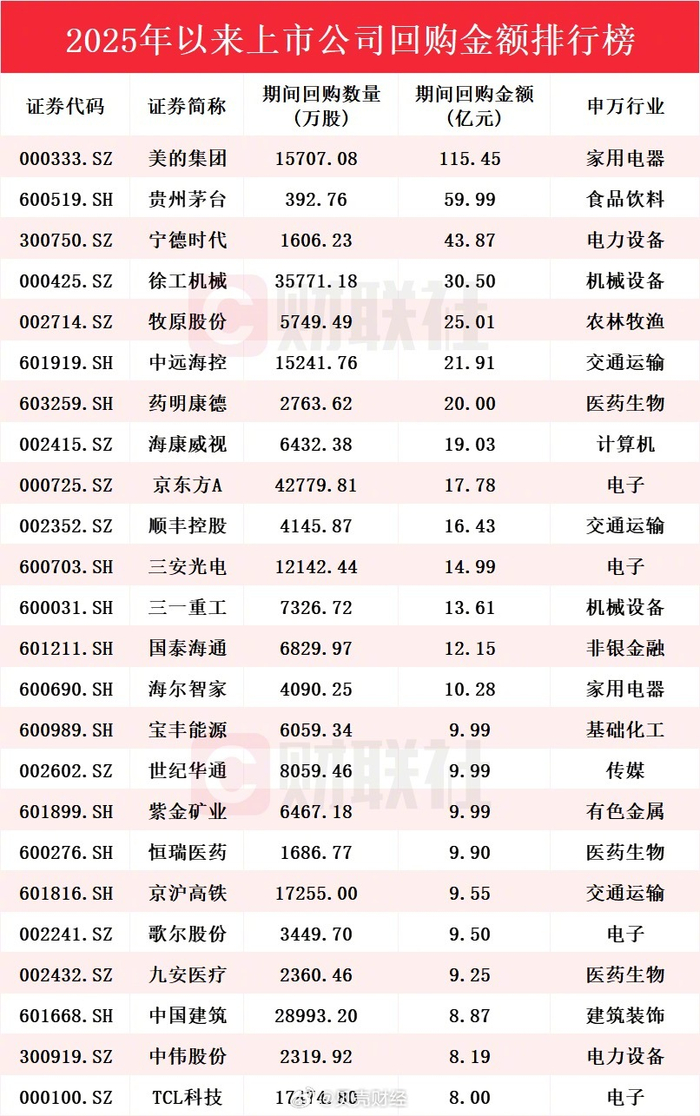
年内1494家A股公司回购1392亿元,美的集团115亿元居首
Bei Ke Cai Jing· 2025-12-31 14:23
Group 1 - As of the report date, 1494 A-share companies have implemented share buybacks in 2025, with a total amount exceeding 1392.84 billion yuan [1] - Among these, 14 companies have repurchased more than 1 billion yuan, with Midea Group leading at 115.45 billion yuan [1] - Other notable companies include Kweichow Moutai with 59.99 billion yuan and CATL with 43.87 billion yuan in buybacks [1] Group 2 - The top companies by buyback amount include: - Midea Group: 15,707.08 thousand shares, 115.45 billion yuan [1] - Kweichow Moutai: 392.76 thousand shares, 59.99 billion yuan [1] - CATL: 1,606.23 thousand shares, 43.87 billion yuan [1] - XCMG Machinery: 35,771.18 thousand shares, 30.50 billion yuan [1] - Muyuan Foods: 5,749.49 thousand shares, 25.01 billion yuan [1]






趋势研判!2025年中国图像采集卡行业产业链全景、发展现状、企业格局及未来发展趋势分析:工业视觉需求驱动,图像采集卡市场空间持续拓展[图]
Chan Ye Xin Xi Wang· 2025-12-31 01:45
Core Insights - The image capture card industry in China is experiencing growth driven by the demand for industrial automation and digital transformation, with market size expected to reach approximately 6.07 billion yuan in 2024 and 7 billion yuan in 2025 [1][11] - The industry is characterized by a clear supply chain, with upstream components primarily consisting of core chips, midstream manufacturers focusing on customized solutions, and downstream applications heavily centered on industrial automation [1][7] Industry Overview - Image capture cards, also known as video capture cards, serve as essential hardware connecting computers to external image sources, converting signals for digital processing [2][3] - The core functions include real-time transmission, caching, and preprocessing of image signals [2][4] Industry Chain Analysis - The upstream of the industry relies on core components and software, with high-end chips being imported but domestic FPGA/ASIC chips rapidly replacing them [7][9] - Midstream manufacturers are breaking into the mid-tier market with customized solutions and gradually penetrating high-end sectors [7] - Downstream applications are diverse, with industrial automation accounting for over 45% of demand, and new applications like autonomous driving and telemedicine emerging as growth areas [7][9] Market Size and Growth - The FPGA market in China is projected to grow significantly, reaching approximately 27.9 billion yuan in 2024 and expected to exceed 30 billion yuan in 2025, supporting the performance and cost optimization of image capture cards [9] - The industrial automation market is anticipated to surpass 322.5 billion yuan by 2025, driving demand for high-bandwidth, low-latency capture cards [9][10] Competitive Landscape - The industry features a layered competitive structure, with international leaders dominating high-performance markets while domestic companies leverage cost-effectiveness and localized services to establish advantages in mainstream sectors [11][12] - Domestic firms are focusing on addressing practical challenges in industrial settings, developing low-latency transmission and multi-channel synchronization capabilities [12] Development Trends - The industry is expected to evolve towards three main directions: technological integration of high-speed interfaces and AI, standardization and modular design for better compatibility, and expansion into cross-domain applications such as healthcare and intelligent transportation [12][15] - Standardization efforts will aim to unify interface protocols and software, reducing integration costs and development cycles [12][14] - The application scope will extend beyond traditional industrial automation to include high-precision medical imaging, real-time monitoring in security, and defect detection in high-end manufacturing [15]




海康威视股价涨1.01%,鹏扬基金旗下1只基金重仓,持有5.95万股浮盈赚取1.78万元
Xin Lang Cai Jing· 2025-12-30 06:41
Group 1 - Hikvision's stock increased by 1.01%, reaching 29.90 CNY per share, with a trading volume of 660 million CNY and a turnover rate of 0.25%, resulting in a total market capitalization of 274.03 billion CNY [1] - The company, founded on November 30, 2001, and listed on May 28, 2010, specializes in the research, production, and sales of security video surveillance products [1] - The revenue composition of Hikvision includes: main products and services 70.00%, robotics business 7.50%, smart home business 6.58%, automotive electronics 5.63%, thermal imaging 4.80%, storage business 2.47%, construction engineering 1.87%, and other innovative businesses 1.15% [1] Group 2 - Pengyang Fund has one fund heavily invested in Hikvision, with the Pengyang CSI A500 Index Enhanced A (022756) holding 59,500 shares, accounting for 1.07% of the fund's net value, making it the eighth largest holding [2] - The estimated floating profit from this investment is approximately 17,800 CNY [2] Group 3 - The Pengyang CSI A500 Index Enhanced A (022756) was established on March 4, 2025, with a current size of 135 million CNY and a cumulative return of 26.22% since inception [3] - The fund manager, Ma Chao, has been in position for 4 years and 31 days, with total assets under management of 419 million CNY, achieving a best return of 41.24% and a worst return of -13.12% during his tenure [3]
计算机设备板块12月25日涨0.78%,航天智装领涨,主力资金净流出10.5亿元
Zheng Xing Xing Ye Ri Bao· 2025-12-25 09:14
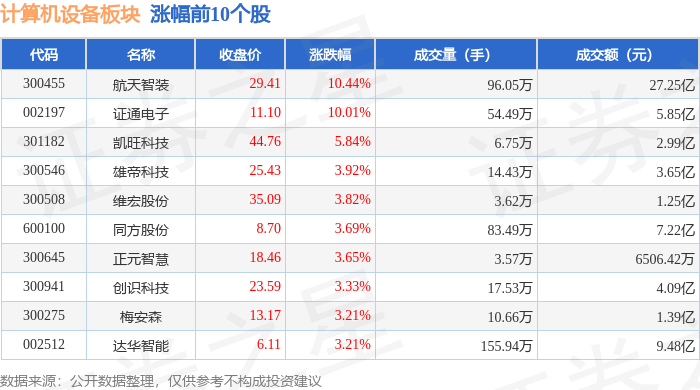
Market Overview - The computer equipment sector increased by 0.78% on December 25, with Aerospace Intelligence leading the gains [1] - The Shanghai Composite Index closed at 3959.62, up 0.47%, while the Shenzhen Component Index closed at 13531.41, up 0.33% [1] Top Gainers in Computer Equipment Sector - Aerospace Intelligence (300455) closed at 29.41, up 10.44% with a trading volume of 960,500 shares [1] - Zhengtong Electronics (002197) closed at 11.10, up 10.01% with a trading volume of 544,900 shares [1] - Kaiwang Technology (301182) closed at 44.76, up 5.84% with a trading volume of 67,500 shares [1] - Other notable gainers include Xiongdi Technology (300546) up 3.92%, Weihong Co., Ltd. (300508) up 3.82%, and Tongfang Co., Ltd. (600100) up 3.69% [1] Top Losers in Computer Equipment Sector - Zhongwei Electronics (300270) closed at 11.70, down 3.23% with a trading volume of 189,000 shares [2] - Anjubao (300155) closed at 5.65, down 2.92% with a trading volume of 129,000 shares [2] - Kalait (301391) closed at 81.17, down 2.87% with a trading volume of 11,300 shares [2] Capital Flow Analysis - The computer equipment sector experienced a net outflow of 1.05 billion yuan from institutional investors, while retail investors saw a net inflow of 1.07 billion yuan [2][3] - Notable net inflows from retail investors were observed in Aerospace Intelligence (300455) with 12.3 million yuan and Zhengtong Electronics (002197) with 10.9 million yuan [3] - Conversely, significant net outflows from institutional investors were noted in Zhengtong Electronics (-80.8 million yuan) and Kaiwang Technology (-13.96 million yuan) [3]


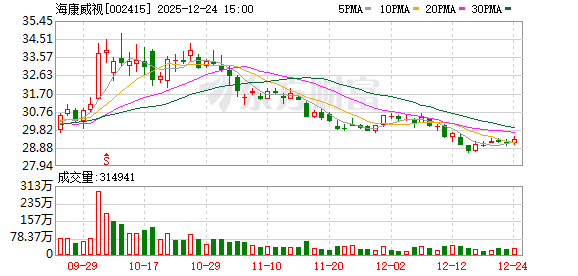
海康威视大宗交易成交601.27万元,买方为机构专用席位
Zheng Quan Shi Bao Wang· 2025-12-24 10:49
Summary of Key Points Core Viewpoint - Hikvision conducted a block trade on December 24, with a transaction volume of 205,000 shares and a transaction value of 6.0127 million yuan, at a price of 29.33 yuan per share, indicating stable trading activity in the stock [2]. Group 1: Trading Activity - The block trade on December 24 involved an institutional buyer and was executed by Guosen Securities Co., Ltd. Beijing branch as the seller [2]. - In the last three months, Hikvision has recorded a total of three block trades, with a cumulative transaction value of 51.8109 million yuan [2]. - The closing price of Hikvision on the same day was 29.33 yuan, reflecting a 0.65% increase, with a daily turnover rate of 0.35% and a total trading volume of 922 million yuan [2]. Group 2: Fund Flow and Financing - The net inflow of main funds for Hikvision on December 24 was 51.9477 million yuan, while over the past five days, the stock has seen a cumulative increase of 0.89% despite a total net outflow of 218 million yuan [2]. - The latest margin financing balance for Hikvision stands at 4.005 billion yuan, with a decrease of 53.746 million yuan over the past five days, representing a decline of 1.32% [2]. Group 3: Company Background - Hikvision, officially known as Hangzhou Hikvision Digital Technology Co., Ltd., was established on November 30, 2001, with a registered capital of 9.16487155 billion yuan [2].
A股回购规模超1400亿元,真金白银护航市场估值修复|2025中国经济年报
Hua Xia Shi Bao· 2025-12-23 14:15
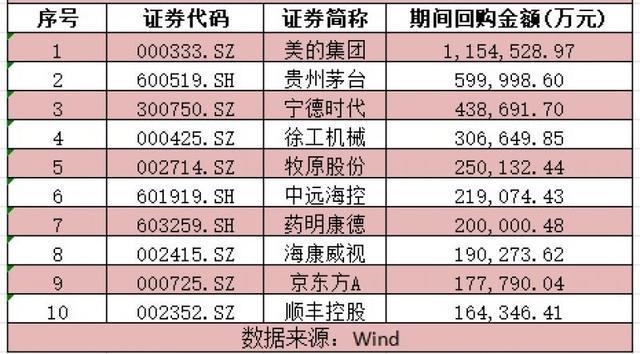
Core Viewpoint - The A-share market has seen a significant wave of stock buybacks in 2025, with nearly 1,500 companies participating, reflecting a robust response to economic recovery and external fluctuations [2][3]. Group 1: Market Overview - As of December 23, the Shanghai Composite Index closed at 3,919.98 points, with a year-to-date increase of 16.95%, peaking above 4,000 points [1]. - The overall market has shown a "shock bottoming and gradual recovery" trend, supported by favorable policies and improved corporate earnings [3]. - The three major indices have all risen this year, with the Shanghai Composite Index, Shenzhen Component Index, and ChiNext Index increasing by 16.95%, 28.37%, and 49.66%, respectively [3]. Group 2: Buyback Activity - Nearly 1,500 companies have initiated stock buybacks this year, with a total repurchase amount exceeding 1,400 billion yuan and over 13 billion shares repurchased [2][3]. - The buyback trend spans various sectors, including consumer, manufacturing, technology, and finance, indicating a comprehensive market support structure [2]. - Companies are increasingly using buybacks to enhance shareholder value and stabilize market expectations [2][3]. Group 3: Leading Companies in Buybacks - The top ten companies by buyback amount include Midea Group (11.55 billion yuan), Kweichow Moutai (5.99 billion yuan), and CATL (4.39 billion yuan) [1][6]. - Notably, Midea Group is the only company with a buyback amount exceeding 10 billion yuan this year [6]. - Companies like JD Display and XCMG Machinery have also made significant contributions to both buyback quantity and amount, showcasing their commitment to shareholder interests [6][7]. Group 4: Industry Participation - The manufacturing, consumer, and information technology sectors have the highest participation rates in buybacks, with leading firms like BOE Technology Group and XCMG Machinery actively repurchasing shares [4][5]. - These companies, backed by stable operating performance and ample cash flow, play a crucial role in stabilizing their stock prices and driving industry valuation recovery [4]. Group 5: Regulatory Support - The ongoing buyback trend is supported by regulatory policies, including the establishment of stock buyback and repurchase loans, which provide low-cost funding for companies [7]. - As of December 23, over 780 companies have disclosed receiving buyback loan support, with total loan amounts reaching over 100 billion yuan [7]. - The combination of these policies encourages companies to shift from passive stabilization to proactive value management [7][8].



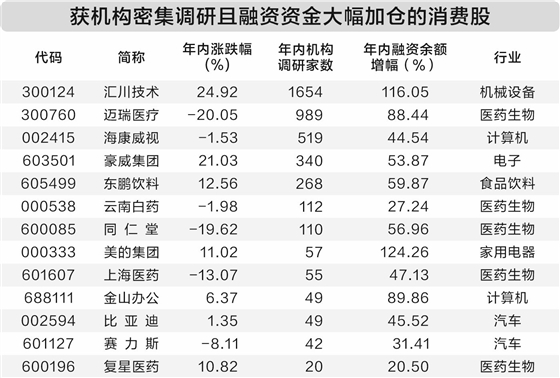
这些消费股获机构密集调研且融资资金大幅加仓(名单)
Zheng Quan Shi Bao Wang· 2025-12-23 01:20
Group 1 - The consumer sector shows signs of stabilization and rebound, with the Wind Consumer Index rising by 1.33% last Friday and continuing to increase by 0.13% on Monday [1] - The retail and dairy sectors have seen significant increases, with the Wind Retail Index up 7.44% and the Wind Dairy Index up 5.35% since December [2] - Over 20 ETFs related to consumption themes have seen a net inflow of over 2.2 billion yuan since December, with the Fortune CSI Tourism Theme ETF receiving nearly 1.4 billion yuan [2] Group 2 - The long-term growth resilience of China's consumer market is evident, with retail sales expected to rise from 39.1 trillion yuan in 2020 to 48.3 trillion yuan in 2024, averaging a growth rate of 5.5% [3] - The Wind Consumer Index has underperformed this year, with a year-to-date increase of only 5.34%, significantly lower than other popular indices [3] - The average price-to-earnings ratio of the Wind Consumer Index is 23.31, well below the 10-year average of 28.56 [3] Group 3 - Institutions predict that the total net profit of the Wind Consumer Index constituents will reach nearly 460 billion yuan in 2025, an increase of 8.63% from the previous year, with growth rates expected to exceed 14% in 2026 and 2027 [4] - The Wind Consumer Index and the Wind Domestic Demand Upgrade Index consist of 87 stocks across 12 industries, including pharmaceuticals, automotive, electronics, and food and beverage [4] - The average year-to-date increase for the 87 constituent stocks is over 29%, driven primarily by high-performing electronics and pharmaceuticals stocks [4] Group 4 - As of December 19, the total financing balance for the 87 constituent stocks is close to 320 billion yuan, an increase of over 45% from the end of last year, with more than 70% of the stocks seeing increased financing [4] - Thirteen stocks with a financing balance increase of at least 20%, over 20 institutional surveys, and a year-to-date increase of less than 25% are primarily in the pharmaceuticals, food and beverage, and home appliance sectors [4] Group 5 - Huichuan Technology, Mindray Medical, and Hikvision have received the highest number of institutional surveys this year, with Huichuan Technology's stock price increasing nearly 25% [5] - Mindray Medical has been surveyed by nearly 1,000 institutions, while Hikvision has received over 500 surveys [5] - Dongpeng Beverage has been surveyed by nearly 270 institutions, with a stock price increase of around 12% [5]