
多空博弈

Search documents
——近期市场反馈及思考11:多空博弈,市场方向怎么选?
Shenwan Hongyuan Securities· 2026-03-30 07:05
Group 1 - The report discusses the current market's focus on the direction of the bond market amid a tug-of-war between bullish and bearish sentiments, emphasizing the need to monitor factors beyond inflation that could exceed expectations [1][7] - Key factors influencing the bond market include the recovery strength and sustainability of the macroeconomic fundamentals, which are seen as the core contradictions to watch in the next phase [4][9] - The steepening of the yield curve is attributed to a shift in long-term macro narratives, with a focus on the transition from old to new economic drivers and the easing of credit contraction pressures [10][12] Group 2 - The report suggests that the bond market environment in the first half of 2026 will differ from that of 2025, with limited downward space for bond yields and potential upward risks requiring new catalysts [16] - Investment strategies for credit bonds should focus on the 3-year maturity range, with a cautious approach to duration while seeking opportunities in the upcoming credit market [19][21] - The report highlights the anticipated recovery of perpetual bonds issuance in the second quarter, with manageable pressure expected, particularly in the context of the evolving demand dynamics [23][24] Group 3 - The report identifies the next observation window for the growth of credit bond ETFs as potentially occurring in April-May, driven by market conditions and the recent regulatory changes in the technology innovation bond sector [25][26] - The recent decline in the convertible bond market is linked to external shocks and a risk-averse approach by investors, leading to significant reductions in positions [27][28] - Future pricing logic in the convertible bond market will increasingly depend on how equities are priced in response to external shocks, with a focus on potential mispricing opportunities relative to equities [29]
解套率新低
第一财经· 2026-03-23 11:23
Core Viewpoint - The A-share market experienced a significant decline, with all three major indices dropping over 3.4%, indicating a phase of market adjustment as the Shanghai Composite Index fell below 3900 points [4]. Market Performance - A total of 305 stocks rose, while the market showed a broad decline with a涨跌停比 of 38:14, reflecting a significant contraction in market profitability [5][6]. - Key sectors such as computing hardware, AI applications, cloud computing, consumer electronics, semiconductors, cybersecurity, commercial aerospace, fintech, humanoid robots, gold, basic metals, aviation, tourism, agriculture, brokerage, and real estate saw notable declines, while coal stocks performed positively [6]. Trading Volume - The total trading volume across both markets reached 4.43 trillion yuan, an increase of 6.33%, indicating heightened trading activity despite the index adjustments [7]. Capital Flow - There was a net outflow of funds from institutional investors, while retail investors showed a net inflow, indicating contrasting strategies between the two groups [8]. - Institutions displayed a cautious approach, reducing positions in most sectors while selectively allocating to undervalued defensive sectors, focusing on managing exposure to market volatility [9]. Investor Sentiment - Retail investors adopted a reverse strategy, actively participating in the market with significant net inflows, primarily focusing on buying on dips and optimizing their holdings [9].


宝城期货豆类油脂早报-20260319
Bao Cheng Qi Huo· 2026-03-19 05:25
Report Industry Investment Rating No relevant content provided. Core Viewpoints of the Report - The market is in a tug - of - war between short - term supply rhythm concerns and the long - term reality of a global soybean supply surplus, with prices in a wide - range oscillation. The risk premium driven by short - term concerns is not solid, and once the Brazilian logistics bottleneck eases, the premium will decline [5]. - The palm oil market is in a fierce game between strong expectations and weak reality. Short - term prices will maintain a wide - range oscillation, and the trend highly depends on factors such as the persistence of crude oil prices, the implementation of the US RVO policy, and the domestic inventory depletion rhythm [7]. Summary by Relevant Catalogs For Soybean Meal (M) - Short - term, Medium - term, and Daily View: All are considered "oscillating on the strong side". The core logic is that the uncertainty on the supply side makes the near - month contracts the focus of multi - empty gaming. The market is switching from trading short - term risks to returning to fundamental reality. The price is affected by the tension between short - term supply rhythm concerns and the long - term global soybean supply surplus [5][6]. - Influential Factors: Imported soybean cost, arrival rhythm of imports, oil mill operation rhythm, and inventory pressure [6]. For Palm Oil (P) - Short - term, Medium - term, and Daily View: All are considered "oscillating on the strong side". The core logic is the conflict between strong expectations and weak reality. Geopolitical conflicts and market expectations about Malaysian palm oil production and exports support the price, while high domestic inventory and weak consumption drag it down. The price will maintain a wide - range oscillation [7]. - Influential Factors: Energy attributes, Indonesian biodiesel policy expectations, cost increase, domestic arrivals and inventory, and substitution demand [6][7]. For Soybean Oil (Y) - Short - term, Medium - term, and Daily View: All are considered "oscillating on the strong side". - Influential Factors: Energy attributes, US biofuel policy, US soybean oil inventory, imported soybean cost support, supply rhythm, and oil mill inventory [6].
硅铁:多空双方博弈,宽幅震荡;锰硅:多空双方博弈,宽幅震荡
Guo Tai Jun An Qi Huo· 2026-03-09 02:47
Report Summary 1. Report Industry Investment Rating - No investment rating provided in the report. 2. Core View - The silicon iron and manganese silicon markets are characterized by a game between long and short positions, with wide - range fluctuations [1]. 3. Summary by Directory 3.1 Fundamental Tracking - **Futures Data**: - Silicon iron futures: The closing price of SiFe2605 is 5,868, with a change of 40 compared to the previous trading day, and the trading volume is 157,951, with an open interest of 223,284. The closing price of SiFe2607 is 5,956, with a change of 44, the trading volume is 49,217, and the open interest is 97,265 [1]. - Manganese silicon futures: The closing price of MnSi2605 is 6,130, with a change of 38, the trading volume is 217,679, and the open interest is 434,120. The closing price of MnSi2607 is 6,154, with a change of 40, the trading volume is 43,568, and the open interest is 93,511 [1]. - **Spot Data**: - The price of silicon iron (FeSi75 - B) in Inner Mongolia is 5,430 yuan/ton. The price of silicon - manganese (FeMn65Si17) in Inner Mongolia is 5,850 yuan/ton. The price of manganese ore (Mn44 block) is 43.8 yuan/ton - degree. The price of semi - coke (small material) in Shenmu is 695 yuan/ton [1]. - **Spread Data**: - The spot - futures spread of silicon iron (spot - 05 futures) is - 438 yuan/ton, a change of - 40 yuan/ton. The spot - futures spread of manganese silicon (spot - 05 futures) is - 304 yuan/ton, a change of - 38 yuan/ton [1]. - The near - far month spread of silicon iron (SiFe2605 - 2607) is - 88 yuan/ton, a change of - 4 yuan/ton. The near - far month spread of manganese silicon (MnSi2605 - 2607) is - 24 yuan/ton, a change of - 2 yuan/ton [1]. - The cross - variety spread of manganese silicon 2605 - silicon iron 2605 is 262 yuan/ton, a change of - 2 yuan/ton. The cross - variety spread of manganese silicon 2607 - silicon iron 2607 is 198 yuan/ton, a change of - 4 yuan/ton [1]. 3.2 Macro and Industry News - **Price Information**: - On March 6, the price range of 72 silicon iron in different regions is as follows: Shaanxi 5,250 - 5,350 yuan/ton, Ningxia 5,400 - 5,450 yuan/ton, Qinghai 5,350 - 5,400 yuan/ton, Gansu 5,350 - 5,400 yuan/ton, Inner Mongolia 5,350 - 5,450 yuan/ton. The price range of 75 silicon iron: Shaanxi 5,950 - 6,050 yuan/ton, Ningxia 5,850 - 5,950 yuan/ton, Qinghai 5,850 - 5,950 yuan/ton, Gansu 5,800 - 5,850 yuan/ton, Inner Mongolia 5,950 - 6,000 yuan/ton. The FOB price of 72 silicon iron is 1,100 - 1,120 (+20) US dollars/ton, and that of 75 is 1,140 - 1,170 (+20) US dollars/ton. The northern price of 6517 silicon - manganese is 5,800 - 5,850 yuan/ton, and the southern price is 5,850 - 5,950 (+25) yuan/ton [1]. - Multiple companies have announced the April 2026 manganese ore shipment prices to China, with varying degrees of increase compared to the previous month. For example, NMT's Mn36% (minimum) South African block is reported at 4.75 US dollars/ton - degree, a 0.25 US dollars/ton - degree increase from last month [3]. - Some steel mills have set silicon iron and silicon - manganese purchase prices. For example, Jinshenglan Group set the silicon iron price in Anhui at 5,820 yuan/ton cash on March 5, with a quantity of 500 tons. A steel mill in Guangdong set the silicon iron price at 5,989 yuan/ton cash on March 5, a 69 - yuan/ton increase from the previous round, with a quantity of 400 tons [3]. - **Inventory Information**: As of March 6, the manganese ore inventory in Tianjin Port is 337.02 million tons, a decrease of 19.88 million tons compared to the previous period; the inventory in Qinzhou Port is 132.38 million tons, a decrease of 0.69 million tons; the inventory in Caofeidian Port is 0 million tons; the inventory in Fangchenggang is 4 million tons, a decrease of 1.1 million tons. The total manganese ore inventory is 473.4 million tons, a decrease of 21.67 million tons [3]. 3.3 Trend Intensity - The trend intensity of silicon iron is 0, and the trend intensity of manganese silicon is 0 [3].
苯乙烯:多空博弈,价格先下跌后小幅反弹
Sou Hu Cai Jing· 2026-02-12 06:18
Core Viewpoint - Styrene prices experienced a decline followed by a slight rebound, with the average closing price in Jiangsu at 7620 yuan/ton as of February 11, down 310 yuan/ton or 3.91% from February 4 [1] Cost Analysis - International oil prices fluctuated, primarily influenced by negotiations between the U.S. and a Middle Eastern country, with Brent crude oil closing at a decrease of $0.06 per barrel as of February 11 [1] - Pure benzene prices initially fell due to the end of downstream stocking, but later rebounded slightly as market expectations shifted towards tighter supply post-Spring Festival, with the average price in East China down 1.54% from the previous Wednesday [1] Supply and Demand Dynamics - Domestic production increased more than expected due to the restart of facilities by companies such as Xinyang Technology, Sinochem Quanzhou, and Tianjin Bohua; however, production of key downstream products like PS and EPS decreased, while ABS saw a slight increase, indicating continued weak consumption [1] - Main port arrivals were insufficient to meet demand, leading to a decrease in inventory levels [1] Market Forecast - As the Spring Festival approaches, the fundamental supply-demand balance is expected to weaken, putting pressure on prices; however, actual trading in the East China spot market remains limited, with prices primarily driven by expectations [1] - Current market sentiment leans towards a lower accumulation of inventory at main ports post-Spring Festival and a favorable macroeconomic outlook, providing support for prices [1] - In the context of the ongoing tug-of-war between bullish and bearish sentiments, short-term styrene prices may exhibit a strong consolidation trend [1]
形态怪异的7连阳,抛压大小看明天
Sou Hu Cai Jing· 2026-02-11 10:45
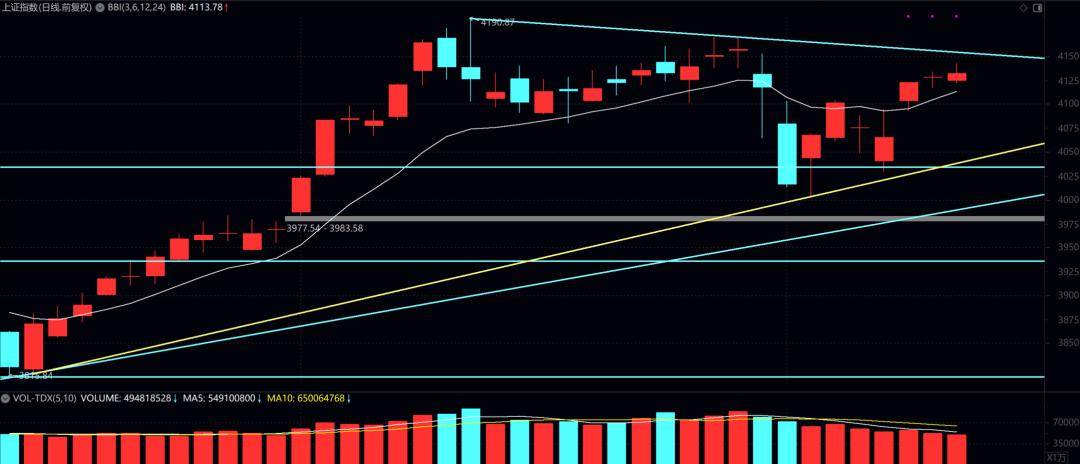
Core Viewpoint - The market showed mixed performance with a slight upward trend, closing at 4131, indicating a short-term bullish sentiment despite a majority of individual stocks declining [1][2]. Market Performance - The market opened lower at 4124, reached a low of 4022, and a high of 4142, ultimately closing at 4131, with a ratio of advancing to declining stocks at 2050:3241 [1]. - The closing above 4125 is considered acceptable, while a close above 4135 would be better, and above 4145 would indicate strong performance [2]. Key Levels and Indicators - The next critical observation point is on Friday, with a noted decrease in the likelihood of breaking through 4190 before the Spring Festival [3]. - The market is currently positioned between 4110 and 4046, with the upper boundary being a strong indicator and the lower boundary indicating weakness [8]. - The ChiNext index is between 3299 and 3250, with the lower boundary being a critical support level [9]. - The 50 index is situated between 3071 and 3052, with the upper boundary indicating strength [10]. Technical Analysis - The market closed with a small upward candle, remaining above daily, weekly, and monthly life lines, suggesting potential for further strength [13]. - Volume has decreased, remaining below the 5 and 10-day average volume lines, indicating a lack of strong buying interest [13]. - Short-term technical indicators suggest that the market must stay above the daily life line around 4115 to maintain a bullish outlook [16]. Support and Resistance Levels - Key resistance levels for the market are at 4142, 4152, and 4157, while support levels are at 4124, 4113, and 4103 [17]. - For the ChiNext index, the strong and weak dividing line is at 3348, with resistance at 3324, 3344, and 3361, and support at 3276, 3260, and 3250 [17]. Market Sentiment - The overall sentiment indicates a short-term bullish advantage for the market, while the ChiNext index shows a short-term bearish trend [15][16].
油价悬殊之谜!2月10日最新数据,92、95汽油价格相差之大,令人咋舌!
Sou Hu Cai Jing· 2026-02-10 16:45
Core Viewpoint - The recent fluctuations in oil prices reflect a complex interplay of market psychology and geopolitical factors, with potential implications for consumer behavior and investment strategies [1][6]. Market Dynamics - Last week, WTI crude oil futures experienced a significant drop of over 5%, marking the largest single-day decline in recent times, driven by rising U.S. crude oil production and a rebound in the dollar [1][6]. - Following the initial drop, oil prices rebounded unexpectedly on Tuesday and Wednesday, recovering nearly all losses, but then fell again on Thursday and exhibited a mixed performance on Friday [3][6]. - The volatility in oil prices has led to fluctuating investor sentiment, oscillating between panic and hope, which is intricately linked to the price movements [3][6]. Geopolitical Influences - Ongoing geopolitical tensions, particularly in the Middle East, continue to impact market sentiment, with recent talks between Iran and the U.S. aimed at easing nuclear tensions, while U.S. maritime advisories add uncertainty [6]. - The Federal Reserve's monetary policy signals, including a notable drop in the dollar index, further complicate the market landscape, intertwining with oil price fluctuations [6]. Consumer Impact - Domestic consumers are closely monitoring oil price trends, with expectations of a potential increase in gasoline prices by approximately 0.06 yuan per liter, following a projected rise of 70 yuan per ton [6][8]. - This could mark the first decrease in oil prices in over seven months, breaking a trend of nine consecutive price hikes since July 2017, which may positively influence consumer sentiment [6][8]. Price Data - Current gasoline prices across various regions in China show a range for 92, 95, and 98 octane fuels, with prices varying from 6.84 to 8.87 yuan per liter [4][5]. - Diesel prices also reflect regional variations, with 0号柴油 prices ranging from 6.37 to 7.61 yuan per liter [7]. Future Outlook - Analysts suggest that international oil prices may continue to face downward pressure, with expectations of a potential "double decline" in the next round of refined oil price adjustments [6][8]. - The market remains influenced more by speculative sentiment than by fundamental factors, indicating a need for careful monitoring of price movements and consumer behavior [6][8].

多空博弈加剧金价波动,黄金ETF如何把控布局节奏
Sou Hu Cai Jing· 2026-02-10 03:50
Core Viewpoint - The global gold market is experiencing significant volatility, with ongoing battles between bulls and bears, leading to fluctuations in gold prices. The focus is on the strategic allocation of gold ETFs as a convenient tool for investors to access gold assets [1]. Group 1: Market Volatility and Price Drivers - Recent fluctuations in gold prices are driven by an imbalance in the forces of supply and demand, influenced by various macroeconomic and market factors [8]. - Key supporting factors for gold prices include changes in global macroeconomic policies, which lower the opportunity cost of holding gold, and ongoing geopolitical uncertainties that drive investors towards gold as a safe-haven asset [5][8]. - Short-term factors suppressing gold prices include market sentiment and capital flows, with profit-taking leading to increased selling pressure and cautious positioning among investors due to concerns over policy shifts [8][9]. Group 2: Gold ETF Allocation Strategy - Gold ETFs are favored by ordinary investors for their low entry barriers, high liquidity, and transparency, making them an ideal tool for hedging market risks [11]. - Investors are advised to focus on long-term allocation value rather than short-term speculation, as gold can effectively diversify investment portfolios and enhance resilience against volatility [11][12]. - It is crucial to monitor macroeconomic policies and geopolitical developments to identify strategic allocation opportunities, adjusting positions based on market conditions [12].
现货金银回升,金银市场惊现杠杆绞杀,现货白银跌幅收窄
Sou Hu Cai Jing· 2026-02-06 23:15
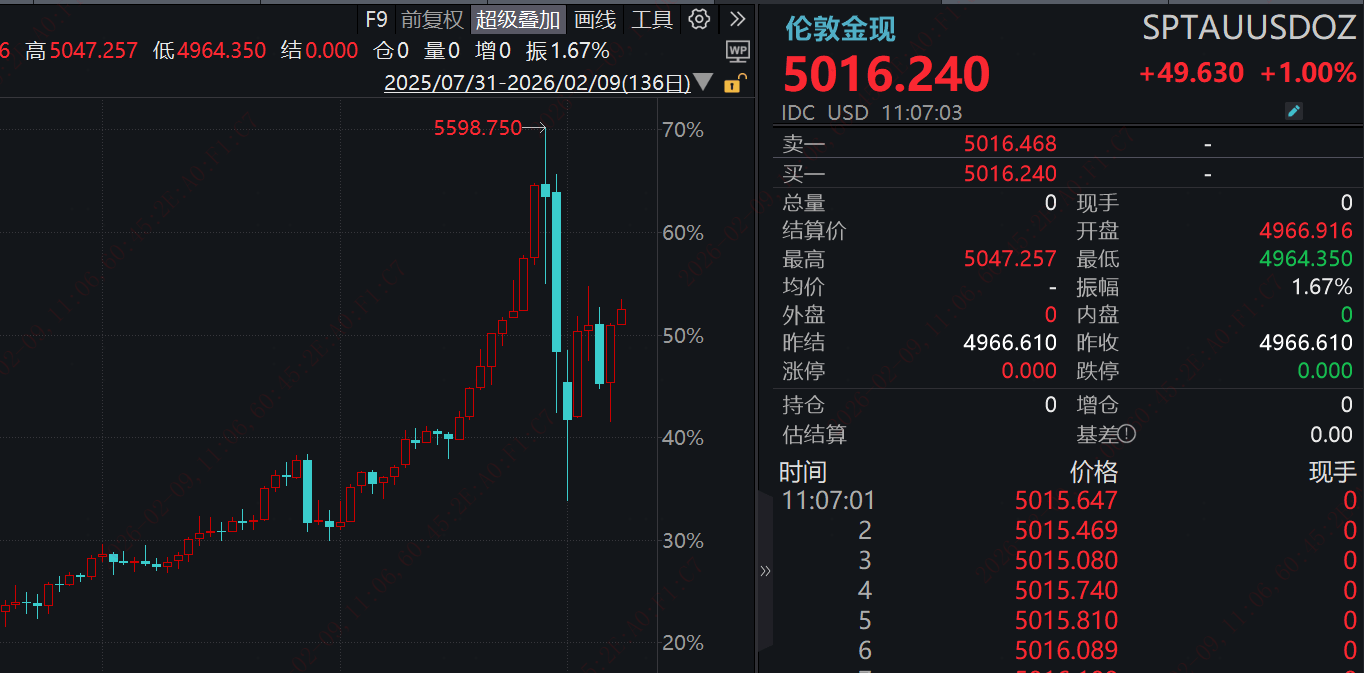
Core Viewpoint - The global precious metals market experienced significant volatility on February 6, 2026, with gold and silver prices plummeting sharply due to regulatory changes and market reactions to economic conditions [1][3]. Group 1: Market Volatility - On February 6, spot gold fell over 2.5% before narrowing to under 1%, while spot silver experienced a dramatic drop of nearly 10%, ultimately closing down 2% [1] - The day prior, London silver saw a single-day decline of 12.31%, with domestic silver T D dropping 11.64%, marking a 40% retreat from its historical high set on January 29 [1] Group 2: Regulatory Impact - The CME raised initial margin requirements for COMEX gold futures from 8% to 9% and for silver futures from 15% to 18%, effective after the close on February 6, which was interpreted as a direct crackdown on speculative trading [3] - This regulatory change forced high-leverage traders to liquidate positions, triggering a chain reaction of sell-offs, particularly in silver, which saw a daily volatility of 15%, the largest in five years [3] Group 3: Market Dynamics - There is a stark divide between short-term speculators and long-term investors, with many retail investors aggressively leveraging positions at high prices, leading to forced liquidations during market downturns [5] - Institutional investors, such as Morgan Stanley and Goldman Sachs, reduced their net long positions significantly before the crash, while retail investors continued to increase their holdings, indicating a misalignment in market sentiment [10] Group 4: Silver's Vulnerability - Silver's volatility is significantly higher than that of gold, with an implied volatility of 85%, attributed to its dual role as both a financial and industrial metal [6] - Industrial demand for silver, particularly in sectors like photovoltaics and electric vehicles, accounts for nearly 30% of global silver production, but expectations of a slowdown in industrial recovery have dampened demand prospects [6] Group 5: Broader Market Reactions - The sharp decline in precious metals triggered a broader market sell-off, with major U.S. stock indices dropping over 1% and Bitcoin falling below $65,000, alongside a more than 3% drop in oil prices [8] - Algorithmic trading exacerbated the situation, leading to a "gamma squeeze" effect that resulted in rapid selling by market makers, causing prices to plummet without substantial negative news [8]

多空博弈剧烈 沪银期货短期或将进入震荡降波过程
Jin Tou Wang· 2026-02-05 06:33
Core Viewpoint - The main focus of the news is the significant drop in Shanghai silver futures, with the main contract falling over 10% to a low of 18,500.00 yuan, closing at 20,427.00 yuan, indicating a bearish trend in the market [1]. Group 1: Market Analysis - Chuangyuan Futures suggests that gold and silver may enter a period of fluctuating decline in the short term, while maintaining a long-term outlook based on their annual report [2]. - Wenkang Futures indicates that precious metals continue their previous trend of fluctuating recovery, with a cautious market sentiment during the short covering process [3]. - Dayue Futures notes that the volatility of silver at high levels is significant, recommending cautious operations as the market awaits a decrease in volatility [3]. Group 2: Price Ranges and Market Sentiment - Wenkang Futures provides a reference range for the main contracts, suggesting that Shanghai gold should operate between 1,050-1,300 yuan per gram, while Shanghai silver should be in the range of 22,000-25,000 yuan per kilogram [3]. - Dayue Futures highlights that despite the recent drop, the bullish sentiment remains strong, with Shanghai silver maintaining a premium of 3,300 yuan per gram, indicating a potential for price rebound [3].