JINZI HAM(002515)

Search documents
金字火腿:全资子公司完成工商变更登记并换发营业执照
Zheng Quan Ri Bao Wang· 2025-10-20 12:44
Core Viewpoint - The company, Jinzi Ham, announced changes in the business registration information of its wholly-owned subsidiaries, Jin Hua Jinzi Ham Co., Ltd. and Jinzi Frozen Food City Co., Ltd., due to business development needs [1] Group 1 - Jinzi Ham has received notifications regarding changes in the legal representative and business scope of its subsidiaries [1] - Both subsidiaries have completed the business registration changes and obtained new business licenses from the Jinhua Market Supervision Administration [1]

金字火腿(002515) - 关于全资子公司完成工商变更登记并换发营业执照的公告
2025-10-20 08:45
证券代码:002515 证券简称:金字火腿 公告编号:2025-057 | 经营活动)。许可项目: | 经营活动)。 | | --- | --- | | 道路货物运输(不含危险 | | | 货物);道路货物运输(网 | | | 络货运)(依法须经批准 | | | 的项目,经相关部门批准 | | | 后方可开展经营活动,具 | | | 体经营项目以审批结果 | | | 为准)。 | | 特此公告。 金字火腿股份有限公司董事会 2025 年 10 月 21 日 关于全资子公司完成工商变更登记并换发营业执照的公告 本公司及董事会全体成员保证信息披露的内容真实、准确、完整,没有虚假记载、误 导性陈述或重大遗漏。 金字火腿股份有限公司(以下简称"公司")于近日收到全资子公司金华金 字火腿有限公司(以下简称"金华金字")及金字冷冻食品城有限公司(以下简 称"金字冷冻城")的通知,因业务发展需要,金华金字及金字冷冻城对法定代 表人、经营范围等工商登记信息进行了变更。现上述两家全资子公司均已完成工 商变更登记手续,并取得由金华市市场监督管理局换发的营业执照,具体变更信 息如下: | 变更主体 | 变更项目 | 变更前 | 变 ...
食品加工板块10月20日涨0.14%,*ST春天领涨,主力资金净流出5382.64万元
Zheng Xing Xing Ye Ri Bao· 2025-10-20 08:30
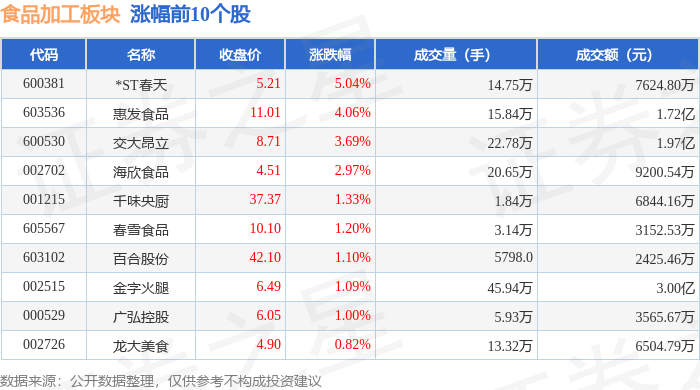
Market Overview - On October 20, the food processing sector rose by 0.14% compared to the previous trading day, with *ST Chuntian leading the gains [1] - The Shanghai Composite Index closed at 3863.89, up 0.63%, while the Shenzhen Component Index closed at 12813.21, up 0.98% [1] Stock Performance - The top performers in the food processing sector included: - *ST Chuntian (600381) with a closing price of 5.21, up 5.04% with a trading volume of 147,500 shares and a turnover of 76.248 million yuan [1] - Huifa Food (603536) closed at 11.01, up 4.06% with a trading volume of 158,400 shares and a turnover of 172 million yuan [1] - Jiaoda Anli (600530) closed at 8.71, up 3.69% with a trading volume of 227,800 shares and a turnover of 197 million yuan [1] Capital Flow - The food processing sector experienced a net outflow of 53.8264 million yuan from institutional investors, while retail investors saw a net inflow of 46.0448 million yuan [2] - The capital flow for individual stocks showed: - Jiaoda Anli (600530) had a net inflow of 18.9711 million yuan from institutional investors [3] - *ST Chuntian (600381) had a net inflow of 13.8693 million yuan from institutional investors [3] - Double Happiness Development (000895) had a net inflow of 18.8154 million yuan from institutional investors [3]


大消费行业周报(10月第3周):海南离岛免税政策5大调整落地-20251020
Century Securities· 2025-10-20 00:44
Investment Rating - The report does not explicitly state an investment rating for the industry, but it suggests focusing on the duty-free retail sector and the ice and snow economy as potential investment opportunities. Core Insights - The recent adjustments to the Hainan duty-free shopping policy are expected to enhance the attractiveness of Hainan as a free trade port, expanding the range of duty-free goods and increasing consumer participation [2][3]. - The early onset of the snow season in Xinjiang is anticipated to benefit the ice and snow economy, with government initiatives aiming for a total output value of 200 billion yuan by 2030 [2][3]. - The report highlights the performance of various sectors within the consumer industry, noting significant stock price changes among leading companies [2][3]. Summary by Sections Market Weekly Review - The consumer sector showed mixed performance, with food and beverage, retail, and home appliances experiencing gains, while beauty care and textiles saw declines [2][3]. - Notable stock performances included Kuaijishan (+11.08%) and Dongbei Group (+8.97%) leading the gains, while Jinzi Ham (-17.80%) and Biyi Co. (-19.63%) faced significant losses [2][3]. Industry News and Key Company Announcements - The Hainan duty-free policy adjustments include expanding the range of duty-free goods to 47 categories and allowing more consumer participation [2][3]. - The ice and snow industry is projected to exceed 1 trillion yuan by 2025, driven by upcoming major events and government support [2][3]. - Various companies reported significant revenue growth, such as Spring Breeze Power with a 28.56% increase in Q3 revenue [2][3].





食品饮料行业本周资金流出榜:5股净流出资金超亿元
Zheng Quan Shi Bao Wang· 2025-10-19 13:11
Market Overview - The Shanghai Composite Index fell by 1.47% this week, with only four industries showing gains, led by the banking and coal sectors, which rose by 4.89% and 4.17% respectively [1] - The food and beverage industry ranked third in terms of weekly gains [1] Fund Flow Analysis - Total net outflow of main funds from both markets reached 301.749 billion yuan this week, with only two industries experiencing net inflows: banking (24.19 billion yuan) and coal (2.67 billion yuan) [1] - The electronic industry saw the largest net outflow, totaling 70.079 billion yuan, followed by the power equipment sector with a net outflow of 41.692 billion yuan [1] Industry Performance - The food and beverage sector increased by 0.86% this week, despite a net outflow of 378 million yuan in main funds [3] - Within the food and beverage sector, 49 out of 124 stocks rose, with notable increases from Kweichow Moutai (11.08%), Miaokelando (8.52%), and Guifaxiang (6.90%) [3] - Conversely, 71 stocks declined, with Jinzi Ham, Yangyuan Beverage, and Zhuangyuan Pasture experiencing significant drops of 17.80%, 16.56%, and 14.06% respectively [3] Top Stocks in Food and Beverage - Kweichow Moutai led the net inflow with 680 million yuan, followed by Luzhou Laojiao (204 million yuan) and Wuliangye (198 million yuan) [3] - The top outflow stocks included Jinzi Ham (-186 million yuan), Yangyuan Beverage (-171 million yuan), and Zhuangyuan Pasture (-135 million yuan) [4]




食品加工板块10月17日跌0.96%,金字火腿领跌,主力资金净流出2.36亿元
Zheng Xing Xing Ye Ri Bao· 2025-10-17 08:31
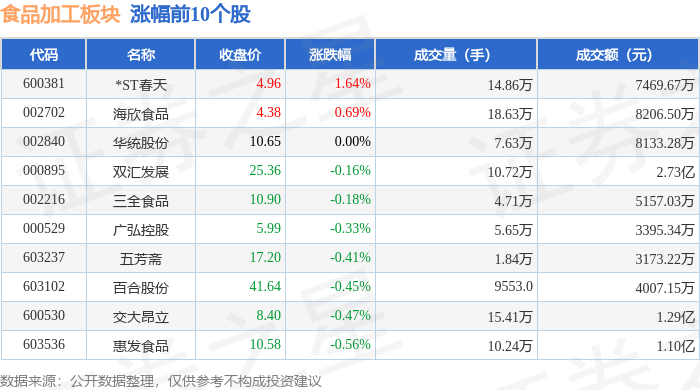
Market Overview - On October 17, the food processing sector declined by 0.96%, with Jinzi Ham leading the drop [1] - The Shanghai Composite Index closed at 3839.76, down 1.95%, while the Shenzhen Component Index closed at 12688.94, down 3.04% [1] Stock Performance - Notable stock performances included: - *ST Chuntian: Closed at 4.96, up 1.64% with a trading volume of 148,600 shares and a turnover of 74.7 million yuan [1] - Jinzi Ham: Closed at 6.42, down 8.02% with a trading volume of 848,900 shares and a turnover of 563 million yuan [2] - Other stocks like Huazhong Food and Shuanghui Development showed minor declines [1][2] Capital Flow - The food processing sector experienced a net outflow of 236 million yuan from institutional investors, while retail investors saw a net inflow of 222 million yuan [2] - The capital flow for specific stocks indicated: - *ST Chuntian: Net inflow from retail investors was 434,440 yuan, while institutional investors had a net outflow of 764,960 yuan [3] - Jinzi Ham had a significant net outflow of 5.63 billion yuan from institutional investors [2][3] Summary of Key Stocks - The following stocks had notable capital movements: - *ST Chuntian: 10.24% of net inflow from institutional investors [3] - Jinzi Ham: 8.02% decline in stock price, indicating significant selling pressure [2] - Other stocks like Huazhong Food and Wufangzhai also faced net outflows from institutional investors [3]
食品加工板块10月16日涨0.49%,*ST春天领涨,主力资金净流出1.06亿元
Zheng Xing Xing Ye Ri Bao· 2025-10-16 08:20
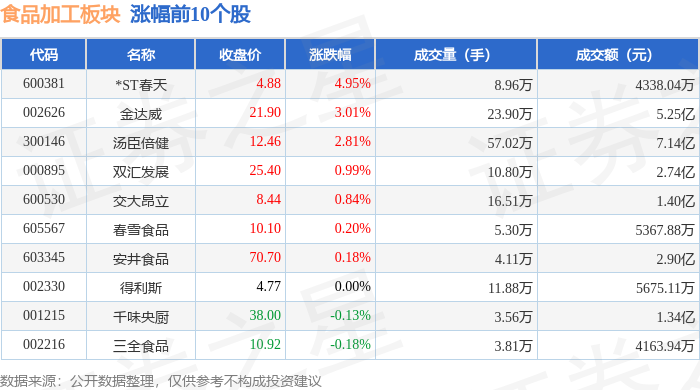
Market Overview - The food processing sector increased by 0.49% on October 16, with *ST Chuntian leading the gains [1] - The Shanghai Composite Index closed at 3916.23, up 0.1%, while the Shenzhen Component Index closed at 13086.41, down 0.25% [1] Stock Performance - *ST Chuntian (600381) closed at 4.88, up 4.95% with a trading volume of 89,600 shares and a turnover of 43.38 million yuan [1] - Quandawei (002626) closed at 21.90, up 3.01% with a trading volume of 239,000 shares and a turnover of 52.5 million yuan [1] - Tangchen Beijian (300146) closed at 12.46, up 2.81% with a trading volume of 570,200 shares and a turnover of 714 million yuan [1] - Shuanghui Development (000895) closed at 25.40, up 0.99% with a trading volume of 108,000 shares and a turnover of 274 million yuan [1] - Other notable stocks include Jiaoda Anli (600530) and Chunxue Food (605567), with minor increases of 0.84% and 0.20% respectively [1] Capital Flow - The food processing sector experienced a net outflow of 106 million yuan from institutional investors, while retail investors saw a net inflow of 69.89 million yuan [2] - The overall capital flow indicates a mixed sentiment, with institutional investors withdrawing funds while retail investors are actively buying [2] Individual Stock Capital Flow - Anjiu Food (603345) had a net inflow of 18.59 million yuan from institutional investors, while retail investors had a net outflow of 34.42 million yuan [3] - Jiaoda Anli (600530) saw a net inflow of 16.91 million yuan from institutional investors, but retail investors had a net outflow of 9.50 million yuan [3] - *ST Chuntian (600381) had a net inflow of 11.76 million yuan from institutional investors, with retail investors also experiencing a net outflow [3]


金字火腿跌2.09%,成交额1.71亿元,主力资金净流出1620.30万元
Xin Lang Cai Jing· 2025-10-16 06:35
Core Viewpoint - The stock of Jinzi Ham has experienced fluctuations, with a notable decline in recent trading days despite a significant year-to-date increase in price [1][2]. Financial Performance - As of June 30, 2025, Jinzi Ham reported a revenue of 170 million yuan, representing a year-on-year decrease of 14.73% [2]. - The net profit attributable to shareholders for the same period was 22.92 million yuan, down 25.11% year-on-year [2]. - Cumulative cash dividends since the company's A-share listing amount to 257 million yuan, with 80.1 million yuan distributed over the past three years [3]. Stock Market Activity - On October 16, Jinzi Ham's stock price fell by 2.09%, trading at 7.04 yuan per share, with a total market capitalization of 8.523 billion yuan [1]. - The stock has seen a year-to-date increase of 56.44%, but has declined by 12.44% over the last five trading days and 5.76% over the last twenty days [1]. - The net outflow of main funds was 16.203 million yuan, with significant selling pressure observed [1]. Shareholder Information - As of June 30, 2025, the number of shareholders decreased to 32,600, a reduction of 9.15% from the previous period [2]. - The average number of circulating shares per shareholder increased by 14.78% to 37,121 shares [2]. - Hong Kong Central Clearing Limited has exited the list of the top ten circulating shareholders [3]. Business Overview - Jinzi Ham, established on November 15, 1994, and listed on December 3, 2010, specializes in the research, production, and sales of Jinhua ham and various fermented meat products [1]. - The company's main business revenue composition includes: ham (58.94%), specialty meat products (24.82%), cold chain services (6.83%), branded meat (5.98%), ham products (1.82%), and others (1.61%) [1].
食品加工板块10月14日涨0.04%,盖世食品领涨,主力资金净流出1.25亿元
Zheng Xing Xing Ye Ri Bao· 2025-10-14 08:39
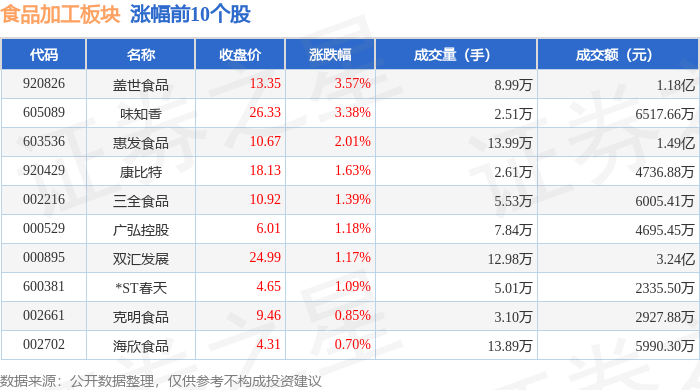
Market Overview - On October 14, the food processing sector rose by 0.04% compared to the previous trading day, with Gai Shi Food leading the gains [1] - The Shanghai Composite Index closed at 3865.23, down 0.62%, while the Shenzhen Component Index closed at 12895.11, down 2.54% [1] Stock Performance - Gai Shi Food (code: 920826) closed at 13.35, up 3.57% with a trading volume of 89,900 shares and a turnover of 118 million yuan [1] - Wei Zhi Xiang (code: 605089) closed at 26.33, up 3.38% with a trading volume of 25,100 shares and a turnover of 65.18 million yuan [1] - Hui Fa Food (code: 603536) closed at 10.67, up 2.01% with a trading volume of 139,900 shares and a turnover of 149 million yuan [1] - Other notable performers include Kang Bi Te (code: 920429) up 1.63% and Shuanghui Development (code: 000895) up 1.17% [1] Capital Flow - The food processing sector experienced a net outflow of 125 million yuan from institutional investors, while retail investors saw a net inflow of 140 million yuan [2] - The overall capital flow indicates a mixed sentiment, with institutional investors pulling back while retail investors are more active [2] Individual Stock Capital Flow - ST Chuntian (code: 600381) had a net inflow of 3.86 million yuan from institutional investors, while it faced a net outflow of 3.76 million yuan from speculative funds [3] - Hui Fa Food (code: 603536) saw a net inflow of 2.40 million yuan from institutional investors, but a net outflow of 2.55 million yuan from retail investors [3] - Shuanghui Development (code: 000895) had a net inflow of 1.87 million yuan from institutional investors, with a significant outflow of 38.42 million yuan from speculative funds [3]


食品加工板块10月13日跌1%,金字火腿领跌,主力资金净流出1.49亿元
Zheng Xing Xing Ye Ri Bao· 2025-10-13 12:38
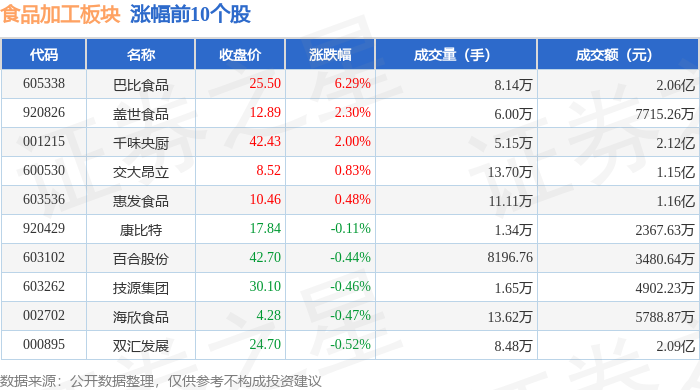
Core Insights - The food processing sector experienced a decline of 1.0% on October 13, with Jinzi Ham leading the drop [1] - The Shanghai Composite Index closed at 3889.5, down 0.19%, while the Shenzhen Component Index closed at 13231.47, down 0.93% [1] Stock Performance - Baba Foods (605338) saw a significant increase of 6.29%, closing at 25.50 with a trading volume of 81,400 shares and a transaction value of 206 million [1] - Jinzi Ham (002515) reported a notable decline of 6.02%, closing at 7.34 with a trading volume of 1,203,900 shares and a transaction value of 883 million [2] - Other notable performers included Qianwei Yangchu (001215) with a 2.00% increase and a closing price of 42.43, and Guangming Meat Industry (600073) with a 4.33% decrease [1][2] Capital Flow - The food processing sector experienced a net outflow of 149 million from institutional investors, while retail investors saw a net inflow of 15.51 million [2] - Major stocks like Baba Foods and Qianwei Yangchu attracted net inflows from retail investors, while Jinzi Ham and Longda Food faced significant outflows from institutional investors [3]