QRCB(002958)

Search documents
青农商行:独立董事任职资格获核准
Zheng Quan Ri Bao Wang· 2025-11-07 14:09
Group 1 - The core point of the article is the approval of Wang Qingjin's qualification as an independent director of Qingdao Rural Commercial Bank by the National Financial Supervision Administration [1] Group 2 - Qingdao Rural Commercial Bank (002958) announced the receipt of the approval on November 7 [1] - The approval was issued by the Qingdao Regulatory Bureau of the National Financial Supervision Administration [1] - This appointment is significant for the governance structure of the bank [1]

青农商行(002958) - 关于独立董事任职资格获核准的公告
2025-11-07 10:31
王庆金先生的简历详见本行 2025 年 8 月 13 日在巨潮资讯网 (http://www.cninfo.com.cn)披露的《第五届董事会第十次临时会议决议公告》。 特此公告。 青岛农村商业银行股份有限公司董事会 2025 年 11 月 7 日 证券代码:002958 证券简称:青农商行 公告编号:2025-054 转债代码:128129 转债简称:青农转债 青岛农村商业银行股份有限公司 关于独立董事任职资格获核准的公告 本行及董事会全体成员保证公告内容的真实、准确和完整,没有虚假记载、误导 性陈述或者重大遗漏。 近日,青岛农村商业银行股份有限公司(以下简称本行)收到《国家金融监督管 理总局青岛监管局关于王庆金青岛农商银行独立董事任职资格的批复》(青金复〔2025〕 253 号),核准王庆金青岛农村商业银行股份有限公司独立董事的任职资格。 ...
农商行板块11月7日跌0.26%,渝农商行领跌,主力资金净流出5990.34万元
Zheng Xing Xing Ye Ri Bao· 2025-11-07 08:37
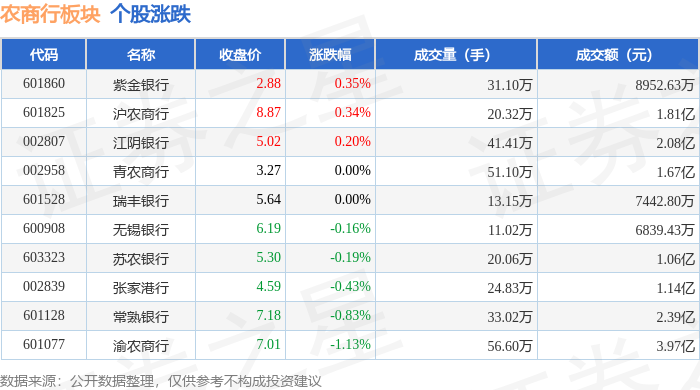
Market Overview - On November 7, the rural commercial bank sector declined by 0.26% compared to the previous trading day, with Yunnan Rural Commercial Bank leading the decline [1] - The Shanghai Composite Index closed at 3997.56, down 0.25%, while the Shenzhen Component Index closed at 13404.06, down 0.36% [1] Individual Stock Performance - Key stock performances in the rural commercial bank sector included: - Zijin Bank: Closed at 2.88, up 0.35% with a trading volume of 311,000 shares and a turnover of 89.53 million yuan - Hu'nong Commercial Bank: Closed at 8.87, up 0.34% with a trading volume of 203,200 shares and a turnover of 181 million yuan - Jiangyin Bank: Closed at 5.02, up 0.20% with a trading volume of 414,100 shares and a turnover of 208 million yuan - Yunnan Rural Commercial Bank: Closed at 7.01, down 1.13% with a trading volume of 566,000 shares and a turnover of 397 million yuan [1] Fund Flow Analysis - The rural commercial bank sector experienced a net outflow of 59.90 million yuan from institutional investors and 50.91 million yuan from retail investors, while there was a net inflow of 111 million yuan from individual investors [1] - Detailed fund flow for individual stocks showed: - Yunnan Rural Commercial Bank: Net outflow of 10.11 million yuan from retail investors, with a net inflow of 777.16 thousand yuan from institutional investors [2] - Jiangyin Bank: Net outflow of 560.48 thousand yuan from institutional investors, with a net inflow of 1.24 million yuan from retail investors [2] - Common trends included significant net outflows from institutional and speculative investors across various banks, while retail investors showed some net inflows in several cases [2]




资产规模前十大农商行部分财务指标
Zhong Guo Zheng Quan Bao· 2025-11-06 20:15
Core Insights - The article provides a summary of the financial performance of various rural commercial banks in China as of September 2025, highlighting their total assets, operating income, and net profit compared to the previous year [1] Group 1: Financial Performance - Chongqing Rural Commercial Bank reported total assets of 165.58 billion yuan, a 9.30% increase, with operating income of 21.66 billion yuan and net profit of 10.93 billion yuan [1] - Shanghai Rural Commercial Bank's total assets reached 155.81 billion yuan, up 4.72%, with operating income of 19.83 billion yuan and net profit of 10.81 billion yuan [1] - Guangzhou Rural Commercial Bank had total assets of 141.64 billion yuan, a 3.96% increase, with operating income of 1.10 billion yuan and net profit of 0.17 billion yuan [1] - Beijing Rural Commercial Bank's total assets were 134.98 billion yuan, a 7.29% increase, with operating income of 1.19 billion yuan and net profit of 0.60 billion yuan [1] - Chengdu Rural Commercial Bank reported total assets of 99.92 billion yuan, a 9.29% increase, with operating income of 1.42 billion yuan and net profit of 0.60 billion yuan [1] - Shenzhen Rural Commercial Bank experienced a decline in total assets to 80.25 billion yuan, down 1.78%, with no disclosed operating income or net profit [1] - Dongguan Rural Commercial Bank's total assets were 76.97 billion yuan, a 3.19% increase, with operating income of 0.86 billion yuan and net profit of 0.37 billion yuan [1] - Jiangsu Jiangnan Rural Commercial Bank reported total assets of 61.65 billion yuan, a 5.39% increase, with operating income of 0.99 billion yuan and net profit of 0.40 billion yuan [1] - Hangzhou United Bank had total assets of 59.61 billion yuan, a 6.39% increase, with operating income of 0.87 billion yuan and net profit of 0.42 billion yuan [1] - Qingdao Rural Commercial Bank reported total assets of 50.99 billion yuan, a 3.01% increase, with operating income of 0.80 billion yuan and net profit of 0.33 billion yuan [1]

农商行板块11月6日跌0.04%,江阴银行领跌,主力资金净流出1.74亿元
Zheng Xing Xing Ye Ri Bao· 2025-11-06 08:51
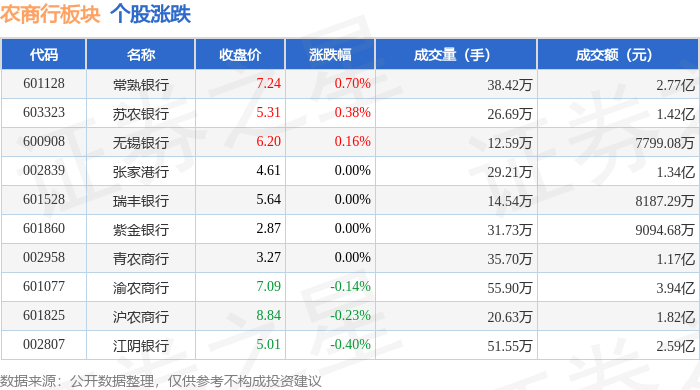
Core Viewpoint - The rural commercial bank sector experienced a slight decline of 0.04% on November 6, with Jiangyin Bank leading the drop, while the overall market indices showed positive performance with the Shanghai Composite Index rising by 0.97% and the Shenzhen Component Index increasing by 1.73% [1] Market Performance - The closing prices and performance of key rural commercial banks are as follows: - Changshu Bank: Closed at 7.24, up 0.70% with a trading volume of 384,200 shares and a turnover of 277 million yuan - Sunong Bank: Closed at 5.31, up 0.38% with a trading volume of 266,900 shares and a turnover of 142 million yuan - Wuxi Bank: Closed at 6.20, up 0.16% with a trading volume of 125,900 shares and a turnover of 77.99 million yuan - Jiangyin Bank: Closed at 5.01, down 0.40% with a trading volume of 515,500 shares and a turnover of 259 million yuan [1] Fund Flow Analysis - The rural commercial bank sector saw a net outflow of 174 million yuan from main funds, while retail investors contributed a net inflow of 131 million yuan [1] - Detailed fund flow for selected banks includes: - Zijin Bank: Main fund net inflow of 4.69 million yuan, retail net outflow of 1.24 million yuan - Wuxi Bank: Main fund net inflow of 0.96 million yuan, retail net outflow of 2.41 million yuan - Jiangyin Bank: Main fund net outflow of 24.66 million yuan, retail net inflow of 29.15 million yuan [2]



农商行板块11月5日涨0.09%,沪农商行领涨,主力资金净流出1974.75万元
Zheng Xing Xing Ye Ri Bao· 2025-11-05 08:55
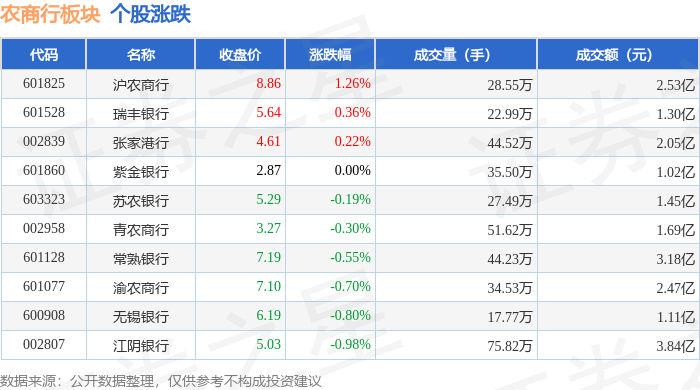
Core Insights - The agricultural commercial bank sector experienced a slight increase of 0.09% on November 5, with Shanghai Agricultural Commercial Bank leading the gains [1] - The Shanghai Composite Index closed at 3969.25, up 0.23%, while the Shenzhen Component Index closed at 13223.56, up 0.37% [1] Stock Performance - Shanghai Agricultural Commercial Bank (601825) closed at 8.86, with a rise of 1.26% and a trading volume of 285,500 shares, amounting to a transaction value of 253 million yuan [1] - Other notable performances include: - Ruifeng Bank (601528) at 5.64, up 0.36% - Zhangjiagang Bank (002839) at 4.61, up 0.22% - Zijin Bank (601860) at 2.87, unchanged - Su Nong Bank (603323) at 5.29, down 0.19% [1] Capital Flow - The agricultural commercial bank sector saw a net outflow of 19.75 million yuan from institutional investors and 51.92 million yuan from speculative funds, while retail investors contributed a net inflow of 71.67 million yuan [1] - Detailed capital flow for specific banks includes: - Changshu Bank (601128) with a net inflow of 32.61 million yuan from institutional investors - Shanghai Agricultural Commercial Bank (601825) with a net inflow of 19.93 million yuan from institutional investors [2] - Jiangyin Bank (002807) had a net inflow of 2.13 million yuan from retail investors despite a net outflow from institutional and speculative funds [2]
农商行板块11月4日涨1.31%,江阴银行领涨,主力资金净流出9791.62万元
Zheng Xing Xing Ye Ri Bao· 2025-11-04 08:48
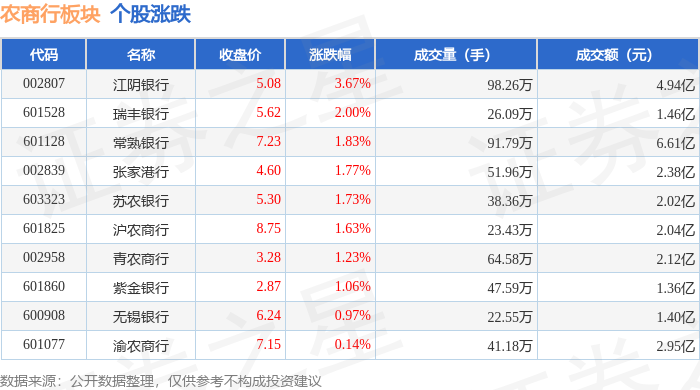
Core Insights - The rural commercial bank sector experienced a rise of 1.31% on November 4, with Jiangyin Bank leading the gains [1] - The Shanghai Composite Index closed at 3960.19, down 0.41%, while the Shenzhen Component Index closed at 13175.22, down 1.71% [1] Stock Performance - Jiangyin Bank (002807) closed at 5.08, up 3.67% with a trading volume of 982,600 shares and a transaction value of 494 million [1] - Ruifeng Bank (601528) closed at 5.62, up 2.00% with a trading volume of 260,900 shares [1] - Changshu Bank (601128) closed at 7.23, up 1.83% with a trading volume of 917,900 shares [1] - Zhangjiagang Bank (002839) closed at 4.60, up 1.77% with a trading volume of 519,600 shares [1] - Sunong Bank (603323) closed at 5.30, up 1.73% with a trading volume of 383,600 shares [1] - Hunan Agricultural Commercial Bank (601825) closed at 8.75, up 1.63% with a trading volume of 234,300 shares [1] - Qingnong Bank (002958) closed at 3.28, up 1.23% with a trading volume of 645,800 shares [1] - Zijin Bank (601860) closed at 2.87, up 1.06% with a trading volume of 475,900 shares [1] - Wuxi Bank (600908) closed at 6.24, up 0.97% with a trading volume of 225,500 shares [1] - Chongqing Rural Commercial Bank (601077) closed at 7.15, up 0.14% with a trading volume of 411,800 shares [1] Capital Flow - The rural commercial bank sector saw a net outflow of 97.9162 million from institutional investors and 7.3315 million from retail investors, while retail investors had a net inflow of 105 million [1] - Jiangyin Bank experienced a net outflow of 29.0366 million from institutional investors, with a net inflow of 10.6027 million from retail investors [2] - Wuxi Bank had a significant net outflow of 24.3647 million from institutional investors, with a net inflow of 19.8965 million from retail investors [2] - Changshu Bank saw a net outflow of 33.9791 million from institutional investors, while retail investors had a net inflow of 46.5376 million [2]
青岛农商银行创富优享875号11月4日起发行,业绩比较基准2%-3%
Cai Jing Wang· 2025-11-04 07:57
Core Viewpoint - Qingdao Rural Commercial Bank has launched a fixed-income product, aiming to raise a minimum of 1 million yuan with an initial target of 300 million yuan, indicating a strategic move to attract investors in a low-risk environment [1] Group 1: Product Details - The product, named Chuangfu Youxiang No. 875, has a fundraising period from November 4, 2025, to November 10, 2025 [1] - The minimum investment amount is set at 10,000 yuan, with a minimum fundraising scale of 1 million yuan [1] - The product has a term of 394 days and an internal risk rating classified as medium-low risk [1] Group 2: Performance Benchmark - The performance comparison benchmark for the product is set between 2.00% and 3.00% [1] - It is important to note that the performance comparison benchmark does not represent the expected yield or guarantee future performance [1]
银行股全线上涨
第一财经· 2025-11-04 02:16
Core Viewpoint - The banking sector continues to show positive momentum, with several banks experiencing significant stock price increases on November 4th, indicating a bullish trend in the market [1]. Group 1: Stock Performance - Shanghai Bank, CITIC Bank, Industrial Bank, China Merchants Bank, Xiamen Bank, and Postal Savings Bank all saw stock price increases of over 2% [1]. - Specific stock performance data includes: - CITIC Bank: +2.29%, current price 8.04 [2] - Industrial Bank: +2.24%, current price 21.02 [2] - Shanghai Bank: +2.27%, current price 9.90 [2] - China Merchants Bank: +2.23%, current price 42.72 [2] - Xiamen Bank: +2.11%, current price 7.25 [2] - Postal Savings Bank: +2.08%, current price 5.90 [2] - Other banks also showed positive performance, with Agricultural Bank up by 1.87% and Industrial and Commercial Bank up by 1.65% [2].




农商行板块11月3日涨1.58%,渝农商行领涨,主力资金净流出4308.08万元
Zheng Xing Xing Ye Ri Bao· 2025-11-03 08:43
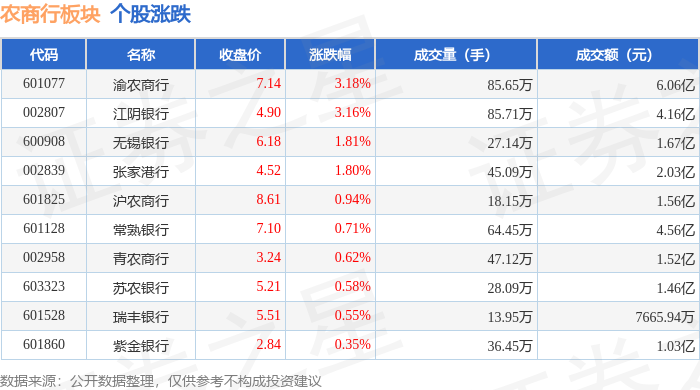
Market Performance - The rural commercial bank sector increased by 1.58% on November 3, with Chongqing Rural Commercial Bank leading the gains [1] - The Shanghai Composite Index closed at 3976.52, up 0.55%, while the Shenzhen Component Index closed at 13404.06, up 0.19% [1] Individual Stock Performance - Chongqing Rural Commercial Bank (601077) closed at 7.14, up 3.18% with a trading volume of 856,500 shares and a transaction value of 606 million yuan [1] - Jiangyin Bank (002807) closed at 4.90, up 3.16% with a trading volume of 857,100 shares and a transaction value of 416 million yuan [1] - Wuxi Bank (600908) closed at 6.18, up 1.81% with a trading volume of 271,400 shares and a transaction value of 167 million yuan [1] - Other notable performances include Zhangjiagang Bank (002839) up 1.80% and Shanghai Rural Commercial Bank (601825) up 0.94% [1] Capital Flow Analysis - The rural commercial bank sector experienced a net outflow of 43.08 million yuan from institutional investors, while retail investors saw a net inflow of 35.81 million yuan [1] - The table indicates that Chongqing Rural Commercial Bank had a net inflow of 13.38 million yuan from institutional investors but a net outflow of 64.68 million yuan from retail investors [2] - Jiangyin Bank had a net inflow of 2.47 million yuan from retail investors despite a net outflow from institutional and speculative investors [2]