
QRCB(002958)

Search documents
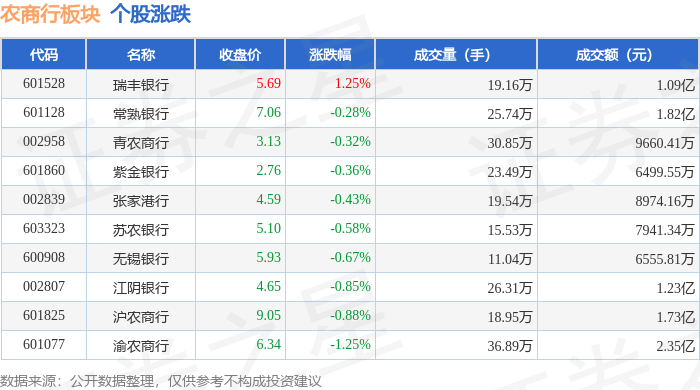
农商行板块12月26日跌0.72%,渝农商行领跌,主力资金净流出6353.1万元
Zheng Xing Xing Ye Ri Bao· 2025-12-26 09:07
Core Viewpoint - The rural commercial bank sector experienced a decline of 0.72% on December 26, with Yunnan Rural Commercial Bank leading the drop [1] Market Performance - The Shanghai Composite Index closed at 3963.68, up 0.1% - The Shenzhen Component Index closed at 13603.89, up 0.54% [1] Individual Stock Performance - 瑞丰银行 (Rui Feng Bank) closed at 5.69, up 1.25% with a trading volume of 191,600 shares and a transaction value of 1.09 billion - 常熟银行 (Changshu Bank) closed at 7.06, down 0.28% with a trading volume of 257,400 shares and a transaction value of 182 million - 青农商行 (Qingnong Bank) closed at 3.13, down 0.32% with a trading volume of 308,500 shares and a transaction value of 96.6 million - 紫金银行 (Zijin Bank) closed at 2.76, down 0.36% with a trading volume of 234,900 shares and a transaction value of 64.99 million - 张家港行 (Zhangjiagang Bank) closed at 4.59, down 0.43% with a trading volume of 195,400 shares and a transaction value of 89.74 million - 苏农银行 (Sunong Bank) closed at 5.10, down 0.58% with a trading volume of 155,300 shares and a transaction value of 79.41 million - 元锡银行 (Yuanxi Bank) closed at 5.93, down 0.67% with a trading volume of 110,400 shares and a transaction value of 65.56 million - 江阴银行 (Jiangyin Bank) closed at 4.65, down 0.85% with a trading volume of 263,100 shares and a transaction value of 123 million - 沪农商行 (Hu Nong Bank) closed at 9.05, down 0.88% with a trading volume of 189,500 shares and a transaction value of 173 million - 渝农商行 (Yun Nong Bank) closed at 6.34, down 1.25% with a trading volume of 368,900 shares and a transaction value of 235 million [1] Capital Flow - The rural commercial bank sector saw a net outflow of 63.53 million from main funds, while retail funds had a net inflow of 15.54 million [1] - The detailed capital flow for individual stocks shows varying trends, with some banks experiencing significant net outflows from main funds [2]




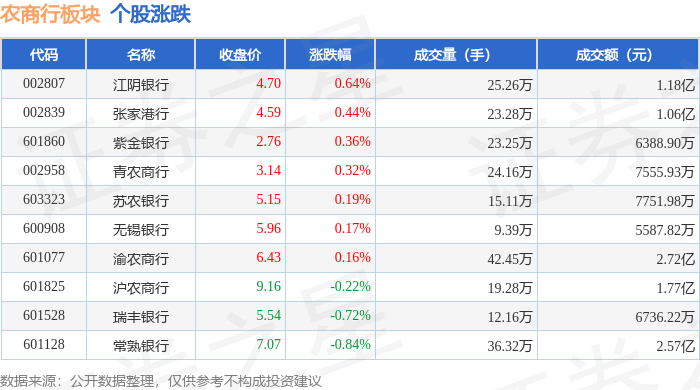
农商行板块12月24日跌0.05%,常熟银行领跌,主力资金净流出1080.22万元
Zheng Xing Xing Ye Ri Bao· 2025-12-24 09:10
Market Overview - The agricultural commercial bank sector experienced a slight decline of 0.05% on December 24, with Changshu Bank leading the drop [1] - The Shanghai Composite Index closed at 3940.95, up 0.53%, while the Shenzhen Component Index closed at 13486.42, up 0.88% [1] Individual Stock Performance - Jiangyin Bank closed at 4.70, with a gain of 0.64% and a trading volume of 252,600 shares, amounting to 118 million yuan [1] - Zhangjiagang Bank closed at 4.59, up 0.44%, with a trading volume of 232,800 shares, totaling 106 million yuan [1] - Zijin Bank closed at 2.76, gaining 0.36%, with a trading volume of 232,500 shares, amounting to 63.89 million yuan [1] - Qingnong Commercial Bank closed at 3.14, up 0.32%, with a trading volume of 241,600 shares, totaling 7.56 million yuan [1] - Shinan Bank closed at 5.15, gaining 0.19%, with a trading volume of 151,100 shares, amounting to 7.75 million yuan [1] - Wuxi Bank closed at 5.96, up 0.17%, with a trading volume of 93,900 shares, totaling 5.59 million yuan [1] - Yunnan Agricultural Commercial Bank closed at 6.43, gaining 0.16%, with a trading volume of 424,500 shares, amounting to 272 million yuan [1] - Shanghai Agricultural Commercial Bank closed at 9.16, down 0.22%, with a trading volume of 192,800 shares, totaling 177 million yuan [1] - Ruifeng Bank closed at 5.54, down 0.72%, with a trading volume of 121,600 shares, amounting to 6.74 million yuan [1] - Changshu Bank closed at 7.07, down 0.84%, with a trading volume of 363,200 shares, totaling 257 million yuan [1] Fund Flow Analysis - The agricultural commercial bank sector saw a net outflow of 10.80 million yuan from main funds, while speculative funds had a net inflow of 53.25 million yuan, and retail investors experienced a net outflow of 42.45 million yuan [1] - Yunnan Agricultural Commercial Bank had a main fund net inflow of 18.22 million yuan, accounting for 6.69% of its total [2] - Wuxi Bank experienced a main fund net inflow of 1.33 million yuan, representing 2.37% of its total [2] - Zijin Bank had a main fund net inflow of 130,700 yuan, which is 0.20% of its total [2] - Changshu Bank faced a main fund net outflow of 2.10 million yuan, accounting for -0.82% of its total [2] - Jiangyin Bank had a main fund net outflow of 5.73 million yuan, representing -4.84% of its total [2] - Zhangjiagang Bank experienced a main fund net outflow of 6.66 million yuan, accounting for -6.26% of its total [2] - Qingnong Commercial Bank had a significant main fund net outflow of 9.53 million yuan, representing -12.61% of its total [2]



农商行板块12月22日跌1.18%,渝农商行领跌,主力资金净流入1998.09万元
Zheng Xing Xing Ye Ri Bao· 2025-12-22 09:10
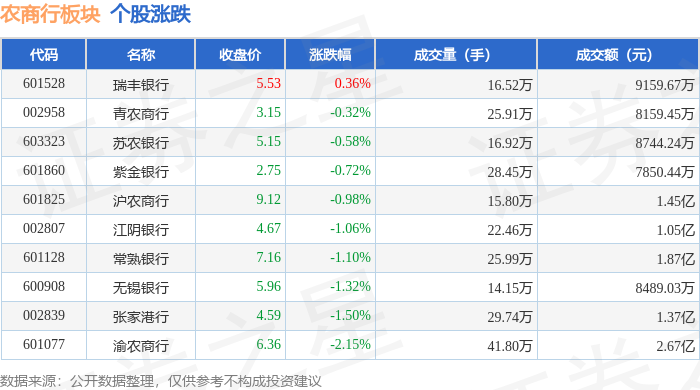
Core Viewpoint - The rural commercial bank sector experienced a decline of 1.18% on December 22, with Yunnan Rural Commercial Bank leading the drop [1] Group 1: Market Performance - The Shanghai Composite Index closed at 3917.36, up by 0.69% [1] - The Shenzhen Component Index closed at 13332.73, up by 1.47% [1] - The rural commercial bank sector saw mixed individual stock performances, with notable declines in several banks [1] Group 2: Individual Stock Performance - Wuxi Bank (600908) had a closing price of 5.96, down by 1.32%, with a trading volume of 141,500 shares and a transaction amount of 84.89 million [1] - Changshu Bank (601128) closed at 7.16, down by 1.10%, with a trading volume of 259,900 shares and a transaction amount of 187 million [1] - Yunnan Rural Commercial Bank (601077) closed at 6.36, down by 2.15%, with a trading volume of 418,000 shares and a transaction amount of 267 million [1] Group 3: Capital Flow - The rural commercial bank sector had a net inflow of 19.98 million from main funds, while retail investors saw a net outflow of 44.62 million [1] - Individual stocks within the sector showed varied capital flows, with some banks experiencing significant net outflows from retail investors [2]
转债建议把握泛主线催化真空窗口(东吴固收李勇 陈伯铭)20251220
Xin Lang Cai Jing· 2025-12-22 01:20
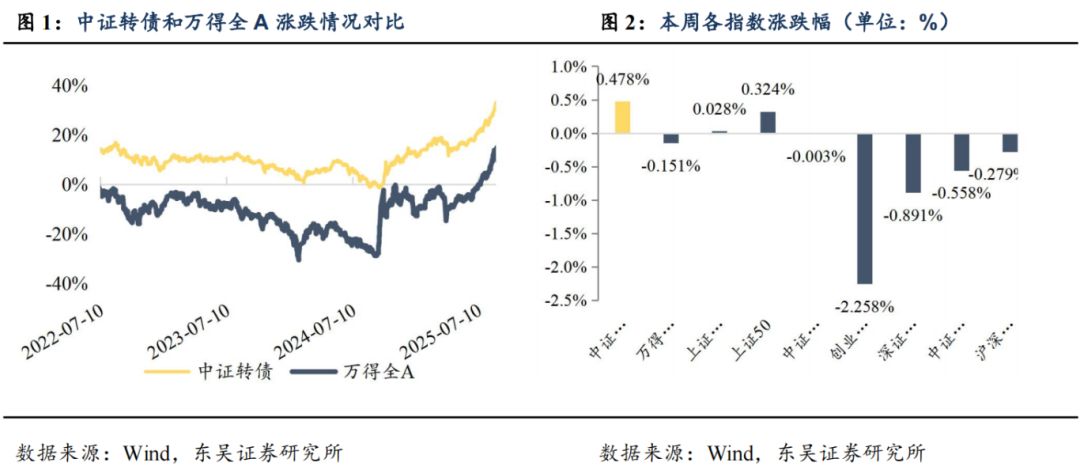
Group 1: Global Economic Impact - The ongoing geopolitical influences and misalignment of monetary policies are expected to fundamentally reshape purchasing power across both private and public sectors in the medium to long term [1] - Japan's prolonged ultra-loose monetary policy is reportedly helping the country emerge from a "deflation trap," with the yen's depreciation significantly boosting overall demand [1] - Despite a 40% increase in the average price of second-hand homes in Tokyo over five years and a nearly 20% rise in major stock indices, the actual purchasing power of residents has declined due to high input inflation [1] Group 2: Domestic Market Overview - The domestic equity market has shown continued volatility, with a notable focus on the fourth quarter as a critical period for industry information and monetary policy direction [2][34] - The uncertainty in policy is expected to decrease marginally, while the sustainability of the computing power sector will face ongoing scrutiny from the market [34] - Smaller stocks are anticipated to benefit more from the market's expansion trends compared to larger stocks [34] Group 3: Convertible Bond Market - The convertible bond market has seen an overall increase of 0.48% during the week, with 20 out of 29 sectors experiencing gains [47] - The average daily trading volume in the convertible bond market reached 636.11 billion yuan, reflecting a significant increase of 29.75 billion yuan from the previous week [47][48] - Approximately 63.48% of convertible bonds recorded an increase in value, with 15.37% of bonds rising more than 2% [48] Group 4: Sector Performance - Among the 31 sectors, 19 experienced gains, with retail, non-bank financials, and beauty care leading the way with increases of 6.66%, 2.90%, and 2.87% respectively [45] - Conversely, sectors such as electronics and power equipment faced declines, with drops of -3.28% and -3.12% respectively [45]



机构密集调研银行股 息差改善成市场关注焦点
Zhong Guo Jing Ying Bao· 2025-12-20 04:00
Core Viewpoint - Several brokerage firms, funds, and insurance asset management institutions are evaluating listed banks to optimize asset allocation and investment strategies for the coming year, with a focus on net interest margin performance [1] Group 1: Net Interest Margin Stability - Multiple banks have indicated that net interest margins have shown signs of stabilization in Q3, with a narrowing of the overall decline and an improvement in funding costs expected over the next three years [1] - Hangzhou Bank reported that its net interest margin remained stable at the end of Q3 compared to the end of Q2, with a marginal narrowing of the annual decline expected [1] - Suzhou Bank stated that its net interest margin has narrowed less than the industry average this year, supporting growth in net interest income [2] Group 2: Strategies for Managing Interest Margin - Banks are actively exploring ways to alleviate interest margin pressure through optimizing asset-liability structures and enhancing non-interest income [1] - Chongqing Rural Commercial Bank noted that its Q3 interest margin stabilized due to a slowdown in the decline of asset yields and a faster decrease in liability interest rates [2] - Ouyang Rihui emphasized the importance of increasing the proportion of intermediary business income and investing in information technology to improve interest margin management [3] Group 3: Regional Banks' Performance - The Q3 reports of listed banks show structural differentiation in net interest margins, with some regional banks experiencing improvement [3] - A report indicated that net interest margins for city commercial banks and rural commercial banks continued to stabilize in the first three quarters of 2025, with a decrease in the cost of interest-bearing liabilities [4] - Some regional banks, such as Jiangyin Bank and Chongqing Bank, reported an increase in net interest margins at the end of Q3 compared to the end of Q2 [3][4] Group 4: Future Outlook - Some banks anticipate that the trend of improving interest margins will continue into 2026, with Qingnong Commercial Bank indicating that its interest margin is expected to remain stable [5] - Factors such as the repricing of existing loans and adjustments in deposit pricing strategies are expected to support net interest margins moving forward [5]


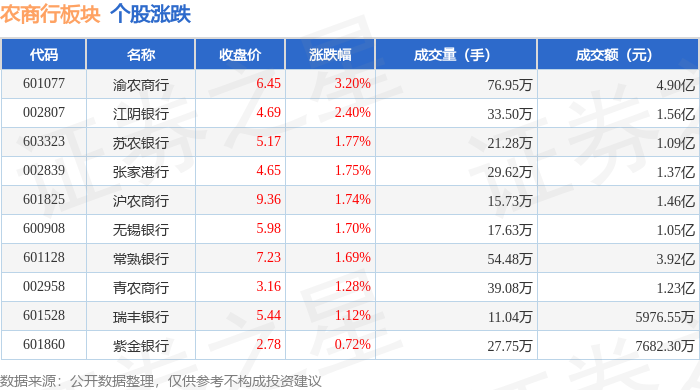
农商行板块12月18日涨2%,渝农商行领涨,主力资金净流出1208.63万元
Zheng Xing Xing Ye Ri Bao· 2025-12-18 09:09
Group 1 - The agricultural commercial bank sector increased by 2.0% on December 18, with Chongqing Rural Commercial Bank leading the gains [1] - The Shanghai Composite Index closed at 3876.37, up 0.16%, while the Shenzhen Component Index closed at 13053.98, down 1.29% [1] - Key stocks in the agricultural commercial bank sector showed various performance metrics, with Chongqing Rural Commercial Bank closing at 6.45, up 3.20% [1] Group 2 - The net capital flow for the agricultural commercial bank sector showed a net outflow of 12.09 million yuan from institutional investors and 10.73 million yuan from speculative investors, while retail investors had a net inflow of 22.82 million yuan [1] - Detailed capital flow data indicates that Chongqing Rural Commercial Bank had a net inflow of 17.10 million yuan from institutional investors, but a net outflow of 17.70 million yuan from retail investors [2] - Jiangyin Bank experienced a net inflow of 9.28 million yuan from institutional investors, while retail investors contributed a net inflow of 1.45 million yuan [2]
中央结算公司支持青岛农商银行通过区块链系统发行养老主题金融债
Zheng Quan Ri Bao Wang· 2025-12-16 11:09
Core Viewpoint - The Central Clearing Company announced the successful issuance of "25 Qingdao Rural Commercial Bank" bonds, amounting to 500 million yuan, with a term of 3 years and a coupon rate of 1.85%, utilizing its blockchain digital bond platform [1] Group 1: Bond Issuance Details - The bond issuance by Qingdao Rural Commercial Bank is specifically aimed at funding loans for the elderly care industry [1] - The total issuance scale is 500 million yuan, with a maturity period of 3 years and a fixed interest rate of 1.85% [1] Group 2: Strategic Importance - Qingdao Rural Commercial Bank is actively responding to national strategies by focusing on elderly finance, which is seen as a key initiative in promoting high-quality development in the elderly care industry [1] - The Central Clearing Company emphasizes its role in supporting direct financing in the bond market, particularly directing funds towards innovation, green projects, small and micro enterprises, rural revitalization, and elderly care [1] Group 3: Future Directions - The Central Clearing Company plans to continue optimizing financial products and services to support the high-quality development of the bond market, in line with the spirit of the 20th National Congress of the Communist Party of China [1]
青农商行:5亿元金融债券发行完毕
Xin Lang Cai Jing· 2025-12-10 12:13
Group 1 - The core announcement is that Qingnong Commercial Bank has received approval from the People's Bank of China to issue "Qingdao Rural Commercial Bank Co., Ltd. 2025 Financial Bonds" in the national interbank bond market [1][5] - The bond issuance scale is set at 500 million RMB, with a fixed interest rate of 1.85% and a maturity period of 3 years [1][5] - The bond's book-building date is December 8, 2025, and the payment date is December 10, 2025 [1][5] Group 2 - The funds raised from this bond issuance will be specifically used for loans in the elderly care industry, in accordance with applicable laws and regulatory approvals [2][6]
青岛农商行5亿元金融债券发行完毕
Bei Jing Shang Bao· 2025-12-10 11:39
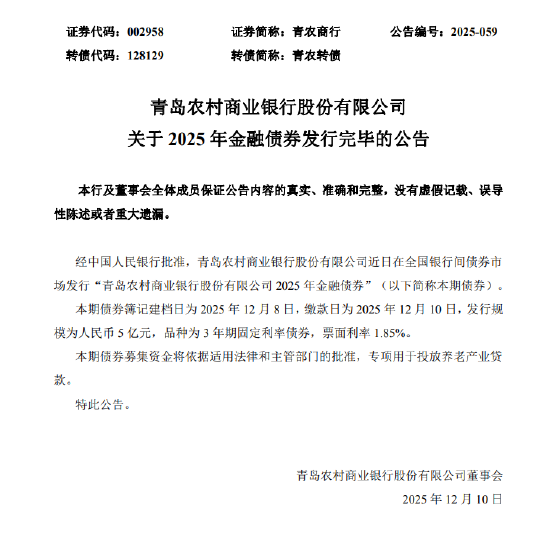
北京商报讯(记者 孟凡霞 周义力)12月10日,青岛农商行发布公告,经中国人民银行批准,该行近日 在全国银行间债券市场发行"青岛农村商业银行股份有限公司2025年金融债券"(以下简称"本期债 券")。本期债券簿记建档日为2025年12月8日,缴款日为2025年12月10日,发行规模为人民币5亿元, 品种为3年期固定利率债券,票面利率1.85%。本期债券募集资金将依据适用法律和主管部门的批准, 专项用于投放养老产业贷款。 ...
青农商行(002958) - 关于2025年金融债券发行完毕的公告
2025-12-10 10:51
证券代码:002958 证券简称:青农商行 公告编号:2025-059 转债代码:128129 转债简称:青农转债 青岛农村商业银行股份有限公司 关于 2025 年金融债券发行完毕的公告 本行及董事会全体成员保证公告内容的真实、准确和完整,没有虚假记载、误导 性陈述或者重大遗漏。 经中国人民银行批准,青岛农村商业银行股份有限公司近日在全国银行间债券市 场发行"青岛农村商业银行股份有限公司 2025 年金融债券"(以下简称本期债券)。 本期债券簿记建档日为 2025 年 12 月 8 日,缴款日为 2025 年 12 月 10 日,发行规 模为人民币 5 亿元,品种为 3 年期固定利率债券,票面利率 1.85%。 本期债券募集资金将依据适用法律和主管部门的批准,专项用于投放养老产业贷 款。 特此公告。 青岛农村商业银行股份有限公司董事会 2025 年 12 月 10 日 1 ...