
QRCB(002958)

Search documents
金融风向标2026-W09:“两会”释放的金融信号
CMS· 2026-03-08 12:38
Investment Rating - The report maintains a recommendation for the banking sector, indicating a defensive value amidst external uncertainties affecting the A-share market [2][5]. Core Insights - The "Two Sessions" have provided financial signals, focusing on monetary policy, financial risk prevention, and institutional reforms. The monetary policy is expected to remain moderately loose, prioritizing stable economic growth and reasonable price recovery [5][11]. - The report anticipates that the frequency of reserve requirement ratio (RRR) and interest rate cuts will remain consistent with the previous year, with a lower probability of implementation in the first half of the year. The growth rate of social financing (社融) and M2 may fall below 8% [5][11]. - Structural monetary policy tools will be emphasized, with an expected net investment scale exceeding 540.5 billion in 2025, focusing on supporting domestic demand, technological innovation, and small and micro enterprises [6][11]. Summary by Sections Regulatory Dynamics - The report highlights the successful convening of the "Two Sessions" and the focus on monetary policy and financial risk prevention by the People's Bank of China [3][14]. Market Dynamics - The report notes a decline of 2.30% in the Wind All A Index, while the Shenwan banking sector increased by 1.64% [17]. Data Overview - The central bank's net withdrawal this week was 1.56 trillion, with a decrease in various interest rates, including the Shibor rates [4][25]. - The report provides detailed data on the performance of various banking stocks, including their dividend rates and price-to-earnings ratios [22]. Banking Sector Trends - The report indicates that the net interest margin decline is stabilizing, suggesting that revenue challenges for commercial banks may be easing. It recommends focusing on city commercial banks in key development areas and national banks with lower non-performing asset pressures [11].






一日五家银行披露首席合规官任职事项
Jin Rong Jie· 2026-02-28 03:58
Group 1 - Several banks, including China Construction Bank, Bank of Communications, Lanzhou Bank, Zhejiang Commercial Bank, and Qingdao Rural Commercial Bank, announced the appointment of their Chief Compliance Officers [1][2][3] - China Construction Bank appointed Zhang Yi, the current President, as the Chief Compliance Officer, effective immediately [1] - Bank of Communications appointed Liu Jianjun, the Chief Risk Officer, to also serve as Chief Compliance Officer, pending approval from the National Financial Regulatory Administration [1] - Lanzhou Bank appointed Liu Min, the current President, as Chief Compliance Officer, effective immediately [2] - Zhejiang Commercial Bank appointed Lü Linhua as Chief Compliance Officer, pending regulatory approval [2] - Qingdao Rural Commercial Bank appointed Yu Fengxing, the current President, as Chief Compliance Officer, effective immediately [2] Group 2 - The recent appointments are in response to regulatory requirements set by the National Financial Regulatory Administration, specifically the Compliance Management Measures for Financial Institutions [3] - The Compliance Management Measures, effective from March 1, 2025, mandate that financial institutions establish a Chief Compliance Officer at their headquarters, who may be the President or another senior executive [3] - The transition period for implementing these measures is nearing its end, prompting banks to expedite the enhancement of their compliance management structures [3]



银行,春天里的“第一场”董事会
Hua Er Jie Jian Wen· 2026-02-27 12:45
Core Viewpoint - The recent board meetings of Qingdao Rural Commercial Bank and Zheshang Bank emphasize the importance of compliance and risk management in the banking sector, signaling a proactive approach to regulatory requirements and a commitment to stable development in the financial industry [1][2]. Group 1: Leadership Appointments - Qingdao Rural Commercial Bank appointed its president, Yu Fengxing, as the Chief Compliance Officer, highlighting the bank's commitment to integrating compliance into daily operations and strategic decision-making [1]. - Zheshang Bank appointed Lv Linhua as the Chief Compliance Officer, pending approval from the National Financial Regulatory Administration, indicating a focus on strengthening compliance leadership [2]. Group 2: Institutional Developments - Zheshang Bank approved the establishment of the "Zheshang Bank Compliance Management Measures" and the revision of the "Zheshang Bank Credit Risk Asset Responsibility Identification and Pursuit Management Measures," marking significant steps in enhancing compliance management and accountability [2]. - Both banks' early meetings in spring reflect a strategic alignment with regulatory expectations and a commitment to prioritizing compliance as a foundation for sustainable growth in the banking sector [2].
青岛农商行:聘任行长于丰星兼任首席合规官
Bei Jing Shang Bao· 2026-02-27 10:30
Group 1 - The core point of the article is that Qingdao Rural Commercial Bank has appointed its president, Yu Fengxing, as the Chief Compliance Officer during the 18th temporary meeting of its fifth board of directors [1] Group 2 - The announcement was made on February 27, indicating a significant governance decision within the bank [1] - The appointment reflects the bank's commitment to compliance and regulatory oversight [1]
青农商行:2月27日召开董事会会议
Mei Ri Jing Ji Xin Wen· 2026-02-27 10:12
Group 1 - The company, Qingnong Commercial Bank, announced the convening of its 18th temporary meeting of the fifth board of directors on February 27, 2026, to discuss the appointment of a Chief Compliance Officer and other documents [1] - In February, China's AI usage surpassed that of the United States for the first time, with four major models ranking among the top five globally, indicating a significant increase in domestic computing power demand [1] - The growth in AI usage reflects an exponential increase in the need for domestic computational resources, highlighting a shift in the global AI landscape [1]
青农商行(002958) - 第五届董事会第十八次临时会议决议公告
2026-02-27 10:00
| 证券代码:002958 | 证券简称:青农商行 | 公告编号:2026-007 | | --- | --- | --- | | 转债代码:128129 | 转债简称:青农转债 | | 青岛农村商业银行股份有限公司 第五届董事会第十八次临时会议决议公告 审议并通过《关于聘任首席合规官的议案》。 表决结果为:同意 11 票,反对 0 票,弃权 0 票。 同意聘任于丰星行长兼任首席合规官。于丰星先生简历详见青岛农村商业银行股 份有限公司第五届董事会第一次会议决议公告。 本议案已经董事会提名与薪酬委员会审议通过。 本行及董事会全体成员保证公告内容的真实、准确和完整,没有虚假记载、误导 性陈述或者重大遗漏。 青岛农村商业银行股份有限公司(以下简称本行)第五届董事会第十八次临时会 议于 2026 年 2 月 27 日在本行总行召开。会议通知已于 2026 年 2 月 10 日以电子邮件 及书面方式发出。应出席本次会议的董事 11 人,实际出席本次会议(含网络方式) 的董事 11 人。张坤、唐静、薛健、鲁玉瑞、王少飞、潘爱玲、李维安、王绍宏、王 庆金董事以网络方式参加会议。会议由执行董事、行长于丰星(代为履行董事长职责 ...
银行股马年开局遇冷,机构调研透露几大隐忧
Di Yi Cai Jing· 2026-02-24 12:01
Core Viewpoint - The enthusiasm for institutional research on banks has declined compared to previous years, with a focus on credit quality and the impact of interest rate spreads on profitability [1][6]. Group 1: Market Performance - On the first trading day of the Year of the Horse, the A-share market saw a rise, with the Shanghai Composite Index up 0.87% and the Shenzhen Component Index up 1.36%, while the banking sector fell by 0.24% [2]. - The banking sector has experienced a divergence in performance, with state-owned banks declining while some regional banks have shown improvement [2]. - The China Securities Banking Index has retreated nearly 16% from its peak in July 2022, while the broader market has increased by nearly 18% during the same period [2]. Group 2: Credit and Monetary Policy - The latest LPR remained unchanged for both the 1-year and 5-year terms, marking a period of stability in interest rates [3]. - In January, new RMB loans totaled 4.71 trillion yuan, lower than the 5.13 trillion yuan in January 2022, indicating a slowdown in credit growth [2][3]. - The People's Bank of China (PBOC) is expected to maintain liquidity support through MLF operations, with a net injection of 300 billion yuan in February [3][4]. Group 3: Institutional Research Focus - Institutional research has shown a preference for banks in economically promising regions, with a significant number of surveys conducted on smaller banks in the Yangtze River Delta [6]. - Key areas of focus during institutional surveys include credit demand, interest margin pressures, capital adequacy, and asset quality outlook [6][7]. - The trend of "deposit migration" towards equity markets is noted, with banks expected to enhance their wealth management and middle-income sources [4][7]. Group 4: Profitability and Capital Management - Banks are under pressure regarding profitability, with institutions increasingly inquiring about capital adequacy and internal capital replenishment strategies [8]. - Several banks plan to explore diverse capital replenishment channels, including issuing capital-boosting bonds and optimizing business structures to enhance capital efficiency [8].


青农商行高层变动与机构调研,资产质量与分红政策引关注
Jing Ji Guan Cha Wang· 2026-02-14 02:19
Group 1: Management Changes - The board of Qingnong Commercial Bank has nominated Liang Yanbo as the fifth chairman candidate to replace the retiring Wang Xifeng, pending shareholder approval and regulatory qualification [1] Group 2: Institutional Research - In January 2026, Qingnong Commercial Bank received multiple institutional research visits, focusing on loan allocations for "supporting agriculture and small enterprises," green finance, and strategic emerging industries, while emphasizing the stability of its core Tier 1 capital adequacy ratio through internal replenishment [2] Group 3: Performance and Operations - The financial report for the first three quarters of 2025 shows revenue of 8.028 billion yuan, a year-on-year decrease of 4.92%, and a net profit attributable to shareholders of 3.318 billion yuan, a year-on-year increase of 3.57%. However, the revenue decline in a single quarter has widened to 11.91%. The non-performing loan ratio stands at 1.73%, the highest among A-share rural commercial banks, indicating a need for ongoing monitoring of asset quality improvement [3] Group 4: Company Status - At the beginning of 2026, the company attracted attention due to a dispute over the dividend ratio, as the board did not submit a temporary proposal for shareholder meeting review. The dividend ratio for 2024 was set at 23.34%, lower than some peers, suggesting potential adjustments in future dividend policies [4]
银行股集体下跌,重庆银行跌超2%
Ge Long Hui· 2026-02-12 02:37
Core Viewpoint - The A-share market for banks experienced a collective decline, with several banks showing significant drops in their stock prices on February 12 [1] Group 1: Stock Performance - Chongqing Bank saw a decline of 2.27%, with a total market value of 36 billion [2] - Agricultural Bank dropped by 1.62%, with a market capitalization of 2,337.9 billion [2] - CITIC Bank decreased by 1.57%, with a market value of 417.9 billion [2] - Xiamen Bank fell by 1.57%, with a market capitalization of 19.9 billion [2] - Qingnong Commercial Bank declined by 1.55%, with a market value of 17.6 billion [2] - Qingdao Bank decreased by 1.41%, with a market capitalization of 32.6 billion [2] - Qilu Bank fell by 1.18%, with a market value of 36.2 billion [2] - Xi'an Bank dropped by 1.30%, with a market capitalization of 16.9 billion [2] - China Construction Bank decreased by 1.23%, with a market value of 23,152 billion [2] - Everbright Bank fell by 1.19%, with a market capitalization of 195.6 billion [2] - Pudong Development Bank decreased by 1.18%, with a market value of 334.7 billion [2] - Industrial and Commercial Bank dropped by 1.10%, with a market capitalization of 25,697 billion [2] - Jiangyin Bank fell by 1.06%, with a market value of 11.5 billion [2] - Zijin Bank decreased by 1.05%, with a market capitalization of 10.3 billion [2] - Zhangjiagang Bank fell by 1.05%, with a market value of 11.5 billion [2] - China Merchants Bank decreased by 1.04%, with a market capitalization of 983.3 billion [2] Group 2: Year-to-Date Performance - Chongqing Bank has a year-to-date decline of 2.91% [2] - Agricultural Bank has seen a year-to-date drop of 13.02% [2] - CITIC Bank's year-to-date decline is 2.47% [2] - Xiamen Bank has a year-to-date increase of 2.59% [2] - Qingnong Commercial Bank's year-to-date increase is 2.26% [2] - Qingdao Bank has a significant year-to-date increase of 25.00% [2] - Qilu Bank has a year-to-date increase of 4.53% [2] - Xi'an Bank's year-to-date increase is 2.70% [2] - China Construction Bank has a year-to-date decline of 4.63% [2] - Everbright Bank's year-to-date decline is 2.26% [2] - Pudong Development Bank has a significant year-to-date decline of 19.21% [2] - Industrial and Commercial Bank has a year-to-date decline of 9.08% [2] - Jiangyin Bank has a year-to-date increase of 2.19% [2] - Zijin Bank's year-to-date increase is 4.03% [2] - Zhangjiagang Bank has a year-to-date increase of 3.06% [2] - China Merchants Bank has a year-to-date decline of 4.99% [2]






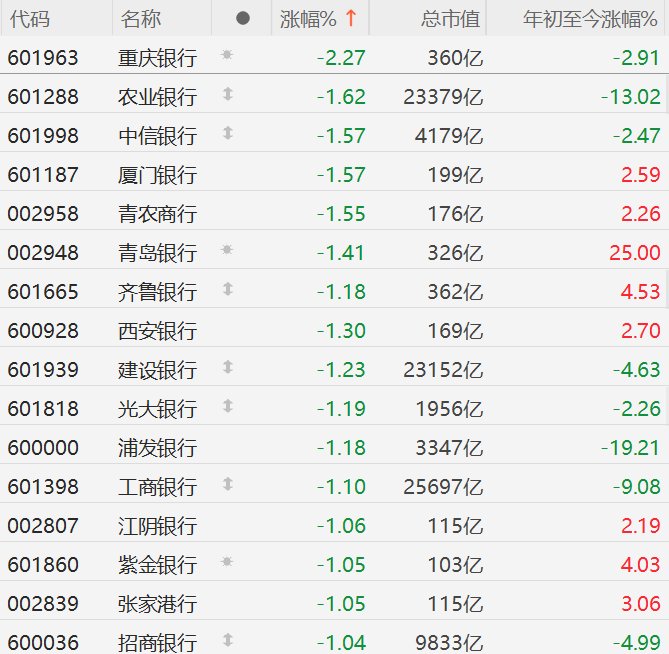
A股银行股集体下跌,重庆银行跌超2%
Ge Long Hui A P P· 2026-02-12 02:25
Group 1 - The A-share market saw a collective decline in bank stocks, with Chongqing Bank dropping over 2% and several other banks, including Agricultural Bank, CITIC Bank, and Xiamen Bank, falling more than 1% [1] - Chongqing Bank's stock decreased by 2.27%, with a total market capitalization of 36 billion and a year-to-date decline of 2.91% [2] - Agricultural Bank's stock fell by 1.62%, with a market cap of 2,337.9 billion and a year-to-date decline of 13.02% [2] Group 2 - CITIC Bank's stock decreased by 1.57%, with a market capitalization of 417.9 billion and a year-to-date decline of 2.47% [2] - Xiamen Bank's stock also fell by 1.57%, with a market cap of 19.9 billion and a year-to-date increase of 2.59% [2] - Qingnong Commercial Bank's stock dropped by 1.55%, with a market cap of 17.6 billion and a year-to-date increase of 2.26% [2] Group 3 - Other banks such as Qilu Bank, Xi'an Bank, and China Construction Bank experienced declines of 1.18% to 1.30%, with respective market caps of 36.2 billion, 16.9 billion, and 23,152 billion [2] - The stock of Industrial and Commercial Bank fell by 1.10%, with a market cap of 25,697 billion and a year-to-date decline of 9.08% [2] - China Merchants Bank's stock decreased by 1.04%, with a market cap of 98.33 billion and a year-to-date decline of 4.99% [2]