
QRCB(002958)

Search documents
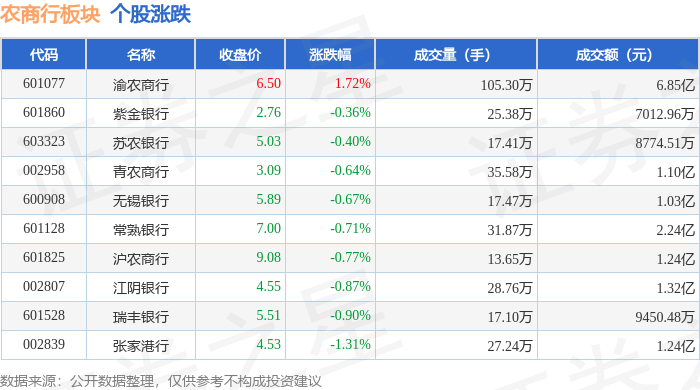
农商行板块1月8日跌0.18%,张家港行领跌,主力资金净流出3731.72万元
Zheng Xing Xing Ye Ri Bao· 2026-01-08 08:56
Core Viewpoint - The agricultural commercial bank sector experienced a slight decline of 0.18% on January 8, with Zhangjiagang Bank leading the drop [1] Group 1: Market Performance - The Shanghai Composite Index closed at 4082.98, down 0.07%, while the Shenzhen Component Index closed at 13959.48, down 0.51% [1] - The agricultural commercial bank sector's individual stock performance showed varied results, with Yunnan Agricultural Commercial Bank rising by 1.72% to a closing price of 6.50 [1] Group 2: Trading Volume and Turnover - The trading volume and turnover for various banks were reported, with Jiangyin Bank having a turnover of 1.32 billion and a trading volume of 287,600 shares [1] - The overall net outflow of main funds from the agricultural commercial bank sector was 37.32 million, while retail funds saw a net outflow of 18.16 million [1] Group 3: Fund Flow Analysis - The main fund inflow for Ruifeng Bank was 4.77 million, accounting for 5.04% of its total, while it faced a retail net outflow of 8.39 million [2] - Zhangjiagang Bank experienced a significant main fund outflow of 6.71 million, with retail investors also withdrawing 7.63 million [2]

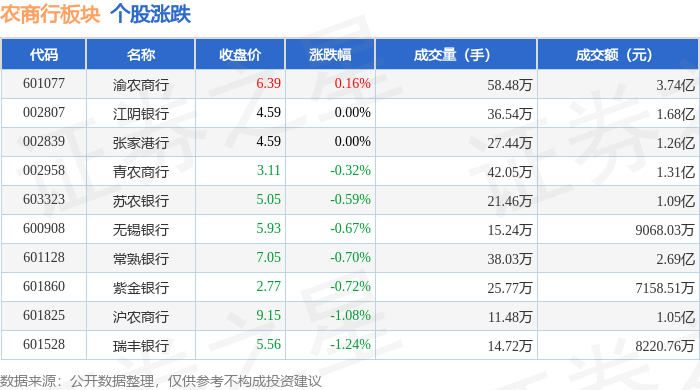
农商行板块1月7日跌0.57%,瑞丰银行领跌,主力资金净流入5042.72万元
Zheng Xing Xing Ye Ri Bao· 2026-01-07 08:58
Core Viewpoint - The rural commercial bank sector experienced a decline of 0.57% on January 7, with Ruifeng Bank leading the drop, while the Shanghai Composite Index rose by 0.05% and the Shenzhen Component Index increased by 0.06% [1] Group 1: Market Performance - The closing prices and performance of key rural commercial banks on January 7 are as follows: - Yunnan Rural Commercial Bank (601077) closed at 6.39, up by 0.16% - Jiangyin Bank (002807) closed at 4.59, unchanged - Zhangjiagang Bank (002839) closed at 4.59, unchanged - Qingnong Bank (002958) closed at 3.11, down by 0.32% - Sunan Bank (603323) closed at 5.05, down by 0.59% - Wuxi Bank (600908) closed at 5.93, down by 0.67% - Changshu Bank (601128) closed at 7.05, down by 0.70% - Zijin Bank (601860) closed at 2.77, down by 0.72% - Hunan Rural Commercial Bank (601825) closed at 9.15, down by 1.08% - Ruifeng Bank (601528) closed at 5.56, down by 1.24% [1] Group 2: Capital Flow - On January 7, the rural commercial bank sector saw a net inflow of 50.43 million yuan from main funds, while retail investors experienced a net outflow of 84.63 million yuan [1] - The capital flow for individual banks is as follows: - Zhangjiagang Bank (002839) had a main fund net inflow of 13.66 million yuan, but a retail net outflow of 13.84 million yuan - Changshu Bank (601128) had a main fund net inflow of 13.25 million yuan, with a retail net outflow of 22.78 million yuan - Qingnong Bank (002958) had a main fund net inflow of 12.24 million yuan, but a retail net outflow of 8.34 million yuan - Wuxi Bank (600908) had a main fund net inflow of 9.53 million yuan, with a retail net outflow of 6.99 million yuan [2]


青农商行(002958) - 关于2025年第四季度可转债转股结果暨股份变动公告
2026-01-05 09:46
| 证券代码:002958 | 证券简称:青农商行 | 公告编号:2026-001 | | --- | --- | --- | | 转债代码:128129 | 转债简称:青农转债 | | 青岛农村商业银行股份有限公司 关于 2025 年第四季度可转债转股结果暨股份变动公告 本行及董事会全体成员保证公告内容的真实、准确和完整,没有虚假记载、误导 性陈述或者重大遗漏。 特别提示: 可转债转股情况:截至 2025 年 12 月 31 日,累计已有人民币 323,000 元青农转债 转为本行 A 股普通股,累计转股股数为 66,910 股,占青农转债转股前本行已发行普 通股股份总额的 0.0012%。 未转股可转债情况:截至 2025 年 12 月 31 日,尚未转股的青农转债金额为人民 币 4,999,677,000 元,占青农转债发行总量的比例为 99.9935%。 根据《深圳证券交易所股票上市规则》、《深圳证券交易所上市公司自律监管指 引第 15 号——可转换公司债券》的有关规定,青岛农村商业银行股份有限公司(以 下简称本行)现将自 2025 年 10 月 1 日至 2025 年第四季度末可转换公司债券(以下 ...
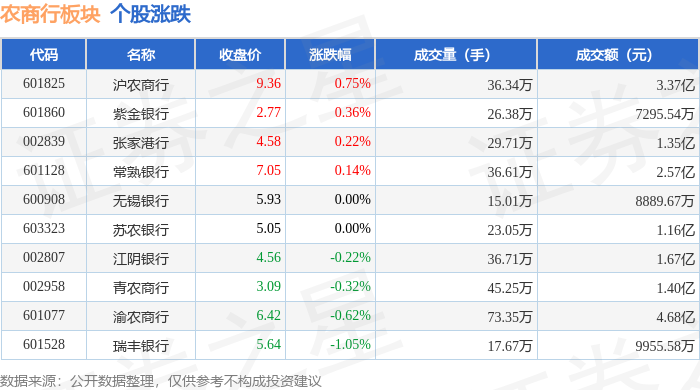
农商行板块1月5日涨0.09%,沪农商行领涨,主力资金净流入7699.1万元
Zheng Xing Xing Ye Ri Bao· 2026-01-05 09:09
Core Insights - The agricultural commercial bank sector experienced a slight increase of 0.09% on January 5, with Shanghai Agricultural Commercial Bank leading the gains [1] - The Shanghai Composite Index closed at 4023.42, up by 1.38%, while the Shenzhen Component Index closed at 13828.63, up by 2.24% [1] Stock Performance - Shanghai Agricultural Commercial Bank (601825) closed at 9.36, with a rise of 0.75% and a trading volume of 363,400 shares, totaling a transaction value of 337 million yuan [1] - Other notable banks include: - Zijin Bank (601860) at 2.77, up 0.36% with a transaction value of 72.96 million yuan [1] - Zhangjiagang Bank (002839) at 4.58, up 0.22% with a transaction value of 135 million yuan [1] - Changshu Bank (601128) at 7.05, up 0.14% with a transaction value of 257 million yuan [1] - Wuxi Bank (600908) remained unchanged at 5.93 with a transaction value of 88.9 million yuan [1] Capital Flow - The agricultural commercial bank sector saw a net inflow of 76.99 million yuan from institutional investors and 84.57 million yuan from retail investors, while individual investors had a net outflow of 162 million yuan [1] - Specific capital flows for key banks include: - Shanghai Agricultural Commercial Bank had a net inflow of 47.24 million yuan from institutional investors, but a net outflow of 54.86 million yuan from individual investors [2] - Changshu Bank saw a net inflow of 32.72 million yuan from institutional investors, with a net outflow of 33.53 million yuan from individual investors [2] - Suzhou Agricultural Bank had a net inflow of 13.51 million yuan from institutional investors, with a net outflow of 12.27 million yuan from individual investors [2]
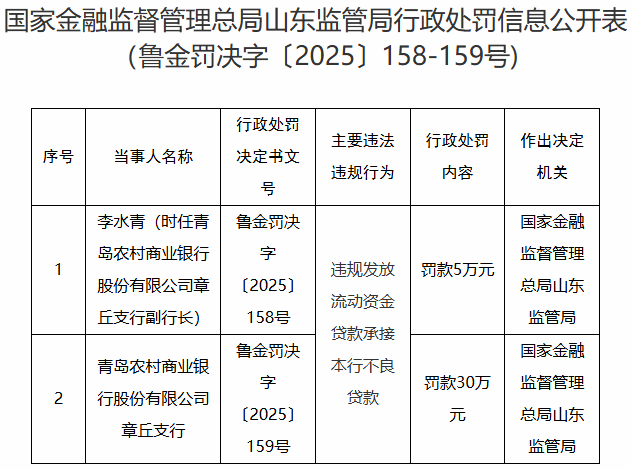
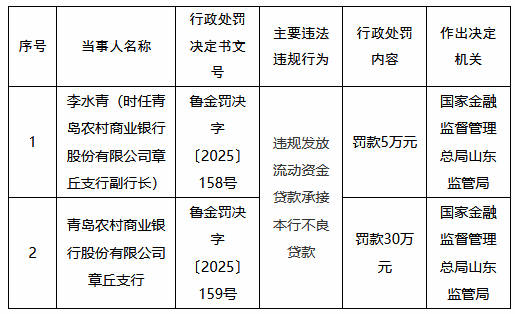
青农商行章丘支行被罚 违规发放流动资金贷款承接不良
Zhong Guo Jing Ji Wang· 2026-01-05 07:36
Core Viewpoint - The Shandong Regulatory Bureau of the National Financial Supervisory Administration has imposed fines on Qingdao Rural Commercial Bank's Zhangqiao Branch for violating regulations related to the issuance of working capital loans to cover the bank's non-performing loans [1] Group 1: Regulatory Actions - Qingdao Rural Commercial Bank's Zhangqiao Branch was fined 300,000 yuan for the violation of issuing working capital loans to take on the bank's non-performing loans [1] - Li Shuiqing, the then Deputy General Manager of Qingdao Rural Commercial Bank's Zhangqiao Branch, was fined 50,000 yuan for his involvement in the violation [1]
农商行板块12月31日涨0.94%,渝农商行领涨,主力资金净流入1263.96万元
Zheng Xing Xing Ye Ri Bao· 2025-12-31 09:06
Group 1 - The agricultural commercial bank sector increased by 0.94% on December 31, with Chongqing Rural Commercial Bank leading the gains [1] - The Shanghai Composite Index closed at 3968.84, up 0.09%, while the Shenzhen Component Index closed at 13525.02, down 0.58% [1] - The trading volume and turnover for Chongqing Rural Commercial Bank were 791,700 shares and 509 million yuan, respectively, with a price increase of 2.38% [1] Group 2 - The net inflow of main funds into the agricultural commercial bank sector was 12.64 million yuan, while retail investors experienced a net outflow of 39.35 million yuan [1] - The main net inflow for Changshu Bank was 22.32 million yuan, accounting for 13.28% of its trading volume [2] - Zhangjiagang Bank saw a main net inflow of 15.00 million yuan, representing 11.93% of its trading volume [2]

青岛农商行章丘支行被罚30万元:违规发放流动资金贷款承接本行不良贷款
Xin Lang Cai Jing· 2025-12-31 07:54
Group 1 - The Qingdao Rural Commercial Bank's Zhangqiao Branch was fined 300,000 yuan for illegally issuing working capital loans to take over the bank's non-performing loans [1][2][3] - Li Shuiqing, the former deputy manager of the Qingdao Rural Commercial Bank's Zhangqiao Branch, was fined 50,000 yuan for the same violation [1][2][3] Group 2 - The penalties were issued by the Shandong Regulatory Bureau of the National Financial Supervision Administration [1][2][3] - The administrative penalty decisions are documented as Lu Jin Penalty Decision No. [2025] 158 and 159 [2][3]
【微头条】青岛数字金融创新大赛破解行业共性难题
Xin Lang Cai Jing· 2025-12-30 11:04
Core Insights - The fourth Qingdao Digital Financial Innovation Competition successfully concluded, focusing on the theme "Leading the Financial Wave with Data, Wisdom Gathering Wealth in Qingdao" and achieving a strategic shift from "single-point breakthroughs" to "systematic tackling" [1][6] Group 1: Competition Overview - The competition featured two main units: "Outstanding Financial Technology Projects" and "Financial Technology Challenge," selecting a range of forward-looking, practical, and replicable industry-level solutions to support high-quality regional digital financial development [1][6] - A total of 28 outstanding projects were recognized, showcasing the hard power and diversified layout of local financial institutions in their digital transformation [7] Group 2: Award-Winning Projects - The first prize projects included Qingdao Rural Commercial Bank's "Technology Financial Empowerment Project based on Big Data Analysis and Privacy Computing," China Merchants Bank Qingdao Branch's "Qing Chain Pass," and Qingdao Bank's "Smart Credit Assistant System Construction Project," representing the highest level in data value release, supply chain financial ecosystem construction, and credit intelligence transformation [7] - Other notable projects included Industrial and Commercial Bank of China Qingdao Branch's "General Plug-and-Play Large Model Empowerment System," Rizhao Bank Qingdao Branch's "New Paradigm for Agricultural Product Pledge Business," and Bank of Communications Qingdao Branch's "Smart Anti-Fraud Risk Control Ecosystem," reflecting a comprehensive digital innovation landscape in Qingdao's financial sector [2][7] Group 3: Technology Companies Participation - Top technology companies such as 360 Digital Security, iFLYTEK, Ant Blockchain, and Hang Seng Electronics participated in the "Financial Technology Challenge," submitting high-scoring solutions that matched the core pain points identified by financial institutions [3][8] - A total of 21 benchmark solutions were selected, including 360 Digital Security's "Host Protection System Thinking," which won the "Network Security Protection and Micro-Isolation Technology" category, and iFLYTEK's AI digital human application that supports over 130 languages and enhances financial services [8][9] Group 4: Collaborative Mechanism - The competition introduced a collaborative mechanism involving three organizing bodies and four financial institutions, addressing the challenges of resource fragmentation and demand diversification in financial innovation [4][10] - Joint lists focused on key aspects of digital financial scene implementation, elevating the goals from individual institutional needs to addressing systemic challenges affecting regional financial development [10] Group 5: Ecosystem Development - The Qingdao Digital Financial Innovation Competition has evolved into a significant platform for deepening financial supply-side structural reform and building a regional financial technology innovation ecosystem [11] - The competition has successfully established a fusion system of "government guidance, enterprise leadership, and market operation," facilitating the transition of innovative results from the laboratory to practical applications [11][12]



青农商行:12月29日召开董事会会议
Mei Ri Jing Ji Xin Wen· 2025-12-29 10:28
Group 1 - The core point of the article is that Qingnong Commercial Bank held its seventh board meeting of the fifth session on December 29, 2025, to review the proposal for adjusting the members of the board's audit committee [1] - For the first half of 2025, Qingnong Commercial Bank's revenue composition shows that interest income accounted for 133.84%, while non-interest income accounted for 10.31% [1] - As of the report date, Qingnong Commercial Bank has a market capitalization of 17.3 billion yuan [2]
青农商行(002958) - 第五届董事会第七次会议决议公告
2025-12-29 10:15
| 证券代码:002958 | 证券简称:青农商行 | 公告编号:2025-060 | | --- | --- | --- | | 转债代码:128129 | 转债简称:青农转债 | | 青岛农村商业银行股份有限公司 第五届董事会第七次会议决议公告 本行及董事会全体成员保证公告内容的真实、准确和完整,没有虚假记载、误导 性陈述或者重大遗漏。 青岛农村商业银行股份有限公司(以下简称本行)第五届董事会第七次会议于 2025 年 12 月 29 日在本行总行召开。会议通知已于 2025 年 12 月 18 日以电子邮件及 书面方式发出。应出席本次会议的董事 12 人,实际出席本次会议(含网络方式)的 董事 12 人。张坤、薛健、鲁玉瑞、潘爱玲、王绍宏董事以网络方式参加会议。会议 由于丰星董事主持,部分高级管理人员列席了会议。会议的召开及表决程序符合《中 华人民共和国公司法》及《公司章程》的有关规定。 会议审议通过了以下议案: 1.审议并通过《关于调整董事会审计委员会人员的议案》。 3.审议并通过《关于<青岛农村商业银行股份有限公司 2025 年度业务连续性管理 专项审计报告>的议案》。 表决结果为:同意 12 票, ...