
EASPRING(300073)

Search documents
欧洲电动车销量月报(2025年12月):2025年欧洲9国BEV同比+31%,2026年多国补贴将延续或重启
Zhong Guo Neng Yuan Wang· 2026-01-23 00:53
Core Viewpoint - The report from Zhonghang Securities indicates a strong recovery in the sales of new energy vehicles (NEVs) in nine European countries, projecting sales of 2.885 million units in 2025, a year-on-year increase of 32.6%, with a penetration rate of 29.0%, up by 6.7 percentage points [1][2]. Summary by Sections Overall Market Outlook - In 2025, NEV sales in nine European countries are expected to reach 2.885 million units, representing a 32.6% increase year-on-year, with a penetration rate of 29.0%, up 6.7 percentage points [2]. - The sales of Battery Electric Vehicles (BEVs) are projected at 1.892 million units, a year-on-year increase of 30.6%, while Plug-in Hybrid Electric Vehicles (PHEVs) are expected to reach 992,000 units, up 36.6% year-on-year [2]. Country-Specific Insights - **Germany**: The BEV sales are projected at 545,000 units, a 43.2% increase year-on-year, and PHEV sales at 311,000 units, up 62.3%. Germany will restart EV subsidies in January 2026, including Chinese brands [2][3]. - **United Kingdom**: BEV sales are expected to be 473,000 units, a 23.9% increase, and PHEV sales at 225,000 units, up 34.7%. EV subsidies will resume from July 2025 [2][3]. - **France**: BEV sales are projected at 326,000 units, a 12.1% increase, with December sales reaching 42,000 units, up 37.7%. Subsidies will continue into 2026 with increased standards [3]. - **Italy**: BEV sales are expected to be 95,000 units, a 44.2% increase, and PHEV sales at 99,000 units, up 89.4%. EV subsidies will be effective from October 22, 2025 [3]. - **Spain**: BEV sales are projected at 102,000 units, a 77.2% increase, and PHEV sales at 124,000 units, up 111.7%. The MOVES III subsidy plan will drive sales [3]. Investment Recommendations - The report suggests that the EU's proposal to adjust the 2035 emission reduction targets will not hinder the long-term trend of electrification in Europe. Instead, it will promote sales of small electric vehicles [4]. - Investment recommendations include: - **Lithium Batteries**: Recommended companies include CATL, Yiwei Lithium Energy, and Xinwangda [4]. - **Lithium Materials**: Recommended companies include Hunan Youneng and Tianci Materials [4]. - **Lithium Battery Structural Components**: Recommended companies include Minglida and Minth Group [4]. - **Power/Drive Systems**: Recommended companies include Weimaisi and Fute Technology [4]. - **Automotive Safety Components**: Beneficiary companies include Zhongrong Electric and Zhejiang Rongtai [4]. - **Charging Stations and Modules**: Recommended companies include Youyou Green Energy and Tonghe Technology [4].




当升科技(300073)披露芬兰子公司获得政府补助,1月21日股价上涨2.04%
Sou Hu Cai Jing· 2026-01-21 14:18
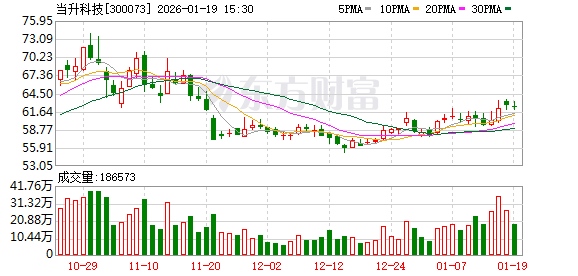
《关于芬兰子公司获得政府补助的公告》 以上内容为证券之星据公开信息整理,由AI算法生成(网信算备310104345710301240019号),不构成 投资建议。 截至2026年1月21日收盘,当升科技(300073)报收于61.66元,较前一交易日上涨2.04%,最新总市值 为335.61亿元。该股当日开盘60.09元,最高62.57元,最低60.0元,成交额达11.03亿元,换手率为 3.54%。 公司近日发布公告称,其控股子公司当升科技(芬兰)新材料有限公司已获得芬兰国家商务促进局批准 的最高约1.15亿欧元政府补助,用于欧洲新材料产业基地一期项目。2026年1月20日,该公司已收到首 笔补助款27,810,484.00欧元(折合人民币约22,578.22万元)。该补助与资产相关,将确认为递延收益, 并按相关规定处理。补助资金分阶段拨付,后续拨付需满足项目建设进度、合规投入等条件。本次补助 占公司最近一期经审计净资产的1.71%。 最新公告列表 ...

当升科技:获得政府补助折合人民币2.26亿元
Sou Hu Cai Jing· 2026-01-21 09:18
Group 1 - The core point of the article is that Dangsheng Technology announced a government subsidy of €27,810,484 (approximately 226 million RMB) from the Finnish government, which is related to assets and accounts for 1.71% of the company's most recent audited net assets attributable to shareholders [1] Group 2 - The subsidy is expected to support the company's operations and growth in the Finnish market [1] - The announcement reflects a positive development for the company, indicating government support for its initiatives [1] - The financial impact of the subsidy may enhance investor confidence in the company's future performance [1]
当升科技:芬兰子公司获得政府补助
Ge Long Hui· 2026-01-21 08:54
Core Viewpoint - The Finnish government has approved a subsidy of up to approximately €115 million to support the development of the battery industry and clean energy transition in Finland, specifically for the European new materials industrial base project of Beijing Easpring Material Technology Co., Ltd.'s subsidiary, Easpring (Finland) New Materials Co., Ltd. [1] Group 1: Subsidy Details - The subsidy amount will not exceed 20% of the total capital investment required for the project [1] - The funding will be disbursed in phases based on the progress of the construction [1] - On January 20, 2026, Easpring (Finland) New Materials received a government subsidy of €27,810,484, which is approximately ¥225.78 million [1] Group 2: Financial Impact - The government subsidy related to assets accounts for 1.71% of the company's most recent audited net assets attributable to shareholders [1]
当升科技(300073.SZ):芬兰子公司获得政府补助
Ge Long Hui A P P· 2026-01-21 08:52
Core Viewpoint - The Finnish government has approved a subsidy of up to approximately €115 million to support the development of the battery industry and clean energy transition in Finland, specifically for the European new materials industrial base project of Beijing Easpring Material Technology Co., Ltd.'s subsidiary, Easpring (Finland) New Materials Co., Ltd. [1] Group 1 - The subsidy will cover no more than 20% of the total capital investment required for the project, with funds disbursed in phases based on construction progress [1] - On January 20, 2026, Easpring (Finland) New Materials received a government subsidy of €27,810,484, equivalent to approximately ¥225.78 million, which is 1.71% of the company's most recent audited net assets attributable to shareholders [1]
当升科技(300073) - 关于芬兰子公司获得政府补助的公告
2026-01-21 08:32
北京当升材料科技股份有限公司 关于芬兰子公司获得政府补助的公告 证券代码:300073 证券简称:当升科技 公告编号:2026-002 北京当升材料科技股份有限公司 关于芬兰子公司获得政府补助的公告 本公司及董事会全体成员保证信息披露的内容真实、准确、完整,没有 虚假记载、误导性陈述或重大遗漏。 一、获取补助的基本情况 为支持芬兰电池产业链的发展及清洁能源转型,芬兰国家商务促进局 (Business Finland)作出决议批准向北京当升材料科技股份有限公司(以下称"公 司")控股子公司当升科技(芬兰)新材料有限公司(以下称"当升(芬兰)新 材料")提供最高约 1.15 亿欧元(具体金额以实际拨付为准)的补助,用于其 欧洲新材料产业基地一期项目。该补贴金额不超过符合项目建设投入要求的资本 性投入总额的 20%,补贴资金按建设进展分阶段拨付。 2026 年 1 月 20 日,当升(芬兰)新材料收到芬兰当地政府下发的 27,810,484.00 欧元补助(折人民币约 22,578.22 万元 1),该政府补助与资产相 关,占公司最近一期经审计归属于上市公司股东净资产的 1.71%。 二、补助的类型及其对上市公司的 ...
德国电动车补贴利好锂电产业链
HTSC· 2026-01-21 02:50
Investment Rating - The report maintains a "Buy" rating for several companies in the lithium battery supply chain, including Ningde Times, Yiwei Lithium Energy, and others, while recommending "Overweight" for companies like Dongsheng Technology [8][11]. Core Insights - The German government announced a €3 billion subsidy program for electric vehicle purchases, providing up to €6,000 per household to stimulate the electric vehicle industry, particularly benefiting pure electric vehicles and low-income families [1][2]. - The policy is expected to drive new electric vehicle demand between 0 to 800,000 units, translating to an additional battery demand of 0 to 48 GWh, which represents approximately 0 to 1.7% of the global battery demand in 2026 [3]. - The report highlights the potential for increased lithium battery demand, particularly benefiting companies with significant exposure to the European market, such as Ningde Times and Yiwei Lithium Energy [3]. Summary by Sections Policy Objectives - The policy emphasizes the environmental benefits and economic viability of electric vehicles, aiming to promote their adoption and support the automotive industry in Germany and Europe [10]. - Households with an annual income below €90,000 can apply for subsidies, which vary based on income and number of children, with higher subsidies for pure electric vehicles [10]. Expected Impact - The subsidy program is anticipated to enhance the penetration rate of pure electric vehicles, with the government expecting to allocate funds for the purchase of 800,000 vehicles [10]. - The report forecasts that the demand for lithium batteries will increase, leading to performance growth for companies in the lithium battery supply chain [3][10]. Company Recommendations - **Ningde Times (300750 CH)**: Target price of 566.18, rated "Buy" due to strong performance and market demand [11]. - **Yiwei Lithium Energy (300014 CH)**: Target price of 96.96, rated "Buy" based on expected volume and profit growth [11]. - **Dongsheng Technology (300073 CH)**: Target price of 75.57, rated "Overweight" due to positive developments in product lines [11]. - **Hunan Youneng (301358 CH)**: Target price of 112.98, rated "Buy" due to strong earnings forecast [11]. - **Shangtai Technology (001301 CH)**: Target price of 130.32, rated "Buy" based on anticipated demand growth [11].


当升科技:公司全固态专用超高镍多元材料在全固态电池当中的性能发挥已经接近液态电池的水平
Mei Ri Jing Ji Xin Wen· 2026-01-19 09:15
Core Viewpoint - The company, as a leader in lithium battery cathode materials, is strategically positioned in the solid-state battery market, which is expected to positively impact its performance as applications mature [2]. Group 1: Solid-State Battery Advantages - Solid-state batteries offer high energy density and safety, making them suitable for various applications, including space [2]. - The company's solid-state dedicated ultra-high nickel multi-materials have performance metrics (cycle life, capacity) approaching those of liquid batteries, meeting the demand for over 400 Wh/kg energy density [2]. - The ultra-high capacity lithium-rich manganese-based materials can achieve energy densities of up to 500 Wh/kg, leading the industry in performance [2]. Group 2: Technological Development - The company has comprehensively laid out different technological routes for solid electrolytes, including sulfides, oxides, and halides [2]. - It has developed a novel chloroiodide composite sulfide electrolyte, which is currently undergoing mass validation with leading customers [2]. Group 3: Future Outlook - As the application scenarios for solid-state batteries continue to mature, the company anticipates a positive impact on its financial performance [2].

当升科技:碘化锂是公司氯碘复合硫化物固态电解质的关键原材料之一
Zheng Quan Ri Bao· 2026-01-16 15:15
Group 1 - The core point of the article is that lithium iodide is a key raw material for the company's chlorine-iodine composite sulfide solid electrolyte, which is currently undergoing batch validation with leading customers [2] Group 2 - The company has confirmed that its electrolyte products are being validated in bulk by top-tier clients [2]
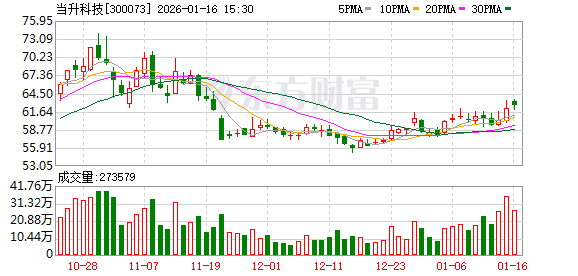
当升科技:公司将严格按照相关法律法规履行信息披露义务
Zheng Quan Ri Bao Wang· 2026-01-16 15:14
Group 1 - The company, Dangsheng Technology, stated that it will strictly adhere to relevant laws and regulations regarding information disclosure obligations [1]