
CORPRO(300101)

Search documents
振芯科技(300101) - 2025 Q1 - 季度财报
2025-04-24 13:00
Financial Performance - The company's revenue for Q1 2025 was ¥168,959,911.61, representing a 21.48% increase compared to ¥139,079,930.56 in the same period last year[4] - Net profit attributable to shareholders decreased by 46.06% to ¥8,546,161.23 from ¥15,842,500.33 year-on-year[4] - The net profit excluding non-recurring gains and losses surged by 250.89% to ¥5,946,175.84 from ¥1,694,618.06 in the previous year[4] - Basic and diluted earnings per share decreased by 46.62% to ¥0.0150 from ¥0.0281 year-on-year[4] - Net profit for the period was ¥5,624,975.42, down from ¥12,057,202.75, indicating a decline of approximately 53.3% year-over-year[23] - Operating profit decreased to ¥4,966,190.47 from ¥10,918,265.80, a drop of around 54.5% year-over-year[23] - Total comprehensive income attributable to the parent company was 8,546,161.23 yuan, compared to 15,842,500.33 yuan in the previous period, reflecting a decrease of approximately 46.0%[24] - Basic and diluted earnings per share were both 0.0150 yuan, down from 0.0281 yuan in the previous period, reflecting a decrease of approximately 46.0%[24] Cash Flow - The net cash flow from operating activities improved significantly to ¥36,273,372.64, a 157.27% increase from -¥63,332,120.22 in the same period last year[4] - Cash inflow from operating activities totaled 279,345,447.90 yuan, compared to 177,114,420.77 yuan in the previous period, indicating an increase of approximately 57.7%[27] - Cash outflow from investing activities was 287,866,964.85 yuan, up from 104,912,371.53 yuan in the previous period, representing an increase of approximately 174.5%[27] - Net cash flow from financing activities was 7,802,338.68 yuan, compared to 2,355,141.10 yuan in the previous period, showing an increase of approximately 231.5%[27] - The company incurred a net cash outflow from investing activities of 201,728,424.86 yuan, worsening from a net outflow of 39,858,682.77 yuan in the previous period[27] Assets and Liabilities - Total assets at the end of the reporting period were ¥2,903,823,197.27, a slight decrease of 0.36% from ¥2,914,221,101.19 at the end of the previous year[4] - Total liabilities decreased to ¥931,891,200.44 from ¥964,120,390.96, a reduction of about 3.3%[20] - Shareholders' equity increased to ¥1,971,931,996.83 from ¥1,950,100,710.23, reflecting a growth of approximately 1.1%[20] - Cash and cash equivalents decreased by 46.19% to ¥183,659,518.23 due to idle funds being used for purchasing financial products[8] - Cash and cash equivalents at the end of the reporting period amount to RMB 183,659,518.23, down from RMB 341,312,231.77 at the beginning of the period[18] - Trading financial assets are valued at RMB 161,000,000.00 at the end of the reporting period[18] - Accounts receivable at the end of the reporting period total RMB 153,816,831.70, decreased from RMB 214,179,911.17 at the beginning of the period[18] Shareholder Information - Total number of common shareholders at the end of the reporting period is 53,967[13] - Chengdu Guoteng Electronics Group Co., Ltd. holds 29.21% of shares, totaling 165,860,000 shares[13] - The top ten shareholders hold a significant portion of shares, with the largest shareholder holding over 29%[14] - The company has no preferred shareholders or changes in actual controllers reported[15] Research and Development - Research and development expenses decreased by 38.77% to ¥26,427,642.28 from ¥43,161,057.61 in the previous year[9] - Research and development expenses were ¥26,427,642.28, down from ¥43,161,057.61, a decrease of about 38.5% year-over-year[23] - The company has not disclosed any new product or technology developments in the current report[15] Investment Activities - Investment income increased significantly by 513.99% to ¥615,035.39 from -¥148,563.48 year-on-year, attributed to gains from the disposal of equity in a subsidiary[9] - The company invested ¥244,000,000.00 in financial products, a 229.73% increase compared to ¥74,000,000.00 in the previous year[11] - The company reported a total cash inflow from investment activities of 86,138,539.99 yuan, compared to 65,053,688.76 yuan in the previous period, marking an increase of approximately 32.5%[27] Share Repurchase Plan - The company plans to repurchase shares with a total amount not less than RMB 36 million and not exceeding RMB 72 million, with a maximum repurchase price of RMB 26.97 per share[16] - The company has not yet implemented the share repurchase plan as of the report date[16]
振芯科技股东大会风暴:控制权博弈下的治理危机与未来困局
Xin Lang Zheng Quan· 2025-04-24 10:27
Core Viewpoint - The annual shareholder meeting of Zhenxin Technology (300101.SZ) witnessed intense conflict, with the controlling shareholder, Guoteng Electronics Group, voting against three key proposals, leading to their rejection with over 95% opposition. This event marks a significant escalation in the long-standing power struggle between the controlling shareholder and the board of directors [1]. Group 1: Governance Legitimacy Disputes - Guoteng Electronics Group's chairman, Gao Hong, accused the board of three major failures: unreasonable compensation mechanisms, with the chairman's salary increasing by 10.6% to 1.0326 million yuan despite a 44.91% drop in net profit; lack of oversight on related party transactions, particularly concerning Chengdu Guoheng, which is controlled by a board member; and violations of information disclosure regulations, misleading the market regarding internal conflicts within Guoteng Electronics Group [2]. Group 2: Audit Institution Selection Controversy - The rejected audit institution proposal revealed deeper trust issues, with concerns over procedural compliance as Zhenxin Technology aimed to appoint Sichuan Huaxin as its auditor for five years, violating annual review principles. Additionally, the quality of Sichuan Huaxin's audits was questioned, as the firm had previously received a warning from the Sichuan Securities Regulatory Bureau due to risk assessment deficiencies, and audit fees had increased for three consecutive years without disclosed pricing rationale [3]. Group 3: On-Site Governance Disorder - The shareholder meeting experienced unprecedented chaos, with minority shareholders questioning the agenda's "review without discussion" approach, leading to some being threatened with expulsion for their heated remarks. Although Guoteng Electronics Group holds 29.21% of the shares, Gao Hong canceled his in-person attendance, opting for online voting, further intensifying mutual distrust [4]. Group 4: Seven-Year Struggle History - The governance crisis at Zhenxin Technology dates back to 2016, following the imprisonment of its actual controller, He Yan, evolving into a prolonged battle between controlling shareholders. The first phase involved a power vacuum and legal disputes, with He Yan's absence allowing other shareholders to push for the company's "de-He Yan" strategy. The second phase saw He Yan regain control in 2024, but a split between legal and operational control emerged. The third phase highlighted a breakdown in decision-making mechanisms, with significant financial losses and deteriorating debt ratios [5][6][8].
振芯科技“内斗”何时了
Shang Hai Zheng Quan Bao· 2025-04-23 19:34
Core Viewpoint - The internal conflict between the core management of Zhenxin Technology and its controlling shareholder, Chengdu Guoteng Electronics Group, has intensified, leading to the rejection of key proposals at the annual shareholder meeting [2][3]. Group 1: Shareholder Meeting and Proposals - The annual shareholder meeting of Zhenxin Technology took place on April 22, where several key proposals, including the 2024 Board of Directors' work report, were rejected due to opposition from Guoteng Group [3][4]. - Guoteng Group's chairman, Gao Hong, opted for online voting to avoid potential disputes at the meeting, indicating the tense atmosphere surrounding the event [3][4]. - The rejection of the proposals highlights the ongoing conflict between the management and the controlling shareholder, with questions raised about how to address the rejected proposals moving forward [3][4]. Group 2: Reasons for Opposition - Gao Hong criticized the board for failing to act in the best interests of the company and its shareholders, citing a 44% decline in net profit while the chairman received a 10.6% salary increase [4]. - Concerns were raised about potential conflicts of interest regarding board members' connections to other companies with similar business operations [4]. Group 3: Shareholder Dynamics - Guoteng Group holds 29.21% of Zhenxin Technology's shares, with the actual control resting with He Yan, who holds 51% of the shares, leading to claims of decision-making being "hijacked" by minority shareholders [5][6]. - The management expressed frustration over the lack of communication and cooperation from Guoteng Group, while Guoteng Group countered that they have been cooperative when it benefits the company [6][8]. Group 4: Future Outlook and Demands - The management of Zhenxin Technology desires the dissolution of Guoteng Group to achieve a more decentralized ownership structure, which would eliminate a controlling shareholder [7][8]. - Guoteng Group's stance is focused on stability and development, advocating for lawful governance and adherence to regulations by all shareholders [8][9].


一线 | 振芯科技控股股东与董事会“冲突”加剧 围绕四大争议,双方各执一词
Mei Ri Jing Ji Xin Wen· 2025-04-23 15:49
Core Viewpoint - The ongoing conflict between the controlling shareholder of Zhenxin Technology and the board of directors has escalated, leading to the rejection of three key proposals at the 2024 annual general meeting, with the controlling shareholder voting against them [2][4][6]. Group 1: Shareholder Meeting Dynamics - The 2024 annual general meeting of Zhenxin Technology was marked by strict entry protocols, with only shareholders who met specific criteria allowed to attend, leading to tensions and disputes during the meeting [4][6]. - The controlling shareholder, Guoteng Electronics Group, voted against the annual board and supervisory reports, as well as the proposal to appoint an auditing firm, resulting in the failure of these proposals [6][8]. - High Hong, the chairman of Guoteng Electronics Group, claimed that the vote against the proposals was based on substantial reasons rather than emotions, criticizing the board for prioritizing its interests over those of the shareholders [8][16]. Group 2: Board Composition and Governance Issues - A significant point of contention arose when Guoteng Electronics Group's proposal to increase the number of board members was rejected by Zhenxin Technology's board, which led to accusations of governance issues and lack of communication [9][10]. - High Hong expressed concerns about the board's decision-making process, particularly regarding executive compensation amidst a significant decline in net profit, highlighting a 44% drop in profits while the chairman's salary increased by approximately 10.6% [8][9]. - The board's refusal to submit Guoteng Electronics Group's proposals for discussion was seen as a violation of shareholder rights, with accusations of a lack of transparency and communication from the board [10][14]. Group 3: Historical Context and Ongoing Disputes - The conflict between the controlling shareholder and the board has historical roots, with unresolved issues dating back to a protracted legal battle over the dissolution of Guoteng Electronics Group [2][22]. - High Hong noted that he had not participated in any shareholder meetings since 2018, raising concerns about the governance and communication breakdown between the controlling shareholder and the board [16][19]. - The lack of face-to-face communication between the parties over the past nine years has exacerbated tensions, with both sides accusing each other of failing to engage in meaningful dialogue [22][24]. Group 4: Future Outlook and Company Development - Despite the ongoing disputes, both parties expressed a desire for Zhenxin Technology to develop positively, acknowledging the challenges posed by limited financing and operational constraints [26][27]. - The management team is striving to maintain profitability and growth under difficult circumstances, emphasizing the need for substantial investment to capitalize on emerging opportunities in the industry [26][27].
振芯科技(300101) - 四川天润华邦律师事务所关于成都振芯科技股份有限公司2024年年度股东大会的法律意见
2025-04-22 11:52
四川天润华邦律师事务所 关于成都振芯科技股份有限公司 2024 年年度股东大会的 法律意见 电话:028-86110855 传真:028-86110842 邮编:610015 成都市青羊区西御街西御大厦 B 座 13 楼 四川天润华邦律师事务所 关于成都振芯科技股份有限公司 2024 年年度股东大会的法律意见 四川天润华邦律师事务所 关于成都振芯科技股份有限公司 2024 年年度股东大会的 法律意见 天润 20250422-1 号 致:成都振芯科技股份有限公司 四川天润华邦律师事务所(以下简称"本所")受成都振芯科技股份有限公 司(以下简称"公司""振芯科技")委托,指派本所律师出席公司 2024 年年 度股东大会(以下简称"本次股东大会"),对本次股东大会的合法性进行见证 并出具法律意见。 公司于 2025 年 3 月 27 日召开第六届董事会第十三次会议,审议通过了《关 于召开 2024 年年度股东大会的议案》。2025 年 3 月 31 日,公司董事会于深圳 证券交易所网站和巨潮资讯网上刊登了《成都振芯科技股份有限公司关于召开 2024 年年度股东大会的通知》(以下称为"《会议通知》"),就召开会议的 ...
振芯科技(300101) - 2024年年度股东大会会议决议公告
2025-04-22 11:52
证券代码:300101 证券简称:振芯科技 公告编号:2025-036 成都振芯科技股份有限公司 2024 年年度股东大会会议决议公告 本公司及董事会全体成员保证信息披露的内容真实、准确、完整,没有虚 假记载、误导性陈述或重大遗漏。 特别提示: 1、本次股东大会是否出现否决议案:是。被否决的议案名称: (1)《2024 年度董事会工作报告》; (四)召开方式:现场投票与网络投票相结合方式 (五)召集人:公司董事会 (六)主持人:董事长谢俊先生 (2)《2024 年度监事会工作报告》; (3)《关于选聘公司 2025 年至 2029 年度审计机构的议案》。 2、本次股东大会不涉及变更前次股东大会决议。 一、会议召开和出席情况 1、会议召开情况 (一)现场会议召开时间:2025 年 4 月 22 日下午 14:30 (二)网络投票时间:通过深圳证券交易所交易系统进行网络投票的时间为: 2025 年 4 月 22 日上午 9:15-9:25,9:30-11:30 和下午 13:00-15:00;通过深圳证券交 易所互联网投票系统投票的时间为:2025 年 4 月 22 日 9:15-15:00。 (三)现场会议召开 ...
研判2025!中国北斗接收机行业发展历程、产业链、市场规模、重点企业及未来前景分析:北斗接收机性能不断提升,高精度产品需求潜力较大[图]
Chan Ye Xin Xi Wang· 2025-04-22 01:29
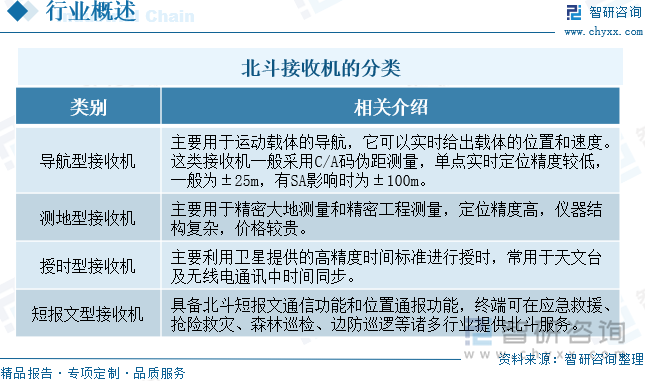
Industry Overview - The Beidou receiver is a crucial component of the Beidou satellite navigation system, serving as a bridge between satellites and users, directly impacting service quality and user experience [1][17] - The global service capability of the Beidou system has been continuously enhanced, providing broader application space and higher performance requirements for Beidou receivers [1][17] - The Chinese Beidou receiver industry is experiencing rapid development opportunities, with market potential gradually being released, projected to reach approximately 30.06 billion yuan in 2024 [1][17] Market Size and Segmentation - The market size for Beidou receivers in China is estimated to be around 30.06 billion yuan in 2024, with high-precision receivers accounting for about 10 billion yuan and low-precision receivers for approximately 20.06 billion yuan [1][17] - The industry is driven by both policy support and market demand, focusing on high performance, low power consumption, and multi-scenario integration [1][17] Industry Development History - The development of the Beidou receiver industry is closely linked to the construction of the Beidou satellite navigation system, which began in the 1990s [5] - The industry has evolved from initial military applications to a broader range of civil applications, including transportation, surveying, and public safety [5] - Recent years have seen significant achievements in technological innovation, market expansion, and the improvement of the industrial chain, enhancing international competitiveness [5] Key Companies in the Industry - Major companies in the Beidou receiver industry include: - **Haige Communication**: Holds over 30% market share in military high-precision receivers [18][20] - **Zhenxin Technology**: Maintains a leading position in the satellite-based augmentation system (SBAS) receiver market [18][20] - **Beidou Xingtong**: Focuses on a comprehensive product range and is accelerating the development of integrated cloud-core business models [18][20] - **HuaCe Navigation**: Specializes in high-precision surveying and geographic information solutions [18][20] Technological Advancements - The Beidou receiver industry is moving towards higher positioning accuracy, with potential breakthroughs expected through the integration of satellite and ground-based augmentation systems [26] - Future receivers will evolve from single-function devices to integrated smart terminals, incorporating 5G communication and environmental sensing capabilities [27] - The application of third-generation semiconductor materials is anticipated to significantly reduce the size and power consumption of receivers, facilitating their use in consumer-grade wearable devices and IoT terminals [28]





振芯科技:签署4.6亿元固定资产借款合同
news flash· 2025-04-18 09:29
Core Viewpoint - The company, Zhenxin Technology, has signed a fixed asset loan agreement with Industrial and Commercial Bank of China Chengdu High-tech Branch for an amount of 460 million yuan, with a loan term not exceeding 10 years [1] Summary by Relevant Categories Financial Details - The loan amount is 460 million yuan [1] - The loan term is set for a maximum of 10 years [1] Project Information - The loan will be secured by the company's land use rights, ongoing construction projects, and properties related to the Chuangxin Intelligent Industrial Park project [1]
振芯科技(300101) - 关于签署《固定资产借款合同》的公告
2025-04-18 09:26
证券代码:300101 证券简称:振芯科技 公告编号:2025-035 成都振芯科技股份有限公司 关于签署《固定资产借款合同》的公告 本公司及董事会全体成员保证信息披露的内容真实、准确、完整,没有虚假 记载、误导性陈述或重大遗漏。 特别提示: 1、贷款存续期内,如控制权纠纷或其他负面舆情严重影响借款人(即成都振 芯科技股份有限公司,以下简称"公司"或"振芯科技")正常生产经营,或公 司初创团队失去经营决策权,或公司以成都振芯科技股份有限公司创芯智能产业 园项目(以下简称"本项目""项目"或"产业园")资产及其项下权益对外投 资或设定抵质押,或以本项目对外新增融资,或发生重大事项可能危及贷款安全 的,视为贷款违约,贷款人(即中国工商银行股份有限公司成都高新技术产业开 发区支行,以下简称"工行成都高新支行")有权采取停止发放贷款、提前收回 部分或全部贷款、追加担保等各种措施控制风险,必要时可依法追究公司的违约 责任。 工行成都高新支行与公司不存在关联关系,也不存在其他可能或已经造成公 司对其利益倾斜的其他关系,不属于失信被执行人。 | 三、合同的主要内容 | | --- | | 合同名称 | 《固定资产借款合同》 ...
振芯科技:为子公司提供3000万元担保
news flash· 2025-04-17 08:44
Core Viewpoint - The company has signed a guarantee contract with Chengdu Bank for a loan of up to 30 million RMB, which represents 1.68% of the company's audited net assets for 2024 [1] Group 1: Contract Details - The guarantee contract is a joint liability guarantee for a working capital loan with a term of one year [1] - The guarantee period lasts for three years from the expiration of the main contract's debt performance period [1] Group 2: Financial Impact - The total amount of external guarantees provided by the company as of the announcement date is 63.975 million RMB, accounting for 3.59% of the company's audited net assets for 2024 [1] - The guarantee amount for this specific contract is within the company's financial capacity, given the relatively low percentage of net assets involved [1]