Absen(300389)

Search documents
艾比森2025年业绩预增超105%,2026年聚焦AI显示与LED电影屏
Jing Ji Guan Cha Wang· 2026-02-13 02:54
Core Insights - The company Absen (300389.SZ) has recently disclosed significant events related to its performance and strategic planning [1] Financial Performance - Absen has announced a forecast for its 2025 annual performance, expecting a substantial net profit increase of 105.32% to a range of 148.09 million [2] - The operating cash flow net amount is projected to rise approximately 440% year-on-year, indicating improved efficiency in accounts receivable and inventory turnover [4] Strategic Development - The company plans to focus on three main areas in 2026: deepening COB and MIP technology optimization, accelerating AI+ display application scenarios, and expanding into the LED cinema screen market [3] - Continuous optimization of the global layout is also part of the strategic initiatives, which may influence the company's long-term development trajectory [3]

艾比森(300389.SZ):2022年员工持股计划股票出售完毕
Ge Long Hui A P P· 2026-02-09 08:55
Core Viewpoint - Abison (300389.SZ) has completed the sale of all shares held under its 2022 employee stock ownership plan, totaling 5.1848 million shares, which represents 1.40% of the company's total share capital [1] Summary by Category - **Employee Stock Ownership Plan** - The employee stock ownership plan has fully sold its shares as of the announcement date [1] - A total of 5.1848 million shares were sold through secondary market centralized bidding [1] - **Impact on Share Capital** - The shares sold account for 1.40% of the company's current total share capital [1]
艾比森:2022年员工持股计划股票出售完毕
Ge Long Hui· 2026-02-09 08:49
Group 1 - The core point of the article is that Abison (300389.SZ) has completed the sale of all shares held under its 2022 employee stock ownership plan, totaling 5.1848 million shares, which represents 1.40% of the company's total share capital [1] Group 2 - The employee stock ownership plan shares were sold through concentrated bidding on the secondary market [1] - The announcement indicates that the company has fully executed its employee stock ownership plan as of the disclosure date [1]
艾比森(300389) - 关于2022年员工持股计划股票出售完毕的公告
2026-02-09 08:45
证券代码:300389 证券简称:艾比森 公告编码:2026-004 深圳市艾比森光电股份有限公司 关于 2022 年员工持股计划股票出售完毕的公告 深圳市艾比森光电股份有限公司(以下简称"公司")2022 年员工持股计 划(以下简称"本持股计划"或"员工持股计划")所持有的公司股份已全部出 售完毕,根据《关于上市公司实施员工持股计划试点的指导意见》《深圳证券交 易所上市公司自律监管指引第 2 号——创业板上市公司规范运作》等相关规定, 现将相关情况公告如下: 本公司及董事会全体成员保证信息披露的内容真实、准确、完整,没有 虚假记载、误导性陈述或重大遗漏。 一、本持股计划的基本情况 公司于 2022 年 7 月 28 日分别召开了第四届董事会第二十四次会议、第四届 监事会第二十一次会议及 2022 年 8 月 18 日召开了 2022 年第二次临时股东大会 审议通过了《关于<2022 年员工持股计划(草案)>及其摘要的议案》等相关议 案,同意公司实施 2022 年员工持股计划并授权董事会办理相关事宜,具体内容 详见 2022 年 8月 1 日和 2022年 8 月 18日公司在巨潮资讯网(www.cninfo ...
艾比森(300389) - 关于2025年员工持股计划锁定期届满的提示性公告
2026-02-09 08:45
证券代码:300389 证券简称:艾比森 公告编码:2026-005 一、本持股计划的基本情况及锁定期 公司于 2025 年 1 月 7 日召开的第五届董事会第二十六次会议、第五届监事 会第二十一次会议和 2025 年 1 月 23 日召开的 2025 年第一次临时股东大会审议 并通过了《关于<2025 年员工持股计划(草案)>及其摘要的议案》《关于<2025 年员工持股计划管理办法>的议案》等相关议案,同意公司实施 2025 年员工持股 计划。本持股计划的具体内容详见公司于 2025 年 1 月 8 日及 2025 年 1 月 23 日 在巨潮资讯网(www.cninfo.com.cn)披露的相关公告。 2025 年 2 月 17 日,公司披露了《关于 2025 年员工持股计划购买完成的公 告》,截至 2025 年 2 月 14 日,公司 2025 年员工持股计划已通过深圳证券交易 所交易系统以集中竞价方式累计买入公司股票 5,076,600 股,占公司当时总股本 的 1.38%,成交金额 59,994,599 元(不含交易费用),成交均价为 11.82 元/股。 至此,公司 2025 年员工持股计划已完成 ...
艾比森:公司持续保持行业技术领先,已储备多项与电影屏幕相关的核心技术
Zheng Quan Ri Bao Wang· 2026-02-04 12:42
Core Viewpoint - The company, Absen (300389), maintains a leading position in industry technology and has developed several core technologies related to movie screens, including sound-image fusion technology and quality enhancement technology [1] Group 1: Technology Advancements - The company has reserved multiple core technologies related to movie screens, such as sound-image fusion technology, quality enhancement technology, lightweight modular structure, and system synchronization control [1] - The iConX4K product has been widely applied in home theater scenarios, with numerous practical application cases already in existence [1] Group 2: Product Features - Existing products utilize advanced technologies including 4K, 3D, high frame rate, and high dynamic range [1] - The flagship product series includes CLV3, SA, and AWpro, showcasing the company's commitment to high-quality visual experiences [1]
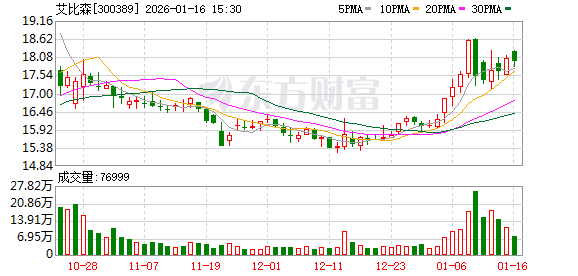
艾比森股价涨5.74%,中欧基金旗下1只基金位居十大流通股东,持有99.89万股浮盈赚取107.88万元
Xin Lang Cai Jing· 2026-01-30 02:31
Group 1 - The core point of the news is that Absen's stock price increased by 5.74% to 19.88 CNY per share, with a trading volume of 204 million CNY and a turnover rate of 4.55%, resulting in a total market capitalization of 7.338 billion CNY [1] - Absen is a Shenzhen-based company established on August 23, 2001, and listed on August 1, 2014, specializing in the research, production, sales, and service of LED application products [1] - The main revenue composition of Absen includes 95.07% from LED displays, 1.70% from hotel operation services related to LED displays, 1.67% from energy storage equipment, and 1.57% from other sources [1] Group 2 - Among Absen's top ten circulating shareholders, a fund under China Europe Fund, specifically the China Europe Value Selection Mixed A (021181), entered the top ten in the third quarter, holding 998,900 shares, which is 0.43% of the circulating shares [2] - The China Europe Value Selection Mixed A fund has a current scale of 441 million CNY and has achieved a year-to-date return of 8.55%, ranking 2749 out of 8872 in its category, with a one-year return of 37.02%, ranking 3496 out of 8126 [2] - The fund manager of China Europe Value Selection Mixed A is Zhang Xueming, who has been in the position for 1 year and 283 days, managing a total asset size of 5.86 billion CNY, with the best fund return during his tenure being 88.61% and the worst being 1.73% [3]
艾比森:公司LED小间距产品广泛应用于智能工业场景
Zheng Quan Ri Bao Wang· 2026-01-27 13:12
Core Viewpoint - Absen (300389) emphasizes the extensive application of its LED small-pitch products in smart industrial scenarios, enhancing efficiency in intelligent production scheduling and high-end manufacturing [1] Group 1 - The company's LED small-pitch products are widely used in smart production scheduling centers and BI data dashboards for intelligent manufacturing [1] - These products align with smart production data, improving the efficiency of scheduling and command in intelligent manufacturing [1] - The technology empowers high-end intelligent manufacturing capabilities [1]
超600家上市公司预告2025年业绩
Shang Hai Zheng Quan Bao· 2026-01-21 18:12
Group 1: Chemical and Metal Industries - Several chemical companies, including Xinong Co. and Dayang Bio, are showing continuous improvement in their operations [1] - The non-ferrous metal sector benefits from high prices and capacity release, with Zijin Mining expected to achieve a net profit of 51 billion to 52 billion yuan in 2025, a year-on-year increase of 59% to 62% [1] - Zijin Mining's growth is driven by increased production and higher sales prices of gold, copper, and silver [1] - The high-end manufacturing sector shows resilience, with Okoyi's net profit projected to grow by 67.53% to 91.96% in 2025, despite rising raw material costs [1] - The new materials industry is also performing well, with China National Materials Technology expected to achieve a net profit of 1.55 billion to 1.95 billion yuan in 2025, a year-on-year increase of 73.79% to 118.64% [1] Group 2: International Market Growth - The overseas market is becoming a new growth engine for many listed companies [2] - Siyuan Electric is expected to achieve total revenue of 21.205 billion yuan in 2025, a year-on-year increase of 37.18%, and a net profit of 3.163 billion yuan, up 54.35% [2] - Absen, a leading global LED display provider, anticipates a net profit of 240 million to 290 million yuan in 2025, representing a year-on-year growth of 105.32% to 148.09% [2] - Absen's overseas revenue reached approximately 3.193 billion yuan, a year-on-year increase of about 8.94% [2] Group 3: Company-Specific Developments - Chutian Technology expects a net profit of 235 million to 300 million yuan in 2025, marking a turnaround to profitability driven by strong international market breakthroughs [3] - The company has made significant progress in Southeast Asia, the Middle East, and the Americas, with overseas sales revenue steadily increasing [3] - Hangcha Group is also expanding into emerging markets while consolidating its traditional markets, indicating the effectiveness of its globalization strategy [3]




艾比森:2025年度公司预计实现营业收入约为41.56亿元
Zheng Quan Ri Bao· 2026-01-16 15:25
Core Viewpoint - The company expects to achieve a revenue of approximately 4.156 billion yuan in 2025, representing a year-on-year increase of about 13.46% compared to 2024 [2] Group 1: Revenue Breakdown - The overseas market is projected to generate approximately 3.193 billion yuan in revenue, reflecting a year-on-year growth of about 8.94%, indicating a strong competitive position in the international market [2] - The domestic market, despite a weak overall demand for LED displays, is expected to achieve approximately 963 million yuan in revenue, with a significant year-on-year increase of about 31.56%, showcasing successful growth strategies [2] Group 2: Strategic Initiatives - The company has focused on high-quality customers, optimized product structure, and adjusted channel strategies to drive growth in the domestic market [2] - The company has developed a highly efficient global channel network and differentiated brand advantages in the overseas market through years of sustained efforts and scientific planning [2]