Absen(300389)

Search documents
艾比森:2025年度公司预计实现营业收入约为41.56亿元,同比上升约13.46%
Jin Rong Jie· 2026-01-16 07:25
Core Viewpoint - The company expects a revenue increase in 2025, driven by both domestic and international markets, with a projected total revenue of approximately 4.156 billion yuan, representing a year-on-year growth of about 13.46% from 2024 [1] Group 1: Revenue Projections - The company anticipates achieving approximately 4.156 billion yuan in revenue for 2025, which is an increase of about 13.46% compared to 2024 [1] - The overseas market is expected to generate around 3.193 billion yuan, reflecting a year-on-year growth of approximately 8.94% [1] - The domestic market is projected to reach about 963 million yuan, with a significant year-on-year increase of approximately 31.56% [1] Group 2: Market Strategies - The company has focused on deepening its overseas market presence through localized operations and building an efficient global channel network, enhancing its competitive edge [1] - In the domestic market, despite overall weak demand for LED displays, the company has successfully achieved growth by targeting high-quality customers, optimizing product structure, and adjusting channel strategies [1]

43家创业板公司预告2025年业绩(附股)
Zheng Quan Shi Bao Wang· 2026-01-15 02:49
Core Insights - A total of 43 companies listed on the ChiNext board have released their performance forecasts for 2025, with 22 companies expecting profit increases, representing 51.16% of the total [1] - The overall proportion of companies forecasting positive performance (including profit increases and profit warnings) stands at 55.81% [1] Performance Forecast Summary - Among the companies forecasting profit increases, 9 are expected to see net profit growth exceeding 100%, while 6 companies anticipate growth between 50% and 100% [1] - The company with the highest expected net profit growth is Huisheng Biological, with a median increase of 1355.24% for 2025 [1] - Other notable companies include Zhongtai Co., expecting a median net profit increase of 677.22%, and Chenguang Biological, with a forecasted increase of 301.38% [1] Companies with Significant Profit Increases - The following companies are highlighted for their substantial expected profit increases: - Huisheng Biological (Code: 300871) - 1355.24% increase, latest closing price: 25.52, year-to-date change: 23.11%, industry: Agriculture, Forestry, Animal Husbandry, and Fishery [1] - Zhongtai Co. (Code: 300435) - 677.22% increase, latest closing price: 29.14, year-to-date change: 31.14%, industry: Public Utilities [1] - Chenguang Biological (Code: 300138) - 301.38% increase, latest closing price: 13.78, year-to-date change: 11.04%, industry: Agriculture, Forestry, Animal Husbandry, and Fishery [1] - Lakala (Code: 300773) - 222.00% increase, latest closing price: 32.08, year-to-date change: 12.64%, industry: Non-banking Financial [1] - Other companies with notable increases include Guokai Technology, Chuanjin Nuo, and Jinli Yong, with expected increases ranging from 144.00% to 158.44% [1]




艾比森:实控人股份减持计划提前终止
Xin Lang Cai Jing· 2026-01-13 13:08
Core Viewpoint - The controlling shareholder and chairman of Absen (300389), Ding Yanhui, has decided to terminate his share reduction plan, which initially aimed to reduce his holdings by up to 11.073 million shares (3% of the total share capital) due to confidence in the company's stable development [1]. Summary by Relevant Sections - **Share Reduction Plan**: Ding Yanhui originally planned to reduce his stake through centralized bidding and block trading, with a maximum reduction of 11.073 million shares [1]. - **Current Status**: As of the announcement date, Ding Yanhui has only reduced his holdings by 400 shares [1]. - **Decision to Terminate**: Ding Yanhui has decided to terminate the remaining share reduction plan and will not reduce any further shares within the planned timeframe [1].
艾比森(300389) - 关于控股股东、实际控制人股份减持计划提前终止的公告
2026-01-13 11:20
本公司及董事会全体成员保证公告内容与信息披露义务人提供的信息一 致。 深圳市艾比森光电股份有限公司(以下简称"艾比森"或"公司")于 2025 年 10 月 24 日在巨潮资讯网披露了《关于控股股东、实际控制人减持股份的预披 露公告》(公告编号:2025-059)。公司控股股东、实际控制人、董事长丁彦辉 先生拟通过集中竞价、大宗交易的方式减持其持有的公司股份不超过 11,073,009 股(含本数),即不超过预披露公告披露之日公司股份总数的 3%。 公司于近日收到丁彦辉先生出具的《关于股份减持计划提前结束的告知函》, 截至目前,丁彦辉先生已减持股份 400 股,本次减持计划提前结束,剩余未减持 股份在本次减持计划期限内不再减持。现将具体情况公告如下: 一、股东减持基本情况 证券代码:300389 证券简称:艾比森 公告编码:2026-003 深圳市艾比森光电股份有限公司 关于控股股东、实际控制人股份减持计划提前终止的公告 公司控股股东、实际控制人、董事长丁彦辉先生保证向本公司提供的信息 内容真实、准确、完整,没有虚假记载、误导性陈述或重大遗漏。 | 股东 | 股份性质 | | 本次减持前持有股份 | 持有股份 ...
艾比森:全资子公司艾比森投资公司对睿电绿能等进行投资并持有相应的股权
Zheng Quan Ri Bao Wang· 2026-01-13 09:09
Core Viewpoint - Abison (300389) has confirmed its investment in RuiDian Green Energy through its wholly-owned subsidiary, Abison Investment Company, which is engaged in the renewable energy storage business [1] Group 1: Company Overview - Abison Investment Company holds equity in RuiDian Green Energy, which focuses on providing safe, intelligent, and sustainable green storage products and services [1] - The business scope of RuiDian Green Energy includes both residential and commercial energy storage solutions [1] Group 2: Market Presence - RuiDian Green Energy leverages the global market layout advantages of its parent company, with its storage products and service network reaching Europe, Asia-Pacific, and domestic markets [1] - The company has successfully delivered multiple commercial projects both domestically and internationally [1]
逾百家A股公司预告2025年业绩 科技与生物医药行业增长强劲
Shang Hai Zheng Quan Bao· 2026-01-12 18:35
Core Insights - Approximately 130 A-share companies have disclosed their performance forecasts for 2025, with around 70 companies expecting positive results, including profit increases and turnaround from losses [2][4]. Company Performance Highlights - **Zhongke Lanyun**: Expected net profit of 1.4 billion to 1.43 billion yuan, a year-on-year increase of 366.51% to 376.51%, driven by strategic investments in high-growth areas like GPU and advanced packaging [4][5]. - **Chuanhua Zhili**: Forecasted net profit of 540 million to 700 million yuan, with a growth rate of 256.07% to 361.57%, supported by optimized marketing strategies and asset structure in logistics and chemical businesses [5]. - **Bai'ao Saitou**: Anticipated net profit of 135 million yuan, reflecting a 303.57% increase, attributed to favorable market conditions [4]. - **Kangchen Pharmaceutical**: Expected net profit of 145 million to 175 million yuan, with a growth of 243% to 315%, due to the absence of goodwill impairment losses in the reporting period [5]. - **Guangku Technology**: Projected net profit of 169 million to 182 million yuan, a growth of 152% to 172%, driven by product innovation and cost control [7]. - **Lixun Precision**: Forecasted net profit of 16.518 billion to 17.186 billion yuan, with a growth of 23.59% to 28.59%, supported by innovations in manufacturing and AI integration [6]. - **Daotong Technology**: Expected net profit of 900 million to 930 million yuan, with a growth of 40.42% to 45.10%, driven by AI-driven services [6]. - **Aibisen**: Anticipated net profit of 240 million to 290 million yuan, reflecting a growth of 105.32% to 148.09%, due to increased R&D investment [7]. - **Chaohongji**: Expected net profit of 436 million to 533 million yuan, with a growth of 125% to 175%, supported by a focus on brand optimization and digital transformation [9]. - **WuXi AppTec**: Forecasted net profit of 19.151 billion yuan, with a growth of approximately 102.65%, including gains from divesting joint ventures [9]. - **Hui Sheng Biological**: Expected net profit of 23.5 million to 27.1 million yuan, indicating a turnaround, driven by market expansion and improved production efficiency [9]. Industry Performance Insights - The electronics, semiconductor, pharmaceutical, and machinery sectors are showing strong performance among listed companies [3].



艾比森丁彦辉:做企业就像马拉松式的接力赛
Jing Ji Guan Cha Wang· 2026-01-12 13:10
Core Viewpoint - The company Absen (300389) is experiencing significant growth, with a projected net profit increase of 105-148% for 2025 and a substantial rise in operating cash flow by approximately 440% [1] Financial Performance - The business has secured orders amounting to 4.76 billion yuan, and its brand value has reached 16.672 billion yuan [1] - The company has received accolades such as the "International Credibility Brand" [1] Strategic Development - Chairman Ding Yanhui introduced a four-dimensional development strategy focusing on optimizing mechanisms, strengthening team building, clarifying goal paths, and anchoring core foundations [1] - The company aims for a target of 6.8 billion yuan in orders for 2026, emphasizing a "big platform + small front-end" model [1] Market Positioning - Absen will concentrate on the LED display main channel, prioritizing customer-centric approaches to establish benchmarks for commercial civilization [1]
艾比森紧抓机遇盈利最高预增148% 双线突围海外营收31.9亿占76.8%
Chang Jiang Shang Bao· 2026-01-11 23:43
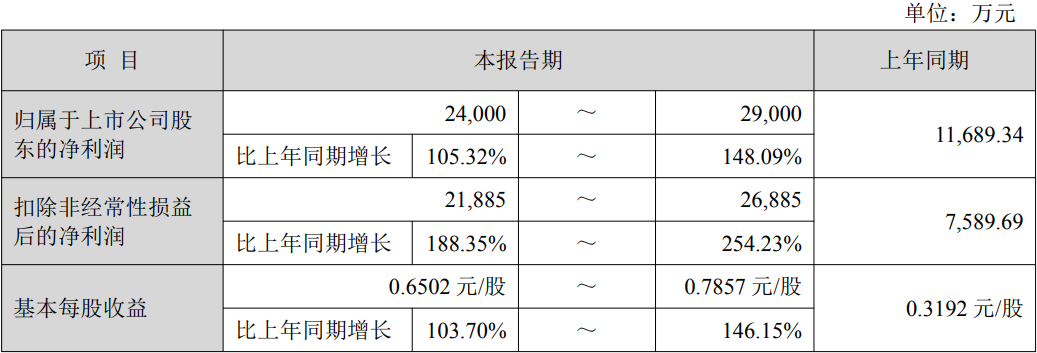
Core Viewpoint - The company, Absen (300389.SZ), has reported strong performance for 2025, exceeding market expectations with significant revenue and profit growth driven by domestic and international market opportunities, product optimization, and operational efficiency [1][4]. Group 1: Financial Performance - For 2025, Absen expects revenue of 4.156 billion yuan, a year-on-year increase of 13.46% [1][4]. - The projected net profit attributable to shareholders is between 240 million and 290 million yuan, representing a substantial increase of 105.32% to 148.09% compared to the previous year's 117 million yuan [1][4]. - The company anticipates a non-recurring net profit of 219 million to 269 million yuan, reflecting a growth of 188.35% to 254.23% year-on-year [4][5]. - The gross profit margin for 2025 is expected to be around 31%, an increase of 3.5 percentage points from 2024 [5]. Group 2: Market Dynamics - Absen's overseas revenue is projected to be approximately 3.193 billion yuan, a year-on-year growth of about 8.94%, accounting for approximately 76.83% of total revenue [1][4]. - The domestic market is expected to generate around 963 million yuan in revenue, with a year-on-year increase of approximately 31.56% despite overall weak demand in the LED display sector [5]. Group 3: Research and Development - From 2021 to the first three quarters of 2025, Absen's cumulative R&D expenses reached 698 million yuan, reinforcing its technological barriers [2][7]. - The company has maintained a consistent R&D investment strategy, with R&D expenses as a percentage of annual revenue ranging from 4.17% to 4.63% over the past five years [7]. - As of June 2025, Absen has applied for over 1,300 intellectual property rights globally, with 30% being invention patents, supporting its competitive edge in advanced technologies [7]. Group 4: Asset Growth and Capital Operations - As of the end of the third quarter of 2025, Absen's total assets reached a historical high of 4.301 billion yuan, an increase of 18.48% year-on-year [2][6][8]. - The company plans to raise up to 360 million yuan through a private placement to enhance liquidity and optimize its capital structure [8]. - Absen's total assets have grown from 2.121 billion yuan at the end of 2020 to 3.673 billion yuan at the end of 2024, marking a 73.17% increase during this period [8]. Group 5: Market Recognition - The capital market has recognized Absen's growth potential, with the company's stock price increasing by 56.14% throughout 2025 [9]. - As of January 9, 2026, Absen's stock closed at 17.51 yuan per share, reflecting a year-to-date increase of 7.89% and a total market capitalization of 6.463 billion yuan [9].
艾比森(300389) - 关于完成工商变更登记的公告
2026-01-09 08:16
本公司及董事会全体成员保证信息披露的内容真实、准确、完整,没有 虚假记载、误导性陈述或重大遗漏。 证券代码:300389 证券简称:艾比森 公告编码:2026-002 深圳市艾比森光电股份有限公司 关于完成工商变更登记的公告 深圳市艾比森光电股份有限公司(以下简称"公司")于 2025 年 11 月 7 日 召开的 2025 年第四次临时股东大会审议通过了《关于变更注册资本及修订<公司 章程>的议案》,公司于近日在深圳市市场监督管理局完成了工商变更登记及备 案手续,领取了《登记通知书》。 公司本次变更后的工商登记基本信息如下: 统一社会信用代码:91440300731127582R 企业名称:深圳市艾比森光电股份有限公司 特此公告。 住所:深圳市龙岗区坂田街道雪岗路 2018 号天安云谷产业园一期 3 栋 A 座 18、19、20 层 注册资本(万元):36,910.0317 企业类型:上市股份有限公司 法定代表人:丁彦辉 成立日期:2001 年 8 月 23 日 经营期限:永续经营 经营范围:兴办实业(具体项目另行申报);LED 电子显示屏的研发、销 售,计算机软件开发、服务、销售(以上不含禁止、限制项目) ...
艾比森:预计2025年净利润同比增长105%-148%
Xin Lang Cai Jing· 2026-01-09 06:42
Core Viewpoint - The company, Absen, anticipates significant growth in its 2025 financial performance, projecting a net profit attributable to shareholders between 240 million to 290 million yuan, representing a year-on-year increase of 105.32% to 148.09% [1][5]. Financial Performance - The expected operating revenue for 2025 is approximately 4.156 billion yuan, with a basic earnings per share forecasted between 0.6502 to 0.7857 yuan [1][5]. - The net profit for the reporting period is projected to be 240 million to 290 million yuan, with a year-on-year growth of 105.32% to 148.09% [3][6]. - The net profit after deducting non-recurring gains and losses is expected to be around 218.85 million to 268.85 million yuan, reflecting a year-on-year increase of 188.35% to 254.23% [3][6]. Revenue Breakdown - The company achieved approximately 4.156 billion yuan in operating revenue, marking a year-on-year increase of about 13.46% [4][6]. - Revenue from overseas markets reached approximately 3.193 billion yuan, with a year-on-year growth of about 8.94%, indicating strong performance in over 140 countries [4][6]. - In the domestic market, despite overall weak demand for LED displays, the company generated about 963 million yuan in revenue, reflecting a year-on-year increase of approximately 31.56% [4][7]. Profitability and Efficiency - The overall gross margin for the reporting period is approximately 31%, an increase of about 3.5 percentage points compared to 2024 [4][8]. - The company has focused on enhancing research and development, leading to a virtuous cycle of investment, technological breakthroughs, and market premiums [8]. - The company has implemented a "big product" strategy to optimize production efficiency and has reduced the period expense ratio by approximately 0.8 percentage points [8]. Cash Flow and Management - The net cash flow from operating activities for 2025 is expected to be around 824 million yuan, representing a substantial year-on-year increase of approximately 440% [5][8]. - The company has improved accounts receivable management, reducing the average collection period by about 16 days, and has enhanced inventory turnover efficiency, shortening the inventory turnover period by approximately 3 days [5][8]. - The expected impact of non-recurring gains and losses on net profit is estimated to be around 21.15 million yuan, a decrease compared to the previous year [9].