Adobe(ADBE)

Search documents
Calls of the Day: TKO Group, Adobe
CNBC Television· 2025-08-11 17:50
Stock Performance & Market Dynamics - TKO's stock price increased significantly after agreeing to sell its UFC rights to Paramount [1] - Cummins was upgraded to outperform at Wolf Research, reaching a record high with 19% revenue growth, benefiting from the AI data center buildout story [4] - Adobe was downgraded to sell at Melius Research due to concerns that AI is impacting software, with a target price of $310 [5] Company Strategy & Financials - One company added balance sheet improvement and revenue growth acceleration to its strategy at the end of the most recent quarter [2] - Adobe has been outperforming in terms of earnings surprises for many quarters and buying back shares at a relatively cheap price, trading at 16 times forward earnings [6] - Adobe's top-line growth rate has slowed over the last several years [9] - Adobe's stock is trading at 15-16 times forward earnings due to concerns about the impact of AI [17][18] AI Impact & Future Outlook - The market is concerned that AI is negatively impacting Adobe's business, but the company believes this is already priced into the stock [5][10] - One analyst believes AI and new AI mechanisms were going to impact the core business of Alphabet [14] - S&P software companies are experiencing strong revenue growth, highlighting idiosyncratic challenges for specific companies [12]



Default Alive:警惕 AI 公司“亏损死亡螺旋”| AGIX PM Notes
海外独角兽· 2025-08-11 12:06
Core Insights - AGIX aims to capture the essence of the AGI era, positioning itself as a key indicator similar to Nasdaq100 during the internet age [2] - The concept of "Default Alive" versus "Default Dead" highlights the importance of companies being able to sustain themselves without further funding, emphasizing the risks of over-reliance on financing [3] - The demand for high-quality AI products is immense, particularly in programming, but supply constraints related to computing power and infrastructure can limit growth [4][5] - Companies that can balance innovation speed with profitability are more likely to survive, especially in niche areas that larger firms may overlook [5] - The success of Salesforce's ecosystem illustrates the importance of building a robust platform to address market needs, which is relevant for current cloud vendors [6] - Palantir's recent revenue growth demonstrates that service-driven growth and solving last-mile problems can be effective strategies in the AI era [7] Market Performance - AGIX has shown a weekly performance of 2.61%, a year-to-date increase of 15.58%, and a return of 55.02% since 2024 [9] - The semiconductor and hardware sectors have seen a weekly performance of 1.78% and a year-to-date increase of 5.59% [10] Hedge Fund Activity - Hedge funds have significantly increased their positions in global equities, particularly in the U.S. market, countering previous reductions in market value [13] - The TMT sector has seen substantial buying activity, with funds focusing on semiconductor and software stocks despite recent volatility [14] AI Developments - OpenAI's release of GPT-5 marks a significant advancement in AI capabilities, with improvements in various fields and reduced hallucination issues [16] - Anthropic's Claude Opus 4.1 has enhanced programming and reasoning abilities, showcasing the competitive landscape in AI model development [18] Company Updates - Nvidia has received export licenses for its H20 chips to China, easing market access challenges [19] - Duolingo has raised its revenue guidance for the year, reflecting strong growth and the integration of AI tools into its offerings [21] - Datadog's target price has been raised due to strong performance driven by AI-related usage growth [22]




Adobe: Rating Upgrade Per Rule Of 40
Seeking Alpha· 2025-08-11 11:21
Core Viewpoint - The article discusses Adobe's strategic acquisition of Figma and its implications for the company's growth and market positioning [1]. Group 1: Company Overview - Adobe's acquisition of Figma was highlighted as a significant move aimed at enhancing its product offerings and competitive edge in the design software market [1]. Group 2: Investment Strategy - The article emphasizes the importance of actionable investment ideas derived from independent research, suggesting that such insights can lead to better performance compared to the S&P 500 [2].

These 3 Artificial Intelligence (AI) Stocks Could Soar More Than 40% Over the Next 12 Months, According to Wall Street
The Motley Fool· 2025-08-11 09:41
Core Insights - The article discusses the potential rebound of AI software stocks, highlighting that AI is transforming businesses and creating wealth for investors [1][2]. Group 1: Atlassian - Atlassian has received strong support from analysts, with 25 out of 31 rating it as a "buy" or "strong buy" [4]. - The average 12-month price target for Atlassian suggests an upside potential of around 60%, with the most pessimistic analyst predicting a 23% increase [5]. - Despite a 30% decline year to date and being nearly 50% below its 52-week high, Atlassian's revenue grew by 22% year over year to nearly $1.4 billion [6][7]. Group 2: Salesforce - Salesforce also enjoys positive sentiment, with 42 out of 54 analysts rating it as a "buy" or "strong buy" [8]. - The consensus 12-month price target indicates a potential increase of 45%, with one analyst forecasting an 80% rise [8]. - Similar to Atlassian, Salesforce's stock is down almost 30% year to date, but the company is pursuing an acquisition of Informatica for $8 billion to enhance its AI strategy [9]. Group 3: Adobe - Adobe has a favorable outlook, with 27 out of 40 analysts rating it as a "buy" or "strong buy" [10]. - The average 12-month price target for Adobe reflects an upside potential of around 42%, with one analyst predicting a nearly 79% increase [10]. - Adobe's stock has decreased over 20% this year, but it reported record revenue of $5.87 billion in Q2, up 11% year over year [11][12].



Adobe's Record-High Profitability Outshines Digital Media Deceleration
Seeking Alpha· 2025-08-11 08:33
Core Thesis - Adobe Inc. (ADBE) is rated as a buy based on four main pillars: improved profitability over the last decade and the past year, valuation ratios significantly below historical averages, and a focus on GARP, Value, and Growth investment approaches [1] Profitability - Profitability has shown improvement both over the last 10 years and in the last 12 months, indicating a positive trend in financial performance [1] Valuation - Current valuation ratios for Adobe Inc. are considerably lower than historical averages, suggesting potential for price appreciation [1] Investment Approach - The investment strategies employed include GARP (Growth at a Reasonable Price), Value, and Growth, with a close watch on insider buying and stock buybacks [1] Technical Analysis - Technical analysis tools such as Elliott Wave, EMA crossovers, and chart patterns are utilized to inform investment decisions [1]

Why I Fear Adobe's AI Risks, Yet Still See Large Upside
Seeking Alpha· 2025-08-11 05:13
Core Insights - There is ongoing debate regarding the impact of artificial intelligence on Adobe, drawing parallels to the experiences of Duolingo [1] Group 1 - The analysis emphasizes the uncertainty surrounding the effects of AI on Adobe's business model and future growth [1]

万亿美元AI狂欢的另一面:Wix/Adobe股价暴跌30% 美银列26家高危企业平均跑输大盘22%
智通财经网· 2025-08-11 05:03
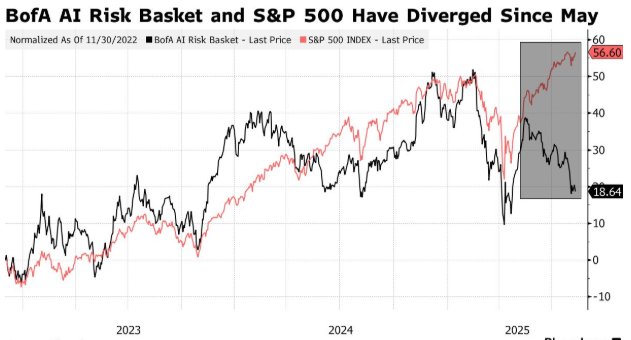
Group 1 - The impact of artificial intelligence (AI) on the U.S. financial market is significant, with companies like Nvidia (NVDA.US) reaching a market capitalization of nearly $4.5 trillion, while startups like OpenAI and Anthropic have raised billions [1] - Investors are increasingly concerned about the potential disruption caused by AI, leading to sell-offs in stocks of companies expected to see declining demand due to AI advancements, including Wix.com (WIX.US), Shutterstock (SSTK.US), and Adobe (ADBE.US) [1][5] - Since mid-May, the performance of the group of companies identified as most at risk from AI has lagged the S&P 500 index by approximately 22 percentage points [1] Group 2 - Daniel Newman, CEO of Futurum Group, indicated that the anticipated impact of AI on service-oriented industries may occur sooner than expected, potentially within two years instead of five [2] - Major tech companies like Microsoft (MSFT.US) and Meta (META.US) are investing hundreds of billions into AI research, causing investors to adopt a more cautious stance [5] - By 2025, Wix.com and Shutterstock's stock prices are projected to drop by at least 33%, while Adobe's stock is expected to decline by 23% due to fears of clients shifting to AI-generated content [5] Group 3 - Investor sentiment is turning negative as AI changes how information is accessed and how businesses operate, with even leading tech firms like Microsoft reducing jobs to allocate more resources for AI investments [6] - Gartner Inc. recently lowered its revenue forecasts, resulting in a 30% drop in its stock price, highlighting the market's concerns about AI's disruptive potential [6][9] - Historical precedents exist where new technologies have replaced old industries, raising fears that many companies may become obsolete due to AI [9] Group 4 - The current market dynamics show that AI is a dominant factor in determining stock winners and losers, contrasting with earlier concerns about competition from low-cost AI models in China [10] - Major companies like Microsoft, Meta, Alphabet, and Amazon are expected to invest approximately $350 billion in capital expenditures this fiscal year, a nearly 50% increase from the previous year, primarily for AI infrastructure [10] - Google is seen as well-positioned in the AI landscape, yet it is also included in the basket of companies assessed for AI risk, indicating ongoing concerns about its stock performance [10] Group 5 - Companies in the advertising sector, such as Omnicom Group, are facing significant challenges, with Omnicom's stock down 15% due to competition from AI-driven advertising solutions [11] - WPP, a competitor, has seen its stock price drop over 50%, reflecting the pressure on traditional advertising models from AI advancements [11][12] - Analysts predict that the investment theme surrounding AI risks will continue to gain traction as many companies face potential threats from AI technologies [12]


Adobe: Initiating Coverage; A Buy On Solid Fundamentals
Seeking Alpha· 2025-08-10 14:52
Company Overview - Adobe is a multinational software company valued at over $140 billion [2] - The company recently missed the opportunity to acquire Figma, which is now valued at nearly $40 billion [2] Investment Strategy - The Value Portfolio focuses on building retirement portfolios using a fact-based research strategy [2] - This strategy includes thorough analysis of 10Ks, analyst commentary, market reports, and investor presentations [2]

Adobe: Don't Count This Stock Out Yet As Firefly AI Drives New Subscribers
Seeking Alpha· 2025-08-10 13:10
Group 1 - The stock market is experiencing volatility but remains near all-time highs during the Q2 earnings season, indicating strong investor interest in large-cap momentum trades [1] - There is a noticeable trend of investors crowding into several momentum-driven large-cap stocks, particularly in the technology sector [1] Group 2 - The article highlights the author's extensive experience in covering technology companies and working with startups, which provides insights into current industry trends [1]
Figma敲钟背后:90后辍学少年,如何站上AI资本塔尖?
首席商业评论· 2025-08-06 04:16
Core Viewpoint - Figma's recent IPO marks a significant event in Silicon Valley, showcasing a resurgence in capital markets after a downturn in 2022 due to inflation and rising interest rates. CEO Dylan Field emphasizes the volatility of stock prices, reminding the team that they are merely snapshots of a moment in time [3][4]. Group 1: Figma's Founding and Growth - Dylan Field's entrepreneurial journey began with a $100,000 scholarship from Peter Thiel, which he used to co-found Figma with Evan Wallace, initially creating a simple 3D ball animation [5][7]. - Figma aimed to democratize design by providing a free web-based design tool, especially after Adobe discontinued its Fireworks software, creating a market opportunity [8][9]. - The company faced early challenges, including poor user feedback and slow progress, but a pivotal moment came with the hiring of Sho Kuwamoto, leading to the launch of a free preview version [9][10]. Group 2: Competitive Landscape and Acquisition Attempts - Adobe, a $1.7 trillion giant, recognized Figma as a competitor and attempted to acquire it, but Figma's real-time collaboration features gained traction during the pandemic, making it a necessity for remote teams [12][13]. - Field rejected Adobe's acquisition offers twice, asserting Figma's independence and vision, which led to a valuation exceeding $10 billion [12][13]. - Despite the acquisition discussions, regulatory challenges arose, ultimately preventing the deal and leading to a significant $1 billion breakup fee for Adobe [14][15]. Group 3: Financial Performance and Market Position - Figma's net revenue retention rate (NDR) dropped from 159% to 122% during the acquisition turmoil, raising concerns about customer loyalty and market stability [15][16]. - Following the failed acquisition, Figma's NDR rebounded to 132%, indicating resilience and a strong employee commitment, with 95% choosing to stay after a compensation adjustment [16][15]. Group 4: Future Prospects in AI - As Figma navigates the AI landscape, it introduced Figma Make, a tool designed to convert sketches into functional prototypes, but initial demonstrations faced technical issues [20][21]. - Critics question Figma's ability to replicate its design tool success in the AI domain, with some suggesting it appears to be lagging behind competitors [20][21]. - Field actively engages with user feedback to improve Figma Make, demonstrating a commitment to innovation and responsiveness to market needs [21].