Amazon(AMZN)

Search documents
Musk Empire Merger Possibility, Memory Costs Weigh on Apple | Bloomberg Tech 1/30/2026
Youtube· 2026-01-30 20:53
Group 1: Federal Reserve and Market Reactions - President Trump has nominated Kevin Warsh as the next Chair of the Federal Reserve, which is causing market reactions as investors speculate on his hawkish monetary policy stance [1][45]. - The market is currently experiencing a mixed picture, with the S&P 500 down approximately 0.5% and the NASDAQ 100 off by 0.6% [2][46]. - There is a notable concern regarding the impact of rising memory prices on tech companies, particularly Apple, which has reported record quarterly sales but faces investor anxiety over future gross margins [1][17]. Group 2: Apple and Memory Prices - Apple has delivered record quarterly sales, exceeding expectations, but is facing challenges due to rising memory prices, which CEO Tim Cook expects to significantly impact gross margins [17][51]. - The tight supply of memory chips is expected to persist, with analysts indicating that prices will remain higher than usual due to extremely high demand and limited producers [15][56]. - Despite strong sales, there is concern about Apple's ability to navigate future challenges, particularly with forecasts predicting a potential 1% drop in the smartphone market in 2026 [51][54]. Group 3: AI and Economic Implications - Kevin Warsh believes that AI will serve as a significant disinflationary force, improving productivity and potentially doubling standards of living within a generation [5][6]. - There is ongoing debate about the impact of AI on labor and the broader economy, with some experts expressing skepticism about the deflationary effects of AI amidst persistent inflationary pressures [10][12]. - The tech industry is closely monitoring how AI developments will influence market dynamics and regulatory frameworks, especially in light of Warsh's potential leadership at the Fed [4][7]. Group 4: SpaceX and Potential Mergers - SpaceX is reportedly considering a merger with Tesla or AI firm XAI, driven by investor interest in consolidating operations [28][29]. - The potential merger could streamline operations and enhance synergies between the companies, which already have a strong collaborative relationship [30][32]. - However, there are significant regulatory hurdles that could complicate any merger discussions, given the scale of the companies involved [33][34]. Group 5: Amazon and AI Investments - Amazon is reportedly in talks to invest $50 billion in OpenAI, aiming to strengthen its position in the AI market [41][42]. - This investment reflects Amazon's desire to enhance its AI capabilities and compete more effectively with rivals like Microsoft and Oracle [41][43]. - The evolving landscape of AI is leading to a shift in how companies approach partnerships and investments, with a focus on securing access to cutting-edge technologies [43][44].





Tech earnings: Investors reward companies that own the full stack of AI
Youtube· 2026-01-30 19:17
Deerra Bosa has more in today's tech check. Dearra, >> hey Kelly. So the early shift in earning season is how the market is pricing AI.It's become Googleesque, meaning that investors are rewarding companies that really own the full stack of AI. So through that lens, uh Meta spending it does look bullish. It's expensive, yes, but it's also internal.Meta controls the models, the infrastructure, the distribution. So that is the control the full control that the market is rewarding these days. Microsoft by cont ...



Amazon’s LTL offering reaching out to shippers as possible customers: report
Yahoo Finance· 2026-01-30 18:49
There are stirrings of the long-awaited entry into the LTL market by Amazon, according to a recent report from a leading Wall Street transportation analyst team. In a report released last week by the transportation team at Morgan Stanley led by Ravi Shanker, the investment bank said Amazon “appears to be in the early stages of reaching out to shippers regarding their LTL offering.” Morgan Stanley said a “trusted” shipper had told the company that Amazon (NASDAQ: AMZN) had said their LTL offering would s ...
Amazon Just Fired Thousands — And Somehow The Story Is About Discipline, Not Distress - Amazon.com (NASDAQ:AMZN)
Benzinga· 2026-01-30 17:33
Core Insights - Amazon has announced another round of layoffs, totaling around 30,000 positions or 10% of its corporate workforce since October [1] - The perception of layoffs has shifted from being seen as a failure to being viewed as a strategic move to enhance efficiency and control costs [2][5] Group 1: Layoff Trends - The recent layoffs at Amazon are part of a broader trend in the tech industry, where hundreds of thousands of jobs have been eliminated since 2022 [4] - The approach to layoffs in Europe has also evolved, with companies using terms like "strategic refocuses" to comply with labor laws while reducing staff [4] Group 2: Changing Perceptions - Layoffs are increasingly interpreted as a sign of corporate discipline rather than failure, reassuring investors about management's commitment to maintaining margins [5][6] - The framing of layoffs as proactive measures rather than reactive panic reflects a shift in corporate messaging [6] Group 3: Employee Psychology - The stigma associated with layoffs has diminished, with employees viewing them as part of broader business strategies rather than personal failures [7] - Job loyalty has eroded over time, with median job tenure decreasing significantly since 2012, indicating a shift in employee attitudes towards job security [8] Group 4: Market Dynamics - The rise of remote work has contributed to a trend where employees view their careers as markets, adapting to changes in strategic relevance rather than traditional loyalty [9][10] - Workers have learned that job security is linked to their strategic importance within the company, leading to a more market-oriented approach to career management [10]
Amazon Is Cutting 16,000 Jobs. Should You Buy, Sell, or Hold AMZN Stock Here?
Yahoo Finance· 2026-01-30 16:54
Amazon (AMZN) stepped up its restructuring efforts on Jan. 28 when it announced cutting 16,000 corporate jobs at the company. Roughly 4.6% of its corporate workforce. This has reminded people of the late 2022 and early 2023 period, when the firm laid off about 27,000 people. Beth Galetti, who is the senior vice president of people experience and technology at Amazon, has stated that these layoffs were a part of efforts to reduce bureaucracy and layers within the organization, which is quite bloated at an ...
《华盛顿邮报》员工敦促贝索斯停止裁员
Xin Lang Cai Jing· 2026-01-30 15:57
责任编辑:张俊 SF065 责任编辑:张俊 SF065 在战略动荡和订户流失的情况下,《华盛顿邮报》记者呼吁其所有者亚马逊(AMZN)首席执行官杰夫 ·贝索斯重新考虑大规模新闻编辑部裁员。贝索斯于2013年10月收购了《华盛顿邮报》。美股周五早 盘,亚马逊公司上涨0.15%。 在战略动荡和订户流失的情况下,《华盛顿邮报》记者呼吁其所有者亚马逊(AMZN)首席执行官杰夫 ·贝索斯重新考虑大规模新闻编辑部裁员。贝索斯于2013年10月收购了《华盛顿邮报》。美股周五早 盘,亚马逊公司上涨0.15%。 ...
Amazon Stock, Alphabet, Palantir Headline Another Busy Earnings Calendar


Investors· 2026-01-30 15:42
Amazon Stock, Alphabet, Palantir Headline Another Busy Earnings Calendar | Investor's Business DailyBREAKING: [Trump Names Warsh New Fed Chairman]---After an earnings sell-off for Microsoft (MSFT) and strong reports from Apple (AAPL) and Meta Platforms (META), attention turns to quarterly results from Alphabet (GOOGL), Amazon.com (AMZN) and Palantir Technologies (PLTR) in the coming week. Amazon stock came close to clearing a buy point Wednesday but reversed lower in higher volume, hurt by a stalling sessio ...
民主党执政州拟对高收入群体加税
Xin Lang Cai Jing· 2026-01-30 15:28
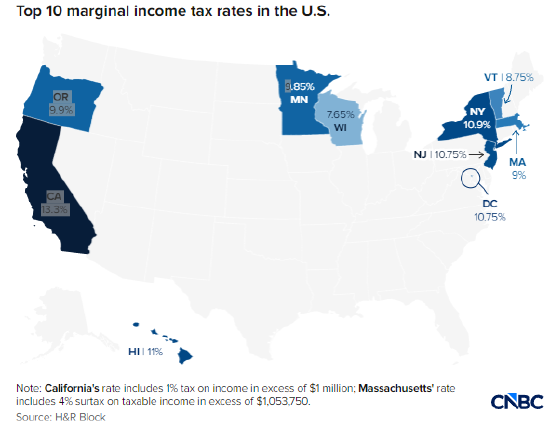
核心要点 弗吉尼亚、华盛顿、罗得岛等州纷纷加入加利福尼亚州的行列,呼吁对最高收入者和亿万富翁加税,一 波针对高收入群体的加税 "蓝潮" 正席卷美国各州议会。 眼下各州面临联邦财政援助可能缩减的局面,同时民粹主义抬头、经济贫富差距扩大,让民主党议员的 立场愈发坚定,多个民主党执政州的议员和州长正着手制定多项针对高收入群体的新税目。而另一边, 众多共和党执政州为提升自身竞争力,仍在不断下调甚至取消个人所得税。 城市研究所税收政策中心首席副研究员、州税专家露西・达达扬表示:"当前的鲜明趋势就是各州税收 政策的分化。一方面,部分州在减税、退税和提升税收竞争力上持续加码;另一方面,一些州则选择对 高收入者征收定向附加税,以此为快速增长的重点民生支出筹资,同时避免对广大民众加税。" 尽管左翼州议员几乎每年都会提议加税,但此次的加税推动行动声势更为浩大。通胀加剧了中低收入群 体的经济压力,民众再次呼吁对高收入者加税,以弥补医疗和教育成本的上涨。自新冠疫情以来,各州 财政支出持续攀升,财政增收的需求再次凸显。 多位民主党领导人还以马萨诸塞州对高收入者加税的实践为例,证明高收入群体并不会因此逃离。2022 年,马萨诸塞州选民通 ...
由于就业市场降温,美国大型公司计划裁员至少5.2万人
Xin Lang Cai Jing· 2026-01-30 14:48
Core Viewpoint - A significant number of large U.S. companies, including Amazon, UPS, Dow Chemical, Nike, and Home Depot, have announced plans to lay off over 52,000 employees, indicating a trend of workforce reduction amid ongoing economic uncertainty and increasing pressure to invest in artificial intelligence [1][4][5]. Group 1: Layoff Announcements - Amazon plans to cut 16,000 jobs in its second round of layoffs within three months, aiming to streamline bureaucracy [7]. - UPS will lay off up to 30,000 employees due to a decrease in package volume for Amazon deliveries, offering voluntary departure incentives [7]. - Dow Chemical will implement a comprehensive operational simplification plan, resulting in the reduction of 4,500 jobs [7]. Group 2: Economic Context - The layoffs reflect concerns from Federal Reserve policymakers and economists about a cooling job market after years of strong hiring [5]. - The U.S. economy added only 50,000 jobs in December, with the median duration of unemployment rising to 11.4 weeks, the longest since 2021 [2][5]. - Despite the increase in layoffs, the overall scale of layoffs in the past year is not considered unusually high compared to pre-pandemic levels [2][5]. Group 3: Labor Market Dynamics - Employers are hesitant to hire new employees or lay off existing ones, leading to stagnation in the job market [5]. - The unemployment rate decreased from 4.5% in November to 4.4% in December, showing signs of stabilization [5]. - The Federal Reserve has cut interest rates by 0.75 percentage points in response to signs of a cooling job market [6].


亚马逊“史上最大规模裁员潮”落地 AI又成背锅侠?
Zhong Guo Jing Ying Bao· 2026-01-30 14:43
Core Insights - The wave of layoffs in the tech industry, driven by AI advancements, is reshaping organizational structures and strategies, with Amazon leading the charge by announcing a reduction of approximately 16,000 positions in its China offices, following a previous cut of 14,000 in October 2025, totaling 30,000 employees or nearly 10% of its global workforce, marking the largest layoffs in its 30-year history [2][5] Group 1: Layoff Trends - The latest round of layoffs at Amazon primarily targets corporate functions, with significant cuts in HR and AWS administrative roles, as AI can now automate tasks such as resume screening and performance tracking, reducing recruitment cycles by 60% [3][5] - The layoffs reflect a shift from traditional performance-based criteria to a more functional approach, with even high-performing employees being affected, indicating a fundamental change in how companies assess workforce needs [3][5] Group 2: AI Investment and Strategy - Amazon's investment in AI surpassed $150 billion in 2025, marking the first time it exceeded human labor costs, signifying a shift in corporate financial logic from "human-centric" to "AI-centric" [5][6] - The trend of AI-driven layoffs is not isolated to Amazon; major companies like IBM, Microsoft, and Meta have also implemented significant workforce reductions, with IBM cutting 8,000 jobs and Microsoft reducing document processing roles by 30% due to AI integration [5][6] Group 3: Broader Industry Implications - The ongoing layoffs are indicative of a structural transformation in the tech industry, with AI targeting roles in HR, administration, and repetitive technical jobs, leading to a shrinking job market for entry-level programmers and white-collar positions [6] - Despite the risks, new opportunities are emerging, such as AI trainers and management roles, with demand for professionals who can effectively leverage AI technologies increasing significantly [6]