AstraZeneca(AZN)

Search documents
2026年服贸会首设出海专区
Bei Jing Wan Bao· 2025-12-26 08:24
Core Insights - The 2026 China International Service Trade Fair (CIFTIS) is scheduled to take place from September 9 to 13, 2026, at Shougang Park, with participation from over 10 countries and international organizations, including Norway and the World Intellectual Property Organization [1][2] - The fair will feature nearly 100 Fortune 500 companies and industry leaders, such as AstraZeneca, Eli Lilly, and Siemens, expressing intent to exhibit [1] - CIFTIS has successfully hosted 12 editions, attracting 1.47 million exhibitors and visitors from nearly 200 countries and regions [1] Group 1 - The 2026 CIFTIS will continue to host a high-profile Global Service Trade Summit, inviting foreign dignitaries, international organization leaders, and CEOs of multinational companies to speak [1] - The event will also include forums and meetings to facilitate discussions, consensus-building, and result announcements among various sectors [1] Group 2 - The fair will invite various parties to set up exhibitions and hold meetings, continuing to establish guest countries and provinces, and inviting international organizations and leading enterprises to showcase their strengths [2] - Specialized exhibitions will focus on key service trade areas such as financial services, cultural tourism, education, and sports, highlighting industry trends and showcasing new technologies and applications [2] - A new "Overseas Zone" and a small and medium-sized enterprise exhibition area will be introduced, showcasing China's foreign trade, particularly in service and technology exports [2]



中国首个用于“淀粉人”治疗的基因沉默剂获批
Xin Jing Bao· 2025-12-26 07:36
Core Insights - AstraZeneca and Ionis Pharmaceuticals have jointly developed Ipupronit Sodium Injection, which has been approved by the National Medical Products Administration for the treatment of adult patients with hereditary transthyretin amyloidosis polyneuropathy (ATTRv-PN) [1] - Ipupronit Sodium is the first and currently the only gene-silencing agent approved for the treatment of ATTRv-PN in China [1] Group 1: Disease Overview - ATTR is caused by the accumulation of misfolded TTR protein produced by the liver, leading to organ damage and failure, with various complications affecting cardiovascular, neurological, and renal health [2] - ATTR has multiple phenotypes, including ATTR-CM (primarily affecting the heart) and ATTRv-PN (primarily affecting the peripheral nervous system), with ATTRv-PN being a debilitating disease that can lead to motor function impairment within five years of diagnosis [2] - The average age of onset for patients in China is 42 years, with a range from 17 to 68 years, and there is a significant delay of 3 to 4 years from symptom onset to diagnosis due to low awareness among the public and healthcare professionals [2] Group 2: Treatment Insights - Ipupronit Sodium is a gene-silencing agent administered once a month, which works by upstream inhibition of TTR protein production, showing potential for treating various types of transthyretin amyloidosis [3] - The approval of Ipupronit Sodium provides new hope for ATTRv-PN patients, as clinical evidence indicates it can halt the progression of neuropathy and significantly improve neurological function and quality of life [3]

ATTRv-PN基因沉默剂万诺维在华获批
Huan Qiu Wang Zi Xun· 2025-12-25 09:00
Core Viewpoint - The approval of Wainua® (eplontersen) by AstraZeneca and Ionis for the treatment of ATTRv-PN in China represents a significant advancement in addressing a previously underserved medical need for patients suffering from this debilitating disease [1] Group 1: Product Approval - Wainua® is the first and currently the only gene-silencing agent approved in China for the treatment of ATTRv-PN [1] - The drug was officially approved on December 22, 2025, marking a milestone in the treatment options available for patients [1] Group 2: Disease Impact - ATTRv-PN is a debilitating disease that can lead to peripheral nerve damage, with patients typically experiencing motor function impairment within five years of diagnosis and a general mortality rate within ten years if untreated [1] - The disease has been included in China's second batch of rare disease catalog, highlighting its significance and the need for effective treatments [1] Group 3: Expert Commentary - Professor Zhang Shuyang, the chief researcher of EPIC-ATTR in China, emphasized the long-standing impact of ATTRv-PN on patients' neurological symptoms and quality of life, noting the limited treatment options available prior to the approval of Wainua® [1]
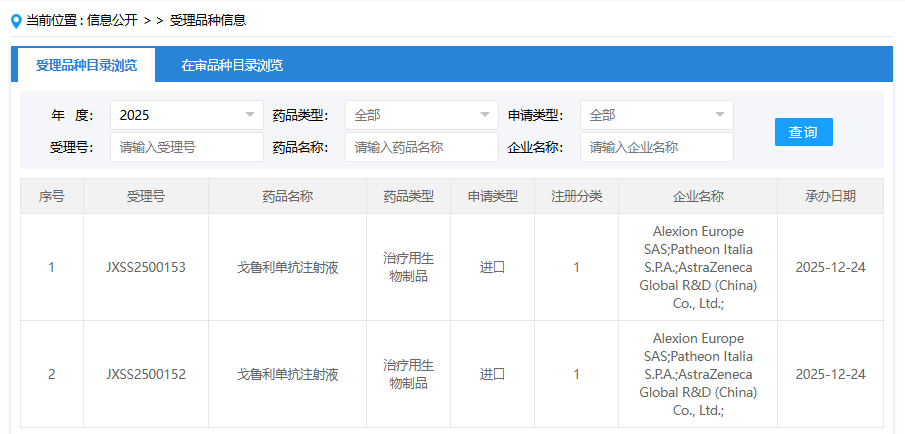
阿斯利康(AZN.US)自免双抗“戈鲁利单抗”在华申报上市
智通财经网· 2025-12-24 05:57
Core Viewpoint - AstraZeneca has submitted an application for the approval of gefurulimab in China, targeting generalized myasthenia gravis (gMG) as its indication, based on clinical trial progress [1] Group 1: Product Information - Gefurulimab is a mini bispecific antibody (25kD) that includes a variable region of the antibody heavy chain targeting C5 and an antibody fragment that specifically binds to albumin [1] - The smaller molecular weight of gefurulimab allows for better permeability, and its binding to albumin extends its half-life [1] Group 2: Disease Context - Generalized myasthenia gravis (gMG) is a rare, debilitating, chronic autoimmune neuromuscular disease that leads to muscle function loss and severe weakness [2] - Initial symptoms of gMG may include slurred speech, diplopia, ptosis, and weakness, with progression leading to more severe symptoms such as extreme fatigue, difficulty swallowing, choking, and respiratory failure [2]

ABBV vs. AZN: Which Pharma Stock is the Better Investment Now?
ZACKS· 2025-12-23 16:56
Core Insights - AbbVie (ABBV) and AstraZeneca (AZN) are both leading global healthcare companies with diverse drug portfolios, excelling in immunology and oncology, with AbbVie also focusing on neuroscience and aesthetics, while AstraZeneca emphasizes rare diseases and vaccines [1][2] AbbVie Overview - AbbVie has achieved significant success in immunology with three blockbuster drugs: Skyrizi, Rinvoq, and Humira, which together contribute nearly 50% of its revenue [3] - Despite losing U.S. exclusivity for Humira in 2023, AbbVie has returned to strong growth, with Skyrizi and Rinvoq sales increasing by 53% year-over-year to $18.5 billion, and projected to exceed $25 billion by 2025 [4] - The oncology segment generated approximately $5 billion in revenue in the first nine months of 2025, up nearly 3% year-over-year, while neuroscience drug sales rose over 20% to nearly $7.8 billion [5] - AbbVie has pursued an aggressive acquisition strategy, completing over 30 M&A transactions since early 2024, including acquiring Gilgamesh Pharmaceuticals for a drug in mid-stage development for major depressive disorder [6] - AbbVie faces near-term challenges, including biosimilar competition for Humira, pressure on Imbruvica sales, and a decline in its aesthetics franchise, which saw a 7% drop in sales in the first nine months of 2025 [7] AstraZeneca Overview - AstraZeneca has a diversified geographical presence and a portfolio of blockbuster drugs, including Imfinzi, Lynparza, Farxiga, Ultomiris, and Tagrisso, which are driving revenue growth [8][9] - The company aims for $80 billion in total revenues by 2030, supported by the launch of 20 new medicines, with nine already launched or approved [10] - AstraZeneca has also expanded its pipeline through acquisitions, including EsoBiotec, a biotech specializing in cell therapies [11] - Challenges for AstraZeneca include the impact of U.S. policy changes on oncology sales, ongoing investigations in China, and competition from generics and biosimilars affecting key drugs [12][13] Financial Estimates and Performance - The Zacks Consensus Estimate for AbbVie indicates an 8.2% increase in 2025 sales and a 5.1% increase in EPS, with recent EPS estimates declining from $11.04 to $10.64 [14] - For AstraZeneca, the 2025 sales and EPS estimates suggest a 9% and 11.9% increase, respectively, with EPS estimates rising from $4.56 to $4.60 [16] - Year-to-date, AbbVie shares have increased by 28%, while AstraZeneca shares have risen by 40%, outperforming the industry average of 17% [17] - AbbVie has a lower P/E ratio of 15.90 compared to AstraZeneca's 17.81, making AbbVie appear more attractive from a valuation perspective [18] - AbbVie offers a higher dividend yield of 2.88% compared to AstraZeneca's 1.10% [22] Comparative Analysis - Both companies hold a Zacks Rank of 3 (Hold), indicating a challenging decision for investors [24] - AbbVie's recovery post-Humira is notable, driven by Skyrizi and Rinvoq, but its reliance on acquisitions may weigh on near-term earnings [25] - AstraZeneca's growth profile is more balanced, with a diverse range of blockbuster products reducing reliance on any single drug [27]


5 Big Drug Stocks That May Continue to Outperform in 2026
ZACKS· 2025-12-23 14:51
Industry Overview - The drug and biotech sector has shown recovery after a weak first half, with large drugmakers signing pricing agreements with the Trump administration [1] - Dealmaking activity surged in the second half, boosting investor confidence, with the Large Cap Pharmaceuticals industry outperforming the S&P 500 in the past three months [1][4] - Innovation is at its peak, particularly in areas like obesity, cell and gene therapy, and next-gen oncology treatments, attracting investor attention [2] - Despite headwinds such as pipeline setbacks and regulatory risks, the outlook for growth in 2026 remains favorable due to rapid innovation and increased use of AI in drug development [2] Eli Lilly - Eli Lilly has achieved significant success with its tirzepatide medicines, including diabetes drug Mounjaro and weight loss medicine Zepbound, which are key revenue drivers [6][7] - Strong sales growth in 2025 is attributed to international market launches and improved production, with continued demand expected in 2026 [7] - Lilly is investing in obesity treatments with new molecules in clinical development, including orforglipron and retatrutide, with regulatory applications filed for orforglipron [8][9] - Despite challenges like declining product prices and competition in the GLP-1 market, Lilly's stock has risen 39.3% year to date, with 2026 earnings estimates improving from $30.78 to $33.61 per share [10] Johnson & Johnson - J&J has shown strong operational performance in 2025, with double-digit revenue growth from key brands despite the loss of exclusivity for Stelara [11] - The Innovative Medicine segment is expected to accelerate growth in 2026, driven by key products and new launches [12] - J&J's MedTech business has improved, with growth driven by acquired cardiovascular businesses and new product launches expected to contribute to 2026 growth [13][14] - The company has advanced its pipeline significantly and is on an acquisition spree, with a Zacks Rank of 2 (Buy) and a stock rise of 43.3% year to date [17] AbbVie - AbbVie faces declining sales from Humira due to loss of exclusivity but has successfully launched new immunology medicines Skyrizi and Rinvoq, generating combined sales of $18.5 billion in the first nine months of 2025 [18][19] - Strong market growth and new indications for these drugs are expected to drive future growth, alongside contributions from newer drugs [20] - AbbVie anticipates a high single-digit CAGR through 2029, supported by robust performance from Skyrizi and Rinvoq, with a Zacks Rank of 3 and a stock rise of 28.2% year to date [21][22] Amgen - Amgen's revenue growth is driven by key medicines like Repatha and new biosimilars, compensating for declines from mature drugs [23][24] - The company is focusing on obesity treatments with its candidate MariTide, which differentiates itself with a convenient dosing method [24] - Amgen's stock has risen 27.3% year to date, with 2026 earnings estimates increasing from $21.43 to $21.62 per share [25] AstraZeneca - AstraZeneca has several blockbuster drugs exceeding $1 billion in sales, with newer products contributing to growth despite losses from mature brands [26][27] - The company expects to achieve industry-leading top-line growth through 2030, with plans to launch 20 new medicines and generate $80 billion in total revenues [28] - AstraZeneca faces challenges such as competition and regulatory impacts but maintains a stable earnings estimate of $5.15 per share for 2026, with a stock rise of 10.7% year to date [29][30]



AZN, Daiichi's Enhertu Gets FDA Nod for First-Line Breast Cancer (Revised)
ZACKS· 2025-12-23 09:16
Core Insights - AstraZeneca PLC and Daiichi Sankyo received FDA approval for Enhertu as a first-line treatment for HER2-positive breast cancer, in combination with Roche's Perjeta [2][7] - The approval is based on the DESTINY-Breast09 study, which showed a significant improvement in progression-free survival (PFS) [5][8] - AstraZeneca will pay Daiichi Sankyo a $150 million milestone payment following this approval [3][7] Regulatory Approval - Enhertu was reviewed under the FDA's real-time oncology review (RTOR) program [3] - The drug is already approved in over 85 countries for second-line treatment of HER2-positive breast cancer and for other cancers [3] Clinical Study Results - The DESTINY-Breast09 study demonstrated a median PFS of 40.7 months for the Enhertu-Perjeta combination, compared to 26.9 months for the standard regimen [5][8] - The combination reduced the risk of disease progression by 44% compared to the current standard treatment [5][7] Market Performance - Over the past year, AstraZeneca's shares increased by 36.3%, outperforming the industry average rise of 12.1% [4]

AZN, Daiichi's Enhertu Gets Breakthrough Tag for Expanded Cancer Use
ZACKS· 2025-12-22 16:25
Core Insights - The FDA has granted Breakthrough Therapy designation to AstraZeneca and Daiichi Sankyo's Enhertu for expanded use in treating HER2-positive early breast cancer with residual invasive disease [1][2][7] - This marks the tenth Breakthrough Therapy designation for Enhertu, highlighting its potential to transform breast cancer treatment [2] - The designation is based on phase III DESTINY-Breast05 data, which indicates Enhertu may reduce invasive disease recurrence compared to current standard care [3] AstraZeneca's Stock Performance - AstraZeneca's shares have increased by 29.3% over the past six months, outperforming the industry average rise of 26.2% [4] Enhertu's Current Approvals and Developments - Enhertu is approved in over 85 countries for second-line treatment of HER2-positive breast cancer and has additional approvals for lung and gastric cancers [8] - Recently, the FDA approved Enhertu in combination with Roche's Perjeta as a first-line treatment for unresectable or metastatic HER2-positive breast cancer based on phase III DESTINY-Breast09 data [9] Partnership and Development Strategy - AstraZeneca and Daiichi Sankyo are jointly responsible for developing and marketing Enhertu globally, except in Japan where Daiichi has exclusive rights [11] - Both companies are pursuing extensive development programs for Enhertu and Datroway across multiple tumor types [11] Recent Study Outcomes - AstraZeneca's phase III LATIFY study, evaluating ceralasertib with Imfinzi in lung cancer, did not meet its primary overall survival goal [12] - The LATIFY study focused on patients without actionable genomic alterations whose disease progressed after prior treatments [13] Imfinzi Sales Performance - Imfinzi generated $4.32 billion in sales during the first nine months of 2025, reflecting a 25% increase driven by demand in lung and liver cancer indications [14]

AstraZeneca Drug Combination Falls Short of Goal in Lung-Cancer Trial
WSJ· 2025-12-22 07:39
Core Viewpoint - The pharmaceutical company announced that its ceralasertib combination did not achieve the primary objective in a late-stage clinical trial for advanced lung cancer [1] Group 1 - The clinical trial was focused on advanced lung cancer [1] - The primary goal of the trial was not met, indicating potential challenges in the drug's efficacy [1]

AstraZeneca's ceralasertib-Imfinzi combo misses survival target in lung cancer trial
Reuters· 2025-12-22 07:22
Core Viewpoint - AstraZeneca announced that a late-stage trial of Imfinzi combined with ceralasertib did not show an improvement in overall survival for patients with previously treated advanced non-small cell lung cancer [1] Group 1 - The trial aimed to evaluate the efficacy of Imfinzi in combination with ceralasertib [1] - The patient population consisted of those with advanced non-small cell lung cancer who had previously undergone treatment [1] - The failure of the trial may impact AstraZeneca's strategy in the oncology sector [1]