Barclays(BCS)

Search documents
Barclays share price forms risky patterns ahead of earnings
Invezz· 2026-02-09 08:45
Barclays share price forms risky patterns ahead of earnings false### Choose your country### Choose preferred languagePopular languagesEnglish (USA) [Deutsch] [Español] [Français] [Português]All available languagesEnglish (USA) [English (UK)] [English (Australia)] [English (Canada)] [English (New Zealand)] [English (South Africa)] [English (Ireland)] [English (Singapore)] [English (Nigeria)] [English (Pakistan)] [English (India)] [eština] [Deutsch] [Dansk] [Español] [Français] [Italiano] [] [Melayu] [Nederla ...



下周资本市场大事提醒:美国通胀、非农数据连环发布 中芯、网易等财报将亮相 国产AI大模型扎堆上新
Xin Lang Cai Jing· 2026-02-08 13:27
Economic Data - The People's Bank of China will release January CPI and PPI on February 11 [1] - The National Bureau of Statistics will publish the monthly report on January commodity residential sales price index on February 13 [1] - Financial data including January social financing and new RMB loans will also be released next week [1] - In the US, December retail sales month-on-month will be announced on February 10, followed by January unemployment rate and non-farm employment data on February 11 [1] Earnings Reports - The US earnings season continues with several notable companies reporting next week, including BP, Barclays, Marriott, Coca-Cola, and AstraZeneca on February 10 [2] - Other companies such as NetEase, Youdao, and Total will report on February 11, while TripAdvisor and Hyatt will report on February 12 [2] - In Hong Kong, SMIC will report earnings on February 10, followed by Budweiser APAC and NetEase Cloud Music on February 11 [2] New Stock Issuance - One new stock, Tongbao Optoelectronics, will be available for subscription on February 9, with Ai De Technology listing on the Beijing Stock Exchange on February 10 [2] - Several new stocks will list in Hong Kong, including Lanke Technology on February 9 and Aixin Yuanzhi on February 10 [2] Stock Unlocking - A total of 33 restricted stocks will be unlocked next week, with a total market value exceeding 36 billion yuan, led by Hunan YN with 24.096 billion yuan [3][10] Central Bank Operations - The central bank will have 4.055 billion yuan of reverse repos maturing next week, with specific amounts maturing each day [3][10] Government Bonds - The Ministry of Finance will issue the first phase of RMB government bonds in Hong Kong on February 11, with a scale of 14 billion yuan [13]




外媒:投资者对美国对冲基金兴趣减弱,更多投向亚洲和欧洲
Huan Qiu Wang· 2026-02-08 01:56
【环球网财经综合报道】据路透社报道,投资者对美国对冲基金的兴趣正在减弱,这是自2023年以来的首次。报道根据巴克莱银行对342名管理总资产7.8万 亿美元的投资者进行的调查,美国和欧洲的投资者表示,今年他们计划增加对美国对冲基金敞口的幅度将比2025年减少5%,同时会将资金更多投向亚洲和 欧洲的基金管理人。 路透社援引巴克莱的报告称,自2024年低点以来,投资者对亚太对冲基金的兴趣增长了一倍。在2025年11月和12月进行的调查中,欧洲投资者告诉该行,他 们向欧洲管理人投入资金的意愿提高了8%。对亚洲对冲基金管理人的兴趣增长了约10%。 受访者称,对冲基金费率仍处于历史高位。传统对冲基金产品的平均管理费和业绩费在2025年达到峰值,而将成本转嫁给投资者的那种类型费率有所下降。 自2023年以来,投资者在总回报中的份额已从约47%上升至56%。报告补充说,投资者今年整体对冲基金回报率也增长了约5%。 巴克莱银行表示,基于宏观经济因素做出投资决策的对冲基金以及系统性交易股票的对冲基金获得了最高的净配置者数量。调查结果显示,股票市场中性是 2026年最受青睐的策略,其次是从2020年以来就一直最受欢迎的量化多策略。 ...
Investors look beyond US hedge funds for the first time since 2023, Barclays says
Reuters· 2026-02-06 14:44
Core Viewpoint - Investors are planning to reduce their exposure to U.S. hedge funds for the first time since 2023, influenced by discussions surrounding the "Sell America" trade [1] Group 1 - The trend of decreasing investment in U.S. hedge funds marks a significant shift in investor sentiment [1] - The discussions about the "Sell America" trade have gained traction, indicating a potential change in market dynamics [1] - This shift could reflect broader economic concerns and changing investment strategies among institutional investors [1]

Lincoln Electric to Present at the Barclays 43rd Annual Industrial Select Conference
Businesswire· 2026-02-06 12:30
Core Viewpoint - Lincoln Electric Holdings, Inc. will participate in the Barclays 43rd Annual Industrial Select Conference on February 17, 2026, at 10:25 a.m. Eastern Time, where key executives will present [1] Group 1 - Steve Hedlund, Chairman and CEO, and Gabriel Bruno, Executive Vice President and CFO, will represent the company at the conference [1] - The presentation will be available via webcast on the company's Investor Relations website [1] - A replay of the presentation will also be accessible [1]


Solstice Advanced Materials to Participate in Fireside Chat at the Barclays Industrial Select Conference
Prnewswire· 2026-02-06 12:00
Core Viewpoint - Solstice Advanced Materials will participate in the Barclays Industrial Select Conference on February 19, 2026, with CEO David Sewell leading a discussion [1]. Company Overview - Solstice Advanced Materials is a leading global specialty materials company focused on advancing science for smarter outcomes [2]. - The company provides high-performance solutions for critical industries, including refrigerants, semiconductor manufacturing, data center cooling, nuclear power, protective fibers, and healthcare packaging [2]. - Solstice is recognized for developing next-generation materials under renowned brands such as Solstice, Genetron, Aclar, Spectra, Fluka™, and Hydranal™ [2]. - The company partners with over 3,000 customers across more than 120 countries and territories, supported by a robust portfolio of over 5,700 patents and pending applications [2]. - Solstice employs approximately 4,000 people worldwide, driving innovation in materials science [2].

软件崩盘的“蝴蝶效应”:BDC→私募信贷→金融板块?
Hua Er Jie Jian Wen· 2026-02-06 10:28
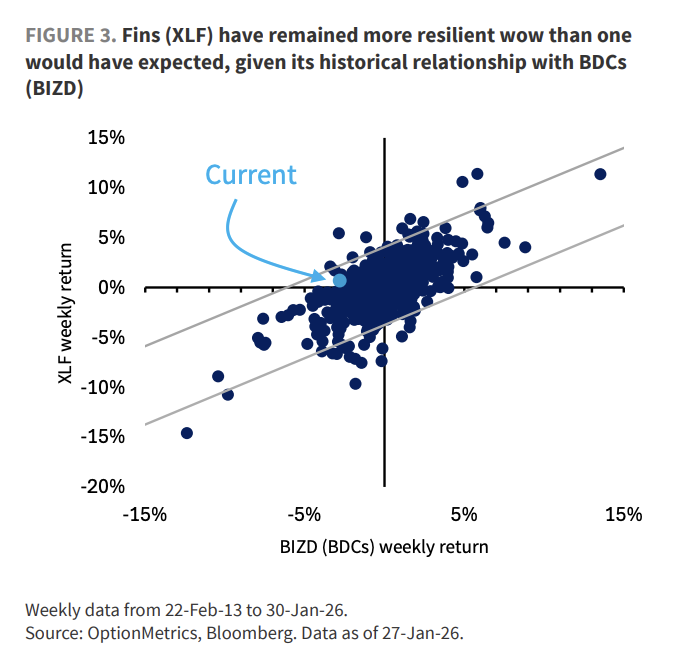
Group 1 - The core viewpoint of the report is that the significant decline in the software industry is transmitting risks to the private credit market through Business Development Companies (BDCs) [1][2] - BDCs have a high concentration of risk exposure in the software sector, accounting for approximately 20% of their portfolios, making them vulnerable to the recent downturn in software stock prices [2] - The software sector has experienced a cumulative decline of about 21% year-to-date, leading to a notable deterioration in the quality of underlying assets [1][2] Group 2 - Financial ETFs and high-yield bond ETFs show a persistent and significant statistical correlation with private credit returns, indicating that the financial sector has not fully priced in the potential risks from the software sector's decline [2] - Despite the weakening BDC index, financial ETFs remain relatively strong, suggesting a possible lag in market adjustments to the emerging risks [2] Group 3 - The report highlights a structural divergence in market volatility pricing, with commodity asset volatility at historically high levels, while fixed income and financial sector volatility remains at historically low levels [4] - The implied volatility for commodities like U.S. crude oil, silver, and gold ETFs is at the 99%-100% historical percentile, reflecting strong market pricing of geopolitical risks and currency devaluation expectations [4] Group 4 - Current market sentiment indicators show extreme polarization, with bearish sentiment concentrated in small-cap and technology sectors, while assets like gold and natural gas exhibit strong bullish expectations [5] - The skewness in options pricing indicates that the cost of downside protection for the Nasdaq 100 and materials sector is significantly high, while oil and gas options are priced more moderately [6] Group 5 - The report identifies high-quality hedging tools for different asset classes, suggesting that high-yield bonds and financial sector put options offer optimal risk-reward ratios for hedging against global equity market risks [7] - For large-cap tech stock downside risks, high-yield bonds and investment-grade corporate bonds provide effective protection, while for commodities, high-yield bonds and energy sector ETFs are recommended [7] Group 6 - The commodity sector is under significant pressure, with its volatility and term structure Z-scores notably above long-term averages, indicating that market pressures are far beyond normal levels [8] - Cross-asset correlations are currently at a high level of 73%, suggesting that the diversification effect of asset allocation is diminishing, while internal correlations within the U.S. stock market remain at a historical low of 2% [8]
United Airlines to Present at Barclays 43rd Annual Industrial Select Conference
Prnewswire· 2026-02-05 15:00
Group 1 - United Airlines will present at the Barclays 43rd Annual Industrial Select Conference on February 18, 2026, at 8:40 a.m. EST [1] - Mike Leskinen, Chief Financial Officer, will discuss current trends affecting the business during the webcast [1] - The live webcast will be accessible on the investor relations section of United's website and will be archived within 24 hours [1] Group 2 - United operates the most comprehensive global route network among North American carriers and is the largest airline in the world by available seat miles [2] - The company is traded on the Nasdaq under the symbol "UAL" [2]


Barclays Harnesses GenAI to Deliver World-Class Customer Service
Businesswire· 2026-02-05 13:06
WILMINGTON, Del.--(BUSINESS WIRE)--Barclays US Consumer Bank is leveraging generative artificial intelligence (GenAI) to create comprehensive summaries of interactions with customers across its contact centers to drive efficiencies and transform customer experience. Using GenAI, customer service calls are summarized by capturing key details such as the reason for the call, actions taken, and next steps. This AI-generated information gives agents the context needed to make quick, informed decisi. ...

Barclays (BCS) Is Up 2.10% in One Week: What You Should Know
ZACKS· 2026-02-04 18:01
Momentum investing is all about the idea of following a stock's recent trend, which can be in either direction. In the "long context," investors will essentially be "buying high, but hoping to sell even higher." And for investors following this methodology, taking advantage of trends in a stock's price is key; once a stock establishes a course, it is more than likely to continue moving in that direction. The goal is that once a stock heads down a fixed path, it will lead to timely and profitable trades.Even ...