
BeiGene(BGNE)

Search documents
百济神州上涨2.04%,报316.0美元/股,总市值374.30亿美元
Jin Rong Jie· 2025-08-15 13:54
Core Insights - BeiGene, Ltd. (百济神州) is a commercial-stage biotechnology company focused on developing and commercializing innovative molecular targeted and immunotherapy drugs for cancer treatment [2] - The company's stock opened at $316.0 per share, with a market capitalization of $37.43 billion as of August 15 [1] Financial Performance - As of June 30, 2025, BeiGene reported total revenue of $2.433 billion, representing a year-over-year growth of 44.73% [1] - The net profit attributable to the parent company reached $95.59 million, showing a significant increase of 125.73% compared to the previous year [1] Product Portfolio - BeiGene has a comprehensive product portfolio that includes six internally developed clinical candidates, three of which are in late-stage clinical trials: zanubrutinib (BTK inhibitor), tislelizumab (PD-1 antibody), and pamiparib (PARP inhibitor) [2] - The company has also obtained licensing rights for five drugs and investigational products, including three drugs (ABRAXANE, REVLIMID, and VIDAZA) exclusively licensed from Celgene, which are already marketed in China [2]
百济神州(688235) - 港股公告:审计委员会行动通告
2025-08-15 10:46
香港交易及結算所有限公司及香港聯合交易所有限公司對本公告的內容概不負責,對其準確性 或完整性亦不發表任何聲明,並明確表示概不就因本公告全部或任何部分內容而產生或因依賴 該等內容而引致的任何損失承擔任何責任。 BeOne Medicines Ltd. 百濟神州有限公司 (根據瑞士法律註冊成立的公司) (股份代號:06160) 審計委員會行動通告 百濟神州有限公司(「本公司」)謹此公佈,本公司董事會(「董事會」)審計委員會 將於2025年8月28日審議及批准(其中包括)本公司及其附屬公司截至2025年6月 30日止六個月的中期業績及根據香港聯合交易所有限公司證券上市規則(「香港上 市規則」)刊發中期業績。本公司先前於2025年8月6日公佈其截至2025年6月30日 止三個月及六個月的中期業績,並以提交表格10-Q的方式將其季度業績送交美國 證券交易委員會(「美國證券交易委員會」)存案。本公司根據香港上市規則將刊發 的中期業績與本公司先前已公佈並送交美國證券交易委員會存案者相同,惟根據 香港上市規則所要求的指定附加資料及將本公司的中期業績從美國公認會計原則 與國際財務報表準則進行核對的結果除外。 承董事會命 百濟神 ...
百济神州(06160) - 审计委员会行动通告
2025-08-15 09:14
香港交易及結算所有限公司及香港聯合交易所有限公司對本公告的內容概不負責,對其準確性 或完整性亦不發表任何聲明,並明確表示概不就因本公告全部或任何部分內容而產生或因依賴 該等內容而引致的任何損失承擔任何責任。 承董事會命 百濟神州有限公司 主席 歐雷強先生 香港,2025年8月15日 於本公告日期,本公司董事會包括主席兼執行董事歐雷強先生、非執行董事 王曉東博士,以及獨立非執行董事Olivier Brandicourt博士、Margaret Han Dugan 博士、Michael Goller先生、Anthony C. Hooper先生、Ranjeev Krishana先生、 Alessandro Riva博士、Corazon (Corsee) D. Sanders博士、Shalini Sharp女士及 易清清先生。 BeOne Medicines Ltd. 百濟神州有限公司 (根據瑞士法律註冊成立的公司) (股份代號:06160) 審計委員會行動通告 百濟神州有限公司(「本公司」)謹此公佈,本公司董事會(「董事會」)審計委員會 將於2025年8月28日審議及批准(其中包括)本公司及其附屬公司截至2025年6 ...
泉果基金调研百济神州,2025年全年总收入指引为50亿美元至53亿美元
Xin Lang Cai Jing· 2025-08-15 07:56
Core Viewpoint - The company has demonstrated strong commercial performance and growth in its product portfolio, particularly with its leading BTK inhibitor, Baiyueze, which has achieved significant market share and revenue growth in various regions [3][6][9]. Group 1: Financial Performance - In Q2 2025, the company reported total revenue of $1.3 billion, a year-over-year increase of 42% [3][6]. - Baiyueze's global revenue reached $950 million, reflecting a 49% increase year-over-year, solidifying its position as the leading BTK inhibitor in the U.S. market [6][9]. - The gross margin improved from approximately 85% to 87.4%, driven by a favorable product mix and production cost efficiencies [6][9]. Group 2: Product Development and Pipeline - The company has submitted the first NDA for Sotokura for the treatment of relapsed/refractory CLL patients and plans to submit a global application for MCL indications later this year [4][5]. - The company is advancing over 20 Phase 3 trials and expects to achieve more than 10 concept validation data readouts by the end of 2026 [3][4]. - The company is focusing on expanding its product pipeline in various disease areas, including breast cancer and solid tumors, with a strategic emphasis on rapid clinical concept validation [5][12]. Group 3: Market Expansion and Regulatory Approvals - Baiyueze has been approved in 75 markets globally, with recent expansions in reimbursement coverage in five new markets [8][9]. - Baiyuean has been approved in 47 markets, with 20 new markets added for reimbursement, including Japan, Europe, and Australia [8][9]. - The company anticipates continued growth in revenue from diverse geographic markets, with the U.S. and China being the largest contributors [9][10]. Group 4: Future Guidance - The company updated its 2025 revenue guidance to a range of $5 billion to $5.3 billion, reflecting strong growth expectations for Baiyueze and ongoing market expansion [6][9]. - The company aims to achieve positive GAAP operating profit and expects to generate positive free cash flow for the year [6][9].
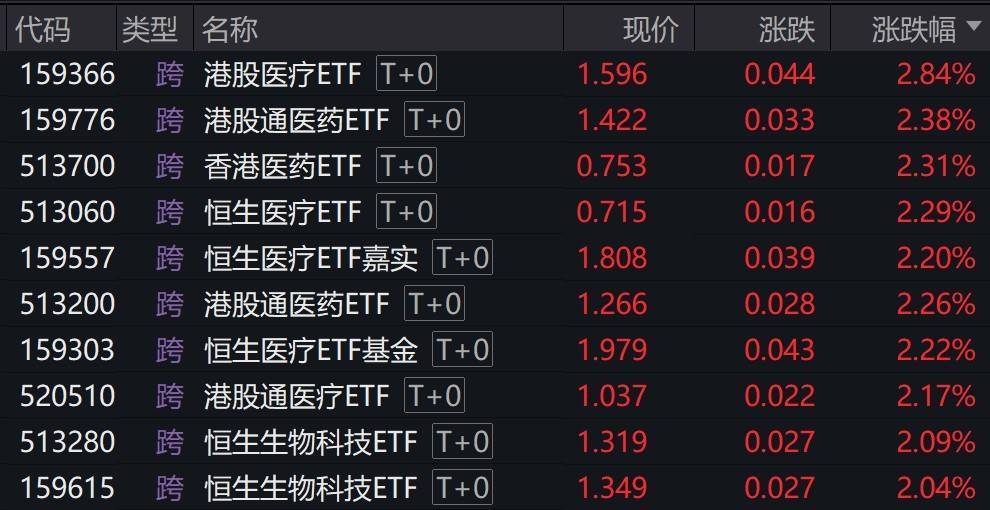
港股医药、医疗概念股盘中大涨,相关ETF涨超2%
Sou Hu Cai Jing· 2025-08-15 02:47
Group 1 - Hong Kong pharmaceutical and healthcare stocks experienced significant gains, with JD Health rising over 14%, Ping An Good Doctor increasing over 10%, and China National Pharmaceutical Group up over 4% [1] - Other notable stocks included Baijie Shenzhou, CSPC Pharmaceutical Group, and 3SBio, each rising over 3% [1] - The positive market sentiment also led to a rise in Hong Kong healthcare and Hong Kong Stock Connect pharmaceutical ETFs, which increased by over 2% [1] Group 2 - Analysis indicates that multinational pharmaceutical companies have significantly increased their procurement of innovative drug patents in China, with procurement amounts from January to May nearing the total expected for the entire year of 2024 [2] - This trend highlights the competitive strength of China's innovative drugs in the international market, suggesting that the acceleration of patent procurement by large multinational companies is likely to continue in the medium to long term [2]



高瓴HHLR二季度美股持仓:31亿美元九成押注中概股,拼多多稳居第一
Jin Rong Jie· 2025-08-14 22:39
Core Insights - HHLR Advisors, a fund management platform under Hillhouse Capital, reported a total market value of $3.105 billion in its U.S. stock holdings as of the end of Q2 2025, with over 90% allocated to Chinese concept stocks, indicating a long-term bullish outlook on quality Chinese assets [1] Group 1: Holdings Overview - Eight out of the top ten holdings of HHLR are Chinese concept stocks, with Pinduoduo being the largest position, having increased by 20% year-to-date [1] - Futu Holdings has seen a remarkable year-to-date increase of 106%, reflecting strong performance among HHLR's key investments [1] - Other notable holdings include BeiGene, NetEase, Alibaba, and Legend Biotech, all of which have shown significant performance [1] Group 2: Recent Changes in Holdings - In Q2, HHLR increased its positions in Futu Holdings and Pinduoduo while partially reducing its stakes in Alibaba, Beike, and NetEase, which have experienced substantial price increases of 52% and 54% respectively year-to-date [1] - This adjustment in holdings suggests a strategy focused on locking in profits and optimizing asset allocation in a high market environment [1] Group 3: New Entrants - For the first time, Moomoo Securities entered HHLR's top ten holdings, with Hillhouse having participated in multiple financing rounds since 2021; Moomoo went public on NASDAQ in April this year, currently valued at approximately $7.5 billion [1]


中华交易服务香港生物科技指数上涨2.22%,前十大权重包含百济神州等
Jin Rong Jie· 2025-08-14 13:56
Group 1 - The core index, the CESHKB, increased by 2.22% to 9684.5 points with a trading volume of 19.513 billion [1] - The CESHKB index has risen by 21.28% over the past month, 67.37% over the past three months, and 111.44% year-to-date [1] - The index is designed to reflect the overall performance of biotechnology companies listed in Hong Kong, with a base date of December 12, 2014, and a base point of 2000.0 [1] Group 2 - The top ten holdings of the CESHKB index include: - CanSino Biologics (13.85%) - Innovent Biologics (9.49%) - WuXi Biologics (8.72%) - 3SBio (8.71%) - BeiGene (8.39%) - WuXi AppTec (7.03%) - Kintor Pharmaceutical (5.02%) - Zai Lab (4.33%) - Nuo Therapeutics (3.91%) - Kingstar Biotech (3.8%) [1] - The CESHKB index is fully composed of companies listed on the Hong Kong Stock Exchange, with 100% of its holdings in the healthcare sector [2]
8月14日汇添富医疗积极成长一年持有混合A净值增长1.04%,今年来累计上涨66.59%
Sou Hu Cai Jing· 2025-08-14 12:38
Group 1 - The core viewpoint of the news is the performance and holdings of the Huatai Fuhua Medical Active Growth One-Year Holding Mixed Fund A, which has shown significant returns in various time frames [1] - As of June 30, 2025, the fund's total assets amount to 1.922 billion yuan, with a recent net value of 0.8263 yuan, reflecting a growth of 1.04% [1] - The fund has achieved a return of 15.15% over the past month, 63.14% over the past six months, and 66.59% year-to-date, ranking 506 out of 4688, 60 out of 4532, and 84 out of 4490 respectively in its category [1] Group 2 - The top ten stock holdings of the fund account for a total of 61.79%, with significant positions in companies such as Sanofi (10.07%), Innovent Biologics (8.94%), and Kelun-Biotech (8.71%) [1] - The fund was established on August 21, 2020, and is managed by Zheng Lei, who has extensive experience in the medical and healthcare investment sector [2]

百济神州: 港股公告:授出受限制股份单位
Zheng Quan Zhi Xing· 2025-08-14 11:11
Core Viewpoint - BeOne Medicines Ltd. has granted restricted stock units (RSUs) to 375 participants under the 2016 Option and Incentive Plan, totaling 34,361 American Depositary Shares (ADS), equivalent to 446,693 shares, representing approximately 0.03% of the company's total issued shares as of the announcement date [1]. Summary by Relevant Sections Grant Details - Grant Date: August 8, 2025 - Number of Participants: 375 - Total Number of RSUs Granted: 34,361 ADS - Total Number of Related Shares: 446,693 - Grant Price: $288.18 per ADS (approximately HKD 174.02 per ordinary share) [1]. Vesting Schedule - RSUs will vest 25% annually on the last trading day of each month for four years, contingent on the participants maintaining a service relationship with the company [1]. - For four non-senior management participants, RSUs will vest 25% annually on July 31 for four years, also contingent on continued employment [1]. Additional Information - The RSUs granted do not have performance targets and are considered competitive and in line with the company's practices [1]. - After this grant, there are still 59,660,288 shares available for future grants under the 2016 Option and Incentive Plan [1].
百济神州(688235) - 港股公告:授出受限制股份单位
2025-08-14 11:00
香港交易及結算所有限公司及香港聯合交易所有限公司對本公告的內容概不負責,對其準確性 或完整性亦不發表任何聲明,並明確表示概不就因本公告全部或任何部分內容而產生或因依賴 該等內容而引致的任何損失承擔任何責任。 BeOne Medicines Ltd. 百濟神州有限公司 (根據瑞士法律註冊成立的公司) (股份代號:06160) 授出受限制股份單位 本公告乃根據上市規則第17.06A、17.06B以及17.06C條作出。於2025年8月8日, 董事會薪酬委員會根據2016期權及激勵計劃的條款向三百七十五名承授人授出涉 及合共34,361股美國存託股份的受限制股份單位。 2016期權及激勵計劃項下的受限制股份單位 受限制股份單位詳情如下: 1 授出日期: 2025年8月8日 承授人數目: 三百七十五名 已授出受限制股份單位涉及 的相關股份數目: 446,693 受限制股份單位總數(美國 存託股份): 34,361 因已授出受限制股份單位獲 歸屬而可予獲得的新美國 存託股份總數: 34,361 授出的代價: 零 美國存託股份於授出日期 的收市價: 於2025年8月8日,董事會薪酬委員會根據2016期權及激勵計劃的條款授 ...