
百泽安

Search documents
首次实现年度盈利!百济神州2025年净利润2.87亿美元,营收增长40%至53.43亿美元
Hua Er Jie Jian Wen· 2026-03-25 18:32
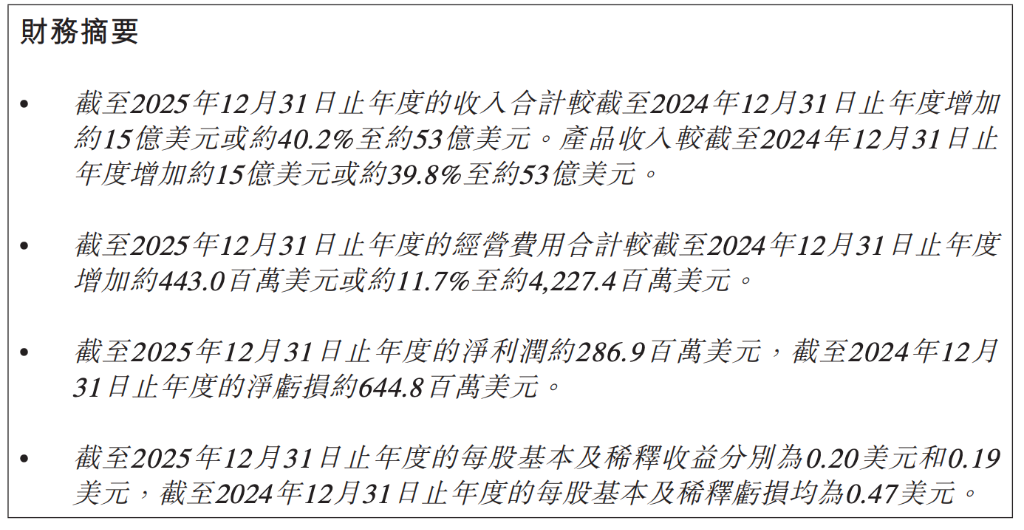
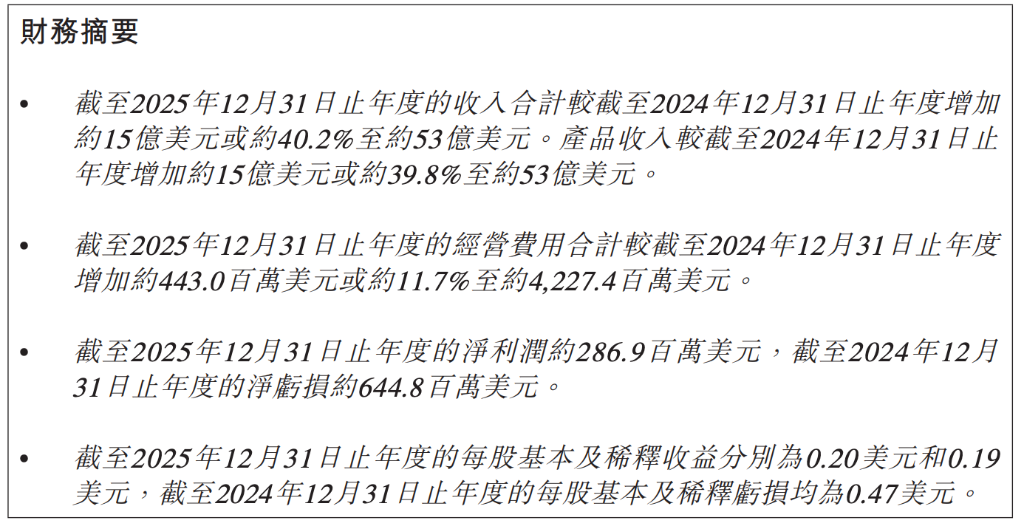
Core Insights - The company achieved a total revenue of $5.343 billion in 2025, marking a year-on-year growth of 40.2%, with product revenue netting $5.282 billion, up 39.8% [1][3] - The company recorded a net profit of $287 million in 2025, a significant turnaround from a net loss of $645 million in the previous year, indicating a sustainable growth phase for its business model [1][3] Revenue Breakdown - The core product, Baiyueze, generated global sales of $3.928 billion, reflecting a 48.6% increase and maintaining its leading position among BTK inhibitors [1][3] - Baiyueze accounted for approximately 74% of total product revenue, while Baizean (Tislelizumab) contributed $737 million, up 18.8% [3] - Other products included Anjavi (Denosumab) with $306 million in revenue, up 36.4%, and Beilitai (Bonetuzumab) with $104 million, up 40.2% [3] Cash Flow and Profitability - Cash and cash equivalents reached $4.548 billion by the end of 2025, a 73.1% increase, with net cash flow from operating activities at $1.128 billion, a turnaround from a net outflow of $141 million in the previous year [1][3] - The gross profit for 2025 was $4.667 billion, with a gross margin of 87.3%, an improvement from 84.3% in 2024 [4] Cost Management - The increase in gross margin was attributed to a higher proportion of high-margin Baiyueze sales, ongoing optimization of manufacturing costs, and the gradual operationalization of the Hopewell production facility [4] - Research and development expenses rose to $2.146 billion, a 9.9% increase, while sales and administrative expenses reached $2.081 billion, up 13.7% [5][7] Financial Health - As of the end of 2025, total assets amounted to $8.189 billion, with shareholder equity at $4.361 billion and total liabilities at $3.827 billion [7] - The company secured a credit agreement with HSBC and other financial institutions for approximately $768 million to refinance short-term operational funding [7] Pipeline Progress - The company is advancing its pipeline with the approval of Sotoclis (a next-generation BCL2 inhibitor) for treating relapsed or refractory mantle cell lymphoma and chronic lymphocytic leukemia, with FDA priority review status [8] - The HERIZON-GEA-01 study for Baihe'an (Zanidatamab) achieved positive endpoints, paving the way for a market application for HER2-positive gastric esophageal adenocarcinoma [8]


首次实现年度盈利!百济神州2025年净利润2.87亿美元,营收增长40%至53.43亿美元|财报见闻
Hua Er Jie Jian Wen· 2026-03-25 13:01
Core Insights - The company achieved a milestone in 2025 by recording a net profit of $287 million, successfully turning around from a net loss of $645 million in the previous year, marking its first annual profit since inception [1] - Total revenue for the year reached $5.343 billion, representing a year-on-year growth of 40.2%, with product revenue netting $5.282 billion, up 39.8% [1] Revenue Breakdown - The core product, Baiyueze, generated $3.928 billion in global sales, a 48.6% increase, maintaining its leading position among BTK inhibitors [3] - Bai Ze An (Tislelizumab) contributed $737 million, growing by 18.8% [3] - Other products included Anjiao Wei (Denosumab) at $306 million, up 36.4%, and Beili Tuo (Bonetuzumab) at $104 million, up 40.2% [3] - Other income reached $60.97 million, a significant increase of 98.6%, primarily from royalties related to the collaboration with Amgen [4] Profitability and Cash Flow - Gross profit for 2025 was $4.67 billion, with a gross margin of 87.3%, up from 84.3% in 2024, driven by improved product mix and manufacturing efficiencies [5] - The company reported a net cash flow from operating activities of $1.128 billion, a turnaround from a net outflow of $141 million in the previous year [1] Cost Structure and Efficiency - Research and development expenses totaled $2.146 billion, a 9.9% increase, while sales and administrative expenses were $2.081 billion, up 13.7% [6] - The combined expenses accounted for 78.6% of product revenue, down from 90.2% the previous year, indicating improved operational leverage [6] Financial Health - As of the end of 2025, total assets were $8.189 billion, with shareholder equity at $4.361 billion and total liabilities at $3.827 billion [8] - The company secured approximately $768 million in term loans from financial institutions for refinancing short-term operational funding [8] Pipeline Progress - The company is advancing its pipeline with the approval of Sotokura (a new generation BCL2 inhibitor) expected in January 2026 for treating relapsed or refractory mantle cell lymphoma and chronic lymphocytic leukemia [9] - The HERIZON-GEA-01 study for Bai He An (Zanidatamab) achieved positive endpoints, paving the way for a market application in HER2-positive gastric adenocarcinoma [9] - The company is uniquely positioned with potential best-in-class candidates across three key targets in chronic lymphocytic leukemia [9]
寒武纪等6家企业将退出科创成长层
21世纪经济报道· 2026-03-10 12:17
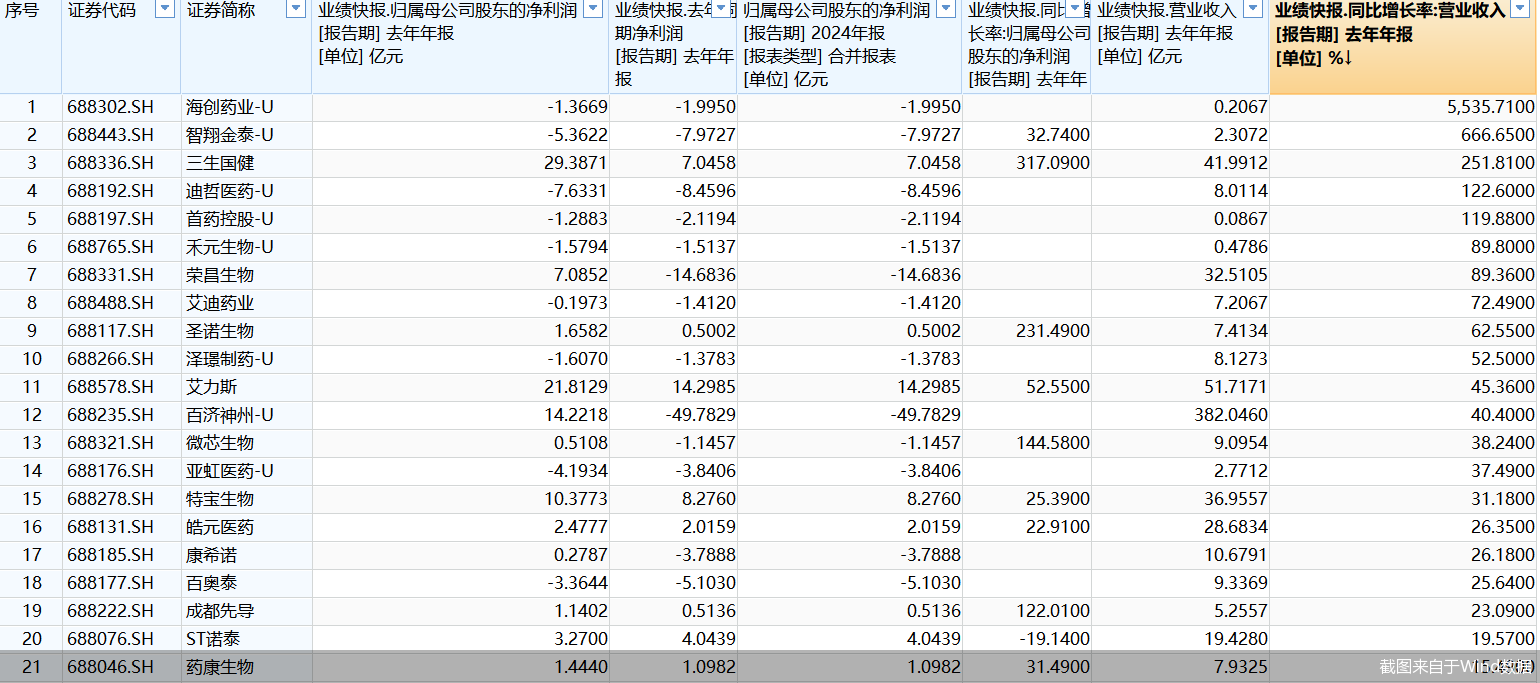
Core Viewpoint - The first "delisting" wave of the Sci-Tech Innovation Board's growth tier marks a significant milestone in the capital market's service to technological innovation, indicating the effectiveness of the tiered mechanism from establishment to realization of results [3][10]. Summary by Sections Delisting Companies - A total of 39 companies in the Sci-Tech Innovation Board's growth tier have disclosed their 2025 performance data, with 6 companies successfully turning profitable and set to exit the growth tier [1][4]. - The companies include: - Zhongke Hanwuji (营业收入: 64.97 billion, 归母净利润: 20.59 billion) - Baiji Shenzhou (营业收入: 382.05 billion, 归母净利润: 14.22 billion) - Aobi Zhongguang (营业收入: 9.41 billion, 归母净利润: 1.27 billion) - Jingjin Electric (营业收入: 27.26 billion, 归母净利润: 1.62 billion) - Beixin Life (营业收入: 5.42 billion, 归母净利润: 0.81 billion) - Nuo Cheng Jianhua (预计营业收入: 23.65 billion, 预计归母净利润: 6.33 billion) [2][8]. Industry Impact - The delisting of these 6 companies reflects the successful implementation of the tiered mechanism, showcasing how technological breakthroughs can translate into market returns [5][11]. - The companies span key sectors such as innovative pharmaceuticals, high-end medical devices, semiconductors, and artificial intelligence [5][6]. Financial Performance - Zhongke Hanwuji reported a revenue increase of 453.21% to 64.97 billion, marking its first annual profit since its listing [6]. - Baiji Shenzhou achieved a revenue of 382.05 billion, a 40.4% increase, and turned a profit of 14.22 billion, recovering from a loss of 49.78 billion the previous year [7]. - Other companies also reported significant revenue and profit growth, indicating a trend of recovery and profitability in the growth tier [8]. Regulatory Framework - The growth tier's delisting process is governed by specific criteria, including a requirement for companies to achieve positive net profit and revenue thresholds [5][6]. - The establishment of the growth tier has provided a platform for unprofitable tech companies to access capital markets earlier, facilitating their transition from research and development to commercialization [11][12].



百济神州全年首次盈利!多家创新药企经营报喜,A股逾七成概念股实现营收增长
Bei Jing Shang Bao· 2026-03-02 12:18
Core Viewpoint - The innovative drug sector in the A-share market has shown significant recovery in 2025, with many companies reporting revenue and profit growth, driven by new drug launches and business development (BD) authorization income [1][8]. Group 1: Performance Highlights - Among the 39 innovative drug concept stocks that disclosed their 2025 performance reports, 29 companies achieved year-on-year revenue growth, and 25 companies reported profit growth or reduced losses [1][7]. - Notable companies like BeiGene (百济神州) and Rongchang Bio (荣昌生物) have turned losses into profits, indicating an expanding profitability landscape in the innovative drug sector [6][1]. - BeiGene reported a revenue of 38.205 billion yuan in 2025, a 40.4% increase year-on-year, and a net profit of approximately 1.422 billion yuan, marking its first annual profit [4][3]. Group 2: Growth Drivers - The primary drivers for revenue growth among these companies include the rapid market release of new drugs and significant income from BD authorizations [8][10]. - For instance, Haichuang Pharmaceutical (海创药业) saw its revenue surge by over 55 times, primarily due to the launch of its first Class 1 new drug, which was approved for sale in May 2025 [8][9]. - Companies like Zhixiang Jintai (智翔金泰) also benefited from expanding sales of their commercialized products and substantial licensing income from BD agreements [8][10]. Group 3: Financial Performance - Zhixiang Jintai achieved a revenue of 231 million yuan in 2025, a 666.65% increase year-on-year, while its net loss decreased from 799.27 million yuan to 536.22 million yuan [9]. - Sanofi (三生国健) reported the highest net profit among the 39 stocks, with a revenue of 4.199 billion yuan, a 251.81% increase, and a net profit of 2.939 billion yuan, a 317.09% increase [9][10]. Group 4: Challenges and Market Dynamics - Despite the positive trends, 9 companies reported revenue declines, with Yifang Bio (益方生物) experiencing the largest drop at 77.89%, leading to an increased net loss [11][12]. - The commercial path for innovative drugs remains challenging, as evidenced by companies like Baili Tianheng (百利天恒) and Shenzhou Cell (神州细胞), which also reported declines in revenue and net profit [12].
首次年度盈利!百济神州2025年营收增超四成 百悦泽全球大卖逾280亿元
Mei Ri Jing Ji Xin Wen· 2026-02-26 15:55
Core Viewpoint - BeiGene achieved a significant milestone by reporting its first annual profit in 2025, with total revenue reaching 38.205 billion yuan, a year-on-year increase of 40.4%, and a net profit of 1.422 billion yuan, recovering from a net loss of 4.978 billion yuan in the previous year [1][5]. Financial Performance - Total revenue for 2025 was 38.205 billion yuan, up from 27.214 billion yuan in the previous year, marking a 40.4% increase [3]. - Product revenue contributed 37.770 billion yuan, reflecting a 39.9% increase from 26.994 billion yuan [3]. - Operating profit was 2.562 billion yuan, a turnaround from an operating loss of 4.162 billion yuan [3]. - Total profit amounted to 2.558 billion yuan, compared to a loss of 4.163 billion yuan in the prior year [3]. - Net profit attributable to the parent company was 1.422 billion yuan, recovering from a loss of 4.978 billion yuan [3]. Product Performance - The growth in product revenue was primarily driven by the sales of the BTK inhibitor Brukinsa (Zebutinib) and the PD-1 inhibitor Tislelizumab [5]. - Brukinsa achieved global sales of 28.067 billion yuan in 2025, a 48.8% increase year-on-year, making it the first "blockbuster" drug in China's pharmaceutical sector [5][6]. - Sales in the U.S. market for Brukinsa reached 20.206 billion yuan, up 45.5%, while sales in Europe and China were 4.265 billion yuan (66.4% increase) and 2.472 billion yuan (33.1% increase), respectively [6]. Regulatory Approvals and Pipeline - Brukinsa has been approved in over 75 markets globally, with recent updates in the U.S., EU, and UK based on positive results from the Phase 3 ALPINE trial [6][7]. - Tislelizumab has been approved in over 50 markets, with plans to submit new indications for gastric cancer treatment in the U.S. and China in 2026 [7]. R&D and Future Outlook - The company is focusing on diversifying its product pipeline to reduce reliance on Brukinsa, with several candidates in late-stage clinical trials [8]. - BeiGene's product BeiGene (Sotigalimab) has received approval for the first global marketing application in China for certain types of lymphoma [9]. - The company anticipates launching multiple candidates for solid tumors and has received fast-track designation for BGB-B2033 for liver cancer treatment [9][10]. - For 2026, BeiGene projects revenue between 43.6 billion and 45 billion yuan, representing a growth rate of 14.12% to 17.79% compared to 2025 [11].
百济神州Q4营收同比增长33%,全年扭亏为盈,百悦泽单季狂揽11亿创历史新高|财报见闻
Hua Er Jie Jian Wen· 2026-02-26 12:55
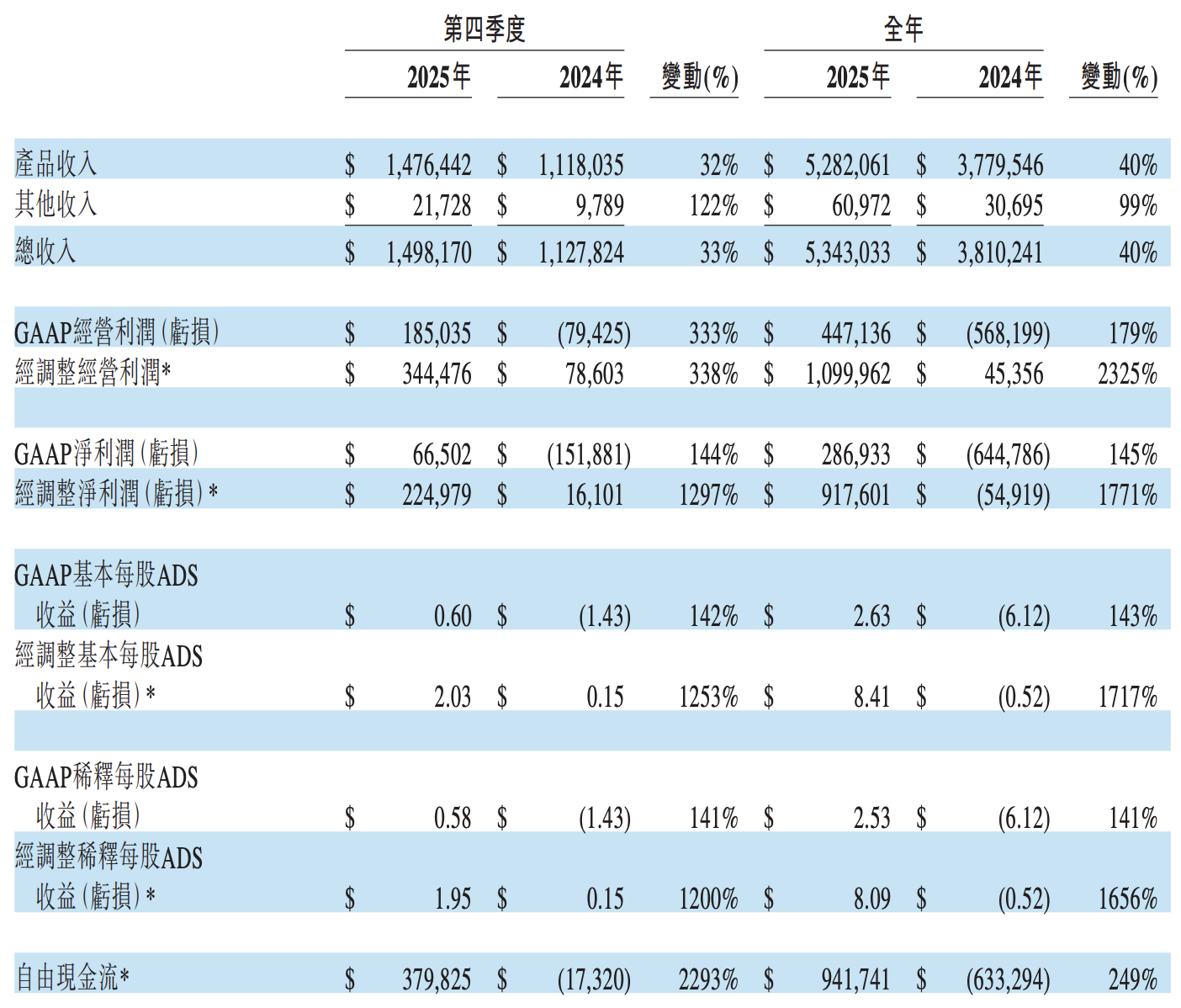
Core Insights - The company has achieved a historic profitability milestone, crossing the breakeven point with total revenue of $5.343 billion in 2025, a 40% increase year-over-year, and a net profit of $286.933 million, reversing a loss of $645 million in 2024 [1][3]. Financial Performance - Total revenue for Q4 2025 reached $1.498 billion, up 33% from $1.128 billion in Q4 2024 [2] - GAAP operating profit for 2025 was $447.136 million, compared to a loss of $79.425 million in 2024, marking a 333% improvement [2] - Non-GAAP operating profit soared to $1.1 billion, a more than 23-fold increase from $45.36 million in 2024 [3] - Free cash flow turned positive at $942 million, a significant turnaround from a negative $633 million in 2024 [3] Product Performance - The flagship product, Bruton Tyrosine Kinase (BTK) inhibitor, generated $3.9 billion in global sales for 2025, a 49% increase, with Q4 sales exceeding $1.1 billion, up 38% [2][4] - The second core product, 百泽安, achieved global sales of $182 million in Q4, an 18% increase, and $737 million for the year, a 19% increase [5] Pipeline Developments - The BCL2 inhibitor, Sotoclar, received global approval in China and is expected to be a key growth driver with an FDA decision anticipated in H1 2026 [6] - Multiple early-stage products have commenced human trials, with a CDK4 inhibitor expected to start a Phase 3 trial in H1 2026 [6] Profitability and Cost Management - GAAP gross margins improved to 87.3% for 2025, up from 84.3% in 2024, reflecting enhanced production efficiency [7] - Operating expenses grew by 12% to $4.227 billion, significantly lower than the 40% revenue growth, indicating effective cost management [7] Cash Flow and Balance Sheet - Cash and cash equivalents increased to $4.61 billion, a 75% rise from $2.64 billion at the end of 2024 [8] - The company reported a net cash inflow from operating activities of $1.128 billion, a stark contrast to a net outflow of $141 million in 2024 [8] 2026 Guidance - The company projects total revenue between $6.2 billion and $6.4 billion for 2026, representing an approximate 20% year-over-year growth [3][9] - Expected GAAP operating profit is forecasted to be between $700 million and $800 million, with non-GAAP operating profit anticipated to reach $1.4 billion to $1.5 billion [9]
百济神州2025年净利14.22亿元,同比扭亏
Bei Jing Shang Bao· 2026-02-26 12:20
Core Viewpoint - BeiGene reported a significant increase in revenue and profitability for the fiscal year 2025, driven by product sales growth and improved operational efficiency [1] Financial Performance - The company achieved a revenue of 38.205 billion yuan, representing a year-on-year growth of 40.4% [1] - The net profit attributable to shareholders was approximately 1.422 billion yuan, marking a turnaround from previous losses [1] Growth Drivers - The revenue increase was primarily attributed to the sales growth of Baiyueze, licensed products from Amgen, and Baizean [1] - Profitability improvements were supported by revenue growth and enhanced operational efficiency through effective cost management [1]
百济神州总裁兼首席运营官吴晓滨:让创新走得更远,让希望触手可及|2026商业新愿景
Jing Ji Guan Cha Wang· 2026-02-13 12:58
Group 1 - The year 2025 marks a milestone for the company, celebrating its 15th anniversary and entering a clearer phase in its globalization process [2] - The company achieved significant global growth in the past year, reaching a critical profitability turning point, with its core self-developed BTK inhibitor, Baiyueze, establishing a leading position globally [2] - The company launched its second self-developed product in the hematology field, the BCL2 inhibitor Baiyueda (Sotukral), which is now commercially available [2] Group 2 - In Thailand, the approval process for Baizean took only 7 months, significantly reducing the time for patients to access innovative treatments [3] - In India, the company's two self-developed products have benefited over 1,500 patients, receiving positive clinical feedback [3] - The company is expanding its global footprint by supporting local commercialization efforts in Indonesia and providing PD-1 inhibitors for clinical trials in sub-Saharan Africa [3] Group 3 - The company's goals for 2026 remain clear: to continue pipeline expansion centered on science and to enhance drug accessibility for patients in more countries [4] - The commitment to making innovations accessible to more patients is seen as a long-term investment and a driving force for the company [4] - The company emphasizes the importance of collaboration with industry partners to gather diverse experiences and wisdom from different regions to improve patient outcomes globally [4]

外资CDMO纷纷易手,它们在华消失殆尽了 | 海斌访谈
Di Yi Cai Jing· 2026-01-30 13:39
Core Insights - The CDMO (Contract Development and Manufacturing Organization) business of multinational companies in China is experiencing significant decline, with many exiting the market entirely [1][8] - The Chinese CDMO market is growing rapidly, with a compound annual growth rate of 39.9% from 2018 to 2023, and is expected to reach 208.4 billion RMB by 2028 [16] Group 1: Multinational CDMO Operations in China - Multinational companies like Lonza, Thermo Fisher, and Merck have faced challenges in their CDMO operations in China, with many either closing facilities or selling them off [4][5][6] - Lonza's Guangzhou factory, which was operational for only three years, was sold to a local company due to insufficient orders [4] - Thermo Fisher's factory in Hangzhou is struggling with low order volumes, and its future remains uncertain [5][6] Group 2: Local CDMO Developments - Zhaoyan Biotech's new manufacturing base in Guangzhou, which focuses on large molecule CDMO, signifies a strategic move to enhance capacity and create a collaborative platform for biopharmaceutical innovation in Southeast Asia [3] - Local companies are increasingly building their own production capabilities, reducing reliance on foreign CDMO services [14] Group 3: Market Dynamics and Trends - The introduction of the MAH (Marketing Authorization Holder) system in 2019 has lowered production barriers, allowing more companies to utilize CDMO services [11] - Despite the advantages of a large workforce and lower costs, foreign CDMOs have struggled to establish a foothold in China due to high pricing models that do not align with local market conditions [12][13] - The efficiency and cost-effectiveness of Chinese CDMOs are becoming competitive with their foreign counterparts, leading to a shift in market dynamics [15][16]



创新药行业研发突破与市场演进的并行:医疗与消费周报-20251214
Huafu Securities· 2025-12-14 05:43
Group 1 - The report highlights that only one of the six sub-industries in the pharmaceutical index recorded positive returns in the recent week [2] - The innovative drug industry in China is characterized by high investment, high risk, and long development cycles, focusing on cutting-edge technologies such as targeted therapy and gene editing [3][8] - The market size of China's innovative drug industry is projected to grow from approximately 819.8 billion RMB in 2020 to 1.14 trillion RMB in 2024, with a compound annual growth rate of 8.53%, and is expected to reach 1.22 trillion RMB by 2025 [3][9] Group 2 - The number of approved innovative drugs in China has significantly increased from 3 in 2015 to 48 in 2024, with 50 new first-class innovative drugs expected to be added to the medical insurance catalog in 2025 [9][21] - The report indicates that the innovative drug sector is becoming the core driving force for the pharmaceutical industry's upgrade, transitioning China from a "generic drug powerhouse" to an "innovative drug powerhouse" [9][21] - The report notes that the innovative drug industry is currently facing both opportunities and challenges, including policy support and intensified competition, which may compress profits [10] Group 3 - The recent addition of 114 new drugs to the national medical insurance catalog includes 50 first-class innovative drugs, with a success rate of 88% [21] - The report emphasizes that the central economic work conference has outlined key tasks for the upcoming year, including optimizing drug procurement and deepening medical insurance payment reforms [25] - The establishment of the medical device technology review center in the Guangdong-Hong Kong-Macao Greater Bay Area has led to a 150% increase in the approval of innovative medical devices over the past five years [26]