Citi(C)

Search documents
Net new assets rebound as Citi smashes analyst expectations
Yahoo Finance· 2025-10-14 21:08
Citi's wealth division reported a record level of net new investment assets in the third quarter, marking a sharp turnaround from the previous quarter, which saw an 81% year-over-year decline in net new investment assets. Citi reported $18.6 billion in NNIA for the third quarter, up 35% over the same period last year — representing a 9% increase in organic growth over the last 12 months. Total revenue for the firm was up 9% year over year, to $22.1 billion, surpassing forecasts by $1 billion. Citi's weal ...

Tuesday's Final Takeaways: Big Day for Big Banks & Powell's Commentary
Youtube· 2025-10-14 21:00
Core Insights - Major banks reported strong Q3 earnings, with several achieving record numbers, although some expressed caution regarding future uncertainties [1][2][4]. Financial Performance - JP Morgan Chase reported a 12% increase in net income with earnings per share (EPS) of $5.70, exceeding expectations, but shares fell nearly 2% due to CEO Jamie Dimon's warnings about geopolitical tensions and inflation risks [2]. - Wells Fargo's net income reached $5.6 billion, with EPS of $1.66, marking a 9% year-over-year increase. Revenue grew across all divisions, leading to a 7% rise in shares [2][3]. - Citigroup's profit surged by 16% in Q3, driven by increased deal-making and trading revenue, with both EPS and revenue surpassing analyst forecasts. Citigroup's stock gained about 4% [3][4]. - Goldman Sachs also exceeded projections, with its investment banking and markets divisions on track for a record year, although it warned of potential market pullbacks, resulting in a 2% drop in shares [4]. - BlackRock reported record assets under management, surpassing $13 trillion for the first time, with its stock rising by about 2% [4]. Market Outlook - Analysts from Argus Research noted no signs of weakness in the banking sector following the earnings reports [5]. - Fed Chair Jerome Powell indicated that the outlook for jobs and inflation remains unchanged, highlighting the importance of government data for economic assessments [7][8]. - Upcoming earnings reports from Bank of America and Morgan Stanley are anticipated, with expectations for strong consumer banking numbers and trading revenues [10][11]. Industry Trends - The airline industry is closely watched, with United Airlines expected to provide insights into economic health, especially following positive commentary from Delta Airlines [14][15]. - Geopolitical uncertainties and tariffs are noted as challenges for airlines, but domestic travel remains robust compared to international travel [15][16].


JPMorgan, Citigroup Kick Off Big Bank Earnings
Yahoo Finance· 2025-10-14 20:11
Several banks reported earnings today with JPMorgan beating analysts' estimates for trading and investment-banking fees, driven by a pickup in dealmaking and underwriting. Similarly, Citigroup Inc. beat Wall Street revenue estimates across all five of its major business lines. Meanwhile, Goldman Sachs Group Inc. posted record third-quarter revenue, though shares were down after the bank reported higher compensation costs and plans for an additional round of job cuts. Also, Wells Fargo & Co. raised a key pr ...
Citigroup Shares Rise After Earnings Beat on Strong Dealmaking Rebound
Financial Modeling Prep· 2025-10-14 20:04
Core Insights - Citigroup Inc. reported stronger-than-expected third-quarter earnings driven by a rebound in dealmaking across all major business segments [1][4] Financial Performance - The bank's net income increased to $3.8 billion, or $1.86 per share, compared to $3.2 billion, or $1.51 per share, in the same period last year [2] - Adjusted earnings per share, excluding a goodwill impairment, reached $2.24, surpassing the $1.75 consensus estimate [2] - Revenue grew 9% year-over-year to $22.1 billion, exceeding expectations [3] Business Segment Performance - All five of Citigroup's core businesses achieved record quarterly revenue, with significant contributions from investment banking, trading, and wealth management [3] - Banking revenue surged 34%, while markets revenue increased 15% despite subdued volatility [3] Shareholder Returns - The bank returned over $6 billion to shareholders during the quarter through dividends and share repurchases [3] Strategic Progress - The results reflect progress on the company's transformation strategy and the benefits of renewed corporate activity, particularly in merger and capital markets [4]

Citigroup Inc. (NYSE:C) Surpasses Earnings and Revenue Estimates in Q3 2025
Financial Modeling Prep· 2025-10-14 20:00
Core Insights - Citigroup Inc. reported earnings per share of $1.86, exceeding estimates of $1.73, and revenue of $22.09 billion, surpassing forecasts of $21.09 billion [1][6] - The bank's net income increased by 15% to $3.8 billion, reflecting strong performance across all business divisions [3][6] Financial Performance - The third-quarter results showcased record revenue achievements across all business divisions, driven by significant mergers and capital-raising deals [2] - The banking unit experienced a remarkable 31.3% year-over-year revenue increase, reaching $2.1 billion, marking the largest growth among its five divisions [2] - The services business had its best quarter ever, with a 7% rise in revenues, while banking revenues surged by 34% and the markets segment delivered a 15% increase in revenues [3] Strategic Initiatives - CEO Jane Fraser attributed the success to investments in new products, digital assets, and AI, which are enhancing capabilities across the franchise [4] - The consistent execution of Citigroup's strategy is leading to stronger business performance and improved returns [4] Valuation Metrics - Citigroup's price-to-earnings (P/E) ratio is approximately 13.01, indicating the price investors are willing to pay for each dollar of earnings [4] Financial Challenges - The enterprise value to operating cash flow ratio is negative at -6.50, indicating difficulties in generating cash flow relative to its enterprise value [5] - The debt-to-equity ratio is notably high at 3.38, suggesting significant reliance on debt financing [5] - The current ratio is 0.32, indicating potential liquidity challenges in covering short-term liabilities with short-term assets [5]
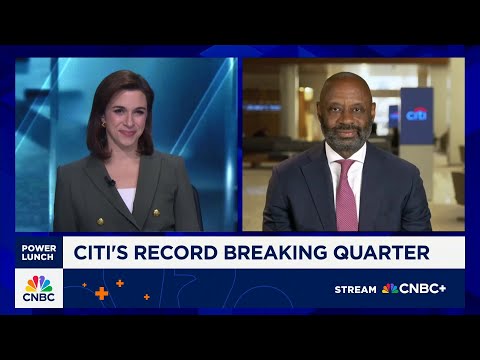
Citigroup CFO: Certain sector stocks have frothiness in them and likely to level off
CNBC Television· 2025-10-14 19:19
Thank you, Brian. And Mark, it is great to see you on this earnings day. As Brian just Leslie, thank you.Um, as Brian just laid out, you had revenue gains, record Q3s in each of your five businesses, big jump in net interest income, and a lower provision for credit losses. So, how much of that was all possible without the current macro backdrop. Yeah, you know, Leslie, first of all, thanks for having me.I'd start by saying what we saw today was a byproduct of us continuing to execute on our strategy. It als ...
Citigroup CFO: Certain sector stocks have frothiness in them and likely to level off
Youtube· 2025-10-14 19:19
Core Insights - The company reported record Q3 revenues across all five business segments, with a 9% increase in topline performance for the quarter and a 7% increase year-to-date [2][3][4] Financial Performance - Investment banking fee revenues increased by 17%, driven by strong M&A, ECM, and DCM activities [4] - The company returned more capital to shareholders, indicating a positive market recognition of its consistent performance [5] Market Conditions - There are concerns about frothy equity valuations in certain sectors, influenced by factors such as tariffs, inflation, and credit environment uncertainties [6] - The company maintains a cautious outlook on credit quality, particularly in light of recent bankruptcies in the auto sector [7] Credit Quality Management - The company has a robust risk appetite framework, focusing on investment-grade credit risk and maintaining reserves of $24 billion, which is 2.7% of the reserve ratio [8][9] - Current credit losses are consistent with expected normalization, and early delinquency indicators show no abnormal stress [10][11]
Citigroup Inc. 2025 Q3 - Results - Earnings Call Presentation (NYSE:C) 2025-10-14
Seeking Alpha· 2025-10-14 19:01
Group 1 - The article does not provide any specific content related to a company or industry [1]

Goldman Sachs, JPMorgan, and Citi surged past expectations as Wall Street bankers get busy again
Business Insider· 2025-10-14 18:09
Core Insights - Dealmaking on Wall Street is showing signs of recovery after nearly three years of stagnation since the pandemic-era highs [1][2] Group 1: Company Performance - Goldman Sachs reported its third-highest quarterly net revenues ever, exceeding $15 billion [3] - Goldman Sachs' advisory revenues increased by 60% year-over-year to $1.4 billion, with overall investment banking fees reaching almost $2.7 billion, a 42% increase from Q3 2024 [4] - JPMorgan's investment banking fees rose by 16%, with commercial and investment banking net revenues nearing $20 billion for the quarter [13] - Citi's investment bank generated over $1.1 billion in fees, marking a 17% increase from the previous year [15] Group 2: Market Trends - The volume of deals worth $5 billion or more surged by 64% year-over-year, with 100 deals completed so far in 2025 compared to 61 at the same point in 2024 [12] - Goldman Sachs advised on significant public offerings and major mergers, including a proposed $50 billion merger and a $55 billion take-private deal [5] - The dealmaking backlog at Goldman Sachs is at its highest in three years across equity, debt, and advisory [6] Group 3: Executive Insights - Goldman Sachs CEO David Solomon expressed optimism about a "constructive M&A environment" through the end of the year into 2026 [6] - JPMorgan's CFO Jeremy Barnum noted that the rebound in lending is reflecting the increase in deal activity, indicating a synchronized recovery in client borrowing and transaction volumes [13][14] - Citi's new investment banking chief is driving a surge of ambition within the investment banking unit, contributing to increased corporate lending revenue [15]
Afternoon Rally Steadies Markets Amid Trade Tensions and Bank Earnings
Stock Market News· 2025-10-14 18:07
Market Performance - U.S. equities showed resilience with major indexes recovering from earlier losses, reflecting a complex interplay of strong bank earnings and U.S.-China trade tensions [1][2] - The S&P 500 rose approximately 0.3%, the Dow Jones Industrial Average increased about 0.9%, while the Nasdaq Composite remained down around 0.1% [2] Sector Performance - Defensive consumer staples saw a modest rise of 0.5%, while the S&P 500 tech sector declined by 1.8% [3] - The S&P 500 banking index dropped 1.4% despite strong earnings reports from major lenders [3] - Consumer discretionary stocks fell by 1.3%, with Tesla (TSLA) notably down approximately 3% [3] Corporate Earnings - Major financial institutions reported strong third-quarter earnings, with JPMorgan Chase, Citigroup, Goldman Sachs, and Wells Fargo all surpassing analyst estimates [6] - JPMorgan Chase reported a profit jump but saw its stock slip less than 1% due to geopolitical concerns [8] - Citigroup's profit surged 16%, leading to a 4.4% increase in its shares [8] - Goldman Sachs announced a significant profit surge but its stock dipped 0.3% [8] - Wells Fargo's shares rose 8% in early trading and 2.9% later, following strong net interest income [8] Noteworthy Corporate Developments - Albertsons Companies (ACI) stock jumped 10% after better-than-expected fiscal second-quarter results [12] - General Motors (GM) announced a $1.6 billion charge related to its electric vehicle business [12] - Broadcom (AVGO) shares were down 2% after a previous surge related to a partnership with OpenAI [12] - Johnson & Johnson (JNJ) raised its full-year sales outlook due to gains in prescription-drug and medical-device segments [12] - BlackRock (BLK) reported strong quarterly results with assets hitting a record $13.5 trillion [12] - Rare earth stocks saw significant movement amid renewed U.S.-China trade tensions, with Critical Metals (CRML) surging 27% [12]