Citi(C)

Search documents
图解丨过去25年全球前十大公司变迁
Ge Long Hui A P P· 2025-08-06 06:43
Core Insights - The top ten global companies in 2000 included General Electric, Microsoft, Cisco, ExxonMobil, Walmart, Intel, Citigroup, NTT DOCOMO, Pfizer, and Vodafone [1] - By 2025, the top ten global companies have shifted to NVIDIA, Microsoft, Apple, Google, Amazon, Meta, Saudi Aramco, Broadcom, TSMC, and Berkshire Hathaway [1] - Microsoft has maintained its position in the top ten global companies for 25 years [1]




人民币兑美元中间价报7.1409,下调43点!机构首次定价美联储50基点降息情景,双线资本:美元或将大幅贬值
Sou Hu Cai Jing· 2025-08-06 01:40
Group 1 - The central bank of China set the RMB to USD exchange rate at 7.1409, a decrease of 43 points [2] - Morgan Stanley indicates that the revision of July's non-farm payroll data has increased the probability of an economic recession by 9 percentage points [4] - Citigroup suggests that if the unemployment rate rises to 4.5%, the Federal Reserve may implement a 50 basis point rate cut [4] Group 2 - Bill Campbell from DoubleLine Capital predicts that the US dollar may experience significant depreciation [5] - Campbell states that if the newly appointed Federal Reserve Chair takes swift action to lower interest rates, it could trigger a decline in the dollar [5] - Campbell believes there is still potential for further declines in the dollar's value [5]


降息预期凌乱 华尔街投行“吵”起来
智通财经网· 2025-08-05 23:10
美国"非农"数据暴雷令美联储降息预期飙升,但本周华尔街知名投行对降息分歧却在加大。 不过,美银全球研究部却对此持有不同看法。该团队认为,劳动力需求的下降与供给减少相匹配,失业 率保持相对稳定,且消费者支出似乎正在增强,这可能预示着美国经济走向更强劲的轨迹。 高盛8月4日发布报告表示,美国潜在的月度就业增长已从第一季度的20.6万骤降至7月的2.8万,这表明 劳动力市场正在迅速降温。基于此,高盛认为9月降息25个基点的可能性极高,若数据进一步恶化,甚 至可能激进降息50个基点。 花旗也预计美联储可能降息50个基点。该机构表示,在就业数据大幅下修后,美联储官员可能会失去观 望的"奢侈",并预计政策利率最终将降至3%。该机构认为,潜在经济活动增长在今年上半年已放缓至 潜力以下,这为将政策利率降至中性或更低水平提供了理由。 摩根大通在最新研报中预测,9月与11月美联储可能各降息50个基点,12月再降25个基点,全年累计125 个基点;并称"存在提前至9月会议前紧急降息的强烈理由"。 高盛预计,即使美联储到2026年中期将利率降至3%-3.25%,欧洲央行仍可能维持较高存款利率,这种 政策分化将进一步削弱美元。同时,对 ...


华尔街“黄金空头”罕见空翻多,金价或再创历史新高?
Zheng Quan Shi Bao· 2025-08-05 22:57
Core Viewpoint - The article highlights a significant shift in Citigroup's outlook on gold, moving from a bearish to a bullish stance, with a revised price forecast for gold reaching $3,500 per ounce in the next three months, up from a previous forecast of $3,300 per ounce [1][2]. Group 1: Citigroup's Revised Gold Outlook - Citigroup has adjusted its gold price expectations, raising the forecast for the next three months from $3,300 to $3,500 per ounce, and the trading range from $3,100-$3,500 to $3,300-$3,600 per ounce [1]. - The bank's previous bearish outlook from June, which anticipated gold prices dropping below $3,000, has been overturned due to factors such as weak U.S. labor data and geopolitical risks from the Russia-Ukraine conflict [2][4]. Group 2: Demand and Market Dynamics - Since mid-2022, total gold demand has increased by over 33%, contributing to a near doubling of gold prices in the second quarter of this year [3]. - Strong investment demand, ongoing purchases by central banks, and resilient jewelry demand are identified as key drivers of the rising gold prices [3]. Group 3: Economic Indicators and Market Reactions - Recent U.S. economic data, including a significant revision of non-farm payrolls, has led to volatile gold price movements, with prices surging past $3,400 per ounce amid rising expectations for interest rate cuts by the Federal Reserve [6]. - The market is reacting to perceived economic weaknesses and adjusting expectations for future monetary policy, with analysts suggesting that the focus will shift to U.S. fiscal expansion and potential rate cuts [6]. Group 4: Central Bank Activity and Investor Behavior - Global gold demand in the second quarter reached 1,249 tons, a 3% year-over-year increase, driven primarily by strong investment demand [9]. - Central banks continued to purchase gold, adding 166 tons in the second quarter, although at a slower pace, indicating sustained high levels of gold accumulation amid economic uncertainties [9].
美元遭遇信任危机!华尔街策略师称其长期趋势疲软
Zhi Tong Cai Jing· 2025-08-05 22:35
Group 1 - Despite a significant rebound in the dollar index (DXY) with a 3.2% increase in July, Wall Street forex strategists remain bearish on the dollar's long-term prospects [1] - The recent strong GDP data and the adaptation to tariff policies temporarily boosted the dollar, reversing previous declines [1] - Concerns over the reliability of U.S. economic data have been raised due to weak employment figures and the firing of the Bureau of Labor Statistics chief [1] Group 2 - The upcoming non-farm payroll report on September 5 is critical, with market attention on data credibility and collection methods [2] - There are concerns that a strong employment report could lead to suspicions of data manipulation, especially with a new appointee expected to be a Trump loyalist [2] - The resignation of Fed Governor Kugler has sparked speculation about potential nominees, which could influence market perceptions of future Fed policies [2] Group 3 - Barclays' forex strategy head believes Kugler's departure opens a new window for short-term dollar weakness, but does not foresee excessive depreciation by 2025 [3] - Both Goldman Sachs and Barclays favor a bullish outlook on the yen against the dollar, highlighting the yen's appeal as a safe-haven currency in uncertain times [3]

Why Citigroup Analysts See Double-Digit Upside in Coinbase Stock
MarketBeat· 2025-08-05 14:37
Group 1 - The current stock market is characterized by a risk-on sentiment, with the S&P 500 reaching new all-time highs, primarily driven by a few leading technology stocks [1] - Investors are anticipating a spill-over effect from stocks to other speculative sectors, highlighting Bitcoin's significance as a top speculative asset in cryptocurrency [2][3] - Coinbase Global Inc. is seen as having renewed upside potential due to expected increases in trading and transaction fees related to Bitcoin's performance [3][4] Group 2 - Coinbase shares experienced a 15% dip during the week of its quarterly earnings report, which was unexpected given Bitcoin's high price [4] - Following the dip, it was recognized that Coinbase's stock price had not reached its full earnings growth potential, making it a potential dip-buying opportunity [5] - The forward price-to-earnings (P/E) ratio for Coinbase is 50.6x, which does not reflect the anticipated earnings growth, resulting in a PEG ratio of only 0.5x, indicating that growth is not priced into the stock [8] Group 3 - Analysts project Coinbase could deliver $2.02 in earnings per share (EPS) for Q2 2026, a significant increase from the current $0.12 EPS [7] - The 12-month stock price forecast for Coinbase is $352.18, suggesting a 10.69% upside from the current price of $318.17, with a high forecast of $510.00 [10] - Citigroup analyst Peter Christiansen upgraded Coinbase's rating to Buy and raised the price target from $270 to $505, indicating a potential rally of approximately 60% from current levels [10][11] Group 4 - Coinbase's earnings are expected to grow as long as the market remains in a risk-on mode, which would support trading volumes and transaction fees [12] - Despite the current Hold rating among analysts, Coinbase is not included in the list of top stocks recommended by leading analysts, suggesting a cautious outlook [13]

华尔街再度集体看空美元
Hu Xiu· 2025-08-05 13:49
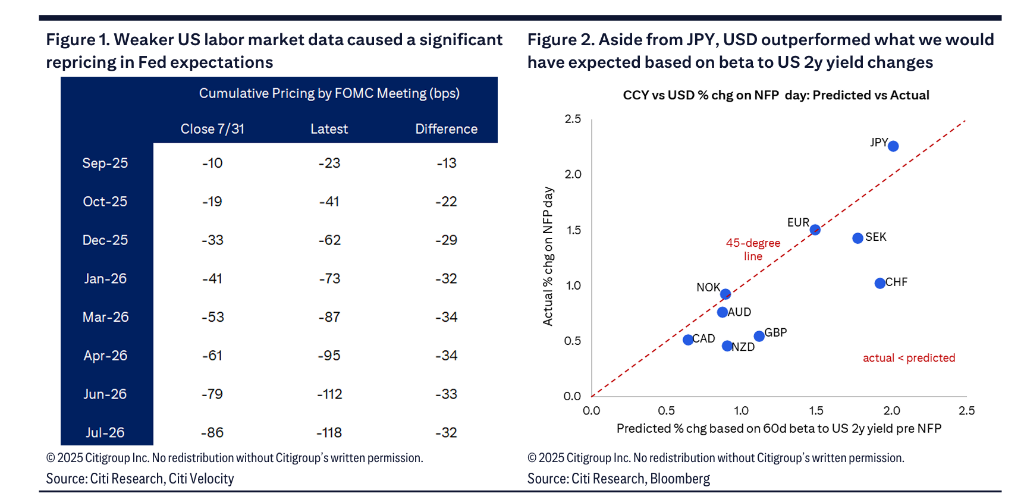
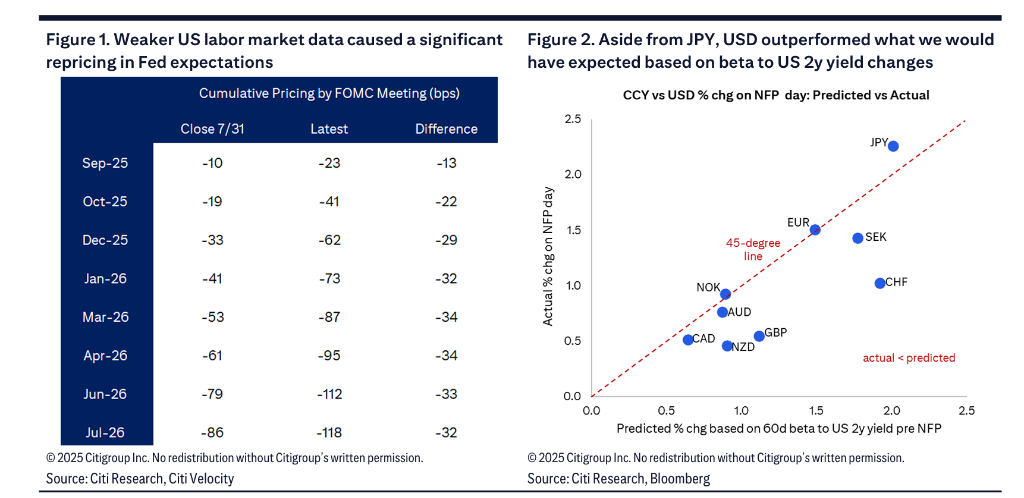
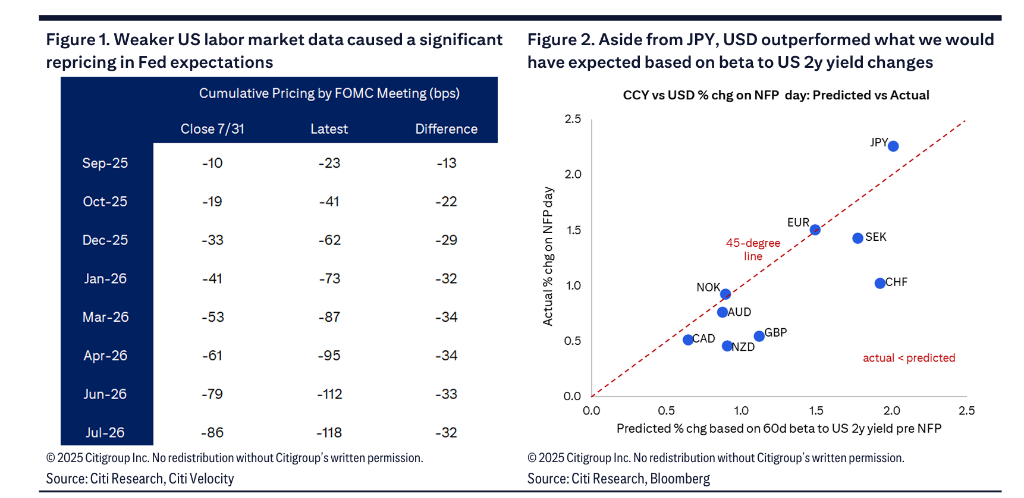
Core Viewpoint - The expectation of interest rate cuts by the Federal Reserve has increased significantly due to weak non-farm payroll data, yet the actual decline of the US dollar has been less than anticipated. Despite this, major Wall Street banks are collectively bearish on the dollar, citing overvaluation and weak fundamentals [1][2]. Group 1: Market Analysis - Citigroup, Goldman Sachs, and Morgan Stanley have published reports indicating that the long-term logic for a decline in the dollar remains intact, with significant short-selling potential still available [2][12]. - Following the release of non-farm data, the market's expectation for Fed rate cuts surged from approximately 30 basis points to about 60 basis points, highlighting the weak labor market [5][6]. - Despite the shift in interest rate expectations, the dollar's actual decline has been relatively moderate, suggesting that downward momentum has not been fully realized [6][10]. Group 2: Currency Valuation - Citigroup believes that the current valuation of the euro against the dollar is still below fair value, with potential for the euro/dollar exchange rate to overshoot to 1.20 [3][10]. - Goldman Sachs notes that the dollar's real trade-weighted exchange rate is still 15% above its long-term average, while the US current account deficit stands at 4% of GDP, both of which are unfavorable for the dollar [12]. - Morgan Stanley emphasizes that domestic policy uncertainties, particularly following the resignation of Fed Governor Kugler, add downward pressure on the dollar [12]. Group 3: Short-term Dynamics - The positioning of leveraged funds in dollars has flattened, indicating that previous large-scale liquidations may have concluded, which could affect the dollar's next movements [4][13]. - The dollar's future trajectory will depend heavily on three potential catalysts: the nomination of a new Fed governor, changes in the leadership of the Bureau of Labor Statistics (BLS), and the upcoming CPI inflation report on August 12 [4][14]. Group 4: Potential Catalysts - The nomination of Kugler's successor is seen as a direct catalyst that could likely be bearish for the dollar, with potential candidates being Walsh or Hassett [14]. - Changes in BLS leadership could inject uncertainty into upcoming employment reports, leading to market speculation on data outcomes rather than accuracy [14]. - The CPI report on August 12 is critical, as unexpected inflation data could challenge the narrative of rapid Fed rate cuts and support the dollar [14].
花旗集团金融服务部门主管Shahmir Khaliq:五大业务支持“端到端”需求,对AI给银行业带来的转型充满信心
Mei Ri Jing Ji Xin Wen· 2025-08-05 13:33
Core Insights - Citi Group's financial services division has integrated five core business lines to enhance customer experience and maintain strong profitability in a complex financial environment [1][2][3] - Despite challenges from declining interest rates, the financial services division contributed over half of Citi's deposits and achieved an 8% year-over-year revenue growth along with a 23% Return on Tangible Common Equity (RoTCE) in the latest fiscal quarter [1][4][10] Integration of Services - The integration of payment, liquidity management, trade financing, issuer services, and investor services creates a seamless "end-to-end" solution for clients, addressing the fragmentation often seen in traditional financial services [2][3] - This comprehensive approach allows Citi to serve as a reliable partner for clients with diverse and complex needs, enhancing operational efficiency and responsiveness to market changes [3][4] Technology Investment - Citi invests $1.5 billion annually in technology to drive innovation and meet evolving customer demands, focusing on real-time processing and digital capabilities [1][5] - The bank is modernizing its platforms to support 24/7 operations, enabling instant cross-border payments and providing clients with real-time visibility into cash flow and investments [5][6] Artificial Intelligence Utilization - The integration of generative AI is transforming customer service and operational efficiency, with initiatives like an interactive AI chatbot for real-time customer support and backend process automation [6][7] - AI applications are aimed at improving response times and reducing error rates, thereby enhancing the overall customer experience [7] Tokenization Strategy - Citi's innovation strategy includes the development of Citi Token Services, which facilitates real-time cross-border fund transfers and automates trade financing processes [8][9] - The bank aims to strengthen existing financial infrastructure while strategically investing in new technologies, with the goal of making these innovations seamlessly integrated into clients' operations [9] Global Market Position - Citi's financial services division maintains a strong global presence across 94 markets, which is crucial for supporting clients in their pursuit of international opportunities [10] - The bank recognizes the growing demand for unified solutions among Chinese enterprises, reflecting the need for comprehensive services in a rapidly evolving market [10]
非农“急刹车”后,华尔街再度集体“看空美元”
Hua Er Jie Jian Wen· 2025-08-05 11:10
Core Viewpoint - The expectation of a Federal Reserve interest rate cut has increased significantly due to weak non-farm payroll data, yet the actual decline of the US dollar has been less than anticipated. Major Wall Street banks are collectively bearish on the dollar, citing overvaluation and weak fundamentals as key reasons [1][6]. Group 1: Market Analysis - Citigroup, Goldman Sachs, and Morgan Stanley have published reports indicating that the long-term logic for a declining dollar remains intact, with significant short-selling potential still available [1][6]. - Following the non-farm data release, the downward momentum of the dollar was restrained due to the pressure on risk currencies and specific weaknesses in certain currencies, preventing a full release of the dollar's decline [3][9]. - Despite the muted response of the dollar, Citigroup emphasizes that the logic for a dollar decline remains valid from a valuation perspective, with the euro currently undervalued and potential to overshoot to 1.20 against the dollar [7][9]. Group 2: Economic Indicators - Goldman Sachs notes that the dollar's actual trade-weighted exchange rate is still 15% above its long-term average, while the US current account deficit stands at 4% of GDP, both of which are unfavorable for the dollar [9]. - Morgan Stanley highlights domestic policy uncertainties, particularly following the resignation of Fed Governor Kugler, which adds downward pressure on the dollar [9]. Group 3: Short-term Catalysts - The dollar's next movements are expected to depend heavily on three potential catalysts: the nomination of a new Fed governor, changes in the leadership of the Bureau of Labor Statistics (BLS), and the upcoming CPI inflation report on August 12 [11][12]. - The nomination of Kugler's successor is seen as the most immediate catalyst, likely to be interpreted as dovish for the dollar if candidates like Walsh or Hassett are chosen [11]. - The leadership change at the BLS introduces uncertainty into upcoming employment data, which could lead to market speculation and positioning ahead of data releases [11].
非农“急刹车”后,华尔街再度集体“空美元”
Hua Er Jie Jian Wen· 2025-08-05 10:47
美联储降息预期因非农数据大幅升温,但美元的实际跌幅却低于预期。尽管如此,华尔街三大投行集体看空美元,认为其估值偏高,基本面疲 软。 据追风交易台消息,花旗、高盛、大摩近日发表研报,认为从估值、贸易赤字和利差等多维度分析,美元下跌的长期逻辑依旧成立,美元头寸仍 有巨大的做空空间。上周非农数据后,美元的下跌动能因风险货币承压、以及部分货币特殊性疲软而受到抑制,并未在第一时间完全释放。 展望后市,三大投行一致看空美元。花旗认为欧元/美元当前估值仍低于公允价值,有潜力超调至1.20;高盛指出,美元实际贸易加权汇率仍比其 长期平均水平高出15%;大摩则强调,美联储领导层变动等政策不确定性也为美元增加了下行压力。 然而,短期走势仍存变数。花旗认为,杠杆基金的美元仓位已趋于扁平化,此前的大规模平仓潮可能已告一段落。因此,美元的下一步走势将高 度依赖三大潜在催化剂:美联储新理事的提名人选、劳工统计局领导层变动带来的就业数据不确定性,以及即将于8月12日公布的CPI通胀报告。 | | | Cumulative Pricing by FOMC Meeting (bps) | | | --- | --- | --- | --- | ...